

Introduction: Why This Decision Matters in KSA Trade
Saudi Arabia’s import ecosystem has grown rapidly due to the Kingdom’s rising consumer demand, booming manufacturing sector, and diversification under Vision 2030. With more than USD 200 billion worth of goods entering the country annually, businesses rely heavily on predictable logistics. Whether you’re shipping electronics from China, furniture from Turkey, automotive parts from Europe, or FMCG from India, the type of container loading used affects:
- How quickly the shipment arrives
- How much the total landed cost becomes
- How often customs interferes
- How safe the cargo remains
- How stable your inventory planning is
Many first-time importers underestimate this choice, assuming FCL is for large shipments and LCL is for small shipments. But the reality is far more nuanced. Shipment density, value, fragility, customs sensitivity, port volumes, and handling patterns all influence the right choice. What works for a new e-commerce store does not work for a construction materials importer. What benefits a seasonal business may harm a business with steady flow.
In Saudi Arabia specifically, where customs clearance, SASO conformity, and SABER procedures require precision, choosing between FCL and LCL becomes even more essential. A delay in LCL deconsolidation can cause a cascade of problems. Similarly, choosing FCL when volume is insufficient can waste budget with no benefit.
This is why many importers rely on expert freight partners like Palm Horizon KSA, who help assess CBM, cost structures, transit windows, and customs exposure before booking.
Understanding the Entity: What FCL and LCL Actually Mean
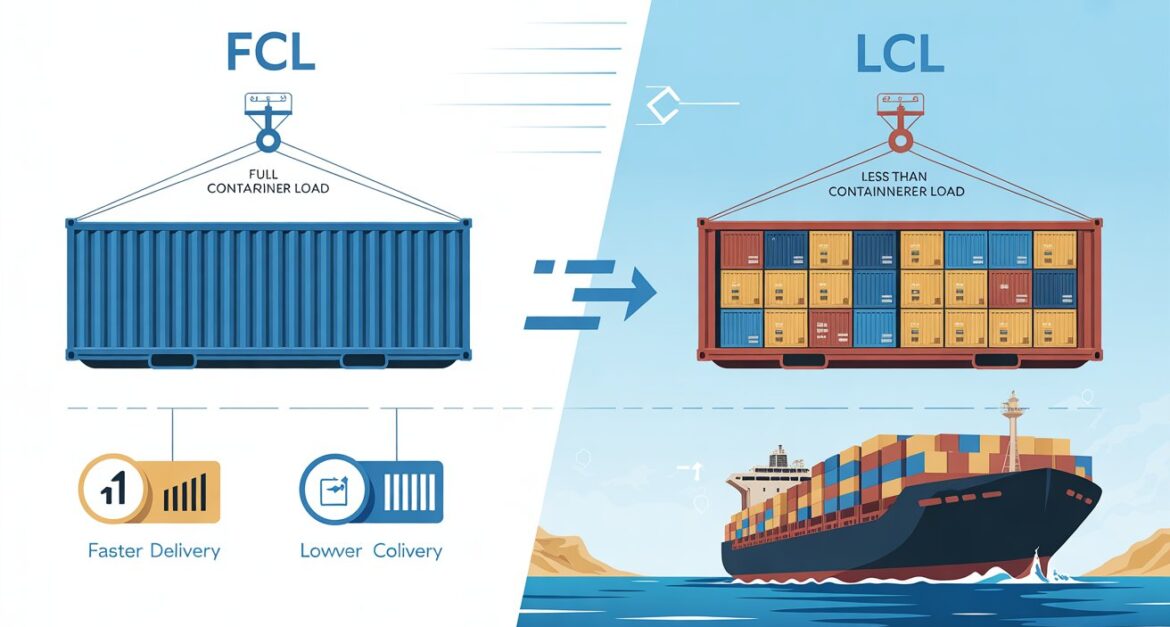
1. Full Container Load (FCL)
FCL means the shipper uses an entire 20ft or 40ft container exclusively for their cargo. It doesn’t matter whether the container is filled to the top or only partially—once booked, it is sealed with the shipper’s goods and transported directly.
Defining Characteristics
- The container belongs to one shipper
- Sealed at origin and unsealed only at the final destination
- Fewer handling points
- Predictable loading and departure
- Lower risk of customs complications from other shippers
- Cost is fixed regardless of how much space is used
FCL is highly valued for security, speed, and consistency.
2. Less-than-Container Load (LCL)
LCL means different shippers share the same container. Each shipper pays only for the volume (CBM) they occupy. Freight forwarders consolidate shipments together at origin warehouses and deconsolidate them at destination warehouses.
Defining Characteristics
- Shared container with multiple shippers
- You pay per CBM (volume-based pricing)
- Involves consolidation and deconsolidation
- More handling at CFS warehouses
- Higher risk of delays from other shippers
- Suitable for lower volumes or frequent small shipments
LCL is known for flexibility and affordability for smaller freight volumes.
Core Attributes and Key Features of FCL and LCL
To choose the correct mode, importers need to understand the fundamental attributes that differentiate FCL and LCL. These attributes influence cost behavior, customs handling, risk exposure, and operational performance.
Core Attributes of FCL (Full Container Load)
1. Transit Speed
FCL shipments move faster because they go straight to the port with no waiting for other cargo. The container is loaded onto the vessel as soon as it arrives at the export port and offloaded directly at destination.
2. Low Handling Interaction
Once sealed, the container is rarely opened. This minimizes human touchpoints and reduces physical risks.
3. Predictable Customs Behavior
Customs clearance is faster for FCL because the shipment belongs to one importer. There are no risks from another shipper’s documentation issues, prohibited goods, or incorrect HS codes.
4. Economies of Scale
The cost per CBM drops significantly once the importer uses more than 14–18 CBM. High-volume importers get maximum savings.
5. Better Cargo Safety
Fragile, expensive, and sensitive cargo benefits from being isolated in a dedicated container.
Core Attributes of LCL (Less-than-Container Load)
1. Cost Efficiency for Small Volumes
LCL is ideal when importing 1–12 CBM. Instead of paying for a whole container, you pay only for what you use.
2. High Flexibility
Small, frequent shipments support fast-moving inventory models, especially for e-commerce sellers and growing brands.
3. Consolidation-Based Operations
Shipments are grouped with others. This enables low cost but introduces dependency on other shippers.
4. Moderate Customs Risk
If another shipper in the same container violates customs rules, your cargo may face delay—even if your documents are perfect.
5. More Handling Touchpoints
Cargo is unpacked and repacked multiple times in CFS warehouses, increasing exposure to minor damage and slower processing.
Use Cases: When Businesses Should Choose FCL or LCL
Not all shipments should use FCL, and not all shipments should rely on LCL. Below is a detailed breakdown of real-world use cases across industries.
Best Use Cases for FCL
1. Large Shipments (14–28 CBM and Above)
Businesses moving high-density cargo benefit from cost efficiency.
2. Fragile Products
Glassware, ceramics, medical devices, and electronics require minimal handling.
3. Time-Sensitive Goods
Retailers preparing for seasonal sales or production-based companies with tight demand cycles rely on fast, predictable movement.
4. High-Value Goods
Luxury products, high-end fashion, and automotive components require isolated security.
5. Industrial and Project Cargo
Construction materials, machinery, HVAC equipment, and spare parts benefit from the stability of FCL.
Best Use Cases for LCL
1. Importers Testing New Markets
Instead of committing to a full container, businesses can ship samples or small volumes.
2. E-Commerce Sellers
Small but frequent shipments support inventory refresh cycles.
3. New Brands and SMEs
Businesses with low initial volume can build a steady supply chain without overspending.
4. Mixed Cargo with Low Sensitivity
Clothing, accessories, small consumer goods, and light electronics travel well through LCL operations.
5. Shipments Requiring Multi-City Distribution
LCL is convenient when shipping multiple small batches to Riyadh, Jeddah, Dammam, and other KSA markets.
Industry Applications: Who Uses Which Mode?
Industries Leaning Toward FCL
- Construction & industrial manufacturing
- Automotive spare parts
- Furniture and home décor
- Appliances & electronics
- FMCG wholesalers
- Chemical suppliers (non-hazardous)
These industries often manage consistent demand and large replenishment cycles.
Industries Leaning Toward LCL
- E-commerce stores
- Fashion brands
- General trading companies
- Pharmaceuticals (non-temp controlled)
- Small importers and start-ups
These industries value flexibility and lower upfront cost.
In-Depth Comparison of FCL vs LCL
Below is the most comprehensive breakdown using prominence, popularity, and relevance attributes—aligned with real-world KSA importing conditions.
1. Cost Comparison
FCL Cost Structure
- Flat container rate
- Handling charges predictable
- Lower cost per unit for high volume
- Fewer surprise fees
LCL Cost Structure
- Paid per CBM
- Additional consolidation fees
- Destination warehousing fees
- Risk of extra charges arising from shared cargo delays
Summary:
FCL is cheaper for large volumes.
LCL is cheaper for small volumes.
2. Transit Time
FCL
- Direct shipping
- Minimal waiting time
- Faster customs
- No dependency on other shippers
LCL
- Requires consolidation
- Slower departure cycles
- Deconsolidation delays likely
- High variance in transit time
3. Cargo Safety
FCL Safety Advantages
- No mixing with other cargo
- Container remains sealed
- Minimal handling
LCL Safety Risks
- Handling at CFS increases damage risk
- Commodity mismatch may cause accidental impact
- Other shippers’ documentation can delay overall movement
4. Customs Clearance
FCL Clearance
- Faster
- Lower inspection probability
- Simplified documentation
LCL Clearance
- Higher inspection probability
- If other shipper’s cargo fails SASO, SABER, or HS checks, entire container is held
- Multiple CFS interactions slow down the process
5. Scheduling & Predictability
FCL
Best for companies with structured restocking schedules.
LCL
Ideal for businesses with dynamic, smaller, irregular shipments.
Implementation Overview: How to Decide Between FCL and LCL
Choosing between FCL and LCL should not be guesswork. Here is a structured method used by experienced logistics planners and freight forwarders.
Step 1: Calculate Volume (CBM) Accurately
Measure length × width × height of each carton. If total volume is:
- Below 10 CBM: LCL is usually best
- 10–15 CBM: Depends on cost comparison
- 15+ CBM: FCL almost always wins economically
Palm Horizon helps importers evaluate this before booking.
Step 2: Identify Cargo Sensitivity
Fragile, high-value, hazardous, or confidential cargo should avoid LCL.
Step 3: Compare Supplier Production Cycles
If the supplier produces in batches, FCL becomes more reliable.
If the supplier produces small ongoing quantities, LCL is easier.
Step 4: Analyze Demand Forecast
Forecasting tools, ERP systems, and seasonality strategies help determine whether full containers or smaller batches are sustainable.
Step 5: Evaluate Customs Risk
Manufacturers in China, Turkey, India, UAE, and Europe all have varying compliance patterns. Shared containers expose you to others’ documentation errors.
Step 6: Assess Delivery Deadlines
Deadlines directly influence the freight mode.
If stockouts affect revenue, FCL reduces the risk.
Step 7: Consult a Freight Forwarder
Palm Horizon provides CBM assessment, shipping schedule evaluation, container availability, and landed cost calculation—allowing importers to choose correctly.
How Palm Horizon KSA Supports FCL and LCL
Palm Horizon is one of the leading logistics partners in Saudi Arabia, supporting importers with:
- Competitive FCL and LCL ocean freight rates
- Weekly consolidation schedules
- Warehousing and distribution
- Import customs clearance and SABER advisory
- Door-to-door shipping to all KSA cities
- Transparent CBM and container planning
- End-to-end tracking and cargo handling
The company’s tailored service ensures importers do not overspend on freight or experience unnecessary delays. Palm Horizon acts as a full logistics partner, not just a booking platform.
FAQ Section
1. How do I know if my shipment qualifies for FCL?
If your total shipment volume exceeds 14–18 CBM or if your cargo is sensitive, fragile, or time-critical, FCL is almost always the better choice.
2. Why can LCL take longer than FCL?
LCL involves multiple stages of consolidation and deconsolidation, which adds extra handling, additional waiting periods, and dependency on other shippers.
3. Can both FCL and LCL be delivered door-to-door in Saudi Arabia?
Yes. Palm Horizon provides DDP, DAP, and DDU services for both FCL and LCL, allowing customers to receive goods directly at their warehouse or office.
4. Does LCL have more customs inspections?
Yes, because customs officers inspect consolidated shipments more often due to mixed cargo. One problematic shipment can delay the entire container.
5. What is the break-even point where FCL becomes cheaper than LCL?
This depends on shipping lane, season, and container rates, but it typically starts around 14–16 CBM.
6. Are FCL shipments safer?
Yes. FCL is sealed at origin and unsealed only at final delivery, minimizing touchpoints and risk exposure.
7. Can I switch between FCL and LCL depending on market cycles?
Absolutely. Many businesses start with LCL and shift to FCL once they scale. Palm Horizon helps customers plan both modes efficiently.
Conclusion: Choose the Mode That Matches Your Shipment Strategy
The decision between FCL and LCL affects everything from your landed cost to the speed and stability of your supply chain. FCL brings predictability, speed, and security. LCL offers flexibility, lower initial cost, and versatility for small shipments. There is no universally “right” method—there is only the method that fits your current shipment volume, urgency, and cargo type.
Businesses growing in KSA rely on smart logistics planning. Whether you’re scaling e-commerce operations, expanding product portfolios, or building a wholesale distribution network, choosing the right freight mode helps protect profits and maintain consistent supply.
If you want expert guidance, transparent pricing, and reliable freight movement across global trade lanes, Palm Horizon KSA is the logistics partner built for your growth.
Take the next step—book your next FCL or LCL shipment with Palm Horizon today.




1 Comment
7 Carrier Management Strategies for Better Logistics Performance September,07 2026
[…] structured approach has a name: carrier management. At Palm Horizon KSA, we help businesses across Saudi Arabia build carrier networks that are […]