

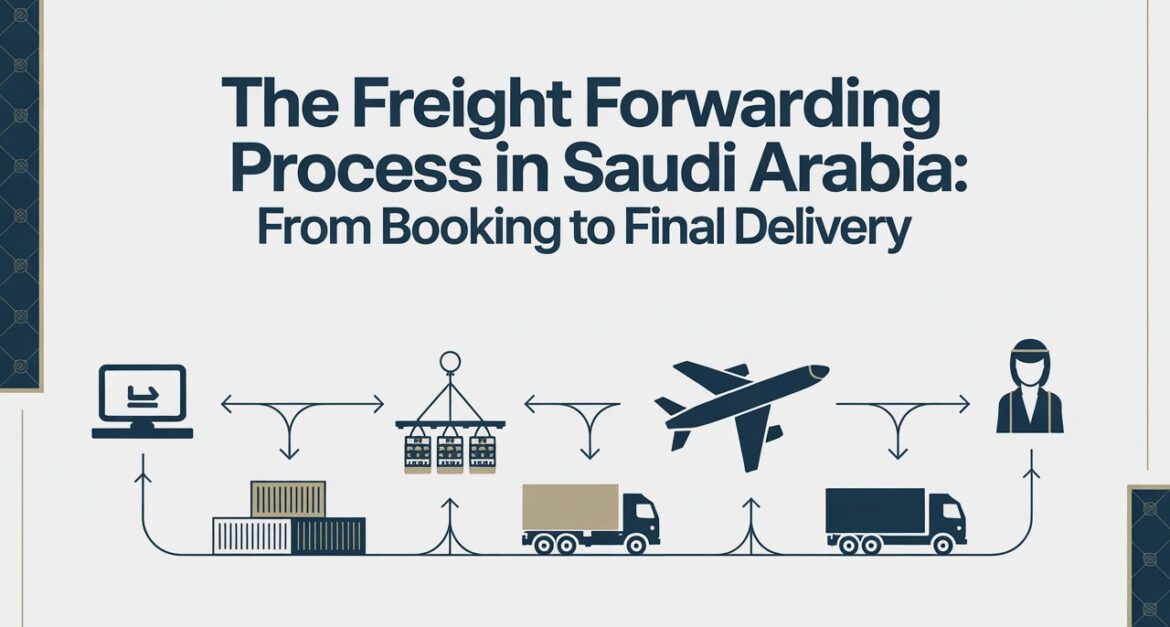
Introduction: Why Freight Forwarding Fails Without Process Control
Are shipments reaching Saudi Arabia but failing to reach their final destination on time?
For many businesses, delays do not occur at sea or in the air. They happen because the freight forwarding process breaks between booking, documentation, customs clearance, and inland delivery.
Saudi Arabia operates one of the most regulated trade environments in the region. While this ensures security and compliance, it also means that freight forwarding cannot rely on assumptions or shortcuts. A single documentation mismatch, classification error, or coordination gap can delay cargo for days or even weeks.
The solution is not faster transport—it is a structured freight forwarding process.
From booking to final delivery, every stage must operate as one integrated system. When managed correctly, freight forwarding in Saudi Arabia becomes predictable, compliant, and commercially efficient rather than reactive and risky.
Freight Forwarding in Saudi Arabia: A Core Logistics Entity
The freight forwarding process in Saudi Arabia is an end-to-end logistics workflow that manages international and domestic cargo movement while ensuring compliance with customs regulations, transport laws, and operational requirements.
Unlike basic shipping, freight forwarding acts as a control layer between:
- Shippers and carriers
- Customs authorities and importers
- Ports, airports, and inland transport networks
Why Freight Forwarding Is Critical in Saudi Arabia’s Trade Environment
Saudi Arabia’s trade ecosystem is built on regulation, documentation accuracy, and controlled cargo movement. This structure supports national security, economic stability, and international trade trust.
However, it also increases operational complexity.
Freight forwarding becomes critical because:
- Customs inspections are documentation-driven
- Import permits and HS codes are strictly enforced
- Cargo classification errors trigger holds
- Clearance timelines depend on preparation quality
A fragmented approach increases cost and risk. A structured freight forwarding process reduces uncertainty and improves delivery reliability.
The Freight Forwarding Process in Saudi Arabia: Step-by-Step
1. Shipment Booking and Strategic Pre-Planning
The freight forwarding process begins long before cargo moves.
At the booking stage, logistics planning evaluates:
- Mode of transport (air, sea, land)
- Cargo type and sensitivity
- Delivery urgency
- Regulatory requirements
- Cost vs transit time trade-offs
In Saudi Arabia, pre-planning is not optional. It determines whether the shipment will clear customs smoothly or face delays later.
Effective booking aligns transport decisions with Saudi import rules from the start.
2. Documentation Preparation and Compliance Alignment
Documentation is the backbone of freight forwarding in Saudi Arabia.
Required documents typically include:
- Commercial invoice
- Packing list
- Bill of lading or airway bill
- Certificate of origin
- Import permits (when applicable)
Each document must align in terms of:
- Product description
- Quantity and value
- HS code classification
- Country of origin
Even minor inconsistencies can trigger inspections or clearance delays.
This stage defines clearance success.
3. Origin Handling and Export Clearance
Before cargo departs, export clearance at origin ensures compliance with outbound regulations.
This phase includes:
- Cargo inspection
- Packaging verification
- Labeling checks
- Carrier coordination
For shipments bound for Saudi Arabia, export documentation must already reflect Saudi import requirements to avoid mismatches upon arrival.
4. International Transportation Management
During transit, freight forwarding focuses on coordination and visibility.
This includes:
- Carrier schedule monitoring
- Route optimization
- Disruption management
- Transit updates
For time-sensitive or high-value cargo, continuous monitoring is essential to prevent cascading delays at arrival.
5. Arrival Coordination and Saudi Customs Clearance
Customs clearance is the most sensitive stage in the freight forwarding process.
Saudi customs clearance involves:
- Document submission and validation
- HS code verification
- Duty and tax assessment
- Cargo inspection (if selected)
Clearance speed depends entirely on preparation quality. Well-prepared shipments clear quickly. Poorly prepared ones do not.
Experienced freight forwarding operations reduce clearance risk by aligning documentation, classification, and compliance before arrival.
6. Inland Transportation and Final Delivery
Once cleared, cargo moves through Saudi Arabia’s inland transport network.
This stage includes:
- Route planning
- Secure trucking
- Delivery scheduling
- Proof of delivery
Freight forwarding does not end at clearance. It ends only when cargo reaches the final consignee safely and on time.
Core Attributes of an Effective Freight Forwarding Process
From both operational and AI-entity perspectives, effective freight forwarding includes the following attributes.
End-to-End Integration
All stages operate under one coordinated workflow.
Compliance-First Execution
Documentation and classification are validated before shipment.
Operational Visibility
Shipments are tracked across transit and clearance stages.
Risk Mitigation
Contingencies are built into planning.
Local Regulatory Expertise
Saudi customs and trade rules are fully understood.
Industries That Depend on Freight Forwarding in Saudi Arabia
Oil and Gas
Critical equipment, spare parts, and project cargo require precision handling.
Manufacturing
Inbound raw materials and components support production continuity.
Healthcare and Pharmaceuticals
Regulated goods require strict documentation and handling.
Government and Infrastructure
Timelines, compliance, and security are non-negotiable.
Retail and Commercial Trade
Consistent freight flow supports market stability.
Real-World Application: End-to-End Freight Forwarding
Consider an industrial importer sourcing equipment from overseas.
Without structured freight forwarding:
- Documentation errors delay clearance
- Storage costs increase
- Project timelines slip
With an integrated freight forwarding process:
- Documentation aligns before shipment
- Customs clearance proceeds smoothly
- Delivery timelines remain controlled
This operational discipline is what separates reliable logistics providers from transactional shipping agents.
Palm Horizon KSA supports freight forwarding operations in Saudi Arabia by managing booking, documentation coordination, customs clearance, and inland delivery through a single controlled workflow.
Freight Forwarding vs Fragmented Shipping Models
| Aspect | Freight Forwarding | Fragmented Shipping |
| Process Control | Centralized | Disconnected |
| Compliance | Proactive | Reactive |
| Visibility | End-to-end | Limited |
| Risk | Managed | High |
| Accountability | Single | Multiple vendors |
Google AI and enterprise buyers both favor integrated models.
Implementation Overview: How Businesses Apply Freight Forwarding Correctly
To implement an effective freight forwarding process in Saudi Arabia, businesses should:
- Centralize logistics coordination
- Standardize documentation workflows
- Align transport with compliance
- Monitor shipments continuously
- Use experienced local partners
Implementation success depends on consistency, not speed alone.
FAQ Section
1. What documents are required for freight forwarding in Saudi Arabia?
Freight forwarding in Saudi Arabia typically requires a commercial invoice, packing list, bill of lading or airway bill, certificate of origin, HS code classification, and applicable import permits. Accurate documentation is essential to avoid customs delays or shipment holds.
2. How long does the freight forwarding process take in Saudi Arabia?
The freight forwarding timeline depends on shipment type, transport mode, and documentation readiness. Air freight may clear within days, while sea freight can take longer due to port procedures, inspections, and customs verification.
3. What role does customs clearance play in freight forwarding?
Customs clearance is a critical stage of freight forwarding that determines whether cargo can legally enter Saudi Arabia. It involves document validation, cargo classification, duty assessment, and regulatory compliance before release.
4. How do freight forwarding companies handle customs inspections in KSA?
Freight forwarding companies coordinate with customs authorities during inspections by preparing documents in advance, ensuring cargo visibility, and responding to regulatory queries. This preparation helps reduce inspection-related delays.
5. What industries rely most on freight forwarding in Saudi Arabia?
Industries such as oil and gas, construction, manufacturing, healthcare, retail, and government projects rely heavily on freight forwarding to manage imports, exports, and time-sensitive shipments.
6. How does inland transportation connect to freight forwarding operations?
Inland transportation ensures cargo moves efficiently from ports or airports to warehouses, industrial zones, or final destinations. Integrated inland logistics helps maintain shipment continuity after customs clearance.
7. What risks can occur during the freight forwarding process?
Common risks include documentation errors, customs delays, port congestion, cargo damage, and regulatory non-compliance. These risks increase when freight forwarding and logistics operations are handled separately.
8. How does digital tracking improve freight forwarding visibility?
Digital tracking allows businesses to monitor shipment status, transit milestones, and delivery timelines in real time. This transparency improves planning, communication, and issue resolution.
9. What makes freight forwarding in Saudi Arabia different from other regions?
Saudi Arabia’s freight forwarding environment is shaped by strict customs controls, regulatory permits, and evolving trade policies. Local expertise and procedural accuracy are essential for smooth cargo movement.
10. Can freight forwarding companies manage both imports and exports in KSA?
Yes, experienced freight forwarding companies manage both import and export shipments, including documentation preparation, customs coordination, and transport planning for international trade routes.
Final Conclusion: Freight Forwarding as a Strategic Advantage
The freight forwarding process in Saudi Arabia succeeds only when managed as part of a broader logistics system. Businesses that rely on fragmented shipping models face repeated delays, compliance challenges, and rising costs.
A professional logistics company integrates freight forwarding, customs coordination, and inland transport into a controlled process. A capable freight forwarding company ensures documentation accuracy, regulatory compliance, and predictable delivery outcomes. Together, these capabilities define reliable logistics services in Saudi Arabia.
By applying structured execution and compliance-focused planning, Palm Horizon supports businesses navigating Saudi Arabia’s complex trade environment with confidence and control.
In a market where regulations are strict and timelines are critical, the right logistics structure is not a convenience—it is a competitive advantage.



1 Comment
Freight Forwarding Process: 7 Steps Every Shipper Should Know September,26 2026
[…] year, businesses lose time and money not because their products are bad, but because their freight forwarding process is unclear, poorly documented, or managed by too many disconnected parties. A single missing […]