

Introduction
Are your imported shipments getting delayed at Saudi ports because of paperwork errors, missing approvals, or unclear customs procedures?
For many businesses, import clearance in Saudi Arabia quickly becomes one of the most challenging parts of international trade. The process involves strict regulations, multiple government authorities, and frequent compliance checks. Even a minor documentation mismatch or a missed approval can result in cargo inspections, unexpected demurrage charges, or shipments being placed on hold for days—or even weeks.
These delays do more than slow down delivery timelines. They disrupt supply chains, increase landed costs, affect inventory planning, and strain customer commitments. Importers often find themselves reacting to issues at the port instead of managing the process proactively, simply because the clearance steps are not clearly understood or properly prepared in advance.
Here’s the solution: understanding and following a structured, step-by-step import clearance process in Saudi Arabia.
When importers clearly understand how Saudi customs procedures work—from pre-arrival compliance checks and documentation preparation to customs declaration, duty payment, and final cargo release—they regain control over their shipments. A well-managed clearance process reduces risk, shortens release timelines, and ensures goods enter the Kingdom smoothly, compliantly, and without unnecessary cost or disruption.
Understanding Import Clearance in Saudi Arabia
Import clearance in Saudi Arabia is the formal process through which goods entering the Kingdom are inspected, documented, and approved by customs authorities before release.
This process is governed by Saudi customs regulations and overseen by relevant government bodies to ensure compliance with trade laws, safety standards, and tax requirements.
The objective of import clearance is not only revenue collection but also protection of national security, consumer safety, and market integrity.
Because of this, accuracy and compliance are essential at every stage.
Why Import Clearance Is Critical for Businesses in KSA
Saudi Arabia is a major trade hub connecting Asia, Europe, and Africa. Its ports, airports, and land borders handle high cargo volumes daily.
With such scale, customs authorities enforce strict controls to maintain efficiency and compliance.
For businesses, proper import clearance ensures:
- Faster cargo release
- Predictable delivery timelines
- Avoidance of penalties and fines
- Protection of supply chain continuity
Without a clear process, imports can quickly become operational bottlenecks.
Key Authorities Involved in Saudi Import Clearance
Several authorities play a role in the import clearance process in Saudi Arabia.
Understanding their involvement helps importers prepare correctly.
These may include:
- Saudi Customs authorities
- Tax and duty administration bodies
- Sector-specific regulatory agencies
- Port and terminal operators
Each authority focuses on a specific compliance aspect, making coordination essential.
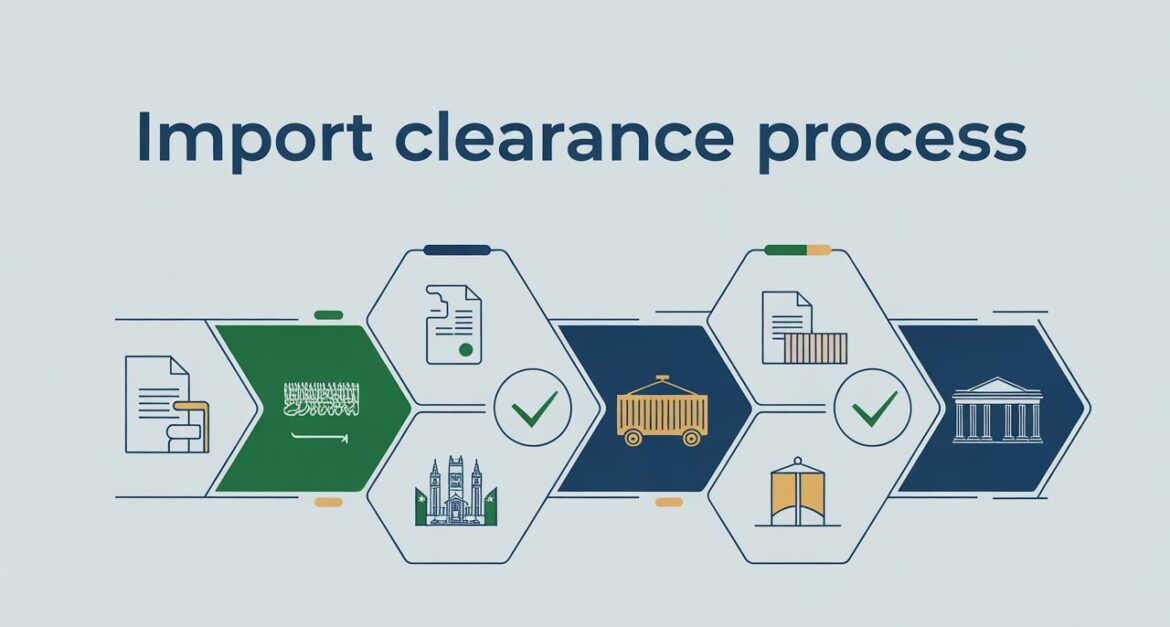
Step-by-Step Breakdown of the Import Clearance Process in Saudi Arabia
Step 1: Pre-Import Compliance Planning and Regulatory Verification
Import clearance in Saudi Arabia begins well before the shipment reaches the port. Importers must first confirm whether their goods are permitted for entry, restricted, or subject to special regulatory controls. Many products require advance approvals, certifications, or conformity assessments under Saudi standards.
This stage includes verifying product specifications, country of origin requirements, and whether SABER registration or additional permits are mandatory. When compliance requirements are addressed before shipping, the risk of cargo being held upon arrival is significantly reduced. Proper planning at this stage sets the foundation for a smooth clearance process.
Step 2: Commercial Documentation Preparation and Verification
Accurate documentation is essential for Saudi customs clearance. All shipment documents must be prepared carefully and reviewed for consistency. The commercial invoice must clearly state the cargo description, declared value, currency, and seller–buyer information.
The packing list must match the invoice details, and transport documents such as the bill of lading or airway bill must reflect the same shipment data. Any inconsistency between documents can trigger inspection, reassessment, or clearance delays. Thorough document verification ensures faster system approval once the declaration is filed.
Step 3: HS Code Classification and Duty Evaluation
HS code classification plays a critical role in the import clearance process. Each product must be classified under the correct tariff code to determine customs duties, VAT rates, and inspection requirements. Incorrect classification can lead to penalties, reclassification, or shipment holds.
At this stage, the importer or authorized customs agent evaluates the correct HS code based on product composition, function, and usage. Accurate classification ensures correct duty calculation and reduces the likelihood of customs challenges during inspection.
Step 4: Shipment Arrival and Customs Declaration Submission
Once the shipment arrives at a Saudi port or airport, the carrier submits the cargo manifest to customs. This formally records the shipment’s entry into the Kingdom. Following this, a customs declaration is submitted electronically through the customs system.
The declaration includes shipment value, HS codes, origin details, importer information, and supporting documents. Saudi customs uses this declaration to assess compliance, calculate duties, and determine whether the shipment requires inspection. Precision at this stage is critical, as errors can halt the clearance process.
Step 5: Customs Risk Assessment and Inspection Process
Saudi customs applies a risk-based assessment to all import declarations. Shipments with a strong compliance history and accurate documentation may proceed without inspection. Customs may select certain shipments for documentary review or physical inspection. When they conduct an inspection, officers actively verify that the cargo matches the declared information. This may involve checking quantities, packaging, labeling, and product conformity. Proper preparation and transparent documentation help minimize inspection time and prevent clearance disputes.
Step 6: Duty, VAT, and Government Fee Settlement
After customs assessment and inspection, applicable duties and VAT are calculated based on the declared value and HS classification. Importers must complete payment of all charges, including customs duties, VAT, and any additional inspection or port fees.
Cargo cannot be released until all payments are settled and confirmed in the system. Delays in payment directly delay clearance and may result in additional storage charges at the port or airport.
Step 7: Customs Release Approval and Cargo Exit
After completing all compliance checks and confirming payments, customs formally approves the release, allowing the importer to take legal control of the cargo.
Port authorities then finalize terminal handling and issue gate passes. These passes allow logistics providers to collect the cargo and move it out of the port or airport. This stage marks the official completion of customs clearance.
Step 8: Inland Transportation and Post-Clearance Management
After release, the cargo is transported to its final destination, such as a warehouse, factory, or distribution center. Coordination at this stage ensures timely delivery and avoids last-mile delays.
Importers should retain all clearance documents for record-keeping and future audits. Post-clearance review helps identify opportunities to improve efficiency, reduce costs, and streamline future imports.
Common Challenges in Saudi Import Clearance
Despite a defined process, importers often face challenges such as:
- Incorrect documentation
- HS code misclassification
- Missing product approvals
- Delayed duty payments
- Poor coordination with customs representatives
These challenges highlight the importance of experience and process knowledge.
How Freight Forwarding Companies Support Import Clearance in KSA
Freight forwarding companies play a critical role in managing import clearance efficiently.
They act as intermediaries between importers, customs authorities, and transport providers.
Their support includes:
- Document verification before shipment arrival
- Accurate customs declaration preparation
- Coordination during inspections
- Duty and tax handling
- Post-clearance delivery management
This structured involvement minimizes risk and delays.
Industry Applications of Import Clearance in Saudi Arabia
Retail and Consumer Goods
Retail imports require fast clearance to meet market demand.
Efficient import processes prevent stock shortages.
Manufacturing and Industrial Imports
Raw materials and machinery must clear customs on schedule to avoid production downtime.
Healthcare and Pharmaceuticals
Medical imports require strict compliance and inspection readiness.
Energy and Project Cargo
Large-scale equipment requires detailed clearance planning and coordination.
Best Practices for Smooth Import Clearance in KSA
To ensure efficient clearance, importers should:
- Prepare documents in advance
- Verify product compliance early
- Use accurate cargo classification
- Maintain transparent declarations
- Work with experienced logistics professionals
Consistency and preparation are key to success.
How Palm Horizon KSA Supports Import Clearance in Saudi Arabia
Palm Horizon KSA provides end-to-end solutions for businesses navigating the complex import clearance process. Palm Horizon KSA ensures that goods enter the Kingdom smoothly, compliantly, and on time through their comprehensive logistics services.
1. Pre-Arrival Compliance and Consultation
- Verify if products are regulated or require special approvals.
- Check SABER and product conformity requirements.
- Advise on documentation, licenses, and import regulations before shipment departure.
2. Documentation Preparation and Verification
- Prepare commercial invoices, packing lists, bills of lading/airway bills, and certificates of origin.
- Ensure all documents match shipment details and customs requirements.
- Reduce risk of inspection delays caused by errors or inconsistencies.
3. Customs Declaration and Duty Settlement
- File electronic customs declarations accurately and on time.
- Calculate and settle applicable customs duties, VAT, and port fees.
- Liaise directly with Saudi Customs and ZATCA authorities to expedite approvals.
4. Cargo Inspection Coordination
- Manage documentary or physical inspections, if selected.
- Provide on-site support to customs officials, ensuring smooth verification.
- Ensure timely resolution of issues to prevent shipment holds.
5. Inland Transportation and Final Delivery
- Arrange port or airport pickup and gate pass coordination.
- Transport cleared goods to warehouses, factories, or distribution centers.
- Provide tracking updates and full visibility until final delivery.
6. Real-Time Shipment Visibility and Support
- Offer end-to-end tracking of cargo movement.
- Send proactive alerts for exceptions, delays, or compliance requirements.
- Serve as a single point of contact for all import-related queries.
Result: By combining customs expertise, freight forwarding, and inland logistics, Palm Horizon KSA ensures that imports move efficiently, safely, and without unnecessary delays or costs.
Frequently Asked Questions (FAQ)
What is the import clearance process in Saudi Arabia?
Customs authorities document, inspect, assess taxes, and approve imported goods before releasing them into Saudi Arabia.
How long does import clearance take in Saudi Arabia?
Clearance time depends on cargo type, documentation accuracy, and inspection requirements. Proper preparation significantly reduces delays.
What documents are required for import clearance in KSA?
Common documents include a commercial invoice, packing list, bill of lading or airway bill, certificate of origin, and required approvals.
Are all shipments inspected by Saudi customs?
No. Inspections are risk-based. Some shipments undergo document checks, while others require physical inspection.
Can freight forwarding companies handle import clearance?
Yes. Experienced freight forwarders manage documentation, customs declarations, inspections, and delivery coordination.
Conclusion
Saudi Arabia regulates its import clearance process strictly, and businesses must carefully manage every stage to ensure smooth and compliant shipment movement. When importers or their logistics partners manage each step—starting with pre-arrival compliance checks, accurate documentation, customs declaration, inspections, duty payment, and final delivery—goods move smoothly, efficiently, and predictably through the supply chain. Understanding this step-by-step process allows businesses to minimize delays, avoid costly penalties, and maintain consistent inventory and operational performance.
For companies importing into the Kingdom, mastering the import clearance process or partnering with experienced logistics professionals is essential for sustainable trade operations. Palm Horizon KSA specializes in guiding businesses through this complex process, providing end-to-end solutions that combine customs expertise, freight forwarding, and inland logistics. Palm Horizon leverages its expertise in Saudi regulations and real-time shipment management to clear imports quickly and compliantly while providing full visibility, allowing businesses to focus on growth instead of operational challenges.