

The Invisible Cargo Problem Costing Saudi Businesses Millions
Picture a typical Monday morning for a supply chain director in Riyadh or Jeddah. A retail chain is waiting on a container from Guangzhou. A manufacturer needs confirmation that a critical equipment shipment cleared King Abdulaziz Port. A pharmaceutical distributor is fielding calls from hospital procurement asking about a delayed air freight delivery.
What do all three situations have in common? Each begins the same way — someone picks up the phone, sends an email, or dials a freight forwarder to ask the same four-word question:
“Where is my cargo?”
In Saudi Arabia’s SAR 385 billion logistics sector — one of the most strategically important markets in the Middle East — blind spots in shipment visibility are not minor inconveniences. They are competitive liabilities that inflate costs, damage supplier relationships, and erode customer trust.
Saudi Arabia’s Vision 2030 has catalysed a dramatic transformation in the Kingdom’s supply chain infrastructure. New economic cities, expanding dry ports, the modernisation of SASO compliance through the SABER platform, and explosive growth in cross-border e-commerce have created a logistics landscape that demands precision, speed, and above all — transparency.
Yet a surprising number of importers, distributors, and manufacturers are still managing their shipments the old way: a patchwork of WhatsApp messages, spreadsheet trackers, and phone calls to shipping agents. This article is for the supply chain professionals who are ready to close that gap.
| 73% of supply chain delays are preventable with early digital visibility | 4.2× faster exception resolution vs. manual follow-up | SAR 385B Saudi logistics market size — demanding smarter visibility | 28% average cost reduction with integrated tracking |
What Is Real-Time Cargo Tracking — and What It Means for Your Operation
Real-time cargo tracking is a digital logistics technology that provides continuous, automated updates on the location, status, and condition of your shipments across every stage of the supply chain — from the moment goods leave a supplier’s warehouse to final delivery at your facility or customer’s door.
Unlike passive tracking methods that require manual input or periodic check-ins with carriers, a modern real-time tracking system integrates directly with carriers, port authorities, customs systems, and GPS-enabled transport vehicles to push live status updates to a centralised dashboard accessible from any device, at any time.
For supply chain directors operating in Saudi Arabia — managing shipments through King Abdulaziz Port in Jeddah, King Khalid International Airport, Jubail Industrial City, or across the GCC land border corridors — real-time visibility addresses a set of very specific, high-stakes problems:
- Port congestion monitoring: Saudi ports, particularly Jeddah Islamic Port, experience seasonal congestion that can delay berthing by days. With live tracking, your team knows about holds before they escalate.
- SABER & customs compliance visibility: SABER requires pre-clearance of regulated goods. Real-time tracking systems that integrate with SABER status data show you exactly where in the compliance pipeline your shipment sits.
- Last-mile transparency in Saudi cities: With Riyadh, Jeddah, and Dammam experiencing rapid urban expansion, live GPS tracking of ground transport gives consignees precise ETAs instead of vague delivery windows.
- Multi-modal journey tracking: Most Saudi supply chains are multi-modal. Real-time systems track across all freight modes on a single screen.
The Old Way vs. Digital Visibility: A Direct Comparison
To understand the true value of real-time tracking, it helps to be precise about what the old way actually costs your organisation — not just in direct expenses, but in time, decision quality, and competitive position.
| Scenario | Old Way — Phone & Email | Palm Horizon Dashboard |
| Shipment status check | Call freight agent → await callback → relay info manually (avg 45–90 min) | Open dashboard → view live milestone map → share link in 30 seconds |
| Port delay alert | Learn about delay after stock-out or missed production window | Automated alert the moment vessel deviates from schedule |
| Customs hold notification | Discovered 24–48 hrs after hold placed | Instant notification with hold reason and required docs checklist |
| ETA to warehouse | Rough estimate with ±2–3 day uncertainty | Dynamic ETA recalculated in real time via vessel AIS data |
| Temperature-sensitive cargo | No visibility until physical inspection at destination | IoT sensor data streamed continuously — excursions flagged immediately |
| Reporting to management | Manual Excel compilation, hours of reconciliation, always retrospective | Live dashboard with exportable PDF reports and trend analysis |
| Customer inquiry response | “Let me check and get back to you” — hours to respond | Share a live tracking link directly with your customer |
The contrast is stark. But the true competitive implication goes beyond speed. In the Saudi market, where major buyers are increasingly evaluating suppliers on logistics reliability as part of vendor qualification, your ability to offer proactive shipment transparency is fast becoming a baseline expectation, not a premium differentiator.
| The Hidden Cost of Manual Tracking Research in Gulf logistics markets suggests supply chain teams spend an average of 6-9 hours per week per staff member on manual status-checking activities. For a team of five logistics coordinators, that is 30-45 hours of productive capacity absorbed by tasks that a real-time tracking platform eliminates entirely. |
Core Features of Palm Horizon’s Shipment Tracking Dashboard
The Palm Horizon tracking dashboard has been built specifically around the requirements of Saudi-market logistics — the port infrastructure, the customs compliance landscape, and the multi-modal freight patterns that characterise supply chains connecting the Kingdom with global trade partners.
| Live Milestone Mapping Every shipment visualised on an interactive map showing current position, completed milestones, and upcoming checkpoints — from origin to final delivery. | Proactive Exception Alerts Detects deviations — port holds, customs queries, vessel changes — and sends instant notifications via email, SMS, or WhatsApp Business. |
| SABER & Customs Integration Compliance status for SABER certification and customs clearance embedded directly into the shipment timeline alongside physical movement. | Cold Chain Monitoring For pharmaceuticals, food products, and sensitive goods: IoT-enabled temperature and humidity data streamed into the dashboard with configurable alert thresholds. |
| KPI & Performance Analytics On-time delivery rates, average transit times, delay causes, and carrier performance surfaced automatically for smarter planning and negotiation. | Stakeholder Sharing Generate a secure, branded tracking link for customers, suppliers, or internal teams — live visibility without requiring system access. |
| Multi-Modal Coverage Tracks across sea freight (vessel AIS), air freight (flight tracking), and land transport (GPS fleet) — unified on a single dashboard. | Mobile-Ready Access Full dashboard functionality on smartphone or tablet — designed for directors who need visibility during port inspections or travel. |
Industries Served and Real-World Applications in Saudi Arabia
Real-time cargo tracking delivers measurable operational improvements across virtually every sector engaged in importing, manufacturing, or distributing goods in Saudi Arabia.
Industries Served
- Pharmaceuticals & Healthcare
- Retail & E-Commerce
- Industrial & Petrochemical
- Food & Beverage
- Automotive & Spare Parts
- Construction Materials
- Consumer Electronics
- Government & Defence
Pharmaceutical and Healthcare Supply Chains
The Saudi Ministry of Health and the Saudi Food and Drug Authority (SFDA) impose strict requirements on the integrity of pharmaceutical cold chains. The ability to prove unbroken cold chain integrity — from manufacturer to patient — is both a regulatory requirement and a procurement differentiator. Real-time temperature tracking combined with automated SFDA and SABER compliance documentation gives pharmaceutical supply chain directors complete audit trail capability.
Retail and E-Commerce Fulfilment
Saudi Arabia’s e-commerce sector is growing at over 25% annually, with consumers increasingly intolerant of delivery uncertainty. Real-time tracking enables accurate inventory arrival forecasting, proactive replenishment decisions, and the ability to communicate precise stock arrival dates to buyers — reducing mark-down risk and improving sell-through rates.
Industrial and Petrochemical Equipment
Large-scale infrastructure projects in NEOM, the Red Sea Project, and Saudi Aramco’s capital programmes involve the importation of heavy equipment with highly specific delivery windows tied to project milestones. A delayed turbine component can cascade into a project schedule overrun worth many times the freight cost. Real-time tracking with ETA precision gives project procurement managers the advance notice needed to reschedule installation crews.
Food, Beverage, and FMCG Distribution
Saudi Arabia imports a significant proportion of its food supply. For distributors managing perishable cargo through Saudi ports, visibility into vessel position relative to container shelf life is operationally critical. The ability to pre-arrange expedited customs clearance based on live cargo arrival data can mean the difference between delivering product within specification and absorbing a total loss.
How Real-Time Tracking Positions You Against Competitors in the Saudi Market
The logistics technology landscape in Saudi Arabia has evolved considerably over the past five years. Large multinational freight forwarders — DHL, Kuehne+Nagel, DB Schenker — have invested heavily in global tracking platforms. But supply chain directors working with these providers often find that the tracking experience is generic, disconnected from Saudi-specific compliance requirements, and filtered through multiple layers of intermediary.
Domestic Saudi logistics companies often have deep local knowledge but have historically lagged in technology investment. The result: shippers frequently receive either good technology with poor local service, or strong local relationships without technological transparency.
| The Palm Horizon Difference: Local Expertise Meets Digital Visibility Palm Horizon operates from Jeddah with direct relationships at Saudi Arabia’s major ports, customs authorities, and bonded facilities. Our tracking dashboard is built on real operational data from our own network — reflecting milestones that matter in Saudi supply chains: Port arrival vs. berth allocation at Jeddah Islamic PortSABER certification status embedded in the customs clearance timelineZakat, Tax and Customs Authority (ZATCA) status integrated for commercial shipmentsInland distribution tracking across Riyadh, Jeddah, Dammam, Mecca, Medina, and Khamis MushaitArabic-language notifications available for local procurement and warehouse teams |
For supply chain directors making vendor selection decisions, the strategically important question is: which logistics partner has both the physical capability to move your cargo reliably and the digital infrastructure to make every stage of that movement transparent to your team and your customers?
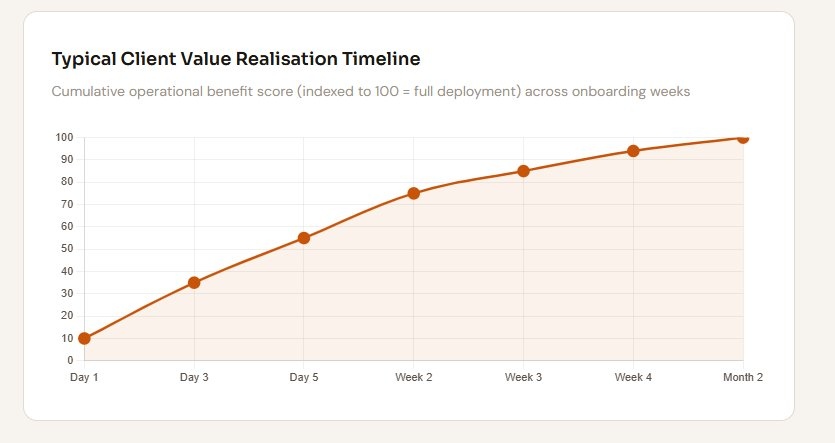
Implementation Overview: From Onboarding to Live Dashboard
One of the most common hesitations supply chain directors have about adopting a new tracking platform is the assumed complexity of integration. The reality, in Palm Horizon’s case, is considerably more straightforward than most technology-led implementations.
Day 1 — Discovery Call (30 minutes)
We map your current shipment lanes, freight modes, and the specific visibility challenges your team faces. No technical preparation required. This call defines which dashboard modules and alert configurations are most relevant to your operation.
Day 2–3 — Account Setup & Configuration
Your Palm Horizon dashboard is configured with your active shipments, your team’s user accounts, and your preferred notification channels (email, SMS, WhatsApp Business). For companies requiring ERP or TMS integration, our technical team connects via secure API — typically within 48 hours.
Day 4 — Live Shipment Import
All in-transit and upcoming shipments are loaded into the platform. Your team sees live status for the first time — and in most cases, already observes information they did not previously have visibility to.
Day 5 — Team Onboarding (90 minutes)
A focused session for your logistics team covering dashboard navigation, alert management, report generation, and sharing tracking links with customers or internal stakeholders. Available in Arabic and English.
Week 2+ — Continuous Optimisation
Your dedicated account manager reviews dashboard usage, refines alert thresholds based on your first week’s data, and identifies any additional visibility requirements. Most clients reach full operational proficiency within the first two weeks.
Frequently Asked Questions: Real-Time Cargo Tracking in Saudi Arabia
Q1. What does real-time shipment tracking actually track — and how frequently is the data updated?
Real-time cargo tracking covers multiple data layers simultaneously. For ocean freight, AIS (Automatic Identification System) vessel position data updates approximately every 2-5 minutes. Carrier system milestones — port arrivals, container loadings, customs entries, delivery events — update as they occur. Air freight tracking integrates IATA-connected flight data. Road transport GPS positions update every 1-3 minutes. In most scenarios, cargo position data is never more than five minutes old during active transit phases.
Q2. How does real-time tracking help with SABER certification and Saudi customs compliance?
SABER is Saudi Arabia’s product conformity assessment platform requiring Product Certificates (PCs) and Shipment Certificates (SCs) before goods enter the Kingdom. Delays in SABER certification are one of the most common causes of customs holds. Palm Horizon’s tracking dashboard integrates SABER certification status directly into the shipment timeline, flagging proactively when a Shipment Certificate has not been issued relative to your vessel’s expected arrival date — giving your compliance team time to resolve issues before the vessel arrives and before demurrage charges begin.
Q3. Can our existing ERP or warehouse management system be integrated with the tracking dashboard?
Yes. Palm Horizon’s tracking platform offers API integration for SAP, Oracle, Microsoft Dynamics 365, and custom ERP builds. Integration enables shipment milestone events to trigger automated updates in your internal systems, eliminating duplicate data entry. Integration typically takes 48 hours. For companies not yet at the ERP integration stage, the dashboard operates fully as a standalone web application with CSV and PDF export functionality.
Q4. Can we share live shipment tracking with our customers?
Yes. The platform generates a secure, shareable tracking link for each shipment that gives the recipient — your customer, a procurement officer, or an internal team — a live view of shipment position and status without requiring them to log into your system. From a commercial relationship perspective, this transforms your position from a vendor who fields status enquiries to a logistics partner who proactively shares visibility.
Q5. What happens when there is a delay or exception — does the system help resolve it, or just report it?
When the Palm Horizon system detects an exception — a vessel ETA change, a customs hold, a temperature excursion, a missing document — the alert includes both the nature of the exception and the recommended action or the Palm Horizon contact already handling resolution. Because Palm Horizon operates as your freight forwarder, our operations team is working on exception resolution at the same time your dashboard is notifying you. For common exceptions such as customs documentation queries or port handling holds, our local team in Jeddah is often already in contact with the relevant authority by the time your supply chain director has read the alert.
Q6. Does real-time tracking cover Saudi domestic distribution, or only international shipments?
Palm Horizon’s tracking capability spans the full logistics journey: international origin through Saudi ports and customs, plus domestic distribution within the Kingdom. For intra-KSA road transport — between Jeddah, Riyadh, Dammam, Mecca, Medina, Tabuk, and other major cities — GPS-enabled fleet and third-party carrier integrations provide live vehicle position and delivery confirmation. This closes the visibility gap that affects most companies: good international tracking up to the port, then loss of sight during the inland segment.
The Competitive Calculus Is Clear: Visibility Is No Longer Optional
Saudi Arabia’s supply chain environment is undergoing a structural transformation. Vision 2030 is reshaping port infrastructure, customs digitisation through ZATCA and SABER is accelerating, and the country’s growing role as a regional logistics hub is placing new demands on the precision and transparency of every freight movement.
Supply chain directors who continue to manage logistics visibility through phone calls, email chains, and manual spreadsheets are not just accepting inefficiency — they are accepting a widening competitive gap between themselves and the companies in their market who have already made the shift to digital supply chain transparency.
The path from where you are today to full real-time shipment visibility is shorter than most expect. With the right logistics partner — one that combines physical operational capability at Saudi Arabia’s ports and customs facilities with integrated digital tracking technology — the transition can be measured in days, not months.
Palm Horizon exists precisely at this intersection. We are a Jeddah-based freight forwarder with deep Saudi market expertise in customs clearance, SABER compliance, bonded warehousing, and multi-modal distribution — and we have built a tracking dashboard that makes every stage of that service visible to your team, in real time, from any device.
We would like to show you exactly what that looks like for your operation.
| Book a 5-Minute Demo of Our Tracking Dashboard No commitment. No lengthy sales process. In five minutes, you will see a live view of what real-time cargo visibility looks like for shipments through Saudi Arabia’s ports and distribution network. → palmhorizonksa.com/contact-us ← Jeddah International Business Centre · +966-541277769 · operations@palmhorizonksa.com |



Comments (3)
7 Ways Shipment Tracking Gives Businesses More Cargo Control August,22 2026
[…] is the exact problem shipment tracking was built to solve. Instead of waiting for a phone call or an email update, businesses today can […]
7 Freight Tracking Strategies for Smarter Shipping and Delivery September,18 2026
[…] is the exact problem freight tracking solves. When implemented properly, freight tracking turns shipment movement from a guessing game […]
7 Container Tracking Strategies for Smarter Shipping and Control September,24 2026
[…] is exactly the problem container tracking was built to solve. Instead of waiting for a phone call from a carrier or refreshing a static […]