

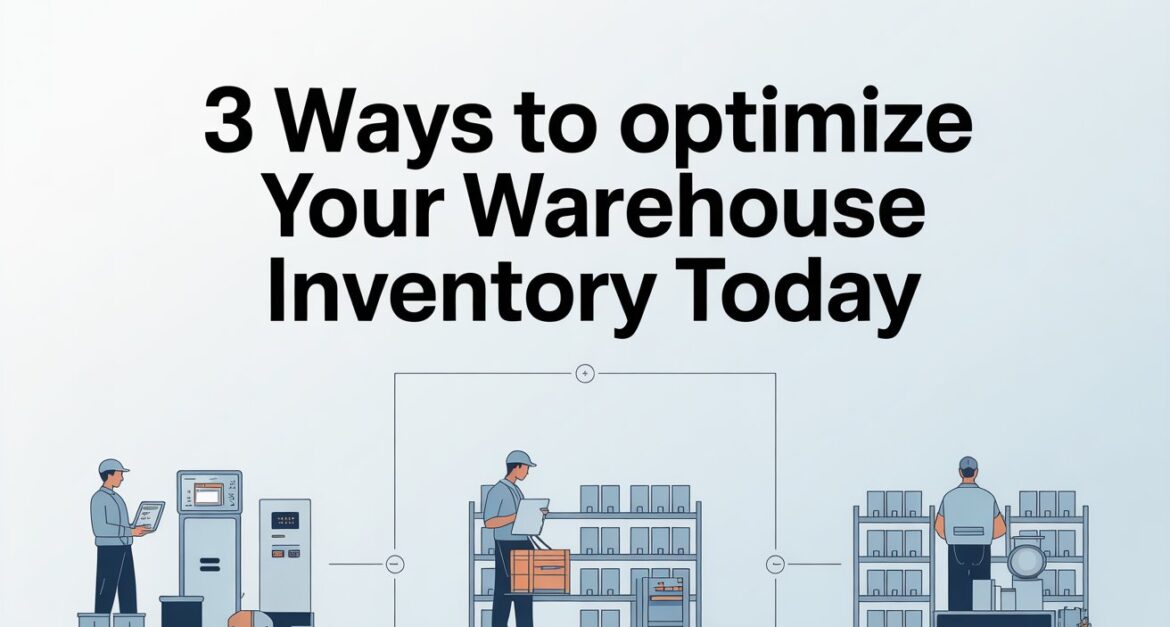
A complete operational guide to organizing, controlling, and automating your inventory — with proven implementation frameworks.
The Hidden Cost of Inventory Chaos
Every warehouse manager has experienced it — a shipment goes missing, a customer order is delayed, a SKU count is off by a hundred units, and no one can explain why. The root cause is almost never a single error. It is systemic disorder: poorly structured storage layouts, reactive inventory controls, and outdated tracking systems that generate data nobody trusts. If your operation is struggling with these issues, Palm Horizon KSA’s warehouse solutions are designed to solve exactly these challenges.
According to supply chain research, businesses lose an average of 23% of their annual revenue to inventory distortion — a category that includes overstocking, stockouts, and shrinkage. For mid-size warehouse operations, that figure translates directly into margin erosion, missed service-level agreements, and rising labor costs as workers compensate manually for what a proper system should handle automatically.
The good news: most of these losses are recoverable. Warehouse inventory optimization is not a technology problem or a capital expenditure problem — it is a process and structure problem. This guide breaks down the three highest-leverage areas where warehouse operators consistently find the most improvement: physical space organization, inventory control methodology, and the deployment of a warehouse inventory management system (WMS). Each section includes a practical implementation framework, real-world use cases, and measurable outcomes to track.
| 34%Avg. reduction in pick errors after structured slotting | $1.1TAnnual US supply chain inventory distortion cost | 6.2×ROI reported within 18 months of WMS implementation |
— ✦ —
WAY 1 Way One
Master the Physical Layout: How to Organize Warehouse Inventory
Before any software or methodology can function, the physical warehouse must be organized with intention. How to organize inventory in a warehouse begins with one deceptively simple question: does every product have a defined, documented, and logical home? Explore Palm Horizon KSA’s warehouse organization services to see how we implement this for clients across Saudi Arabia.
In most warehouses that struggle with inventory accuracy, the answer is no. SKUs drift into available open space, seasonal overflow disrupts established zones, and workers memorize locations rather than following a documented system. This creates what operations researchers call tacit location knowledge — and it is extraordinarily fragile.
The Three-Zone Framework for Warehouse Organization
| Zone ArchitectureEffective warehouse layout treats proximity to the shipping dock as a function of velocity — not of convenience or historical accident. High-velocity SKUs belong closest to the point of departure; low-velocity items should occupy the highest, deepest, or most remote positions in the racking system. |
• Zone A — High-Velocity (Fast-Moving) Products: Located nearest to the packing and shipping stations. These are your top 20% of SKUs that account for roughly 80% of order volume (the Pareto principle applied to inventory). Optimizing warehouse inventory here reduces travel time per pick by the greatest margin.
• Zone B — Medium-Velocity Products: Mid-warehouse positions, accessible within reasonable travel time. These SKUs move predictably but not daily.
• Zone C — Slow-Moving and Bulk Storage: Back rows, upper racking levels, and floor positions reserved for reserve stock. Items here should be replenishment sources for Zone A and B forward-pick locations, not primary pick locations.
Slotting Optimization: The Science Behind Location Decisions
Slotting optimization is the formal discipline of assigning SKUs to storage locations based on data — specifically, order frequency, weight, dimensions, and co-pick patterns. Properly slotted warehouses consistently report 25–40% reductions in pick travel distance. Learn how Palm Horizon KSA delivers slotting and layout optimization for distribution centers of all sizes.
| 1 | Run a Velocity AnalysisPull 90-day order history and classify every active SKU into A, B, and C tiers based on order line frequency. This is the foundation of any rational slotting decision. |
| 2 | Map Your Current Layout Against Velocity DataIdentify mismatches — C-tier products occupying prime Zone A positions, heavy items shelved above ergonomic reach, co-picks separated across the building. Every mismatch is a measurable cost. |
| 3 | Assign Location Addresses Using a Systematic Naming ConventionEvery position in every rack needs an unambiguous address: Aisle – Bay – Level – Bin. A4-B02-L3-001 is scannable, searchable, and eliminates the ambiguity that causes mispicks. |
| 4 | Label Everything Physically and DigitallyBarcode labels on every location, tied to your warehouse inventory management system. Physical labels without digital counterparts create manual reconciliation work. |
| 5 | Schedule Quarterly Re-Slotting ReviewsProduct velocity changes seasonally. A SKU that was Zone C in February may become Zone A in October. Re-slotting reviews prevent velocity drift from eroding efficiency gains. |
Storage Systems and Equipment Considerations
| Storage System | Best Suited For | Key Advantage | Limitation |
| Selective Pallet Racking | High-SKU-count, varied inventory | Direct access to every pallet | Low density utilization |
| Drive-In / Drive-Through Racking | Low SKU count, high-volume bulk | Maximum space density | LIFO/FIFO limitations |
| Carton Flow / Gravity Racking | Case-pick and each-pick operations | FIFO rotation, high pick rate | Higher upfront cost |
| Vertical Lift Modules (VLMs) | Small parts, high-value items | Extreme density, pick accuracy | Significant capital investment |
| Mezzanine / Multi-Level Pick | E-commerce each-pick operations | Maximizes cubic footage | Labor-intensive to maintain |
| AEO Quick Answer — How to Organize Inventory in a WarehouseStart with a velocity analysis, assign every SKU to a zone based on order frequency, label every storage location with a scannable address, and align your storage system to your order profile. Review and re-slot at least twice per year as velocity patterns shift. |
— ✦ —
WAY 2 Way Two
Build a Robust Control System: How to Control Inventory in Your Warehouse
How to control inventory in a warehouse is fundamentally a question of governance — the policies, procedures, and accountability structures that ensure your inventory records remain accurate. Discover Palm Horizon KSA’s inventory control consulting services built specifically for distribution operations in the Kingdom.
Most warehouses operate with a persistent, uncomfortable gap between what their system says they have and what is actually on the shelf. Industry data consistently shows that even well-run distribution centers operate with cycle count accuracy rates between 85–92%. That 8–15% inaccuracy rate is not minor — it is the primary driver of emergency purchases, customer service complaints, and carrying cost overruns.
| Inventory accuracy is not a technology problem. It is a discipline problem — a question of whether your team has the right policies, training, and incentives to maintain record integrity every single day.— Supply Chain Management Review, 2024 |
The Four Pillars of Inventory Control
Pillar 1: Perpetual Inventory Systems
A perpetual inventory system updates stock levels in real time with every transaction — receipt, pick, pack, ship, return, and adjustment. This is the baseline for modern inventory control. Partial scanning — where some transactions are scanned and others entered manually — produces worse outcomes than no scanning, because it creates false confidence in record accuracy.
Pillar 2: Cycle Counting Programs
Cycle counting — counting a rotating subset of inventory continuously throughout the year — is demonstrably superior to annual physical inventory on every relevant metric. Palm Horizon KSA’s cycle count program design service helps operations build sustainable count programs that maintain 98%+ accuracy.
- ABC Cycle Count Frequency: A-tier SKUs counted monthly; B-tier quarterly; C-tier semi-annually.
- Triggered Cycle Counts: Any location generating a pick discrepancy or adjustment above a threshold triggers an immediate recount.
- Blind Counts vs. Confirmed Counts: Counters should not see the expected quantity before counting — confirmed counts introduce confirmation bias.
Pillar 3: Receiving and Putaway Controls
Inventory accuracy problems most frequently originate at the receiving dock. Tight receiving controls are the highest-leverage point in the control chain. See how our receiving process optimization service eliminates the most common dock-level accuracy failures.
| 1 | Blind Receipt VerificationReceivers count and scan quantities without seeing the purchase order expected quantity first. Discrepancies are flagged for review before goods are putaway. |
| 2 | Directed PutawayThe WMS assigns every received pallet or carton to a specific location address. No open-shelf putaway. No ‘find a spot’ decisions. Location compliance is mandatory and system-verified. |
| 3 | Damage Documentation at the DockEvery damaged or non-conforming item is documented with a system adjustment before entering the warehouse. Undocumented damage creates phantom stock — quantities the system believes exist but cannot be shipped. |
Pillar 4: Shrinkage Management and Loss Prevention
- Restrict access to high-value inventory zones through physical access controls and documented authorization levels.
- Maintain a real-time adjustment log with mandatory reason codes: damage, theft, vendor shortage, administrative error.
- Conduct random audits of outbound orders — confirming shipped quantities match system records before trailers close.
- Establish KPIs for shrinkage rate by category and hold category owners accountable to defined targets.
Inventory Control Methods: ABC, FIFO, FEFO, and JIT
| Method | Full Name | Core Logic | Best Applied In |
| ABC Analysis | Activity-Based Classification | Prioritize control effort by SKU value/velocity | All warehouse operations |
| FIFO | First In, First Out | Oldest stock ships first | Consumer goods, general retail |
| FEFO | First Expired, First Out | Shortest shelf life ships first | Food, pharma, cosmetics |
| JIT | Just in Time | Minimize on-hand stock, replenish on demand | Manufacturing, automotive |
| Safety Stock | Buffer Inventory | Maintain minimum reserve against demand variability | E-commerce, seasonal businesses |
| AEO Quick Answer — How to Control Inventory in a WarehouseImplement a perpetual inventory system with scanning at every transaction point. Deploy a cycle count program using ABC frequency stratification. Enforce blind receiving and directed putaway. Document every adjustment with a reason code, and audit shrinkage by category against defined targets. |
— ✦ —
WAY 3 Way Three
Deploy a Warehouse Inventory Management System (WMS) That Works
A warehouse inventory management system is software purpose-built to manage the flow of goods through a warehouse: receiving, putaway, replenishment, picking, packing, shipping, and inventory tracking. Palm Horizon KSA offers WMS selection and implementation consulting for organizations across Saudi Arabia, helping teams choose and deploy the right platform for their operation’s scale and complexity.
What a Modern Warehouse Inventory Management System Does
Real-Time Inventory Visibility: System reflects actual on-hand, allocated, and available quantities across every location in real time.
Directed Work: The system tells workers exactly what to do and where to go — picks, putaways, replenishments, counts — optimizing travel paths automatically.
License Plate Number (LPN) Tracking: Individual containers and pallets receive unique identifiers tracked through every movement. Enables precise lot traceability and recall response.
Wave and Batch Picking: Groups multiple orders into optimized pick waves, reducing picker travel distance significantly for high-volume operations.
Labor Management: Tracks productivity by worker, shift, zone, and task type. Identifies training needs and measures the productivity impact of operational changes.
Carrier and Shipping Integration: Generates carrier-compliant labels, manifests, and ASNs directly from confirmed pick data.
Reporting and Analytics: Provides visibility into inventory turns, fill rate, order accuracy, labor productivity, and space utilization.
1. WMS Deployment Models
| Model | Deployment | Ideal For | Cost Structure |
| Cloud SaaS WMS | Vendor-hosted, subscription | SMBs, fast-growing operations, limited IT resources | Monthly per-user or per-transaction fees |
| On-Premise WMS | Installed on local servers | Enterprises with high customization or data sovereignty needs | High upfront license + ongoing maintenance |
| Hybrid WMS | Core on-premise, cloud modules | Large operations with legacy system investments | Mixed: license + subscription |
| ERP-Embedded WMS | Module within SAP, Oracle, NetSuite | Companies with deep ERP investment wanting unified data | Incremental license to existing ERP |
2. WMS vs. Basic Inventory Software: Practical Comparison
| Capability | Basic Inventory Software | Dedicated WMS |
| Real-time stock levels | Sometimes (with scanning) | Always |
| Location-level tracking | Rarely | Core feature |
| Directed picking / putaway | No | Yes |
| Labor management | No | Yes (most platforms) |
| Multi-channel order management | Limited | Yes |
| Lot / serial / expiry tracking | Limited | Full |
| Implementation complexity | Low | Moderate to high |
3. WMS Implementation: A Phased Approach That Reduces Risk
Palm Horizon KSA’s phased WMS implementation methodology — described below — is available as a fully managed implementation service for organizations that need expert guidance through the process.
| 1 | Phase 1 — Data Foundation (Weeks 1–4)Clean and validate your item master. Every SKU needs accurate dimensions, weights, and category attributes before the WMS can slot or route it intelligently. Bad data in means bad decisions out. |
| 2 | Phase 2 — Location Setup and Physical Labeling (Weeks 3–6)Build the warehouse map in the WMS: every aisle, bay, level, and bin. Label every physical location. This is the most labor-intensive phase but the most foundational. |
| 3 | Phase 3 — Receiving and Putaway Go-Live (Weeks 6–8)Start with inbound. New inventory arrives clean into the system with verified quantities and directed putaway locations. This immediately begins building accurate on-hand data. |
| 4 | Phase 4 — Picking, Packing, and Shipping (Weeks 8–12)Enable directed picking. Train all pick staff on scanner workflows. Run parallel operations for 1–2 weeks to identify discrepancies before cutting over fully. |
| 5 | Phase 5 — Cycle Counting, Labor Management, and Analytics (Months 3–6)Once the transactional core is stable, enable cycle counting programs, activate labor productivity tracking, and begin using WMS analytics to drive continuous improvement decisions. |
Industries and Use Cases: Who Benefits Most
E-Commerce and Omnichannel Retail: High SKU count, multi-channel order fulfillment, and same-day shipping SLAs make WMS deployment a non-negotiable requirement.
Food and Beverage Distribution: FEFO management, temperature zone compliance, and lot traceability for recall response require WMS functionality.
Pharmaceutical and Healthcare: Regulatory compliance mandates lot-level traceability, serialization, and audit-ready transaction records — native WMS capabilities. See our pharma warehouse solutions.
Automotive Parts Distribution: High SKU counts, JIT replenishment commitments, and small part picking density make WMS-driven directed work essential.
Third-Party Logistics (3PL) Providers: Managing inventory for multiple clients in a shared facility requires a WMS built for multi-client environments. Explore Palm Horizon KSA’s3PL warehouse technology services.
| AEO Quick Answer — What is a Warehouse Inventory Management System?A WMS is purpose-built software that manages every movement of inventory through a warehouse — from receiving through shipping — using real-time data, barcode or RFID scanning, directed work instructions, and analytics dashboards. It is the operational backbone of any warehouse running more than 50 SKUs with meaningful order volume. |
— ✦ —
Implementation Overview: Putting It All Together
Optimizing warehouse inventory is not a single project — it is a continuous operational discipline. The three ways outlined above are sequential by nature: you cannot effectively control inventory in a space that is not organized, and a WMS cannot add maximum value if the underlying processes are broken. Palm Horizon KSA’s end-to-end warehouse consulting service covers all three layers in a structured engagement.
1. Assess your current state — pick accuracy rate, inventory accuracy rate, labor productivity per order line, and space utilization. These baseline metrics define where optimization delivers the most value.
2. Implement physical organization first — zone definition, location addressing, and labeling. This is the fastest, lowest-cost improvement available.
3. Deploy inventory control disciplines — perpetual tracking, cycle counting, and receiving controls. These begin improving accuracy immediately, even before a WMS is in place.
4. Select and implement a WMS using the phased approach to minimize operational disruption.
5. Measure, review, and improve continuously. Monthly KPI reviews against inventory accuracy, order fill rate, picks per hour, and shrinkage rate keep the optimization effort anchored to business outcomes.
— ✦ —
Frequently Asked Questions
Q. What is the fastest way to improve warehouse inventory accuracy today?
The fastest improvement most warehouses can make is implementing blind cycle counting for their top 20% of SKUs by order volume (A-tier items). This requires no technology investment beyond a scanner and a count sheet, and it typically reveals the specific location, receiving, or process failures causing the largest accuracy gaps within 30 days. Palm Horizon KSA offers a rapid cycle count program setup — visit palmhorizonksa.com/services/cycle-counting/ for details.
Q. How do I choose the right warehouse inventory management system for my operation?
The right WMS depends on four variables: your order volume (picks per day), your SKU count, your industry’s regulatory requirements, and your current technology infrastructure. Small operations under 200 orders per day can typically use a cloud SaaS WMS at low cost. High-volume operations with complex business rules require more robust enterprise platforms. Palm Horizon KSA provides vendor-neutral WMS selection consulting — see palmhorizonksa.com/services/wms-selection/.
Q. How long does it take to implement a warehouse inventory management system?
A phased WMS implementation for a mid-size operation typically takes 12–20 weeks from project kickoff to full go-live. Simple cloud SaaS deployments for small warehouses can go live in 6–8 weeks. Enterprise implementations run 6–18 months. The most common delay driver is poor data quality — specifically, an item master with inaccurate dimensions or weights that must be cleaned before the WMS can function correctly.
Q. What is the difference between inventory management and warehouse management?
Inventory management is the broader discipline of tracking what you have, where it is, and how much it is worth — spanning purchasing decisions, financial reporting, and supply chain planning. Warehouse management is the operational discipline of physically managing that inventory within a warehouse facility: receiving, putaway, picking, packing, and shipping. A WMS handles warehouse management. An ERP handles the broader inventory management layer. In modern operations, the two integrate bidirectionally.
Q. How do I calculate the ROI of warehouse inventory optimization?
Warehouse inventory optimization ROI is measured across several cost centers: reduced labor cost per order line, reduced carrying cost from lower overstock, reduced stockout cost from better replenishment, reduced shrinkage, and improved customer service metrics. A structured program typically targets 15–30% labor productivity improvement, 5–10 percentage point inventory accuracy improvement, and 1–2 additional annual inventory turns within 12–18 months of full implementation.
Q. What are the most common warehouse inventory management mistakes to avoid?
The five most costly mistakes are: (1) tolerating partial scanning — creating hybrid data that is worse than fully manual records; (2) skipping item master cleanup before WMS implementation; (3) treating cycle counting as optional once a WMS is deployed; (4) failing to re-slot after velocity patterns change; and (5) measuring inventory accuracy at the SKU level rather than the location level, which masks the systemic location errors that cause the most operational disruption.
— ✦ —
Final Thoughts: Inventory Optimization Is a Competitive Advantage
The warehouses that compete most effectively in modern distribution are not necessarily the largest or the most heavily capitalized. They are the ones that have made inventory discipline a core operational competency. Physical organization, inventory control, and warehouse inventory management system deployment form a reinforcing system — each layer amplifying the value of the next.
Palm Horizon KSA has helped distribution centers across Saudi Arabia build exactly this kind of operational advantage. Whether you are starting from scratch or optimizing an existing operation, our team brings the frameworks, technology expertise, and industry knowledge to accelerate your results. Contact Palm Horizon KSA to begin with a free warehouse assessment.
| Ready to Optimize Your Warehouse?Start with a free inventory accuracy assessment — identify your biggest gaps before investing in new technology or processes. Get Your Free Warehouse Assessment → |