

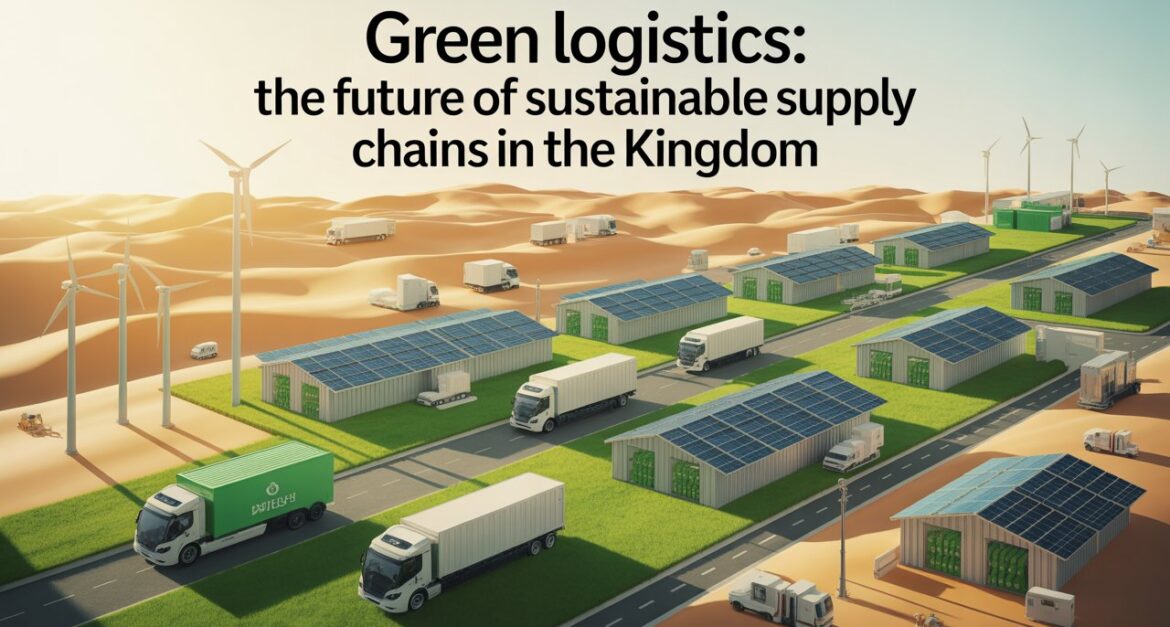
The Billion-Riyal Question Every Procurement Team Is Now Asking
Something changed quietly in the boardrooms of multinationals operating across Saudi Arabia, the UAE, and the wider GCC. Environmental, Social, and Governance (ESG) reporting stopped being a voluntary gesture and became a contractual prerequisite.
Global corporations — from fast-moving consumer goods giants to pharmaceutical distributors — are now embedding carbon accountability clauses directly into their logistics vendor contracts. If your supply chain partner cannot demonstrate measurable emissions reductions, route efficiency data, or warehouse energy benchmarks, you do not make the shortlist. It is that simple, and that consequential.
For the Kingdom of Saudi Arabia, this shift arrives at a defining moment. Vision 2030 has placed sustainability at the heart of national economic strategy. Simultaneously, international enterprises entering or expanding within the Kingdom are bringing their global ESG frameworks with them, creating a new operational standard that local and regional logistics providers must meet — or be replaced by those who do.
This article explores what green logistics actually means in a Saudi and GCC supply chain context, why efficiency and sustainability are the same thing, and how forward-thinking logistics partners are already delivering measurable environmental value to enterprise clients.
What Is Green Logistics? Defining the Entity Correctly
Green logistics is the systematic process of reducing the environmental impact of supply chain operations — spanning transportation, warehousing, inventory management, packaging, and last-mile delivery — without compromising speed, reliability, or cost-effectiveness.
It is not a marketing label. It is an operational discipline rooted in data, engineering, and process design.
The term sits within a broader semantic ecosystem that includes:
- Sustainable supply chain management
- Carbon-neutral freight
- Eco-efficient logistics
- Low-emission last-mile delivery
- Green warehousing and cold chain sustainability
- Scope 3 emissions reporting (the category under which most enterprise supply chain emissions are classified)
Understanding green logistics requires understanding that every inefficiency in a supply chain — an unnecessary route, an idling truck, a poorly insulated warehouse, an overstocked storage bay — is both a financial cost and an environmental cost. The two are inseparable. This is the core insight that separates genuine green logistics providers from those who simply add a leaf icon to their branding.
The Core Principle: Efficient Is Green
The most powerful reframe in sustainable logistics is also the most practical: operational efficiency and environmental responsibility are not trade-offs. They are the same outcome measured differently.
When a logistics provider optimises a delivery route, fuel consumption falls. When warehouse space is used at optimal density, energy per pallet stored decreases. When predictive inventory systems reduce overstock, unnecessary transportation cycles are eliminated. Every one of these improvements shows up on both the operational P&L and the carbon ledger.
This means that a logistics partner who is genuinely excellent at their core job — moving goods reliably, storing them efficiently, managing inventory intelligently — is already a green logistics partner by definition. The distinction lies in whether they measure and report this performance in environmental terms, and whether they design their operations with emissions reduction as an explicit engineering objective alongside cost and speed.
Core Attributes of a Green Logistics Operation
1. Route Optimisation and Fleet Efficiency
Route optimisation is the single highest-impact lever in transport emissions reduction. Advanced logistics providers use AI-powered routing engines that factor in real-time traffic, load consolidation, delivery sequencing, and vehicle capacity to produce routes that minimise distance and idle time simultaneously.
In a geography like Saudi Arabia — where urban centres are separated by significant distances and summer temperatures affect vehicle performance and fuel efficiency — intelligent routing is not optional. It is operationally essential.
Key attributes of a route-optimised green fleet include:
- Dynamic rerouting that responds to traffic conditions, reducing idle fuel burn
- Load consolidation that reduces the number of vehicle movements per tonne of goods delivered
- Multi-stop sequence optimisation that reduces total kilometres driven per delivery cycle
- Telematics integration that monitors driver behaviour, fuel consumption, and engine performance in real time
- Fleet electrification readiness — the infrastructure and operational frameworks to integrate electric commercial vehicles as the market matures in the Kingdom
Every percentage point improvement in route efficiency translates directly into a proportional reduction in fuel consumption and therefore CO₂ emissions. For a logistics operation running hundreds of vehicles across a national network, these percentages represent thousands of tonnes of carbon annually.
2. Efficient Warehousing: The Green Square Metre
Warehousing is frequently underestimated in enterprise carbon accounting, but warehouse operations — lighting, climate control, refrigeration, materials handling equipment, and building energy consumption — can represent a substantial portion of a logistics provider’s total Scope 1 and Scope 2 emissions.
Green warehousing operates on a set of well-defined principles:
- Space utilisation optimisation: Higher storage density per square metre means lower energy cost and emissions per unit stored. Intelligent slotting, vertical storage solutions, and dynamic bay allocation all contribute.
- Energy-efficient climate control: In the Saudi context, where ambient temperatures regularly exceed 45°C, the energy cost of maintaining temperature-controlled environments is extreme. High-performance insulation, smart HVAC systems, and thermal zoning reduce this load significantly.
- Solar integration: Saudi Arabia’s solar irradiance levels are among the highest on the planet. Warehouse rooftop solar installations can offset a substantial proportion of facility energy demand, reducing both cost and grid-sourced emissions.
- LED lighting and motion-activated systems: A basic but highly effective intervention in large warehouse environments.
- Electric materials handling equipment: Replacing diesel or gas-powered forklifts with electric alternatives eliminates direct emissions from within the warehouse footprint.
For enterprise clients reporting under frameworks such as GRI, CDP, or the Task Force on Climate-related Financial Disclosures (TCFD), the ability to receive disaggregated warehouse energy and emissions data from their logistics partners is increasingly a vendor selection criterion.
3. Cold Chain Sustainability
For pharmaceutical, food and beverage, and healthcare logistics, cold chain management introduces specific sustainability challenges. Refrigeration systems are energy-intensive, and temperature excursions — whether from equipment failure or operational inefficiency — result in product waste that carries both economic and embedded-carbon costs.
Sustainable cold chain management combines:
- Precise temperature monitoring with IoT sensor networks
- Predictive maintenance that prevents equipment failures before they cause temperature breaks
- Optimised loading and unloading procedures that minimise door-open time and temperature fluctuation
- Packaging solutions that maintain temperature integrity with less active refrigeration energy
4. Emissions Measurement and Reporting Infrastructure
A green logistics partner must be able to provide enterprise clients with accurate, auditable emissions data. This is not peripheral — it is the foundation of ESG compliance.
This means having the systems to calculate:
- Scope 1 emissions: Direct fuel combustion from owned fleet vehicles and warehouse equipment
- Scope 2 emissions: Indirect emissions from purchased electricity used in warehouse and office operations
- Scope 3 transport emissions: The emissions allocated to a specific client’s goods movement, calculated per shipment, per route, or per tonne-kilometre
Enterprises reporting to international frameworks, institutional investors, or parent companies headquartered in Europe or North America need this data on a regular cadence. A logistics partner without the measurement infrastructure to provide it creates a reporting gap that their clients cannot afford.
Why ESG Requirements Are Reshaping Logistics Vendor Selection in the Kingdom
The ESG compliance landscape in Saudi Arabia is accelerating from multiple directions simultaneously.
Vision 2030 and the National Environmental Objectives: Saudi Arabia has committed to reducing carbon emissions by 278 million tonnes annually by 2030 and achieving net zero by 2060. The logistics sector, as a major contributor to national transport emissions, sits directly within the scope of these commitments.
Tadawul-Listed Company Reporting Requirements: The Capital Market Authority of Saudi Arabia has been progressively increasing ESG disclosure expectations for listed companies. For large enterprises, this means their supply chain partners’ performance increasingly affects their own reported sustainability metrics.
Multinational Procurement Standards: Global corporations operating in the Kingdom — in sectors from petrochemicals to retail to healthcare — are applying the same vendor sustainability standards they use globally. A logistics provider that cannot meet these standards loses access to the largest enterprise contracts in the market.
Financial Institution Requirements: Saudi banks and international lenders financing logistics infrastructure are increasingly applying green financing criteria. Access to competitive capital is beginning to correlate with demonstrated sustainability performance.
The combined effect is a structural shift in what it means to be a competitive logistics provider in the Kingdom. Sustainability capability is no longer a differentiator — it is becoming a threshold requirement.
Real-World Use Cases: Green Logistics in Action
Large-Scale FMCG Distribution
A multinational consumer goods company distributing across Saudi Arabia’s major urban centres — Riyadh, Jeddah, Dammam — faces a classic logistics challenge: high delivery frequency, wide geographic distribution, and strict on-shelf availability targets. Traditional approaches optimise purely for delivery reliability. A green logistics approach layers route consolidation and vehicle load optimisation on top of reliability requirements, reducing the number of vehicle movements required to maintain the same service level. The result is lower cost, lower emissions, and the same or better service reliability.
Pharmaceutical Cold Chain Management
A regional pharmaceutical distributor supplying hospitals and retail pharmacies operates under strict regulatory requirements for temperature integrity. A green cold chain operation delivers the same temperature compliance with lower energy consumption through smarter facility design, better equipment maintenance protocols, and optimised delivery scheduling that consolidates cold deliveries to minimise vehicle door cycles. Carbon footprint data is reported per shipment for integration into the distributor’s ESG reporting.
E-Commerce Last-Mile Optimisation
An e-commerce retailer processing thousands of daily deliveries across Riyadh faces the particular inefficiency of residential last-mile delivery — low drop density, high failed delivery rates, and significant return logistics volumes. A green last-mile operation uses predictive delivery scheduling, customer communication systems that reduce failed attempts, and micro-consolidation hubs that allow higher-density final delivery routes. Emissions per successful delivery fall substantially compared to unoptimised operations.
Retail Supply Chain for a GCC-Wide Retailer
A retailer with operations across Saudi Arabia, UAE, and Kuwait needs a logistics partner capable of providing consolidated carbon reporting across all movement of goods within their supply chain. Palm Horizon’s cross-border network and unified emissions reporting system allows the retailer to report a single, auditable Scope 3 transport emissions figure to their international parent company.
How Palm Horizon Positions as a Green Logistics Partner
Palm Horizon Logistics operates at the intersection of operational excellence and environmental accountability — recognising that these objectives reinforce rather than contradict each other.
Route Intelligence: Palm Horizon’s fleet management platform integrates dynamic route optimisation across its entire vehicle network, delivering measurable reductions in kilometres driven, fuel consumed, and emissions generated per tonne of goods delivered.
Warehouse Efficiency Design: Palm Horizon’s facilities are engineered for high-density utilisation with energy-efficient climate control systems designed for the Saudi climate. Solar integration is incorporated into facility planning, and warehouse energy performance is tracked and reported continuously.
ESG Reporting Infrastructure: Palm Horizon provides enterprise clients with regular emissions reporting at the shipment, route, and account level — formatted for integration with standard ESG reporting frameworks used by multinationals globally.
Cold Chain Expertise: Palm Horizon’s temperature-controlled logistics network covers pharmaceutical, food, and specialty product requirements with IoT-monitored temperature integrity and energy-optimised facility design.
Scalability for Multinational Requirements: Palm Horizon’s operational infrastructure, reporting systems, and service standards are designed to meet the expectations of multinational enterprise clients, with account management structured to support complex, multi-site logistics relationships.
Implementation Overview: What a Green Logistics Partnership Looks Like
For enterprise clients evaluating Palm Horizon as a logistics partner, the implementation pathway follows a structured progression:
Phase 1 — Baseline Assessment: Establishing current emissions and efficiency baseline across the client’s existing logistics operations. This includes route analysis, warehouse utilisation review, and fleet performance benchmarking.
Phase 2 — Optimisation Design: Designing the specific route structures, consolidation strategies, and warehousing configurations that will deliver the target combination of service performance and emissions reduction.
Phase 3 — Reporting Integration: Configuring the emissions data outputs to align with the client’s ESG reporting framework, including data format, reporting frequency, and allocation methodology.
Phase 4 — Continuous Improvement: Operating under a continuous improvement model where route performance, warehouse efficiency, and emissions metrics are reviewed regularly and improvement targets are set collaboratively.
This structured approach allows enterprise clients to demonstrate measurable year-on-year progress against their Scope 3 emissions reduction targets — a requirement that is increasingly built into corporate ESG commitments worldwide.
Frequently Asked Questions
Q1: What is the difference between green logistics and standard logistics, and does it cost more?
Green logistics is standard logistics designed and measured with emissions reduction as an explicit operational objective alongside cost and service level. Because the primary lever for emissions reduction in logistics is operational efficiency — better routes, better warehouse utilisation, better load consolidation — genuinely green logistics typically costs the same or less than unoptimised conventional logistics. The additional investment is in measurement infrastructure and engineering discipline, not in accepting cost penalties for sustainability.
Q2: How does Scope 3 emissions reporting work for logistics, and what data does Palm Horizon provide?
Scope 3 emissions in logistics refer to the greenhouse gas emissions generated by the transportation and storage of a company’s goods, even when those activities are carried out by a third-party logistics provider. Palm Horizon calculates client-specific emissions using actual fuel consumption data, distance data, and load allocation methodology, producing per-shipment and aggregate emissions figures that can be incorporated directly into GRI, CDP, or TCFD reporting frameworks.
Q3: Is green logistics relevant for businesses that are not yet required to report ESG metrics?
Yes, for two reasons. First, ESG reporting requirements in Saudi Arabia and globally are expanding, and businesses that build green logistics capability now are better positioned when requirements formalise. Second, the operational efficiency improvements that underpin green logistics — better routes, better warehouse utilisation, less waste — deliver immediate financial benefits regardless of reporting requirements.
Q4: How does route optimisation actually reduce carbon emissions in practice?
Route optimisation reduces carbon emissions by reducing the total distance driven, minimising idle time in traffic, improving vehicle load factors so fewer trips are required per tonne of goods, and enabling better maintenance scheduling that keeps engines running at peak fuel efficiency. In a typical logistics operation, route optimisation can reduce fuel consumption — and therefore CO₂ emissions — by 10 to 20 percent compared to unoptimised routing, with advanced AI-powered systems achieving greater improvements.
Q5: What makes Saudi Arabia’s logistics sustainability context unique compared to other markets?
Saudi Arabia’s context is shaped by several distinctive factors: extreme summer temperatures that significantly increase the energy cost of cold chain and climate-controlled warehousing; large distances between major urban centres that amplify the impact of route optimisation; a national sustainability agenda under Vision 2030 that creates regulatory and reputational pressure; exceptionally high solar energy potential that makes on-site renewable generation particularly viable for warehouse operations; and a rapidly growing multinational business presence that brings international ESG standards into the local logistics procurement process.
Q6: Can Palm Horizon support businesses with logistics operations across multiple GCC countries in their ESG reporting?
Yes. Palm Horizon’s reporting infrastructure is designed to consolidate emissions data across multi-country logistics operations, allowing clients with operations in Saudi Arabia, UAE, Kuwait, and other GCC markets to receive unified carbon reporting that covers all Palm Horizon-managed logistics activity. This is particularly valuable for multinationals that report a single GCC or MENA regional Scope 3 figure to their international parent company or investors.
Q7: What is the relationship between Saudi Vision 2030 and enterprise logistics sustainability requirements?
Vision 2030’s sustainability commitments — including Saudi Arabia’s 2030 carbon reduction target and 2060 net zero goal — create a policy environment in which logistics sustainability is increasingly aligned with national strategic objectives. For enterprises operating in the Kingdom, demonstrating supply chain sustainability alignment with Vision 2030 objectives is both a compliance consideration and a relationship management priority with government stakeholders.
Conclusion: The Sustainable Supply Chain Is the Competitive Supply Chain
The enterprises that will win the largest contracts in Saudi Arabia and across the GCC over the next decade are those that treat ESG not as a reporting obligation to be managed, but as an operational standard to be built.
Their logistics partners need to match that ambition.
Palm Horizon Logistics understands that every efficient route, every optimised warehouse bay, every well-maintained vehicle in its fleet is simultaneously a financial asset and an environmental contribution. This is not a compromise position — it is an engineering reality. Efficient is green. Green is competitive.
For multinationals and large enterprises with ESG targets, Scope 3 reporting obligations, and sustainability commitments to institutional investors and parent companies, Palm Horizon offers what the market now demands: a logistics partner that measures what matters, optimises what moves, and reports with the accuracy and transparency that serious ESG compliance requires.
The future of supply chain in the Kingdom is not a choice between performance and sustainability. The future belongs to those who understand they were always the same goal.