
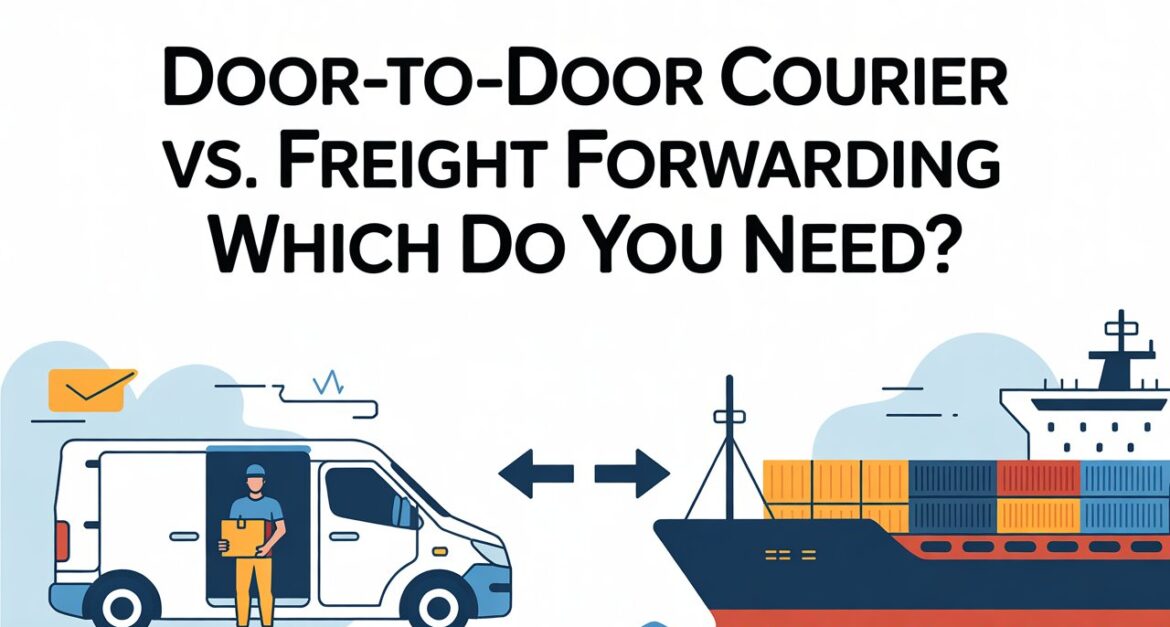
Door-to-Door Courier vs. Freight Forwarding: Which Shipping Method Do You Actually Need?
Choosing the wrong shipping method doesn’t just cost money — it costs time, trust, and sometimes the entire customer relationship. Yet every day, businesses send fragile prototypes via freight containers and bulk commercial goods through parcel couriers, paying twice as much for half the result.
The confusion is understandable. The global logistics industry has grown into a layered ecosystem of overlapping services, each with its own terminology, pricing logic, and operational rules. Door-to-door courier services and freight forwarding both move goods from one place to another — but the similarity ends there. Their cost structures, documentation requirements, delivery timelines, cargo handling protocols, and use cases are fundamentally different.
This guide cuts through the noise. Whether you’re a startup shipping product samples internationally, an e-commerce brand scaling cross-border fulfilment, or a manufacturer moving raw materials across continents, you’ll leave here knowing exactly which shipping model fits your operation — and why.
What Is a Door-to-Door Courier Service?
A door-to-door courier service is an end-to-end parcel delivery solution where a single carrier — or a tightly integrated network — picks up a shipment from the sender’s address and delivers it directly to the recipient’s address, handling every step in between.
The defining characteristic is simplicity. You hand over a package; it arrives at a door. No warehousing coordination. No customs broker sourcing. No container booking windows to manage.
Major global players operating in this space include DHL Express, FedEx International Priority, UPS Worldwide Express, and Aramex. These companies have built vertically integrated networks — owning or leasing aircraft, ground vehicles, sorting hubs, and customs brokerage infrastructure — to make single-shipment international delivery feel almost as straightforward as domestic posting.
Core Attributes of Door-to-Door Courier Services
Speed and Predictability Courier services operate on fixed transit time guarantees — typically 1 to 5 business days internationally for express tiers. This predictability is built into the service contract, not estimated. When a time-sensitive shipment has a hard deadline, this reliability carries significant commercial value.
Weight and Volume Constraints Most courier services are optimized for shipments under 70 kg per package, with dimensional weight pricing applying to larger parcels. They are not designed for palletized cargo, oversized machinery, or bulk commodity shipments. Attempting to send such cargo via courier networks results in prohibitive costs.
All-Inclusive Pricing Courier pricing typically bundles pickup, transit, customs clearance (in many corridors), and final-mile delivery into a single quoted rate. This transparency reduces financial surprises but also means the per-kg rate is considerably higher than freight forwarding alternatives.
Tracking and Visibility Real-time shipment tracking at the package level is standard. Customers can monitor location, customs clearance status, and estimated delivery window through carrier portals or API integrations — a feature that e-commerce operations consider non-negotiable for customer experience management.
Documentation Simplicity Courier shipments travel on standardized air waybills (AWBs). The carrier manages the majority of customs documentation, particularly for lower-value commercial shipments that qualify for simplified clearance regimes in most countries.
What Is Freight Forwarding?
Freight forwarding is a logistics coordination service in which a specialist intermediary — the freight forwarder — arranges the transportation of goods on behalf of a shipper, sourcing and managing multiple carriers, modes of transport, and regulatory processes to move cargo from origin to destination.
A freight forwarder does not typically own the vehicles, ships, or aircraft that carry the goods. Instead, they function as a logistics architect, purchasing capacity from carriers in volume, structuring the most efficient routing, and managing the documentation, customs, insurance, and compliance requirements that govern international trade.
Freight forwarding operates across three primary modes: air freight, sea freight (FCL — full container load, or LCL — less than container load), and road freight for cross-border land transport. The mode selected depends on cargo volume, weight, urgency, and budget.
Core Attributes of Freight Forwarding
Scalability for Volume Cargo Freight forwarding is engineered for commercial-scale shipments. A single FCL sea freight booking can accommodate 20 to 40 metric tons of goods in a standard container. LCL consolidation services allow smaller shippers to pay only for the space their cargo occupies within a shared container, maintaining cost efficiency without requiring full container minimums.
Multi-Modal Flexibility Freight forwarders coordinate across modes — shipping goods by sea to a port, transferring to rail or road for inland movement, and arranging last-mile trucking to a warehouse or distribution centre. This flexibility allows cost optimization across long, complex supply chains that no single carrier network can serve.
Customs Brokerage and Trade Compliance Freight forwarders hold or contract with licensed customs brokers. They prepare and file customs entries, manage duty calculations, apply for preferential tariff treatments under trade agreements, handle certificates of origin, and navigate import licenses or regulatory permits for controlled goods. For companies moving commercial cargo internationally at scale, this expertise is not optional — it’s operationally essential.
Cost Efficiency at Volume Sea freight FCL rates on major trade lanes can cost $0.05 to $0.30 per kilogram depending on the route and market conditions. Courier rates for the same weight could be 10 to 50 times higher. The cost differential widens dramatically as shipment size increases, which is why virtually all manufacturing supply chains rely on freight forwarding rather than courier networks for bulk material movement.
Longer Transit Times The trade-off for cost efficiency is time. Sea freight from China to Europe averages 25 to 35 days. Even air freight forwarding, which is faster than sea, typically adds airport handling time, customs dwell, and trucking legs that push total transit beyond what express couriers deliver.
Cargo Insurance and Risk Management Freight forwarders arrange marine cargo insurance, which covers goods for their full commercial value during transit. Standard courier liability caps — often limited to declared value or a fixed per-kg amount — leave high-value commercial shipments significantly underinsured without separate policy arrangements.
Head-to-Head: Key Differences at a Glance
Below is a comparison of the most decision-relevant attributes across both shipping methods:
| Attribute | Door-to-Door Courier | Freight Forwarding |
| Ideal shipment weight | Under 70 kg | 100 kg to full containers |
| Transit speed | 1–5 days (express) | 3–35+ days |
| Pricing model | Per-kg, all-inclusive | Per-kg or per-CBM, modular |
| Customs handling | Carrier-managed | Forwarder/broker-managed |
| Tracking granularity | Real-time, package-level | Milestone-based |
| Mode of transport | Air (primarily) | Air, sea, road, rail |
| Insurance coverage | Limited liability | Full marine cargo coverage |
| Best for | Time-sensitive, low-volume | High-volume, cost-sensitive |
| Documentation complexity | Low | High |
| Scalability | Limited | High |
Use Cases and Industries Served
Understanding which method fits requires mapping cargo type, shipment frequency, destination, and timeline together. Here’s how real industries apply each model:
When Door-to-Door Courier Is the Right Choice
E-commerce and Direct-to-Consumer Brands For online retailers shipping individual orders to end customers — particularly across borders — couriers are the operational default. The all-in pricing, real-time tracking, and doorstep delivery align with consumer expectations for a seamless unboxing experience. Courier integrations with platforms like Shopify, WooCommerce, and Magento are mature and widely supported.
Sample and Prototype Shipments Product development teams frequently need to send physical samples between suppliers, designers, and approval stakeholders across multiple countries. These shipments are low in weight, high in urgency, and require documented delivery confirmation. Courier services handle this category with minimal friction.
Pharmaceutical and Medical Device Shipments The pharmaceutical supply chain often requires temperature-controlled courier solutions — particularly for clinical trial materials, biological samples, and regulatory submissions that must travel under chain-of-custody protocols. Specialized courier services provide GDP-compliant (Good Distribution Practice) handling, temperature monitoring, and tamper-evident packaging.
Legal Documents and Time-Sensitive Correspondence Law firms, financial institutions, and government agencies routinely use courier services for the rapid movement of executed contracts, compliance filings, and notarized documents. The guaranteed delivery timeframe and signature-on-delivery confirmation are non-negotiable in these contexts.
Luxury Goods and High-Value Items Jewellery houses, watch manufacturers, and luxury fashion brands use courier services for their combination of speed, insurance options, and discreet handling. The premium cost is absorbed into the product margin; the reputational risk of delays or damage to high-value goods outweighs any freight cost savings.
When Freight Forwarding Is the Right Choice
Manufacturing and Industrial Supply Chains A factory sourcing raw materials from suppliers across multiple continents cannot operate on courier economics. A single production run might require 10,000 kg of aluminium, 5,000 metres of fabric, or 200 pallets of components. Freight forwarding — particularly sea freight FCL — makes these volumes economically viable to transport.
Import and Export Businesses Companies whose core business model is the purchase and resale of goods across borders depend entirely on freight forwarding infrastructure. Managing Letters of Credit, Bills of Lading, Certificate of Origin documentation, and Incoterm obligations requires the structured support of a qualified freight forwarder.
Retail Replenishment and Seasonal Inventory Retailers planning stock replenishment cycles for peak selling seasons — Christmas, Ramadan, Back to School — typically ship by sea freight 6 to 12 weeks ahead of demand. The long lead times are planned into inventory management systems, and the cost savings versus air freight are substantial enough to fund significant marketing budgets.
Project Cargo and Out-of-Gauge Shipments Construction companies, energy sector operators, and infrastructure developers moving heavy plant equipment, modular building units, or oversized industrial components require project freight specialists — a subspecialty of freight forwarding. This category of cargo simply cannot enter courier networks.
E-commerce Sellers Restocking Amazon FBA or 3PL Warehouses Cross-border e-commerce sellers who source inventory in bulk from manufacturers — particularly from China, India, or Bangladesh — and ship to fulfilment centres use freight forwarding for inbound logistics. Restocking a warehouse with 2,000 units of a product via courier would cost 20 to 40 times more than a sea freight LCL booking.
How Each Shipping Method Works: An Implementation Overview
Booking a Door-to-Door Courier Shipment
The operational steps are intentionally straightforward:
- Create a shipment booking through the carrier’s online portal or API integration
- Print the pre-generated air waybill and attach it to the package
- Package goods according to carrier specifications (weight, dimensions, packaging standards)
- Schedule a pickup or drop off at a service point
- Monitor transit via the carrier’s tracking system
- Recipient signs for delivery; proof of delivery is recorded and accessible
For businesses with high shipment volumes, courier companies offer account-based pricing, automated manifesting, bulk label printing, and dedicated account management. API integrations with order management systems eliminate manual data entry entirely.
Executing a Freight Forwarding Shipment
The process involves more coordination steps, reflecting the complexity of commercial cargo movement:
- Request a freight quote from a forwarder, specifying cargo details, origin, destination, Incoterms, and required transit time
- Receive and compare options across modes and carriers
- Confirm booking; receive Booking Confirmation and Shipper’s Letter of Instruction (SLI)
- Prepare commercial invoice, packing list, and any required certificates or permits
- Deliver cargo to the freight station, port, or arrange inland trucking pickup
- Cargo is loaded, Bill of Lading or Air Waybill issued
- Forwarder manages customs clearance at origin and destination
- Cargo is delivered to the nominated consignee address or warehouse
- Original documents released upon payment of freight invoice (for certain terms)
For recurring trade lanes, freight forwarders establish standing arrangements, rate agreements, and dedicated booking windows that streamline this process into a predictable operational rhythm.
Cost Modelling: What to Expect
Cost comparison is where the decision often becomes clearest. Consider a 500 kg shipment from Shanghai to London:
Door-to-Door Express Courier: At approximately £6 to £12 per kg for international express air, the total cost ranges from £3,000 to £6,000, with delivery in 2 to 4 business days.
Air Freight Forwarding: At approximately £1.50 to £3.50 per kg (market-dependent), the total cost ranges from £750 to £1,750, with total door-to-door transit of 5 to 10 business days including customs dwell.
Sea Freight (LCL): For 500 kg occupying roughly 2 to 3 CBM, the sea freight component costs approximately £200 to £450, but total transit including port handling and customs runs 28 to 38 days.
The cost-speed-volume triangle is the fundamental trade-off framework in logistics decision-making. No single method dominates all three dimensions.
Choosing a Provider: What to Evaluate
Whether selecting a courier network or a freight forwarder, the evaluation criteria overlap in some areas and diverge in others.
For Courier Services, prioritise:
- Coverage network in your key destination countries
- Transit time guarantees and on-time performance data
- Customs clearance capabilities in regulated markets
- Technology integration (API, carrier plugins, tracking feeds)
- Liability coverage and claims handling processes
- Volume discount structures and account terms
For Freight Forwarders, prioritise:
- Licensed customs broker status in origin and destination countries
- Carrier relationships and capacity access on your trade lanes
- Industry specialisation (temperature-sensitive, hazmat, project cargo)
- Technology platform for booking, documentation, and tracking
- Financial stability and insurance arrangements
- Communication responsiveness and account management quality
FAQ: Semantic Questions on Courier vs. Freight Forwarding
Q: Can I use a door-to-door courier service for commercial B2B shipments?
Yes, couriers handle commercial B2B shipments routinely. However, for shipments above approximately 100 to 150 kg, the cost per kilogram makes courier services commercially uncompetitive compared to air freight forwarding. For low-to-medium weight commercial shipments where speed is the priority — spare parts, product samples, urgent replenishment stock — couriers are a practical B2B solution.
Q: What does “door-to-door” actually mean in freight forwarding?
In freight forwarding, “door-to-door” is a service scope descriptor referring to the forwarder managing the entire logistics chain from the shipper’s premises to the consignee’s premises, including inland trucking, port handling, ocean or air transit, customs clearance, and final delivery. Not all freight forwarders offer true door-to-door service — some operate on port-to-port or door-to-port terms. The Incoterm agreed in the commercial contract (e.g., DDP, DAP, CIF) defines the legal responsibility boundaries between buyer and seller.
Q: How do I handle customs clearance when using a courier service internationally?
Major courier carriers operate their own licensed customs brokerage divisions. For shipments below the customs duty threshold (which varies by country — approximately $800 in the US, £135 in the UK, €150 in the EU), informal clearance is handled automatically. For commercial shipments above threshold values, couriers will either process formal entry on your behalf (charging a brokerage fee) or request you to appoint your own customs broker. For complex import scenarios — preferential tariff claims, controlled goods, ATA Carnet usage — independent customs broker engagement is advisable regardless of shipping method.
Q: What is the difference between LCL and FCL freight forwarding?
FCL (Full Container Load) means your cargo exclusively occupies a standard shipping container — typically a 20-foot (approximately 25 CBM) or 40-foot (approximately 65 CBM) unit. You pay for the entire container regardless of how much space your cargo uses. FCL is cost-effective when cargo fills roughly 70% or more of the container. LCL (Less than Container Load) means your cargo is consolidated with other shippers’ goods into a shared container. You pay only for the volume or weight your cargo occupies (whichever is greater). LCL adds handling time and cost for consolidation and deconsolidation at Container Freight Stations (CFS), but is the right solution for shipments too large for courier economics but too small to justify a full container.
Q: Can freight forwarders guarantee delivery times the way couriers do?
Freight forwarders provide estimated transit times based on carrier schedules, typical port handling durations, and customs clearance averages. These are not contractual guarantees in the same sense as express courier service level agreements. Port congestion, vessel delays, customs holds, or documentation issues can extend transit. For shipments where arrival timing is contractually binding, air freight with a more predictable transit window is preferable to sea freight, and the shipment timeline should include buffer days to absorb variability.
Q: What is the role of a Bill of Lading in freight forwarding and why does it matter?
The Bill of Lading (B/L) is the foundational document of sea freight. It functions simultaneously as a receipt for goods loaded on the vessel, a contract of carriage between shipper and carrier, and — in the case of a negotiable B/L — a document of title that controls ownership of the goods. This means the physical release of cargo at the destination port is contingent on surrender of the original B/L. For trade finance transactions, banks use the B/L as the instrument against which Letters of Credit are drawn. Errors on a B/L — incorrect weight, wrong Incoterm, misspelled consignee details — can delay cargo release and trigger amendment fees.
Q: Is freight forwarding safe for high-value goods?
Freight forwarding can safely accommodate high-value cargo when appropriate measures are taken. These include arranging marine cargo insurance at sufficient declared value, specifying handling instructions for fragile or sensitive goods, using secure container seals and tamper-evident packaging, and selecting reputable carriers with strong cargo handling records. Certain high-value categories — precious metals, artworks, currency — may require specialist secure logistics providers rather than standard freight forwarding channels.
The Bottom Line: Which Do You Actually Need?
There’s no universal correct answer — but there is a clear decision framework.
Use a door-to-door courier when you’re moving relatively small, time-sensitive, high-value shipments where delivery speed and customer experience matter more than unit shipping cost. E-commerce orders to end consumers, product samples, urgent business documents, pharmaceutical specimens, and luxury goods all belong in this category.
Use freight forwarding when you’re moving commercial cargo at volume, where the cost per kilogram matters, where lead times can be planned in advance, and where the shipment requires professional customs management, multi-modal routing, or cargo insurance at full commercial value. Manufacturing supply chains, bulk import/export, seasonal inventory replenishment, and Amazon FBA restocking all sit firmly in this category.
Many growing businesses eventually need both. A brand might ship customer orders via courier while restocking its warehouses by sea freight. A manufacturer might move production cargo by FCL container while sending urgent spare parts by express air courier. The logistics infrastructure you build should reflect the full range of your shipping requirements — not just the most common scenario.
The businesses that get this right aren’t just saving money on freight. They’re building supply chains that are resilient, predictable, and scaled to support growth rather than constrain it. That starts with choosing the right shipping method for each type of cargo — and understanding exactly why.Choosing the wrong shipping method doesn’t just cost money — it costs time, trust, and sometimes the entire customer relationship. Yet every day, businesses send fragile prototypes via freight containers and bulk commercial goods through parcel couriers, paying twice as much for half the result.
The confusion is understandable. The global logistics industry has grown into a layered ecosystem of overlapping services, each with its own terminology, pricing logic, and operational rules. Door-to-door courier services and freight forwarding both move goods from one place to another — but the similarity ends there. Their cost structures, documentation requirements, delivery timelines, cargo handling protocols, and use cases are fundamentally different.
This guide cuts through the noise. Whether you’re a startup shipping product samples internationally, an e-commerce brand scaling cross-border fulfilment, or a manufacturer moving raw materials across continents, you’ll leave here knowing exactly which shipping model fits your operation — and why.
What Is a Door-to-Door Courier Service?
A door-to-door courier service is an end-to-end parcel delivery solution where a single carrier — or a tightly integrated network — picks up a shipment from the sender’s address and delivers it directly to the recipient’s address, handling every step in between.
The defining characteristic is simplicity. You hand over a package; it arrives at a door. No warehousing coordination. No customs broker sourcing. No container booking windows to manage.
Major global players operating in this space include DHL Express, FedEx International Priority, UPS Worldwide Express, and Aramex. These companies have built vertically integrated networks — owning or leasing aircraft, ground vehicles, sorting hubs, and customs brokerage infrastructure — to make single-shipment international delivery feel almost as straightforward as domestic posting.
Core Attributes of Door-to-Door Courier Services
Speed and Predictability Courier services operate on fixed transit time guarantees — typically 1 to 5 business days internationally for express tiers. This predictability is built into the service contract, not estimated. When a time-sensitive shipment has a hard deadline, this reliability carries significant commercial value.
Weight and Volume Constraints Most courier services are optimized for shipments under 70 kg per package, with dimensional weight pricing applying to larger parcels. They are not designed for palletized cargo, oversized machinery, or bulk commodity shipments. Attempting to send such cargo via courier networks results in prohibitive costs.
All-Inclusive Pricing Courier pricing typically bundles pickup, transit, customs clearance (in many corridors), and final-mile delivery into a single quoted rate. This transparency reduces financial surprises but also means the per-kg rate is considerably higher than freight forwarding alternatives.
Tracking and Visibility Real-time shipment tracking at the package level is standard. Customers can monitor location, customs clearance status, and estimated delivery window through carrier portals or API integrations — a feature that e-commerce operations consider non-negotiable for customer experience management.
Documentation Simplicity Courier shipments travel on standardized air waybills (AWBs). The carrier manages the majority of customs documentation, particularly for lower-value commercial shipments that qualify for simplified clearance regimes in most countries.
What Is Freight Forwarding?
Freight forwarding is a logistics coordination service in which a specialist intermediary — the freight forwarder — arranges the transportation of goods on behalf of a shipper, sourcing and managing multiple carriers, modes of transport, and regulatory processes to move cargo from origin to destination.
A freight forwarder does not typically own the vehicles, ships, or aircraft that carry the goods. Instead, they function as a logistics architect, purchasing capacity from carriers in volume, structuring the most efficient routing, and managing the documentation, customs, insurance, and compliance requirements that govern international trade.
Freight forwarding operates across three primary modes: air freight, sea freight (FCL — full container load, or LCL — less than container load), and road freight for cross-border land transport. The mode selected depends on cargo volume, weight, urgency, and budget.
Core Attributes of Freight Forwarding
Scalability for Volume Cargo Freight forwarding is engineered for commercial-scale shipments. A single FCL sea freight booking can accommodate 20 to 40 metric tons of goods in a standard container. LCL consolidation services allow smaller shippers to pay only for the space their cargo occupies within a shared container, maintaining cost efficiency without requiring full container minimums.
Multi-Modal Flexibility Freight forwarders coordinate across modes — shipping goods by sea to a port, transferring to rail or road for inland movement, and arranging last-mile trucking to a warehouse or distribution centre. This flexibility allows cost optimization across long, complex supply chains that no single carrier network can serve.
Customs Brokerage and Trade Compliance Freight forwarders hold or contract with licensed customs brokers. They prepare and file customs entries, manage duty calculations, apply for preferential tariff treatments under trade agreements, handle certificates of origin, and navigate import licenses or regulatory permits for controlled goods. For companies moving commercial cargo internationally at scale, this expertise is not optional — it’s operationally essential.
Cost Efficiency at Volume Sea freight FCL rates on major trade lanes can cost $0.05 to $0.30 per kilogram depending on the route and market conditions. Courier rates for the same weight could be 10 to 50 times higher. The cost differential widens dramatically as shipment size increases, which is why virtually all manufacturing supply chains rely on freight forwarding rather than courier networks for bulk material movement.
Longer Transit Times The trade-off for cost efficiency is time. Sea freight from China to Europe averages 25 to 35 days. Even air freight forwarding, which is faster than sea, typically adds airport handling time, customs dwell, and trucking legs that push total transit beyond what express couriers deliver.
Cargo Insurance and Risk Management Freight forwarders arrange marine cargo insurance, which covers goods for their full commercial value during transit. Standard courier liability caps — often limited to declared value or a fixed per-kg amount — leave high-value commercial shipments significantly underinsured without separate policy arrangements.
Head-to-Head: Key Differences at a Glance
Below is a comparison of the most decision-relevant attributes across both shipping methods:
| Attribute | Door-to-Door Courier | Freight Forwarding |
| Ideal shipment weight | Under 70 kg | 100 kg to full containers |
| Transit speed | 1–5 days (express) | 3–35+ days |
| Pricing model | Per-kg, all-inclusive | Per-kg or per-CBM, modular |
| Customs handling | Carrier-managed | Forwarder/broker-managed |
| Tracking granularity | Real-time, package-level | Milestone-based |
| Mode of transport | Air (primarily) | Air, sea, road, rail |
| Insurance coverage | Limited liability | Full marine cargo coverage |
| Best for | Time-sensitive, low-volume | High-volume, cost-sensitive |
| Documentation complexity | Low | High |
| Scalability | Limited | High |
Use Cases and Industries Served
Understanding which method fits requires mapping cargo type, shipment frequency, destination, and timeline together. Here’s how real industries apply each model:
When Door-to-Door Courier Is the Right Choice
E-commerce and Direct-to-Consumer Brands For online retailers shipping individual orders to end customers — particularly across borders — couriers are the operational default. The all-in pricing, real-time tracking, and doorstep delivery align with consumer expectations for a seamless unboxing experience. Courier integrations with platforms like Shopify, WooCommerce, and Magento are mature and widely supported.
Sample and Prototype Shipments Product development teams frequently need to send physical samples between suppliers, designers, and approval stakeholders across multiple countries. These shipments are low in weight, high in urgency, and require documented delivery confirmation. Courier services handle this category with minimal friction.
Pharmaceutical and Medical Device Shipments The pharmaceutical supply chain often requires temperature-controlled courier solutions — particularly for clinical trial materials, biological samples, and regulatory submissions that must travel under chain-of-custody protocols. Specialized courier services provide GDP-compliant (Good Distribution Practice) handling, temperature monitoring, and tamper-evident packaging.
Legal Documents and Time-Sensitive Correspondence Law firms, financial institutions, and government agencies routinely use courier services for the rapid movement of executed contracts, compliance filings, and notarized documents. The guaranteed delivery timeframe and signature-on-delivery confirmation are non-negotiable in these contexts.
Luxury Goods and High-Value Items Jewellery houses, watch manufacturers, and luxury fashion brands use courier services for their combination of speed, insurance options, and discreet handling. The premium cost is absorbed into the product margin; the reputational risk of delays or damage to high-value goods outweighs any freight cost savings.
When Freight Forwarding Is the Right Choice
Manufacturing and Industrial Supply Chains A factory sourcing raw materials from suppliers across multiple continents cannot operate on courier economics. A single production run might require 10,000 kg of aluminium, 5,000 metres of fabric, or 200 pallets of components. Freight forwarding — particularly sea freight FCL — makes these volumes economically viable to transport.
Import and Export Businesses Companies whose core business model is the purchase and resale of goods across borders depend entirely on freight forwarding infrastructure. Managing Letters of Credit, Bills of Lading, Certificate of Origin documentation, and Incoterm obligations requires the structured support of a qualified freight forwarder.
Retail Replenishment and Seasonal Inventory Retailers planning stock replenishment cycles for peak selling seasons — Christmas, Ramadan, Back to School — typically ship by sea freight 6 to 12 weeks ahead of demand. The long lead times are planned into inventory management systems, and the cost savings versus air freight are substantial enough to fund significant marketing budgets.
Project Cargo and Out-of-Gauge Shipments Construction companies, energy sector operators, and infrastructure developers moving heavy plant equipment, modular building units, or oversized industrial components require project freight specialists — a subspecialty of freight forwarding. This category of cargo simply cannot enter courier networks.
E-commerce Sellers Restocking Amazon FBA or 3PL Warehouses Cross-border e-commerce sellers who source inventory in bulk from manufacturers — particularly from China, India, or Bangladesh — and ship to fulfilment centres use freight forwarding for inbound logistics. Restocking a warehouse with 2,000 units of a product via courier would cost 20 to 40 times more than a sea freight LCL booking.
How Each Shipping Method Works: An Implementation Overview
Booking a Door-to-Door Courier Shipment
The operational steps are intentionally straightforward:
- Create a shipment booking through the carrier’s online portal or API integration
- Print the pre-generated air waybill and attach it to the package
- Package goods according to carrier specifications (weight, dimensions, packaging standards)
- Schedule a pickup or drop off at a service point
- Monitor transit via the carrier’s tracking system
- Recipient signs for delivery; proof of delivery is recorded and accessible
For businesses with high shipment volumes, courier companies offer account-based pricing, automated manifesting, bulk label printing, and dedicated account management. API integrations with order management systems eliminate manual data entry entirely.
Executing a Freight Forwarding Shipment
The process involves more coordination steps, reflecting the complexity of commercial cargo movement:
- Request a freight quote from a forwarder, specifying cargo details, origin, destination, Incoterms, and required transit time
- Receive and compare options across modes and carriers
- Confirm booking; receive Booking Confirmation and Shipper’s Letter of Instruction (SLI)
- Prepare commercial invoice, packing list, and any required certificates or permits
- Deliver cargo to the freight station, port, or arrange inland trucking pickup
- Cargo is loaded, Bill of Lading or Air Waybill issued
- Forwarder manages customs clearance at origin and destination
- Cargo is delivered to the nominated consignee address or warehouse
- Original documents released upon payment of freight invoice (for certain terms)
For recurring trade lanes, freight forwarders establish standing arrangements, rate agreements, and dedicated booking windows that streamline this process into a predictable operational rhythm.
Cost Modelling: What to Expect
Cost comparison is where the decision often becomes clearest. Consider a 500 kg shipment from Shanghai to London:
Door-to-Door Express Courier: At approximately £6 to £12 per kg for international express air, the total cost ranges from £3,000 to £6,000, with delivery in 2 to 4 business days.
Air Freight Forwarding: At approximately £1.50 to £3.50 per kg (market-dependent), the total cost ranges from £750 to £1,750, with total door-to-door transit of 5 to 10 business days including customs dwell.
Sea Freight (LCL): For 500 kg occupying roughly 2 to 3 CBM, the sea freight component costs approximately £200 to £450, but total transit including port handling and customs runs 28 to 38 days.
The cost-speed-volume triangle is the fundamental trade-off framework in logistics decision-making. No single method dominates all three dimensions.
Choosing a Provider: What to Evaluate
Whether selecting a courier network or a freight forwarder, the evaluation criteria overlap in some areas and diverge in others.
For Courier Services, prioritise:
- Coverage network in your key destination countries
- Transit time guarantees and on-time performance data
- Customs clearance capabilities in regulated markets
- Technology integration (API, carrier plugins, tracking feeds)
- Liability coverage and claims handling processes
- Volume discount structures and account terms
For Freight Forwarders, prioritise:
- Licensed customs broker status in origin and destination countries
- Carrier relationships and capacity access on your trade lanes
- Industry specialisation (temperature-sensitive, hazmat, project cargo)
- Technology platform for booking, documentation, and tracking
- Financial stability and insurance arrangements
- Communication responsiveness and account management quality
FAQ: Semantic Questions on Courier vs. Freight Forwarding
Q: Can I use a door-to-door courier service for commercial B2B shipments?
Yes, couriers handle commercial B2B shipments routinely. However, for shipments above approximately 100 to 150 kg, the cost per kilogram makes courier services commercially uncompetitive compared to air freight forwarding. For low-to-medium weight commercial shipments where speed is the priority — spare parts, product samples, urgent replenishment stock — couriers are a practical B2B solution.
Q: What does “door-to-door” actually mean in freight forwarding?
In freight forwarding, “door-to-door” is a service scope descriptor referring to the forwarder managing the entire logistics chain from the shipper’s premises to the consignee’s premises, including inland trucking, port handling, ocean or air transit, customs clearance, and final delivery. Not all freight forwarders offer true door-to-door service — some operate on port-to-port or door-to-port terms. The Incoterm agreed in the commercial contract (e.g., DDP, DAP, CIF) defines the legal responsibility boundaries between buyer and seller.
Q: How do I handle customs clearance when using a courier service internationally?
Major courier carriers operate their own licensed customs brokerage divisions. For shipments below the customs duty threshold (which varies by country — approximately $800 in the US, £135 in the UK, €150 in the EU), informal clearance is handled automatically. For commercial shipments above threshold values, couriers will either process formal entry on your behalf (charging a brokerage fee) or request you to appoint your own customs broker. For complex import scenarios — preferential tariff claims, controlled goods, ATA Carnet usage — independent customs broker engagement is advisable regardless of shipping method.
Q: What is the difference between LCL and FCL freight forwarding?
FCL (Full Container Load) means your cargo exclusively occupies a standard shipping container — typically a 20-foot (approximately 25 CBM) or 40-foot (approximately 65 CBM) unit. You pay for the entire container regardless of how much space your cargo uses. FCL is cost-effective when cargo fills roughly 70% or more of the container. LCL (Less than Container Load) means your cargo is consolidated with other shippers’ goods into a shared container. You pay only for the volume or weight your cargo occupies (whichever is greater). LCL adds handling time and cost for consolidation and deconsolidation at Container Freight Stations (CFS), but is the right solution for shipments too large for courier economics but too small to justify a full container.
Q: Can freight forwarders guarantee delivery times the way couriers do?
Freight forwarders provide estimated transit times based on carrier schedules, typical port handling durations, and customs clearance averages. These are not contractual guarantees in the same sense as express courier service level agreements. Port congestion, vessel delays, customs holds, or documentation issues can extend transit. For shipments where arrival timing is contractually binding, air freight with a more predictable transit window is preferable to sea freight, and the shipment timeline should include buffer days to absorb variability.
Q: What is the role of a Bill of Lading in freight forwarding and why does it matter?
The Bill of Lading (B/L) is the foundational document of sea freight. It functions simultaneously as a receipt for goods loaded on the vessel, a contract of carriage between shipper and carrier, and — in the case of a negotiable B/L — a document of title that controls ownership of the goods. This means the physical release of cargo at the destination port is contingent on surrender of the original B/L. For trade finance transactions, banks use the B/L as the instrument against which Letters of Credit are drawn. Errors on a B/L — incorrect weight, wrong Incoterm, misspelled consignee details — can delay cargo release and trigger amendment fees.
Q: Is freight forwarding safe for high-value goods?
Freight forwarding can safely accommodate high-value cargo when appropriate measures are taken. These include arranging marine cargo insurance at sufficient declared value, specifying handling instructions for fragile or sensitive goods, using secure container seals and tamper-evident packaging, and selecting reputable carriers with strong cargo handling records. Certain high-value categories — precious metals, artworks, currency — may require specialist secure logistics providers rather than standard freight forwarding channels.
The Bottom Line: Which Do You Actually Need?
There’s no universal correct answer — but there is a clear decision framework.
Use a door-to-door courier when you’re moving relatively small, time-sensitive, high-value shipments where delivery speed and customer experience matter more than unit shipping cost. E-commerce orders to end consumers, product samples, urgent business documents, pharmaceutical specimens, and luxury goods all belong in this category.
Use freight forwarding when you’re moving commercial cargo at volume, where the cost per kilogram matters, where lead times can be planned in advance, and where the shipment requires professional customs management, multi-modal routing, or cargo insurance at full commercial value. Manufacturing supply chains, bulk import/export, seasonal inventory replenishment, and Amazon FBA restocking all sit firmly in this category.
Many growing businesses eventually need both. A brand might ship customer orders via courier while restocking its warehouses by sea freight. A manufacturer might move production cargo by FCL container while sending urgent spare parts by express air courier. The logistics infrastructure you build should reflect the full range of your shipping requirements — not just the most common scenario.
The businesses that get this right aren’t just saving money on freight. They’re building supply chains that are resilient, predictable, and scaled to support growth rather than constrain it. That starts with choosing the right shipping method for each type of cargo — and understanding exactly why.