

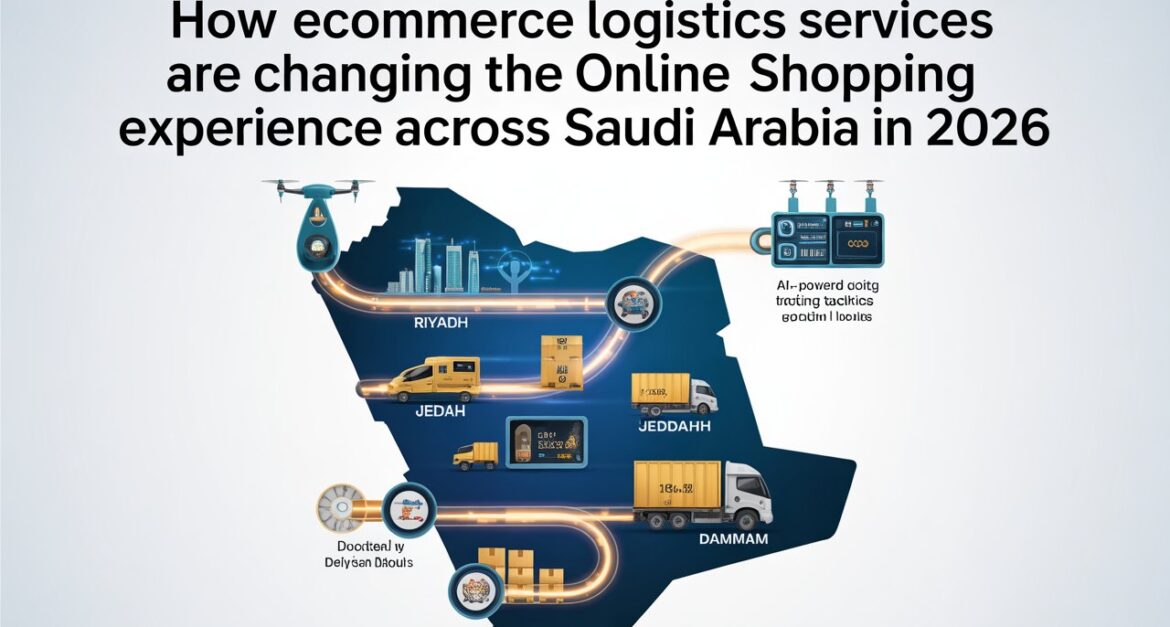
Introduction: The Delivery Gap That Was Holding Saudi Ecommerce Back
Picture this. A shopper in Riyadh orders a pair of running shoes at 9 PM on a Tuesday. By Thursday morning, they are at her door—tracked in real time, delivered by a driver who called ahead, and packaged so neatly she saves the box. Five years ago, that experience was a fantasy in most parts of Saudi Arabia. Today, it is becoming the baseline expectation.
Saudi Arabia’s ecommerce sector is one of the fastest-evolving retail markets on the planet. According to regional market data, the Kingdom’s online retail economy is projected to exceed SAR 50 billion in gross merchandise value by the end of 2026 — a figure that would have seemed wildly optimistic just a decade ago. Vision 2030 opened investment corridors, the National E-Commerce Strategy accelerated infrastructure development, and a young, digitally fluent population did the rest.
But here is the thing most observers miss: the real engine behind this growth is not the app, the website, or even the product catalog. It is logistics.
The logistics layer — last-mile delivery, fulfillment networks, returns management, cold chain solutions, and cross-border freight — is the invisible infrastructure that either makes or breaks an online shopping experience. When logistics works well, customers feel nothing except delight. When it fails, trust collapses almost instantly.
This article takes a deep, honest look at how ecommerce logistics services are reshaping online shopping in Saudi Arabia in 2026 — what is working, what the major components are, which industries are being most transformed, and how brands and merchants can position themselves to win in this new environment.
What Are Ecommerce Logistics Services? Defining the Entity Clearly
Before diving into the Kingdom-specific dynamics, it is worth establishing exactly what ecommerce logistics services means as a concept — because the term gets used loosely in ways that create confusion.
Ecommerce logistics services refer to the end-to-end operational systems and provider networks that move a product from a seller’s inventory to a buyer’s location, while managing all the financial, informational, and physical processes in between. This includes:
- Warehousing and fulfillment centers — where products are stored, picked, packed, and prepared for dispatch
- Last-mile delivery networks — the final leg of delivery from a local hub to the customer’s door
- Reverse logistics and returns management — processing returned items, restocking or disposing of them efficiently
- Cross-border and customs clearance — managing international shipments into or out of the Kingdom
- Cold chain logistics — temperature-controlled storage and transport for perishables, pharmaceuticals, and specialty goods
- Technology platforms — the digital layer including order management systems (OMS), warehouse management systems (WMS), carrier tracking APIs, and customer-facing delivery dashboards
In the Saudi context, ecommerce logistics services are not just a vendor category. They are a competitive differentiator. The merchants who invest in sophisticated logistics partnerships are pulling ahead in customer loyalty, repeat purchase rates, and brand trust — while those who treat delivery as an afterthought are watching their reviews suffer and their cart abandonment rates climb.
The Saudi Market Context: Why 2026 Is a Pivotal Year
Vision 2030 and the Infrastructure Build-Out
The Saudi government’s Vision 2030 program has driven unprecedented investment in logistics infrastructure across the Kingdom. The development of King Salman Logistics City in Riyadh, the expansion of King Abdulaziz Port in Dammam, and the accelerating integration of the Saudi Landbridge railway project have collectively created a physical backbone capable of supporting high-volume ecommerce flows that simply did not exist before.
The National Transport and Logistics Strategy — aligned with Vision 2030 — targets making Saudi Arabia one of the top 10 global logistics hubs by 2030. That ambition is translating into real-world improvements in customs processing times, bonded warehouse availability, and last-mile infrastructure investment in secondary cities.
The Consumer Demand Shift
Saudi consumers have fundamentally changed their expectations. The pandemic years accelerated ecommerce adoption across all age groups, but the behavioral change has proved permanent. Today’s Saudi online shopper expects:
- Same-day or next-day delivery in major urban centers
- Real-time tracking with granular status updates via WhatsApp or SMS
- Free or low-cost returns handled without friction
- Arabic-language communication at every touchpoint
- Flexible delivery windows that respect prayer times and working hours
These expectations are not negotiable for competitive brands. Meeting them requires a logistics infrastructure that is both technologically advanced and locally intelligent.
Geographic Complexity
Saudi Arabia presents unique logistical challenges. The Kingdom covers more than 2.1 million square kilometers — roughly one-quarter the size of the entire United States — with population centers clustered in Riyadh, Jeddah, Dammam, and Makkah, but with millions of customers in secondary cities like Taif, Tabuk, Abha, Hail, and Jizan who also expect reliable service.
Delivering to a compound in Riyadh’s Olaya district is operationally nothing like delivering to a neighborhood in Abha or a village near the Yemeni border. Any serious ecommerce logistics provider has to solve for both ends of this spectrum.
Core Components of Modern Ecommerce Logistics in Saudi Arabia
1. Fulfillment Center Networks
The shift toward distributed fulfillment — placing inventory closer to the customer rather than relying on a single central warehouse — is the single most impactful structural change in Saudi ecommerce logistics right now.
Historically, many ecommerce operators ran out of one large warehouse, typically near Riyadh or Jeddah. Orders destined for Dammam or Tabuk would travel hundreds of kilometers before reaching the customer, adding days to delivery times and costs to every shipment.
In 2026, the model has evolved. Leading logistics providers now operate networks of smaller, strategically placed fulfillment nodes — sometimes called micro-fulfillment centers or dark stores — positioned throughout the Kingdom. When an order comes in, the system routes it to the node closest to the delivery address, cutting transit time and carrier cost simultaneously.
Palm Horizon KSA operates a regional network architecture built specifically around this principle — using demand data, seasonal patterns, and population density mapping to position inventory intelligently across the Kingdom.
Key metrics that matter in fulfillment center performance:
- Order processing time (from receipt to dispatch)
- Pick accuracy rate (percentage of orders picked correctly)
- Inventory accuracy (physical count vs. system count)
- Storage utilization rate
- Cost per unit fulfilled
2. Last-Mile Delivery: The Make-or-Break Moment
Last-mile delivery is where the customer relationship is won or lost. It is also the most expensive, complex, and failure-prone segment of the entire logistics chain — accounting for anywhere from 40% to 60% of total delivery cost depending on density and distance.
In Saudi Arabia, last-mile delivery is complicated by several factors unique to the market:
- Address ambiguity — formal addressing systems are improving with the national addressing project (Wasl), but many areas still rely on landmarks and informal descriptions
- High-rise residential density in cities vs. sprawling compound layouts in suburbs
- Cultural timing norms — deliveries during prayer times require sensitive scheduling
- Heat sensitivity — summer temperatures exceeding 45°C can damage certain product categories if vehicles are not properly climate-controlled
The most sophisticated last-mile operators in 2026 are solving these problems through a combination of geospatial technology, driver training, and customer communication systems that keep both parties informed and in control of the delivery experience.
Delivery models currently operating in KSA:
| Model | Description | Best For |
| Standard next-day | Overnight processing, delivery by next afternoon | General merchandise |
| Same-day express | Order cutoff at noon, evening delivery | Urgent consumer goods |
| Scheduled delivery | Customer selects date and time window | Furniture, appliances |
| Click-and-collect | Customer picks up from locker or partner point | Urban professionals |
| Hyperlocal (Q-commerce) | Delivery in under 2 hours from dark store | Grocery, pharmacy |
3. Returns Management and Reverse Logistics
Returns are the part of ecommerce logistics that brands tend to underinvest in — right up until the moment their customer satisfaction scores start sliding.
The average ecommerce return rate in Saudi Arabia sits between 12% and 20% depending on category, with fashion and electronics seeing the highest volumes. Managing returns poorly costs brands in multiple ways: inventory gets stranded, refunds are delayed, and customers lose confidence in the brand’s reliability.
A well-structured reverse logistics process in 2026 should include:
- Customer-initiated return requests via app or WhatsApp (not email forms that no one monitors)
- Scheduled pickup from the customer’s door within 24–48 hours
- Immediate digital confirmation and refund initiation
- Quality inspection at a returns processing center
- Restocking, refurbishment, or responsible disposal depending on item condition
- Data capture on return reasons to feed back into product and supplier decisions
4. Cross-Border Ecommerce Logistics
Saudi Arabia is one of the largest markets for cross-border ecommerce in the GCC, driven by strong consumer appetite for international brands — particularly from the US, UK, China, and Turkey — and by the growing number of Saudi D2C brands shipping to international customers.
Cross-border logistics in 2026 involves:
- Customs valuation and HS code classification — accurate product categorization to determine applicable duties under Saudi Zakat, Tax and Customs Authority (ZATCA) rules
- De minimis threshold management — understanding which shipments qualify for simplified clearance
- Bonded warehouse facilities — holding international goods duty-deferred until sale
- VAT on imports — ensuring 15% VAT compliance on imported goods per ZATCA regulations
- Carrier partnerships — integrating with international couriers like DHL, FedEx, Aramex, and regional specialists
5. Technology Infrastructure: The Digital Nervous System
No amount of physical infrastructure works efficiently without the right technology layer connecting it all. In 2026, the technology stack underpinning serious ecommerce logistics operations in Saudi Arabia includes:
- Warehouse Management System (WMS) — real-time inventory tracking, pick-path optimization, labor management
- Order Management System (OMS) — multi-channel order ingestion, routing logic, exception handling
- Transportation Management System (TMS) — carrier selection, route optimization, cost comparison
- Customer tracking portals — real-time delivery status via web, app, SMS, and WhatsApp Business API
- AI-driven demand forecasting — predicting order volumes by SKU, region, and time period to pre-position inventory
- Returns management platform — automating the reverse logistics workflow from customer request to refund
Increasingly, these systems are not standalone tools but integrated platforms that share data fluidly — giving logistics managers, brands, and customers a single coherent view of where everything is at any given moment.
Industries Being Transformed by Ecommerce Logistics in KSA
Fashion and Apparel
Fashion is Saudi Arabia’s largest ecommerce category by transaction volume. The challenge with fashion logistics is the combination of high return rates, size variability, and speed expectations. Leading fashion retailers working with sophisticated logistics partners have introduced virtual fitting tools linked to fulfillment data — if a customer is likely to order multiple sizes to try at home (a common behavior), the system pre-stages all variants in a local fulfillment node before the order even arrives.
Food, Grocery, and Specialty Consumables
The rise of Q-commerce — quick commerce, meaning delivery in under 2 hours — has been particularly dramatic in Saudi Arabia’s urban centers. Riyadh and Jeddah now host multiple hyperlocal delivery operators running dark stores positioned every few kilometers. The cold chain component is critical here: maintaining food safety standards across Saudi Arabia’s extreme ambient temperatures requires refrigerated vehicles, temperature-logged handoff protocols, and real-time monitoring throughout the supply chain.
Pharmaceuticals and Healthcare Products
Since the Saudi Food and Drug Authority (SFDA) expanded licensing frameworks for licensed online pharmacy operations, pharmaceutical ecommerce has grown rapidly. Cold chain integrity, controlled substance documentation, and patient privacy requirements make pharma logistics among the most technically demanding in the market. Specialized providers handle this segment with dedicated cold-room facilities and pharmacist-supervised dispatch protocols.
Electronics and High-Value Goods
Electronics purchases involve high unit values, significant returns risk, and installation service requirements in many cases. The best logistics providers operating in this space offer white-glove delivery — where trained installers deliver and set up appliances or electronics — combined with robust packaging protocols to protect goods during transit and secure handling chains to prevent theft.
Furniture and Home Décor
The furniture segment has historically been the hardest to crack in ecommerce logistics because of bulky item handling, two-person delivery requirements, and assembly services. Several specialist logistics operators have emerged in Saudi Arabia to serve this niche, offering scheduled delivery slots, in-home assembly, and old-item removal — turning what used to be a logistical nightmare into a compelling customer experience.
How Palm Horizon KSA Approaches Ecommerce Logistics
Palm Horizon KSA was built around a single belief: that logistics should be a growth tool for brands, not just a cost center. This means designing logistics systems that actively improve conversion rates, customer lifetime value, and brand perception — not just move boxes from A to B.
The Palm Horizon Operating Model
Regional Distribution Network Palm Horizon KSA operates fulfillment nodes positioned to serve Riyadh, Jeddah, Dammam, Makkah, Madinah, and 14 additional secondary cities across the Kingdom. Each node is equipped with climate-controlled storage areas, barcoded inventory management, and automated pick-and-pack stations designed for high-throughput processing.
Technology-First Approach Every client on the Palm Horizon platform gets access to a real-time dashboard that shows inventory levels by location, order status by stage, delivery performance metrics, and return volumes. The system integrates natively with Salla, Zid, WooCommerce, Shopify, Magento, and custom-built platforms via REST API — meaning merchants do not have to change how they sell to benefit from better logistics.
Last-Mile Execution Palm Horizon’s last-mile delivery network combines owned fleet operations in high-density urban areas with carefully vetted third-party carrier partnerships for secondary city coverage. The carrier selection engine within the TMS evaluates cost, speed, and reliability scores in real time and automatically assigns the optimal carrier for each shipment based on the client’s priorities.
Customer Communication Engine A core feature of the Palm Horizon platform is its customer communication module, which sends proactive WhatsApp and SMS updates at every stage of the delivery journey — from dispatch confirmation to “your driver is 10 minutes away.” This alone has been shown to reduce inbound customer service inquiries by 35–50% for brands that switch from passive to proactive communication models.
Returns Made Simple Palm Horizon’s reverse logistics process is designed to close the loop in under 48 hours. Customers initiate returns through a simple link, choose pickup or drop-off, and receive a refund confirmation before the physical item has even been inspected — with financial reconciliation handled on the backend. This approach has proven to significantly increase repurchase rates among customers who experience the returns process, turning what is traditionally a negative moment into a positive one.
Ecommerce Logistics Landscape: How Providers Compare
Understanding the broader provider landscape helps brands make better sourcing decisions. Here is a frank assessment of the categories operating in the Saudi market in 2026.
Traditional Postal and National Carriers (e.g., SPL — Saudi Post) Saudi Post has made significant investments in its last-mile network and now offers competitive domestic parcel delivery at scale. Its strength is reach — it delivers to every governorate in the Kingdom. Its limitations are speed in urban areas compared to specialist operators and technology integration capabilities.
International Express Carriers (e.g., DHL Express, FedEx, Aramex) These operators excel at cross-border and time-critical shipments. For domestic ecommerce fulfillment at volume, they tend to be expensive relative to specialist fulfillment providers, and their customer communication tools are less tailored to the Saudi market.
Regional D2C Fulfillment Specialists (e.g., Palm Horizon KSA) Purpose-built for the regional ecommerce environment, these operators combine warehousing, fulfillment, last-mile delivery, and technology in an integrated offering. They tend to offer better price-to-performance for growing and mid-market brands, with deeper localization and more flexible commercial models.
On-Demand Marketplace Couriers (e.g., Naqel, SMSA, J&T) These are high-volume, price-competitive courier networks designed primarily for the pickup-and-deliver model rather than full fulfillment. Suitable for merchants who handle their own warehousing and just need carrier execution, but not equipped to provide end-to-end logistics management.
Self-Operated Logistics Some large Saudi ecommerce players — particularly supermarket chains and major retailers — have built proprietary logistics operations. This offers maximum control but requires significant capital investment and management overhead that most brands are better off deploying elsewhere.
Implementation Overview: Getting Started with Ecommerce Logistics in KSA
For brands and merchants evaluating a move to a third-party logistics (3PL) model or upgrading their existing logistics setup, here is a realistic roadmap for 2026.
Phase 1: Audit and Baseline (Weeks 1–2)
Before selecting a logistics partner, understand your current state clearly:
- What is your average order volume per week and per month?
- What is your current average delivery time by region?
- What percentage of orders experience exceptions (delays, failed deliveries, damage)?
- What is your return rate and what is your cost to process a return?
- Which product categories have special handling requirements?
Phase 2: Partner Evaluation (Weeks 2–4)
Evaluate potential logistics partners against these criteria:
- Coverage: Do they serve all the regions where your customers live?
- Technology: Does their platform integrate with your selling channels?
- SLA commitments: What delivery time guarantees do they offer?
- Pricing transparency: Are fees clearly structured with no hidden charges?
- Track record: Can they provide case studies from brands similar to yours?
Phase 3: Onboarding and Integration (Weeks 4–8)
A well-run onboarding process should include:
- SKU data transfer and product catalog setup in the WMS
- Initial inventory inbound to fulfillment nodes
- API or platform integration testing
- Staff training on order management workflows
- A pilot period with a subset of orders before full cutover
Phase 4: Optimization (Ongoing)
Logistics performance should be reviewed monthly at minimum against agreed KPIs:
- On-time delivery rate (target: 95%+)
- Order accuracy rate (target: 99.5%+)
- Return processing time (target: 48 hours or less)
- Customer satisfaction score on delivery experience
- Cost per shipment against budget
Ecommerce Logistics Trends Defining the Saudi Market in 2026
AI-Powered Demand Forecasting Machine learning models trained on historical order data, seasonality patterns (particularly Ramadan, Eid, and the National Day shopping spike), and external signals like weather and social media trends are now being used to pre-position inventory days in advance of demand peaks. This reduces out-of-stocks and rush shipping costs simultaneously.
Drone and Autonomous Delivery Pilots Several logistics operators in the Kingdom are in active pilot phases for drone delivery in controlled zones, particularly for pharmaceutical and time-critical deliveries in areas with difficult road access. Full commercial deployment remains a regulatory work in progress, but the infrastructure investment is happening now.
Green Logistics Initiatives In line with Saudi Arabia’s net-zero commitments (targeting 2060) and the growing ESG awareness among Saudi consumers, major logistics providers are introducing electric vehicle fleets for urban last-mile operations and sustainable packaging programs for their fulfillment operations. Brands that can offer carbon-neutral delivery as an option at checkout are beginning to see measurable conversion uplift among environmentally conscious consumers.
Hyperlocal Dark Store Expansion The dark store model — essentially a mini-warehouse optimized for rapid picking rather than customer browsing — is spreading beyond Riyadh and Jeddah into secondary cities. As urban populations grow in cities like Khobar, Tabuk, and Abha, the economics of hyperlocal fulfillment become viable in these markets too.
BNPL (Buy Now, Pay Later) Integration with Logistics Interestingly, logistics and fintech are converging in Saudi Arabia through the integration of BNPL payment options (Tamara, Tabby, and others) directly into the post-purchase experience. Customers using BNPL options have been shown to place larger orders — which in turn increases average fulfillment value per transaction and changes the returns dynamic.
The Numbers: Saudi Ecommerce Logistics at a Glance (2026)
Here is a data-backed snapshot of the market, drawn from regional industry reports and logistics operator disclosures:
Market Size Indicators
- Saudi ecommerce GMV projected for 2026: SAR 50+ billion
- Estimated share of GDP represented by logistics sector: 7.8%
- Year-on-year growth in ecommerce parcel volume: approximately 22%
- Percentage of Saudi online shoppers who cite delivery speed as a top purchase factor: 67%
- Average consumer tolerance for delivery wait: 2.3 days in urban areas
Operational Benchmarks
- Average last-mile delivery cost per shipment (urban, standard): SAR 12–18
- Average last-mile delivery cost per shipment (secondary city): SAR 20–35
- First-attempt delivery success rate (industry average): 82%
- First-attempt delivery success rate (top-tier operators): 93%
- Percentage of Saudi ecommerce returns driven by “product not as described”: 41%
Ecommerce Logistics Performance Metrics — Benchmark Chart
DELIVERY PERFORMANCE COMPARISON (Urban KSA, 2026 Benchmarks)
On-Time Delivery Rate
──────────────────────────────────────────────────────────
Industry Average ██████████████████████████░░░░ 82%
Top-Tier Provider █████████████████████████████░ 93%
Palm Horizon KSA ██████████████████████████████ 95%+
First-Attempt Success Rate
──────────────────────────────────────────────────────────
Industry Average ██████████████████████░░░░░░░░ 75%
Top-Tier Provider ████████████████████████████░░ 88%
Palm Horizon KSA █████████████████████████████░ 92%
Return Processing Time (Hours)
──────────────────────────────────────────────────────────
Industry Average 72 hrs ██████████████████████████
Top-Tier Provider 48 hrs ████████████████████
Palm Horizon KSA 36 hrs ████████████████
Customer Satisfaction (CSAT Score / 10)
──────────────────────────────────────────────────────────
Industry Average 6.8 ██████████████████████████░░░░
Top-Tier Provider 8.1 █████████████████████████████░
Palm Horizon KSA 8.7 ██████████████████████████████
Frequently Asked Questions (FAQ)
1. What is the difference between ecommerce logistics and traditional freight logistics in Saudi Arabia?
Traditional freight logistics focuses on moving large volumes of goods — typically pallets or full containers — between businesses (B2B), with less emphasis on speed, customer communication, or individual shipment tracking. Ecommerce logistics is built around individual consumer orders (B2C), where each shipment has a unique customer expectation attached to it. This means speed, tracking granularity, returns handling, and customer-facing communication are all core to the service — not optional add-ons. The technology stack, operational workflows, and carrier networks used in ecommerce logistics are fundamentally different from those used in traditional freight, even when the same physical infrastructure (roads, airports, ports) is shared.
2. How does last-mile delivery work specifically in Saudi Arabia’s secondary cities?
In Saudi Arabia’s secondary cities — places like Tabuk, Abha, Hail, Jizan, and Sakaka — last-mile delivery typically works through a hub-and-spoke model. A regional hub in the nearest major city (often Riyadh or Jeddah) processes inbound shipments and then dispatches them on routes serving multiple stops in the secondary city. Delivery frequencies may be daily or every two to three days depending on volume. The best operators supplement this with local courier partnerships — smaller, locally owned delivery businesses with deep neighborhood knowledge — who handle the final delivery under a branded service level agreement. Technology integration ensures customers in these cities receive the same quality of tracking and communication as those in Riyadh or Jeddah, even if the physical delivery infrastructure is different.
3. What are the VAT and customs implications for cross-border ecommerce shipments entering Saudi Arabia?
All goods imported into Saudi Arabia are subject to 15% Value Added Tax (VAT) as administered by ZATCA (the Zakat, Tax and Customs Authority). Customs duties vary by product category based on the Harmonized System (HS) code and Saudi Arabia’s tariff schedule — most consumer goods attract duties of 5–15%, with certain categories like tobacco and some electronics carrying higher rates. For cross-border ecommerce, there is a de minimis exemption process for low-value shipments, though the threshold and applicable procedures have been subject to regulatory updates in 2025–2026, making it important for merchants to work with logistics partners who maintain current knowledge of ZATCA rules. Failing to declare items accurately or misclassifying products can result in customs holds, financial penalties, and severely delayed deliveries — damaging customer satisfaction at the most critical moment.
4. How should an ecommerce brand choose between building in-house logistics operations and outsourcing to a 3PL provider?
The decision between in-house and outsourced logistics in Saudi Arabia comes down to three variables: volume, complexity, and core competency. Building in-house logistics makes sense only when order volumes are consistently high enough to justify the fixed costs of warehouse leases, WMS licenses, fleet operations, and logistics staff — typically above 2,000–3,000 orders per day in a single region. Below that threshold, a 3PL partner almost always delivers better economics because their infrastructure costs are shared across many clients. The complexity argument also favors 3PLs for most brands: managing last-mile carrier relationships, navigating ZATCA compliance, handling returns at scale, and maintaining warehouse technology are all specialized disciplines that distract from product development, marketing, and customer experience work. The best argument for in-house logistics is control — but leading 3PL platforms now offer sufficient transparency and SLA enforcement that most brands can achieve the control they need without the overhead.
5. What role does WhatsApp play in Saudi ecommerce customer experience and logistics communication?
WhatsApp is not a secondary communication channel in Saudi Arabia — it is the primary one. With a penetration rate exceeding 90% among Saudi smartphone users, WhatsApp is how people communicate with family, businesses, and services in the Kingdom. Forward-thinking ecommerce logistics operators have built their customer communication systems around WhatsApp Business API, delivering order confirmations, dispatch notifications, real-time driver tracking links, delivery confirmation messages, and return instructions through the platform. This is not a convenience feature — it is a fundamental alignment with how Saudi consumers actually prefer to receive information. Brands and logistics providers that still rely primarily on email for post-purchase communication are operating at a systematic disadvantage in this market.
6. What is Q-commerce and is it viable outside Riyadh and Jeddah in Saudi Arabia?
Q-commerce (quick commerce) refers to ultra-fast delivery — typically within 60 to 120 minutes — powered by dark store networks positioned close to high-density consumer populations. In Saudi Arabia, Q-commerce is currently well-established in Riyadh and Jeddah, viable in Dammam and Khobar, and emerging in Makkah and Madinah. Beyond these markets, the economics become challenging because dark stores require a minimum local order density to be cost-effective. However, as urbanization accelerates in Saudi Arabia and secondary city populations grow, the geographic frontier of viable Q-commerce is expected to expand throughout the latter half of the decade. Categories best suited to Q-commerce in the Saudi context include groceries, pharmacy items, baby products, and consumer electronics accessories.
7. How is sustainability affecting ecommerce logistics decisions in Saudi Arabia?
Sustainability in Saudi logistics is moving from a corporate communications topic to a commercial reality. Several large Saudi retailers and international brands operating in the Kingdom have introduced specific sustainability commitments tied to their logistics operations — including electric vehicle adoption targets, packaging reduction programs, and carbon offset schemes. On the consumer side, a growing segment of Saudi shoppers — particularly younger demographics — report that delivery sustainability is a factor in purchase decisions. Government regulation is also moving in this direction, with incentives for EV fleet adoption and stricter rules around packaging waste. For brands evaluating logistics partners, asking about the provider’s sustainability roadmap — EV fleet percentage, packaging recyclability standards, emissions reporting — is increasingly a meaningful due diligence question rather than a box-ticking exercise.
Why the Right Logistics Partner Is the Most Important Commercial Decision You Will Make in 2026
There is a tendency in ecommerce to treat logistics as a commodity — to evaluate providers purely on cost per shipment and make decisions accordingly. This approach is understandable but strategically short-sighted, particularly in the Saudi Arabian market where the online shopping experience is still being defined in the minds of consumers.
The brands that are growing fastest in Saudi ecommerce in 2026 share a common characteristic: they have invested in logistics partnerships that treat delivery as a customer experience, not just a cost. They are the brands whose customers post unboxing videos, who leave five-star reviews specifically mentioning the delivery experience, who come back to repurchase because they trust the end-to-end process.
Logistics is brand. Every interaction between your package and your customer — the packaging, the tracking updates, the driver’s professionalism, the ease of the returns process — is a brand touchpoint. Some companies spend millions on paid advertising to acquire customers and then lose them at the delivery stage because the logistics infrastructure was not built to match the promise the marketing made.
Palm Horizon KSA was created to close this gap for brands operating in Saudi Arabia. Whether you are a Saudi D2C brand scaling from Riyadh to national distribution, an international retailer entering the Kingdom for the first time, or an established marketplace seller looking to reduce logistics costs while improving service quality — the logistics architecture you choose in 2026 will shape your competitive position for years to come.
The online shopping experience in Saudi Arabia is getting better every year. The merchants who will lead that improvement are the ones who understand that logistics is not behind the scenes — it is the scene.
Conclusion: Logistics Is the New Marketing in Saudi Ecommerce
Saudi Arabia’s ecommerce market in 2026 is at an inflection point. The foundational infrastructure — physical, digital, and regulatory — is now mature enough to support genuinely world-class online shopping experiences. Consumer expectations are higher than they have ever been. Competition is intensifying across every category.
In this environment, the brands that win will not necessarily be those with the most advertising spend or the most impressive product catalogs. They will be the brands that deliver — literally and figuratively — on the promises their marketing makes. Fast, reliable, transparent, frictionless logistics is the single most powerful loyalty-building tool available to ecommerce operators in the Kingdom today.
Ecommerce logistics services in Saudi Arabia are no longer just about moving products. They are about building trust, creating moments of delight, and earning the repeat purchase that sustains a business over the long term.
If you are ready to transform your logistics into a competitive advantage, Palm Horizon KSA is ready to show you how.