
Are you watching your shipment tracker refresh for the fifth time today — and still seeing “in transit”?
That sinking feeling when a critical delivery goes silent mid-journey isn’t just frustrating — it costs you money, client trust, and in some industries, entire contracts. The maddening truth is that most late shipments don’t fail at the border or in a storm. They fail quietly, in the invisible gaps between disconnected systems, manual handoffs, and zero real-time intelligence. Palm Horizon KSA sees this every day — and costly shipment delays like these are entirely preventable.
Here’s the good news — and it’s bigger than you think.
The same businesses that once chased carriers by phone and filed customs paperwork at midnight now run their entire freight operation from a single live dashboard. They don’t react to delays — they prevent them. Palm Horizon KSA was built specifically to eliminate costly shipment delays for businesses across Saudi Arabia and the GCC. If your shipments are still arriving late, it’s not bad luck — it’s a solvable problem, and we has already built the solution that stops costly shipment delays before they ever begin.
🌍 Why On-Time Delivery Is the New Competitive Currency
In traditional commerce, late delivery was an inconvenience. In today’s economy — where B2B buyers compare lead times like consumers compare prices — it is a dealbreaker.
According to supply chain research, companies that consistently miss delivery windows lose 15–25% of their customer base within two years, not from one catastrophic failure, but from the slow erosion of trust caused by repeated, unexplained delays.
The stakes are especially high in the Kingdom of Saudi Arabia, where Vision 2030 has supercharged infrastructure investment, e-commerce growth, and cross-border trade. The logistics sector is no longer a back-office function — it is a strategic asset.
So why are so many shipments still late?
📦 The Real Culprit: Invisible Gaps in the Logistics Chain
Here is the insight that most logistics consultants won’t tell you plainly: shipments don’t fail at the border or in the warehouse. They fail in the data.
Specifically, they fail because of:
- Disconnected systems that don’t speak to each other in real time
- Manual handoffs between freight forwarders, carriers, and customs agents
- Reactive rather than predictive exception management
- No single source of truth for shipment status, documentation, or compliance
Each of these gaps creates friction. And friction, compounding across a supply chain, turns into delay.
🔍 Fun Fact: A study of 500 enterprise shipments found that the average parcel is “touched” by 14 different systems before it reaches the end customer — yet fewer than 3 of those systems share data in real time. That means 11 handoffs where something can silently go wrong.
🤖 What Is Advanced Logistics Technology — And Why Does It Matter Now?
Advanced logistics technology refers to the integrated ecosystem of digital tools — AI, machine learning, IoT tracking, blockchain documentation, and cloud-based platforms — that allow businesses to manage shipments with precision, prediction, and full visibility.
This isn’t simply “software for shipping.” It’s the operational nervous system of a modern supply chain.
At Palm Horizon KSA, advanced logistics technology is the foundation of every freight management solution we design for clients across Saudi Arabia and the wider GCC region. It’s the difference between managing a shipment and commanding one.
Core Components of Advanced Logistics Technology
| Technology Layer | What It Does | Why It Matters |
| AI-Powered Route Optimization | Analyzes hundreds of routing variables in real time | Reduces transit time and fuel cost |
| IoT Shipment Tracking | Monitors location, temperature, humidity, and shock | Eliminates blind spots in transit |
| Predictive Analytics | Flags delay risks before they materialize | Enables proactive rerouting |
| Automated Documentation | Generates and validates customs paperwork | Cuts clearance time dramatically |
| Cloud TMS (Transport Management System) | Centralizes all shipment data in one dashboard | Gives teams a single source of truth |
| Blockchain Freight Documentation | Creates tamper-proof digital records | Reduces fraud and disputes |
🏭 Industries That Suffer Most From Late Deliveries — And How Technology Fixes It
Advanced logistics technology is not a one-size-fits-all tool. Its impact varies by industry, but the principle is universal: visibility prevents delay.
1. Retail and E-Commerce
Saudi e-commerce is growing at over 20% annually. Customer expectations are set by Amazon Prime. A single late shipment in peak season can result in thousands in lost revenue and a damaged seller rating.
How tech helps: Real-time carrier API integration, automated SLA alerts, and last-mile delivery optimization keep fulfillment windows tight even at scale.
2. Pharmaceutical and Healthcare
Cold-chain shipments of medicines and medical devices operate under regulatory mandates. A temperature excursion isn’t just a delay — it’s a write-off and a compliance risk.
How tech helps: IoT sensors monitor cold-chain conditions continuously. Automated alerts trigger rerouting before temperature thresholds are breached.
3. Manufacturing and Industrial Supply
Just-in-time manufacturing models have zero tolerance for parts arriving late. A missing component can idle an entire production line, costing thousands of dollars per hour.
How tech helps: Predictive ETAs allow procurement teams to buffer smartly. Supplier integration gives manufacturers end-to-end visibility across their tier-1 and tier-2 suppliers.
4. Oil, Gas, and Energy Projects
Saudi Arabia’s mega-projects — NEOM, Red Sea Project, and major petrochemical expansions — require precision coordination of equipment and materials from dozens of countries.
How tech helps: Customs pre-clearance technology, multi-modal shipment tracking, and project cargo management systems keep complex logistics on schedule.
5. Food and Perishables
Saudi Arabia imports a significant portion of its food supply. Freshness windows are narrow. Any delay means spoilage.
How tech helps: Real-time tracking combined with predictive port congestion analytics allows importers to choose arrival windows strategically.
⚙️ Core Features of a World-Class Logistics Technology Platform
When evaluating any advanced logistics technology solution, these are the attributes that separate genuinely capable platforms from rebranded spreadsheets with a dashboard:
✅ Real-Time Shipment Visibility
Not “last updated 6 hours ago” visibility — actual, live tracking across all carriers, modes, and geographies. This is table stakes for modern logistics.
✅ Predictive Delay Intelligence
The system shouldn’t just show you where your shipment is. It should tell you where it won’t be on time — and why — before the delay happens. This is what machine learning in logistics actually looks like in practice.
✅ Automated Exception Management
When a shipment is flagged for a delay, customs hold, or route deviation, the platform should trigger a predefined response workflow — not an email to a human who may or may not act on it.
✅ Multi-Modal Coordination
Modern supply chains move shipments by sea, air, road, and rail — sometimes all four in one journey. Your technology must manage all modes under one roof.
✅ Carrier Network Integration
A platform that integrates with 10 carriers is useful. One that integrates with 500+ global and regional carriers — including Saudi Post, Aramex, DHL, and regional last-mile providers — is transformational.
✅ Customs and Compliance Automation
In GCC trade, customs documentation errors are the single biggest cause of border delays. Automated document generation and pre-validation against destination-country rules eliminates this entire category of risk.
✅ Performance Analytics and Reporting
Carrier scorecards, lane-level performance data, cost-per-shipment benchmarking — these insights help logistics teams make smarter sourcing and routing decisions over time.
🔄 How Palm Horizon KSA Implements Advanced Logistics Technology
At Palm Horizon KSA, we don’t hand clients a software subscription and wish them luck. Our implementation model is built around three phases that mirror how supply chains actually work:
Phase 1: Diagnostic and Mapping
We begin with a full audit of your current supply chain — carrier relationships, documentation processes, technology stack, and historical delay patterns. This gives us a baseline and identifies the highest-value intervention points.
Phase 2: Platform Integration and Configuration
We configure and integrate the technology layer — TMS, tracking APIs, customs automation, and analytics dashboards — around your specific lanes, compliance requirements, and carrier mix. For clients operating in Saudi Arabia and the GCC, this includes Arabic-language interfaces and Saudi Customs Authority API integration.
Phase 3: Training, Handoff, and Continuous Optimization
Our operations team trains your people, establishes SLAs, and then stays engaged through quarterly performance reviews. Logistics technology is not a “set and forget” investment — it requires ongoing calibration as your business and trade lanes evolve.
🔍 Fun Fact: Companies that invest in logistics technology training alongside platform rollout see 40% faster ROI than those that deploy the platform alone. The tool is only as smart as the team using it.
🆚 Advanced Logistics Technology vs. Traditional Freight Management
It’s worth being direct about what separates technology-forward logistics from legacy freight management — because many businesses think they’re using advanced technology when they’re actually using a slightly modernized version of 2005-era practices.
| Capability | Traditional Freight Management | Advanced Logistics Technology |
| Shipment visibility | Periodic status updates | Continuous real-time tracking |
| Delay response | Reactive (after delay occurs) | Predictive (before delay occurs) |
| Documentation | Manual, paper or email-based | Automated, digitally validated |
| Carrier selection | Relationship-based | Data-driven, performance-scored |
| Customs management | Manual submission | Pre-validated automated filing |
| Reporting | Monthly PDF reports | Live dashboards with drill-down |
| Scalability | Limited by headcount | Scales with shipment volume |
| Cost visibility | Approximated | Real-time, per-shipment accurate |
The gap is not incremental. It’s structural.
🌐 The Saudi Arabia Logistics Context: Why This Matters More Here
Saudi Arabia sits at the intersection of three of the world’s most important trade routes: Asia-Europe, Asia-Africa, and intra-GCC. The Kingdom’s ports — Jeddah Islamic Port, King Abdulaziz Port in Dammam, and King Fahad Industrial Port — handle hundreds of millions of tons of cargo annually.
Vision 2030 has accelerated the country’s ambition to become a regional logistics hub — and significant investment is flowing into infrastructure, free zones, and trade facilitation.
But infrastructure alone doesn’t make logistics fast. The human and technology layer on top of that infrastructure is what determines whether a shipment clears in hours or sits for days.
This is exactly where Palm Horizon KSA operates — bridging the gap between Saudi Arabia’s world-class infrastructure and the intelligent technology layer that makes it work at full capacity.
🔍 Fun Fact: Saudi Arabia’s logistics sector is projected to reach SAR 100 billion by 2030. The companies that build their technology foundation now will be positioned to capture a disproportionate share of that growth.
💡 5 Practical Steps to Reduce Shipment Delays Starting Today
You don’t have to overhaul your entire operation overnight. These five steps will immediately begin closing the gaps that cause most delays:
- Audit your carrier performance data. If you don’t know your on-time delivery rate by carrier and lane, you’re flying blind. Start measuring.
- Centralize your shipment documentation. Stop managing documents across email threads and WhatsApp groups. Move to a shared digital repository with version control.
- Set up proactive customs pre-filing. For regular trade lanes, documents should be submitted before the shipment arrives at port, not after.
- Define exception escalation rules. What happens when a shipment is delayed by 24 hours? 48? Who gets notified, and what actions are triggered? Write this down and automate it.
- Demand carrier API integration. If your carriers don’t offer live tracking APIs, that’s important information. It means they can’t give you the data you need to manage your supply chain in real time.
❓ Frequently Asked Questions
Q1: What is the most common cause of international shipment delays in Saudi Arabia?
Documentation errors — incomplete or incorrect customs paperwork — account for the single largest category of border delays into Saudi Arabia. The Saudi Customs Authority has specific requirements for commercial invoices, certificates of origin, and HS code classification that differ from other GCC markets. Automated documentation tools that are pre-configured for Saudi Customs requirements eliminate the majority of these errors before submission.
Q2: How does AI improve logistics and supply chain performance?
Artificial intelligence in logistics operates across three layers. First, it processes historical and real-time data to build predictive models — identifying which shipments are at risk of delay based on patterns in carrier behavior, port congestion, weather, and documentation status. Second, it optimizes routing decisions by evaluating dozens of variables simultaneously — cost, speed, reliability, carbon footprint — that no human dispatcher could balance at scale. Third, it automates repetitive operational tasks — document generation, carrier booking, exception alerts — freeing your team to focus on complex decisions rather than data entry.
Q3: What is a Transport Management System (TMS) and does my business need one?
A Transport Management System is the central operating platform for freight management — the place where shipments are planned, booked, tracked, documented, and analyzed. Whether you need one depends on your shipment volume and complexity. As a rough guideline: if your business moves more than 50 shipments per month across multiple carriers or geographies, a TMS will pay for itself in efficiency gains and error reduction within the first year. Businesses moving 200+ shipments monthly typically see ROI within 3–6 months.
Q4: How does IoT tracking technology work in freight and cargo management?
IoT (Internet of Things) tracking in freight typically involves small sensors or devices attached to a shipment or container that transmit data — location, temperature, humidity, shock — via cellular, satellite, or LPWAN networks to a cloud dashboard. Unlike GPS trackers that simply show location, advanced IoT freight sensors create a full environmental record of the shipment’s journey. This is especially critical for temperature-sensitive cargo like pharmaceuticals, food, and certain chemicals, where a documented chain of custody is a regulatory requirement.
Q5: Can advanced logistics technology help with last-mile delivery in Saudi Arabia?
Yes — and this is one of the areas of highest impact in the Saudi market specifically. Last-mile delivery in the Kingdom presents unique challenges: a mix of formal addressing systems and informal location descriptions, wide geographic spread across urban and rural zones, and high consumer expectations shaped by regional e-commerce platforms. Advanced last-mile technology addresses these through dynamic route optimization, driver app integration with live traffic data, and SMS/WhatsApp notification flows that guide recipients through the final leg of delivery. The result is fewer failed delivery attempts, lower cost-per-delivery, and significantly higher customer satisfaction scores.
Q6: What is the difference between logistics automation and logistics technology?
Logistics automation refers specifically to the use of technology to execute tasks without human intervention — things like automated carrier booking, document generation, and customs filing. Logistics technology is the broader ecosystem that includes automation but also encompasses visibility tools, analytics platforms, communication systems, and integration infrastructure. In practice, the two are deeply intertwined: you can’t have meaningful automation without the data infrastructure that logistics technology provides.
Q7: How long does it take to implement a logistics technology platform for a mid-sized business?
For a mid-sized business with established carrier relationships and an existing ERP or order management system, a well-scoped logistics technology implementation typically takes 6–12 weeks from kickoff to go-live. This assumes a phased approach — starting with core tracking and documentation, then layering in analytics and automation. The most common implementation delays are caused by incomplete data migration planning and underestimating the time required for carrier API integrations. Partnering with an implementation team that has done this in the Saudi market specifically — with knowledge of local carrier capabilities and customs requirements — compresses the timeline significantly.
🧭 Conclusion: The Shipments That Always Arrive on Time Have One Thing in Common
They’re not lucky. They’re not handled by better carriers. They don’t move through less congested ports.
They’re managed by businesses that made a deliberate decision to treat logistics intelligence as a competitive advantage — not a cost center.
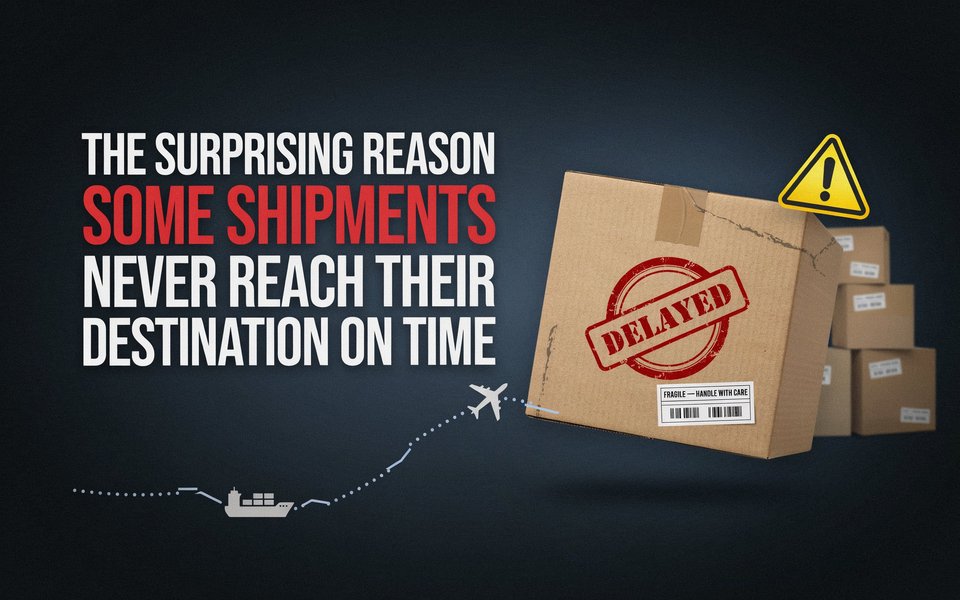
The surprising reason some shipments never reach their destination on time is not the ocean, not customs, not the driver. It’s the gap between what’s happening in the supply chain and what the business actually knows about it. The 11 silent handoffs. It’s the document filed wrong at 4 PM on a Friday. It’s the carrier whose performance has been declining for six months, quietly, with no one measuring it.
Advanced logistics technology closes that gap. It replaces guesswork with data, reaction with prediction, and fragmented processes with a single, intelligent operating layer.
At Palm Horizon KSA, this is what we do — not as a technology vendor, but as a logistics intelligence partner for businesses operating in Saudi Arabia and across the GCC.
The question is not whether your supply chain can afford advanced logistics technology.
The question is whether it can afford to operate without it.