
Introduction: The Hidden Cost of a Single Broken Link
Most businesses spend their energy fixing the problem they can see — the late shipment, the angry customer email, the warehouse backlog. Few stop to ask why these problems keep showing up together. The answer is almost always the same: one weak process upstream is quietly generating every problem downstream.
This is the nature of operational chain reactions. A single sourcing error, a missed customs document, or an unverified supplier detail doesn’t stay contained. It moves through the business like a crack through glass — touching procurement, warehousing, delivery, customer service, and eventually revenue. For companies trading into Saudi Arabia and the broader GCC, where customs accuracy and compliance timing carry real financial weight, this chain reaction can be the difference between a profitable shipment and a costly one. Understanding how it happens — and how to stop it at the source — is exactly the kind of operational discipline Palm Horizon KSA helps businesses build.
What a “Process Chain Reaction” Actually Is
A process chain reaction is the cascading effect that occurs when a single operational failure in one stage of a business — sourcing, documentation, logistics, or fulfillment — triggers a sequence of related failures in every stage that depends on it. Because business operations are interconnected, a weakness that seems small and isolated rarely stays that way.
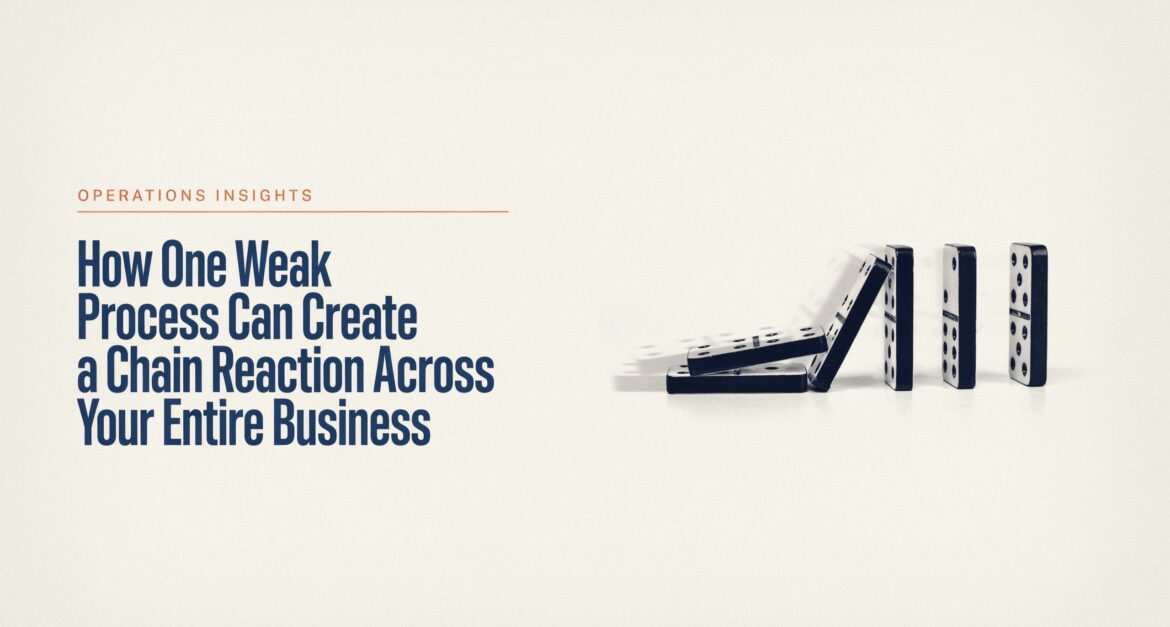
Think of a supply chain as a row of dominoes. The first domino — say, an incorrect HS code on a customs form — looks insignificant on its own. But it knocks into the next domino: the shipment gets flagged and held at port. That knocks into the next: warehouse inventory runs short. That knocks into the next: orders ship late. And that knocks into the last: customers lose trust and take their business elsewhere. The chart above shows this exact pattern — each stage in the sequence carries a larger cost impact than the one before it, because the failure compounds rather than resets.
This is different from a one-off mistake. A chain reaction is structural — it repeats every time the same weak process is used, until someone identifies and fixes the root cause rather than patching the visible symptom.
Core Attributes of a Process Chain Reaction
Recognizing a chain reaction early requires understanding its defining characteristics.
Root cause concealment
- The original failure is often invisible by the time its effects appear downstream
- Teams treat each symptom as a separate issue rather than connecting them to one source
- Without root-cause tracing, the same failure repeats indefinitely
Compounding cost
- Each stage a failure passes through adds new cost — rework, storage fees, expedited freight, lost sales
- A documentation error costing a few hundred riyals to fix at origin can cost many times that once it triggers a port hold and missed delivery window
- Costs are not linear; they accelerate the further the failure travels
Cross-departmental spread
- A weakness in procurement affects logistics
- A weakness in logistics affects customer service
- A weakness in customer service affects retention and brand reputation
- No department operates in isolation, so no failure stays contained to one department
Predictability once mapped
- Chain reactions are not random; they follow the same dependency path every time
- Mapping the sequence — from sourcing to customs to warehousing to delivery to customer experience — makes the pattern visible and preventable
- Businesses that map this sequence can intercept failures before they reach the customer
Compliance sensitivity
- In regulated trade environments like Saudi Arabia, weak processes around SASO conformity, SFDA registration, or Halal certification are especially prone to triggering chain reactions, since a single missing certificate can halt an entire shipment
A fun fact worth knowing: in reliability engineering, this exact pattern has a name — the “domino effect” — first formally studied in industrial accident analysis nearly a century ago. The same logic that explains how one mechanical failure causes a factory accident explains how one weak business process causes a customer to churn.
Use Cases: Where Chain Reactions Show Up in Real Business Operations
Import and export documentation errors A single incorrect HS code or missing FASAH declaration can hold a shipment at a Saudi port for days. That delay cascades into stock shortages, missed retail deadlines, and emergency freight costs that dwarf the original documentation fix.
Supplier verification gaps A supplier that skips Halal certification or SFDA registration creates a downstream failure that surfaces weeks later — at the exact moment a shipment is due to clear customs, when fixing it is most expensive and time-sensitive.
Warehouse and inventory mismanagement A small inventory tracking error can cascade into stockouts during high-demand periods like Ramadan, triggering lost sales, rushed reorders, and inflated last-mile shipping costs to compensate for the shortfall.
Labeling and packaging non-compliance Products shipped without correct Arabic labeling face rejection at customs. That single oversight can delay an entire product launch, affecting marketing timelines, retail partnerships, and revenue projections that were never directly connected to the labeling process.
Customer service breakdowns A logistics delay that isn’t communicated to the customer service team creates a second failure: customers receive no proactive update, file complaints, and associate the brand with unreliability — even though the root cause was a single upstream process gap.
Chain Reaction Businesses vs. Businesses With Process Discipline
| Factor | Chain-reaction-prone business | Process-disciplined business |
| Error detection | Found downstream, after damage is done | Found at the source, before it spreads |
| Documentation | Reactive, fixed after customs rejection | Pre-verified before shipment departs |
| Supplier compliance | Assumed, rarely audited | Verified against SASO, SFDA, Halal standards upfront |
| Cost pattern | Compounds at each stage | Contained at the point of origin |
| Departmental communication | Siloed, problems handled in isolation | Connected, root cause shared across teams |
| Customer impact | Felt as repeated, unexplained delays | Rarely visible to the customer |
| Long-term outcome | Recurring fire drills, eroding trust | Predictable operations, stronger retention |
Where Generic Logistics Providers Fall Short
Many freight and logistics providers only manage the visible stage of a problem — they re-route a delayed shipment or expedite a late delivery — without ever tracing the failure back to its origin. This keeps businesses stuck in a repeating cycle: the same documentation mistake, the same supplier gap, the same warehouse miscount, surfacing again and again under different disguises.
A partner that understands trade facilitation as a connected system — sourcing, customs, compliance, and delivery working together — can identify where a weak process actually lives, rather than continuously treating its symptoms. That distinction is what separates a transactional freight forwarder from a strategic logistics advisory partner.
Implementation Overview: Breaking the Chain Before It Starts
- Map the full operational sequence — document every step from sourcing to final delivery, including every handoff between teams
- Identify single points of failure — pinpoint the steps where one mistake (a missing certificate, an unverified HS code) has the power to halt everything downstream
- Pre-verify compliance requirements — confirm SASO conformity, SFDA registration, and Halal certification before goods are shipped, not after they’re held
- Standardize documentation — build repeatable templates for FASAH declarations and customs paperwork so accuracy doesn’t depend on memory
- Create cross-team visibility — ensure logistics issues are communicated to customer service and sales in real time, before customers have to ask
- Conduct root-cause reviews, not symptom fixes — every recurring delay should trigger a review of where the failure actually originated, not just a faster workaround
Businesses that implement this kind of structured review, supported by an experienced trade facilitation partner like Palm Horizon KSA, typically see the same delays stop recurring — because the weak process generating them gets fixed once, rather than patched repeatedly.
Frequently Asked Questions
What is a process chain reaction in a business context?
It’s the cascading effect where a single failure in one operational stage — such as sourcing, documentation, or warehousing — triggers a sequence of related failures across other departments, ultimately affecting delivery and customer experience.
How does a small customs documentation error lead to bigger business problems?
An error like an incorrect HS code can cause a shipment to be held at port. That delay creates inventory shortages, missed delivery commitments, and unplanned expedited shipping costs, all stemming from one initial mistake.
Why do operational failures often go unnoticed until they reach the customer?
Because the root cause typically occurs early in the process — at sourcing or documentation — while its effects appear much later, at delivery or customer service. Without root-cause tracing, the connection between the two is easy to miss.
How can businesses identify the weak process causing repeated delays?
By mapping the entire operational sequence from sourcing to delivery and identifying points where a single error has historically caused downstream disruption — often documentation, supplier verification, or customs compliance steps.
What role does supplier compliance play in preventing chain reactions?
Verifying supplier compliance with SASO, SFDA, and Halal certification requirements before shipment prevents the most common trigger point for chain reactions in trade into Saudi Arabia and the GCC.
Is this issue specific to large businesses, or do smaller importers face it too?
Smaller importers are often more exposed, since they typically lack dedicated compliance teams and a single process failure can have an outsized impact relative to their overall shipment volume and cash flow.
Conclusion: Fix the Source, Not the Symptom
Every recurring delay, every unexpected cost spike, and every frustrated customer interaction usually traces back to the same place: one weak process that was never properly fixed. Businesses that keep treating symptoms — expediting shipments, apologizing to customers, absorbing extra fees — stay trapped in the same cycle indefinitely. Businesses that trace the chain back to its source break it permanently.
Palm Horizon KSA works with businesses to map that sequence end to end — sourcing, compliance, customs, and delivery — so that the weak link gets identified and resolved before it has the chance to cascade. In a trade environment where one missing certificate or one miscoded shipment can ripple through an entire quarter’s performance, that kind of process discipline isn’t optional. It’s the difference between a business that keeps firefighting and one that operates with confidence.