
Introduction: Why Shipping Across Borders Is Never “Just Shipping”
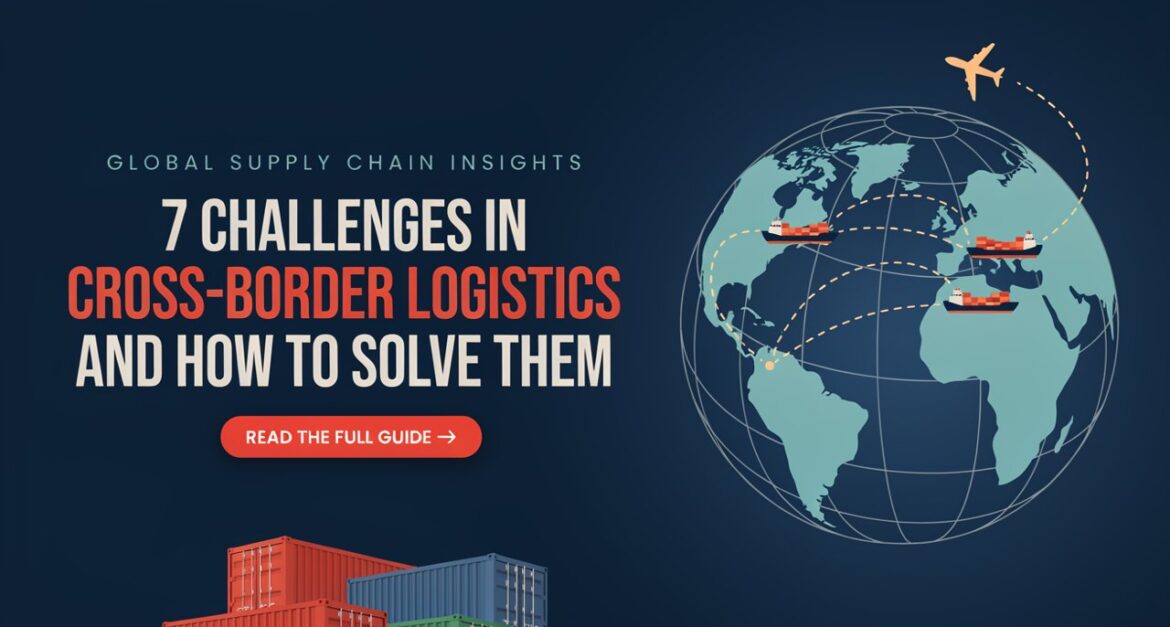
Moving goods within a single country is complicated enough. Moving them across borders adds an entirely different layer of risk: unfamiliar regulations, currency fluctuations, unpredictable customs officers, and supply chains that can unravel the moment a single document is missing a stamp. For businesses expanding into new markets, cross-border logistics often becomes the single biggest obstacle standing between a great product and a satisfied customer overseas.
The frustrating part is that most of these problems are predictable. Businesses that scale internationally without a clear cross-border logistics management strategy tend to hit the same seven walls, over and over, regardless of industry. The good news: each of these challenges has a proven, practical solution. This article breaks down exactly what goes wrong, why it happens, and how experienced cross-border logistics companies solve it in practice.
What Is Cross-Border Logistics?
Cross-border logistics refers to the planning, transportation, and coordination of goods as they move between countries — covering everything from customs documentation and tariff classification to multi-modal transport and final delivery. Unlike domestic shipping, cross-border logistics services must account for differing regulatory regimes, currency conversion, language barriers, and international trade agreements that vary by country pair.
At its core, cross-border logistics involves three interconnected layers:
- Regulatory compliance — customs declarations, import/export licenses, tariff codes, and trade agreement eligibility
- Physical movement — the actual transport of goods via air, sea, road, or rail across international borders
- Information flow — real-time tracking, documentation exchange, and communication between exporters, carriers, customs authorities, and importers
Businesses engaged in cross-border e-commerce logistics face an additional wrinkle: they’re often shipping smaller, higher-frequency parcels directly to individual consumers rather than bulk freight to a single business buyer, which multiplies the documentation and customs touchpoints exponentially.
The 7 Core Challenges (and How to Solve Each One)
Challenge 1: Complex and Inconsistent Customs Regulations
Every country has its own import rules, tariff classifications, and documentation requirements — and these rules change frequently, sometimes without much public notice. A shipment that clears customs smoothly in one country can be held for weeks in another simply because of a mismatched harmonized system (HS) code.
The solution: Partner with cross-border logistics companies that maintain dedicated customs brokerage teams familiar with the specific regulatory environment of your target markets. Pre-classifying goods under correct HS codes and maintaining updated documentation templates for each destination country dramatically reduces clearance delays.
Challenge 2: Unpredictable Delivery Times
Cross-border shipments pass through more checkpoints than domestic ones — origin customs, transit hubs, destination customs, and last-mile carriers — and each handoff introduces a chance for delay. For businesses reliant on just-in-time inventory, this unpredictability can be devastating.
The solution: Use providers offering advanced logistics technology such as predictive ETA modeling and real-time milestone tracking. Building in buffer time for high-risk trade lanes, and diversifying across more than one route, also reduces the impact of a single point of failure.
Challenge 3: Currency Fluctuations and Hidden Costs
Exchange rate volatility can quietly erode profit margins on international shipments, especially for businesses invoicing in one currency while paying freight and duties in another. Add in fluctuating fuel surcharges and unexpected storage fees, and cost predictability becomes a real challenge.
The solution: Lock in freight rates through fixed-term contracts where possible, and request fully itemized quotes that separate freight, duties, taxes, and surcharges. Reputable cross-border logistics services will offer landed-cost calculators that estimate total cost upfront, including currency conversion.
Challenge 4: Fragmented Visibility Across Multiple Carriers
A single cross-border shipment might touch a domestic trucking company, an ocean or air carrier, a customs broker, and a last-mile delivery partner — each with its own tracking system. This fragmentation makes it nearly impossible to get a single, reliable view of where a shipment actually is.
The solution: Consolidate with a single cross-border logistics company that offers end-to-end visibility through one unified tracking platform, rather than juggling multiple vendors and login portals.
Challenge 5: Language and Communication Barriers
Miscommunication between shippers, carriers, and customs officials across different languages can lead to incorrect documentation, misunderstood instructions, and costly delays — particularly in regions where English isn’t the primary business language.
The solution: Choose a partner with multilingual regional staff and standardized, translated documentation templates for each trade corridor, reducing the risk of communication breakdowns at critical handoff points.
Challenge 6: Compliance With Trade Agreements and Sanctions
Trade agreements, tariffs, and international sanctions lists change regularly, and shipping to a restricted entity — even unintentionally — can result in severe legal and financial penalties.
The solution: Work with providers that run automated compliance screening against updated denied-party and sanctions lists, and that stay current on regional trade agreements that could reduce duties on qualifying goods.
Challenge 7: Scaling Cross-Border E-Commerce Fulfillment
Cross-border e-commerce logistics introduces unique pressure: instead of a handful of large shipments, businesses must manage thousands of individual parcels, each requiring its own customs documentation, duty calculation, and delivery tracking — all while customers expect domestic-level delivery speed.
The solution: Use logistics partners with dedicated e-commerce fulfillment infrastructure, including bonded warehouses near border crossings and automated customs pre-clearance for low-value parcels, to keep delivery times competitive.
Fun fact: the World Trade Organization estimates that reducing global trade documentation and border delays through simplified customs procedures (known as “trade facilitation”) could cut global trade costs by more than 14%, according to WTO research on the topic — a reminder of just how much friction sits in cross-border paperwork alone.
How These Challenges Rank in Real-World Impact
Not every challenge hits every business equally. Based on industry surveys and shipper feedback, here’s how frequently these seven issues actually disrupt cross-border shipments in practice.As the chart illustrates, customs regulations and unpredictable delivery times consistently rank as the top two disruptors — which is exactly why customs expertise and real-time visibility deserve the most weight when evaluating a partner.
Industries Most Affected by Cross-Border Logistics Challenges
While every internationally trading business faces some version of these seven challenges, a few industries feel the pressure most acutely:
- E-commerce and retail — high shipment volume, tight delivery expectations, and constant SKU changes make cross-border e-commerce logistics especially demanding.
- Pharmaceuticals and medical devices — strict regulatory compliance and temperature-sensitive handling raise the stakes of customs delays.
- Automotive and industrial manufacturing — reliance on just-in-time components means even short delays can halt production.
- Fashion and apparel — seasonal inventory cycles mean delayed shipments can mean missed selling windows entirely.
- Electronics — high product value combined with rapid product cycles makes both theft risk and obsolescence a real concern during customs holds.
Cross-Border Logistics Companies vs. Domestic-Only Providers
Businesses sometimes assume a domestic freight provider can simply “add on” international shipping. In reality, the skill sets required are fundamentally different.
| Factor | Cross-border logistics company | Domestic-only provider |
| Customs brokerage | In-house or dedicated partnerships | Rarely available |
| Regulatory knowledge | Multi-country trade law expertise | Single-jurisdiction only |
| Documentation | Multilingual, standardized templates | Domestic paperwork only |
| Technology | End-to-end international tracking | Domestic tracking only |
| Risk management | Sanctions and compliance screening | Not typically offered |
Choosing a specialized cross-border logistics company over a domestic provider stretched beyond its expertise is one of the clearest ways to avoid the seven challenges outlined above before they even occur.
Implementation Overview: Building a Resilient Cross-Border Logistics Strategy
- Audit your current trade lanes. Identify which countries and routes you ship to most often, and research their specific customs and regulatory requirements.
- Select a specialized cross-border logistics partner. Prioritize providers with proven experience and in-country presence in your key markets, not just a general international shipping claim.
- Standardize documentation. Create templates for commercial invoices, certificates of origin, and HS code classifications for each trade corridor you operate in.
- Invest in visibility technology. Choose a partner offering unified, real-time tracking across every leg of the shipment, from origin to final delivery.
- Build in compliance screening. Ensure your logistics partner runs automated checks against sanctions and denied-party lists before shipments are dispatched.
- Plan for currency and cost volatility. Use landed-cost calculators and, where possible, fixed-rate contracts to protect margins.
- Diversify routes and carriers. Avoid single points of failure by maintaining backup routes for critical trade lanes.
- Review performance quarterly. Track on-time delivery rates, customs clearance times, and cost variance to catch emerging problems early.
Providers such as Palm Horizon KSA structure their cross-border logistics services around this exact framework — combining regional customs expertise, multilingual documentation support, and unified tracking so businesses face fewer surprises when shipping internationally.
Frequently Asked Questions
What is the biggest challenge in cross-border logistics?
Customs regulations and documentation errors are consistently cited as the leading cause of delays in cross-border shipments, since even minor mismatches in tariff classification or paperwork can hold goods at the border for weeks.
How do cross-border logistics companies handle customs clearance?
Most maintain in-house or closely partnered customs brokers who prepare and verify documentation, classify goods under correct tariff codes, and communicate directly with customs authorities to resolve issues quickly.
What’s the difference between cross-border logistics and cross-border e-commerce logistics?
Cross-border logistics broadly covers all international freight movement, while cross-border e-commerce logistics specifically addresses high-volume, low-value parcel shipments direct to consumers, which require different customs handling and fulfillment infrastructure.
How can businesses reduce hidden costs in international shipping?
Requesting fully itemized quotes, using landed-cost calculators, and locking in freight rates through contracts help businesses anticipate total shipping costs, including duties, taxes, and currency conversion, before goods ship.
Why does cross-border logistics management require different technology than domestic shipping?
Cross-border shipments pass through more handoffs — carriers, customs authorities, and brokers across multiple countries — so unified, real-time tracking technology is essential to maintain visibility that a single domestic tracking system can’t provide.
How do trade agreements affect cross-border logistics costs?
Qualifying goods shipped under applicable free trade agreements can benefit from reduced or eliminated tariffs, which is why compliance teams that stay current on trade agreement eligibility can meaningfully lower landed costs.
Conclusion: Turning Cross-Border Complexity Into a Competitive Advantage
Cross-border logistics will always involve more moving parts than domestic shipping — different regulations, currencies, languages, and carrier networks all have to work in sync. But businesses that treat these seven challenges as predictable, solvable problems rather than unavoidable friction gain a real edge over competitors who are still improvising their way through international shipments.
The difference almost always comes down to the partner chosen. Cross-border logistics companies that combine customs expertise, unified tracking technology, and proactive compliance screening — the kind of comprehensive approach providers like Palm Horizon KSA are built around — turn what used to be a liability into a genuine strength: faster clearance, fewer surprises, and customers abroad who get their orders on time.