
Introduction: The Delivery Problem Every Business Is Fighting
Saudi Arabia’s e-commerce, retail, and industrial sectors are growing faster than most supply chains can keep up with. Customers now expect next-day or same-day delivery. Retailers need shelves stocked without excess inventory sitting idle. Manufacturers need raw materials arriving exactly when production lines need them — not a day early, not a day late.
The gap between what customers expect and what a business can actually deliver usually comes down to one thing: how goods move from origin to destination. This is where distribution logistics steps in — not as a back-office function, but as a competitive advantage.
If you’ve ever wondered why some brands deliver in hours while others take a week, the answer almost always traces back to the strength of their distribution and logistics network, not the product itself.
What Is Distribution Logistics?
Distribution logistics is the coordinated process of storing, managing, and moving goods from a manufacturer or supplier to the end customer or retail point. It sits at the intersection of warehousing, transportation, and inventory control — sometimes referred to interchangeably as logistic distribution, logistics and distribution, or transportation distribution and logistics, depending on the industry and region.
Unlike general logistics, which can cover procurement and reverse logistics too, distribution logistics focuses specifically on the outbound flow — getting the right product to the right place, at the right time, in the right condition.
At its core, it includes:
- Warehousing and distribution centers — strategically located storage hubs
- Transportation networks — trucks, freight, last-mile fleets
- Inventory management systems — real-time stock visibility
- Order fulfillment processes — picking, packing, dispatching
- Technology infrastructure — Warehouse Management Systems (WMS) and Transportation Management Systems (TMS)
Fun fact: The word “logistics” originally comes from the Greek logistikos, meaning “skilled in calculating.” Military commanders used it centuries before it ever touched a delivery truck — armies that mastered supply movement won wars, not just battles.
Core Attributes and Features of Distribution Logistics
A mature distribution logistics system isn’t just a warehouse and a truck. It’s built on several interlocking features:
- Network design — placement of distribution centers relative to demand clusters
- Route optimization — algorithm-driven planning to cut transit time and fuel use
- Real-time tracking — GPS and RFID visibility across the supply chain
- Demand forecasting — predictive inventory allocation based on sales patterns
- Cross-docking capability — minimizing storage time between inbound and outbound shipments
- Scalable fleet management — flexible transport capacity for peak seasons
- Integration with e-commerce and ERP platforms — seamless order-to-delivery data flow
These attributes are what separate a reactive supply chain from a proactive one.
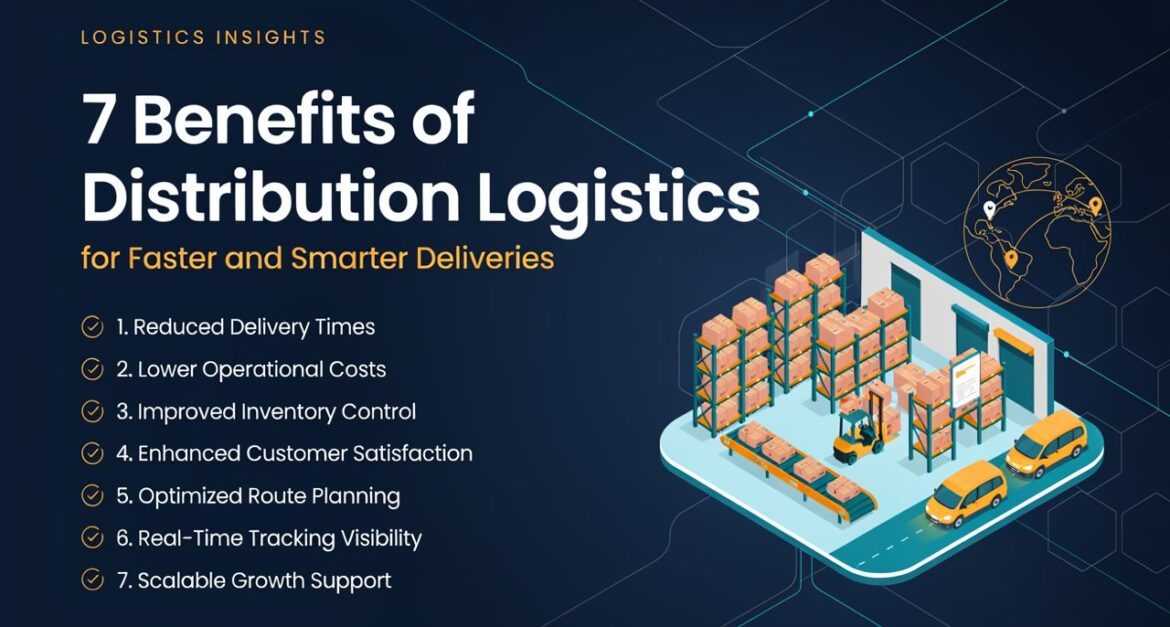
7 Benefits of Distribution Logistics for Faster and Smarter Deliveries
The chart above shows typical improvement ranges businesses report after implementing structured distribution logistics — these numbers set the stage for the seven benefits below.
1. Faster Delivery Times
Structured transportation distribution and logistics planning eliminates the guesswork out of routing. Optimized routes, strategically placed distribution hubs, and real-time traffic data mean packages spend less time in transit and more time actually moving toward the customer.
- Reduces last-mile delivery delays
- Shortens the distance between warehouse and end customer
- Enables same-day or next-day delivery commitments
2. Reduced Operational Costs
Every unnecessary mile driven, every hour a truck sits idle, and every square meter of underused warehouse space is money lost. Logistic distribution systems consolidate shipments, optimize fleet utilization, and reduce fuel consumption through smarter routing.
- Lower fuel and labor costs through route consolidation
- Reduced warehousing overhead via better space planning
- Fewer failed deliveries, which cut re-delivery expenses
3. Improved Inventory Accuracy and Visibility
Real-time inventory tracking removes the blind spots that cause stockouts or overstocking. With logistics and distribution software integrated across warehouses, businesses always know exactly what they have, where it is, and how fast it’s moving.
- Reduces stock discrepancies
- Enables accurate demand forecasting
- Minimizes dead stock and waste — especially critical in food distribution logistics, where shelf life is non-negotiable
4. Enhanced Customer Satisfaction
Speed and reliability directly shape customer loyalty. When deliveries arrive on time, in good condition, and with accurate tracking updates, trust builds — and trust converts into repeat business.
- Consistent delivery windows improve customer confidence
- Real-time tracking reduces “where is my order” support tickets
- Fewer damaged or delayed shipments improve brand reputation
5. Scalability for Growing Businesses
A well-designed distribution logistics framework flexes with demand. Whether it’s a retailer scaling for Ramadan sales spikes or a manufacturer expanding into new regions, the infrastructure adapts without requiring a complete rebuild.
- Supports seasonal demand surges without service disruption
- Enables expansion into new geographic markets
- Scales fleet and warehouse capacity based on real demand signals
6. Better Risk Management and Contingency Planning
Supply chains face disruptions — weather delays, port congestion, fuel price spikes. A strong distribution logistics network builds in redundancy: multiple carriers, backup routes, and buffer stock at regional hubs.
- Reduces single-point-of-failure risk
- Improves recovery speed after disruptions
- Protects against stockouts during supply shocks
7. Sustainability and Reduced Carbon Footprint
Route optimization and load consolidation don’t just save money — they cut emissions. Fewer half-empty trucks on the road and shorter delivery distances mean a measurably smaller environmental footprint, which is increasingly a factor in procurement and brand perception.
- Lower fuel consumption per delivery
- Reduced empty-mile driving through better load planning
- Supports corporate sustainability and ESG reporting goals
Fun fact: Studies on urban delivery networks have found that route optimization alone can cut delivery mileage by roughly 15–20% — the equivalent of taking thousands of unnecessary trips off the road every year for a mid-sized fleet.
Use Cases, Industries Served, and Real-World Applications
Distribution logistics isn’t a one-size-fits-all function. Different industries lean on it in different ways:
- Retail and e-commerce — fast, reliable last-mile delivery to meet online shopping expectations
- Food distribution logistics — temperature-controlled transport and rapid turnaround to preserve freshness
- Pharmaceuticals and healthcare — strict compliance, cold-chain logistics, and traceability
- Manufacturing — just-in-time material delivery to keep production lines running
- FMCG (Fast-Moving Consumer Goods) — high-volume, high-frequency distribution across wide retail networks
- Construction and industrial supply — bulk transport coordinated with project timelines
In Saudi Arabia specifically, the rapid growth of e-commerce, Vision 2030 logistics infrastructure investment, and rising consumer expectations around delivery speed have made distribution logistics a strategic priority rather than an operational afterthought.
Distribution Logistics vs. Traditional Freight Approaches
| Factor | Traditional Freight Model | Structured Distribution Logistics |
| Route planning | Manual, static routes | Dynamic, data-driven optimization |
| Inventory visibility | Periodic manual checks | Real-time tracking and forecasting |
| Delivery speed | Slower, less predictable | Faster, consistent windows |
| Cost control | Reactive cost management | Proactive cost optimization |
| Scalability | Requires manual reconfiguration | Flexible, demand-responsive |
| Risk resilience | Single-route dependency | Built-in redundancy and contingency planning |
The difference isn’t just efficiency — it’s predictability, and predictability is what customers and partners actually pay for.
Implementation Overview: How Businesses Adopt Distribution Logistics
Moving from a traditional model to a modern distribution logistics framework typically follows these stages:
- Assess current supply chain performance — identify delivery delays, cost leaks, and inventory gaps
- Map distribution network needs — determine optimal warehouse and hub locations
- Select technology infrastructure — implement WMS and TMS platforms for visibility
- Optimize transportation routes — integrate route-planning software and fleet management tools
- Establish real-time tracking — connect inventory and shipment data across all touchpoints
- Build contingency protocols — set up backup carriers and buffer stock strategies
- Monitor and refine continuously — use performance data to keep improving delivery speed and cost efficiency
Businesses that treat this as an ongoing process — not a one-time setup — see compounding returns over time.
Frequently Asked Questions
What is the difference between distribution logistics and general logistics?
Distribution logistics focuses specifically on the outbound movement of goods from storage to the end customer, while general logistics covers the broader supply chain, including procurement, production support, and reverse logistics.
How does distribution logistics improve delivery speed?
It improves delivery speed through optimized transportation routes, strategically located distribution centers, and real-time tracking systems that reduce transit delays and last-mile inefficiencies.
Why is food distribution logistics different from standard distribution?
Food distribution logistics requires temperature-controlled transport, strict time windows, and rigorous tracking to preserve product freshness and comply with food safety regulations — factors that don’t apply the same way to non-perishable goods.
Can small businesses benefit from distribution logistics, or is it only for large enterprises?
Small businesses benefit significantly, especially through third-party logistics (3PL) partnerships that provide access to established distribution networks, warehousing, and transportation infrastructure without the capital investment of building it in-house.
How does distribution logistics reduce operational costs?
It reduces costs through route consolidation, better fleet utilization, optimized warehouse space usage, and fewer failed or repeated deliveries — all of which lower fuel, labor, and re-delivery expenses.
What role does technology play in modern distribution logistics?
Technology — particularly Warehouse Management Systems (WMS) and Transportation Management Systems (TMS) — provides real-time visibility into inventory and shipments, enabling faster decision-making, accurate forecasting, and proactive problem-solving.
Conclusion: Distribution Logistics Is the Backbone of Reliable Delivery
Fast, smart deliveries don’t happen by accident. They’re the result of a distribution logistics system engineered for speed, cost efficiency, and resilience — from warehouse placement to last-mile execution. Businesses that invest in structured logistic distribution don’t just move products faster; they build the kind of reliability that turns first-time customers into repeat ones.
At Palm Horizon KSA, we help businesses across retail, food distribution, manufacturing, and e-commerce build distribution logistics networks designed for the realities of the Saudi market — fast, scalable, and built to handle growth without breaking under pressure. If your delivery times aren’t matching customer expectations, the fix usually isn’t the product. It’s the network behind it.