
Introduction: When You Know Something’s Wrong, But Not What
Most supply chain problems don’t announce themselves clearly. Costs creep up gradually. Delivery times slip by a day, then two. Warehouse space runs out faster than expected. Inventory sits unsold in one location while the same product is out of stock somewhere else.
The frustrating part is that these issues rarely have one obvious cause. They’re usually the result of small inefficiencies compounding across procurement, warehousing, transportation, and fulfillment — all at once. Fixing them from the inside is hard, because the people running day-to-day operations are often too close to the problem to see the pattern.
This is exactly the gap a logistics consultant is built to close. Instead of guessing which part of the supply chain is underperforming, a consultant brings an outside, data-driven view that pinpoints exactly where the breakdowns are happening — and how to fix them.
What Is Logistics Consulting?
Logistics consulting is a specialized advisory service where experts analyze, design, and optimize a business’s supply chain operations — from procurement and warehousing to transportation and last-mile delivery. Rather than executing logistics tasks directly, a logistics consultant evaluates existing processes and builds strategic recommendations to improve efficiency, reduce cost, and increase reliability.
Logistics consulting companies typically work across the full supply chain lifecycle, but their engagements can also be narrowly scoped — a single warehouse redesign, a transportation network audit, or a technology implementation roadmap.
The key distinction between consulting and outsourcing is important: a logistics consultant doesn’t take over your operations. They diagnose, design, and guide — leaving the business in control of execution, but armed with an expert-built strategy.
Fun fact: Supply chain consulting as a formal discipline grew rapidly after global manufacturers realized in the 1990s that even minor inefficiencies — a poorly placed warehouse, an inefficient delivery route — could quietly cost millions annually across a large network. That realization essentially created an entire industry built around finding those hidden inefficiencies.
Core Attributes and Features of Logistics Consulting
Not every advisory engagement qualifies as true logistics consulting. The strongest logistics consulting companies typically bring these core capabilities:
- Supply chain network analysis — mapping current flows to identify inefficiencies
- Data-driven diagnostics — using performance metrics rather than assumptions
- Warehouse and distribution center optimization — layout, capacity, and location strategy
- Transportation and routing analysis — cost and time efficiency reviews
- Technology and systems assessment — evaluating WMS, TMS, and ERP integration gaps
- Risk and compliance evaluation — regulatory, customs, and contingency planning
- Custom implementation roadmaps — practical, phased recommendations rather than generic advice
These attributes are what separate genuine strategic consulting from a basic operational review.
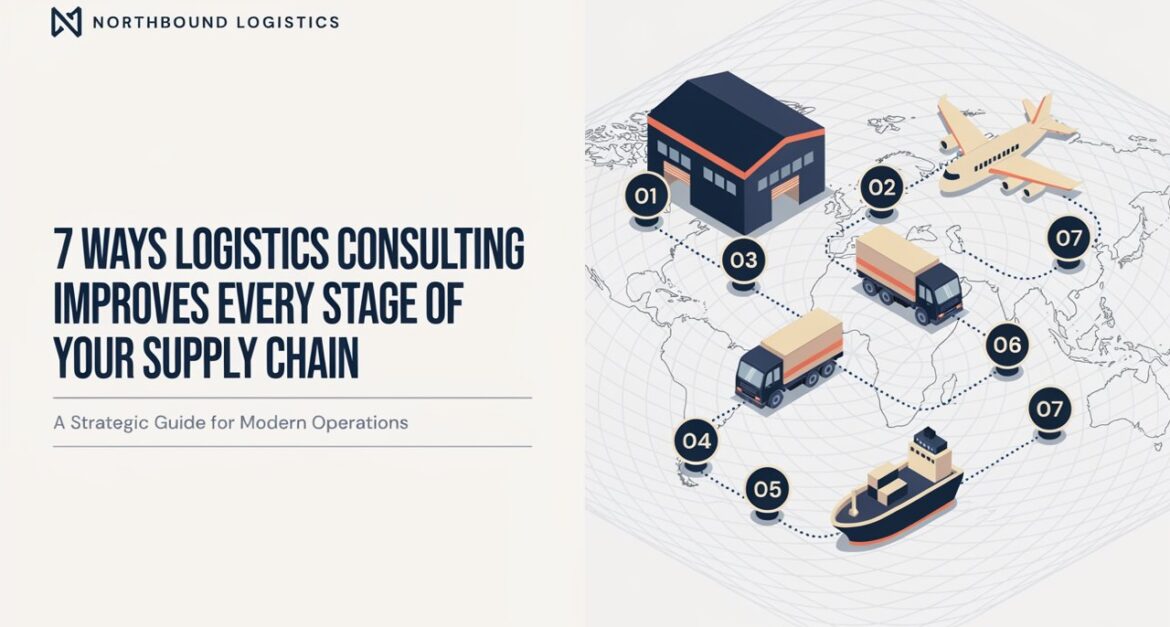
7 Ways Logistics Consulting Improves Every Stage of Your Supply Chain
The chart above shows typical improvement ranges businesses report after engaging a logistics consultant — these set the stage for the seven improvements below.
1. Smarter Network Design
A logistics consultant evaluates where your warehouses, distribution centers, and hubs are actually located versus where they should be, based on demand patterns and delivery zones.
- Identifies misaligned warehouse locations relative to customer demand
- Recommends optimal hub placement to reduce transit distances
- Builds network models that scale with future growth
2. Reduced Procurement Costs
Consulting engagements often uncover procurement inefficiencies that go unnoticed internally — from supplier redundancy to poor contract terms.
- Identifies opportunities for supplier consolidation
- Benchmarks pricing against industry standards
- Improves negotiating leverage through data-backed insights
3. Optimized Inventory Management
Excess stock ties up capital. Stockouts lose sales. A logistics consultant analyzes demand patterns to strike the right balance, often the single highest-impact area of a consulting engagement.
- Reduces overstock and dead inventory
- Improves demand forecasting accuracy
- Aligns safety stock levels with actual sales velocity
4. Better Warehouse Layout and Efficiency
Many warehouses are laid out based on how the space was originally built, not how goods actually move through it today. Consultants redesign layouts around real picking and packing workflows.
- Reduces travel time within the warehouse
- Improves picking accuracy and speed
- Maximizes usable storage capacity
5. Lower Transportation Costs
Transportation is often one of the largest line items in a supply chain budget. Logistics consulting companies analyze routing, carrier contracts, and load consolidation opportunities to cut waste.
- Identifies underutilized shipping capacity
- Recommends route consolidation strategies
- Benchmarks carrier rates against market alternatives
6. Faster Technology Adoption
Many businesses know they need better systems but don’t know which ones fit their actual operation. A logistics consultant evaluates and recommends the right WMS, TMS, or ERP integration — avoiding costly trial and error.
- Matches technology investment to actual operational needs
- Reduces implementation risk through structured rollout plans
- Speeds up return on technology investment
7. Stronger Risk and Compliance Readiness
Supply chains face regulatory requirements, customs complexity, and disruption risk that internal teams don’t always have the bandwidth to fully evaluate. Consultants build this into their recommendations from day one.
- Identifies compliance gaps before they become costly problems
- Builds contingency plans for supply chain disruptions
- Reduces exposure to regulatory penalties and delays
Fun fact: Some of the most well-known global retail turnarounds weren’t driven by better products at all — they came from supply chain consultants finding that a company’s warehouse network was built for a business that no longer existed, and redesigning it from the ground up to match current demand.
Use Cases, Industries Served, and Real-World Applications
Logistics consulting applies across nearly every industry that moves physical goods, though the focus shifts depending on the sector:
- Retail and e-commerce — network design and fulfillment speed optimization
- Manufacturing — procurement efficiency and inbound logistics planning
- FMCG — high-frequency distribution and inventory turnover strategy
- Food and beverage — cold-chain compliance and shelf-life-driven logistics design
- Pharmaceuticals and healthcare — regulatory compliance and controlled distribution
- Startups scaling rapidly — building supply chain foundations before problems compound
In Saudi Arabia, the rapid expansion of retail, e-commerce, and industrial sectors under Vision 2030 has significantly increased demand for logistics consulting companies that understand both global best practices and the specific infrastructure realities of the local market.
Logistics Consulting vs. Other Supply Chain Support Models
| Factor | Logistics Consulting | Logistics Outsourcing (3PL) | Internal Logistics Team |
| Role | Diagnoses and designs strategy | Executes day-to-day operations | Executes and manages internally |
| Control retained | Full — business executes recommendations | Shared — provider manages execution | Full |
| Best for | Identifying inefficiencies and building strategy | Ongoing operational execution at scale | Businesses with existing strong logistics capability |
| Investment type | Project-based or advisory fee | Ongoing service fees | Fixed internal payroll and infrastructure |
| Typical engagement length | Defined project timeline | Long-term partnership | Continuous internal function |
Many businesses actually combine both — bringing in a logistics consultant first to diagnose and design the strategy, then either building internal capability or outsourcing execution based on the consultant’s recommendations.
Implementation Overview: How a Logistics Consulting Engagement Works
A typical engagement with a logistics consultant follows a structured process:
- Initial supply chain audit — reviewing current performance data across procurement, warehousing, and transportation
- Stakeholder interviews — understanding operational pain points from the teams closest to the work
- Data analysis and benchmarking — comparing performance against industry standards
- Gap identification — pinpointing specific inefficiencies and their financial impact
- Strategic recommendations — building a prioritized roadmap of improvements
- Implementation planning — phasing changes to minimize operational disruption
- Post-implementation review — measuring results against original benchmarks
Businesses that treat the consultant’s roadmap as a phased plan — rather than trying to implement everything at once — typically see the smoothest transitions and the strongest measurable results.
Frequently Asked Questions
What does a logistics consultant actually do day to day?
A logistics consultant analyzes a business’s supply chain data, identifies inefficiencies across procurement, warehousing, and transportation, and delivers strategic recommendations to improve cost, speed, and reliability — without directly managing daily operations.
How is logistics consulting different from hiring a 3PL provider?
Logistics consulting focuses on diagnosing problems and designing strategy while the business retains execution control, whereas a 3PL provider takes over the actual operational execution of warehousing, transportation, or fulfillment.
When should a business consider hiring logistics consulting companies?
Businesses typically benefit most from logistics consulting when experiencing rising costs, inconsistent delivery performance, rapid growth outpacing current infrastructure, or planning a major expansion into new markets or distribution channels.
Is logistics consulting only useful for large enterprises?
No — logistics consulting is valuable for businesses of all sizes, since even smaller operations can uncover significant cost savings and efficiency gains that outweigh the cost of the consulting engagement.
How long does a typical logistics consulting engagement take?
Engagement length varies depending on scope, but most projects range from a few weeks for focused audits to several months for comprehensive supply chain network redesigns.
Can a logistics consultant help with technology selection, like choosing a WMS or TMS?
Yes — a core part of many logistics consulting engagements involves evaluating a business’s specific operational needs and recommending the right warehouse or transportation management technology, reducing the risk of costly implementation mistakes.
Conclusion: The Fastest Way to Fix What You Can’t See From the Inside
Supply chain inefficiencies rarely fix themselves, and internal teams — however capable — are often too close to the day-to-day operation to spot the root cause. A skilled logistics consultant brings the outside perspective, data-driven analysis, and industry benchmarking needed to turn vague frustration into a clear, actionable improvement plan.
At Palm Horizon KSA, our logistics consulting services help businesses across retail, manufacturing, FMCG, and e-commerce identify exactly where their supply chain is losing time and money — and build a practical roadmap to fix it. If your operations feel like they’re working harder than they should be, the answer usually isn’t more effort. It’s the right strategy, built by people who can see the whole picture.