

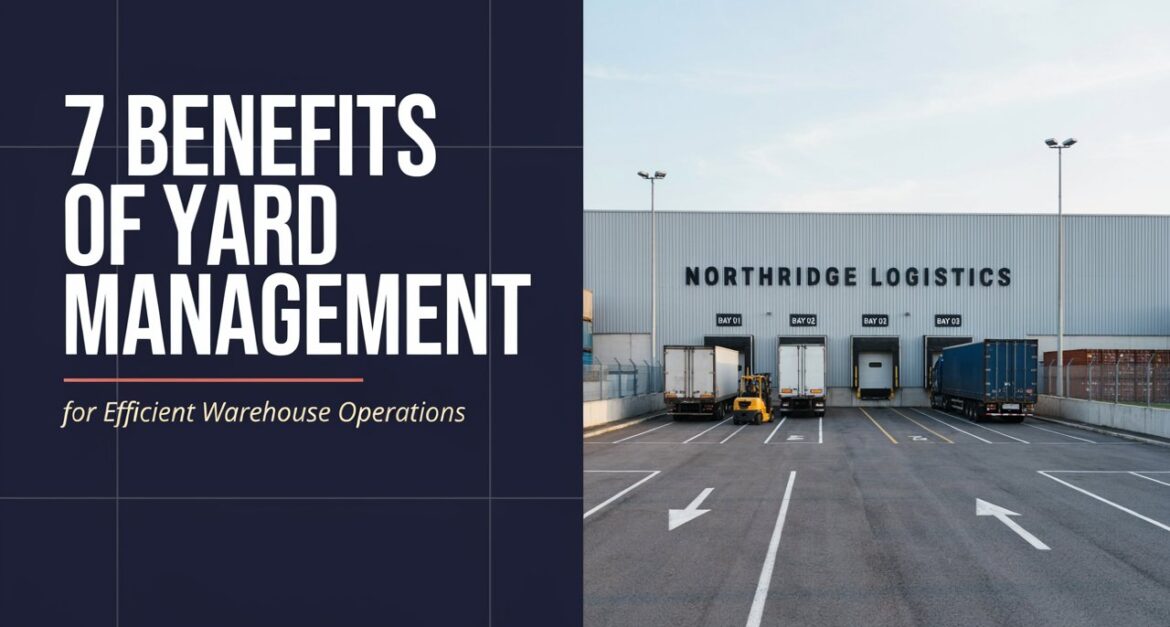
Why Your Warehouse Is Only as Fast as Your Yard
Ask any warehouse manager where their operation actually breaks down, and the answer rarely points to the racking, the pickers, or the conveyor belts. It points to the yard.
Trailers sit idle at the fence line because nobody knows they’ve arrived. Dock doors stand empty because the right trailer can’t be located among forty identical white boxes. Detention invoices pile up because a driver waited two hours for a spot that was technically free the entire time. None of this is a warehouse problem — it’s a yard problem, and it’s costing operations real money every single day.
This is the gap that yard management closes. Below, you can see the kind of measurable shift operations typically report after adopting a proper yard management system — faster gate cycles, less time spent hunting for trailers, and a sharp jump in inventory accuracy across the yard.
The chart above reflects a pattern seen across distribution centers, ports, and manufacturing yards alike: the improvements aren’t marginal, they’re structural. That’s because yard management doesn’t just organize trailers — it turns the yard into a visible, trackable, schedulable extension of the warehouse itself.
This article breaks down what yard management actually is, the core features that make it work, and the seven concrete benefits it delivers — so you can evaluate whether a yard management system or container yard management software belongs in your operation.
What Is Yard Management?
Yard management is the process of controlling and coordinating everything that happens in the space between the gate and the dock door — trailer check-in, spotting, staging, dwell time, and departure. It covers trailers, containers, chassis, drivers, and the flow of freight moving through that outdoor “buffer zone” of a warehouse or distribution center.
A yard management system (YMS) is the software layer that automates this process. Instead of a security guard scribbling license plates on a clipboard and a yard jockey guessing where an empty trailer is parked, a YMS gives dispatchers and warehouse teams a live, digital map of every asset on the property — where it is, how long it’s been there, what’s inside it, and what needs to happen next.
For ports, intermodal facilities, and container-heavy operations, this often takes the specific form of container yard management software — purpose-built to track containers by size, weight, customs status, and stacking position, since container yards have constraints (like block stacking and crane access) that a standard trailer yard doesn’t.
In short: if a warehouse management system (WMS) controls what happens inside four walls, yard management controls everything outside them — and connects the two so freight never stalls in the gap.
Core Attributes and Features of a Yard Management System
Not all yard management tools are built the same, but the strongest platforms consistently include:
- Gate check-in/check-out automation — capturing driver, carrier, trailer ID, and appointment data in seconds instead of minutes
- Real-time yard visibility — a live map or list view showing every trailer’s location, status, and dwell time
- Trailer and container tracking — using barcode, RFID, GPS, or manual entry to eliminate “lost trailer” searches
- Dock scheduling and appointment management — aligning inbound/outbound trailer flow with dock door availability
- Task and move management — digitally dispatching yard jockeys or hostlers instead of radio-based guesswork
- Detention and demurrage tracking — automatically flagging trailers approaching free-time limits
- Integration with WMS, TMS, and ERP systems — so yard data feeds directly into inventory, transportation, and planning workflows
- Reporting and analytics dashboards — surfacing dwell time trends, gate throughput, and labor utilization
These attributes are what separate a true yard management system from a spreadsheet with a fancy name — and they’re the foundation for every benefit discussed below.
The 7 Benefits of Yard Management for Efficient Warehouse Operations
1. Faster Trailer and Container Turnaround
With real-time location tracking, yard jockeys stop wasting time driving the lot in search of a specific trailer. A digital yard map shows exactly where every asset sits, cutting search time dramatically and letting trailers move from gate to dock — and back out — far faster than manual methods allow.
2. Reduced Detention and Demurrage Costs
Detention fees are one of the quietest budget leaks in logistics. A yard management system tracks arrival time automatically and alerts staff before free time expires, so trailers get processed before penalty clocks run out. Over a year, this alone can offset the cost of the software many times over.
3. Improved Dock Door Utilization
When dispatchers can see which trailers are staged and ready, they can assign dock doors based on real priority and appointment windows instead of whichever trailer happens to be closest. This keeps dock doors active instead of sitting empty while the “right” trailer is still being located.
4. Greater Yard Visibility and Inventory Accuracy
Yard checks that once took a physical walk-through — sometimes twice a shift — become instant with digital tracking. Every trailer, container, and chassis is accounted for on a live dashboard, which is why yard inventory accuracy is typically the single biggest jump operations see after implementation.
5. Better Labor Efficiency and Task Prioritization
Instead of running trailer moves over radio chatter, a YMS digitally queues and assigns tasks to yard jockeys based on priority, proximity, and appointment time. This reduces idle time, prevents duplicate moves, and lets a smaller yard crew handle a larger volume of trailers.
6. Stronger Data for Planning and Carrier Performance
A yard management system captures dwell time, gate throughput, and detention data automatically — data that used to live only in a guard’s memory. That data becomes a scorecard: which carriers consistently arrive on time, which lanes cause the most congestion, and where staffing needs to shift by shift or by season.
7. Seamless Integration with Warehouse and Transportation Systems
The real power of yard management shows up when it talks to your WMS and TMS. An inbound trailer arriving at the gate can automatically trigger a putaway task inside the warehouse, and an outbound order nearing completion can automatically summon the right trailer to the right door — closing the loop between yard, warehouse, and transportation planning.
Fun Facts Worth Knowing About Yard Management
- A single “lost” trailer search on a large yard can eat up 20–30 minutes of a yard jockey’s shift — multiply that across a busy week, and it’s the equivalent of losing a full workday of labor.
- The concept of yard management barely existed as dedicated software before the early 2000s — for decades, “yard management” simply meant a clipboard, a radio, and a guard shack.
- Container yards use a stacking logic borrowed from the shipping industry called block stacking, where the container you need is often buried under three others — which is exactly why container yard management software prioritizes retrieval-order tracking, not just location tracking.
- Detention and demurrage charges collectively cost the freight industry billions of dollars annually, and a large share of that is considered avoidable with better yard visibility.
Use Cases, Industries Served, and Real-World Applications
Yard management isn’t limited to one type of facility. It shows up wherever trailers, containers, or trucks need to be tracked and staged:
- Distribution centers and 3PLs — coordinating high volumes of inbound/outbound trailers across dozens of dock doors
- Manufacturing plants — managing raw material trailers and finished goods staging on tight production schedules
- Ports and intermodal terminals — using container yard management software to track container position, customs hold status, and chassis availability
- Cold storage and food distribution — where dwell time directly affects product quality and spoilage risk
- Retail fulfillment centers — managing seasonal surges in trailer volume during peak shopping periods
- Cross-docking operations — where speed of trailer turnaround is the entire business model
Any facility where a trailer sits and waits before it’s needed is a candidate for yard management — the only variable is how much money that waiting is currently costing.
Yard Management vs. Manual Processes vs. WMS-Only Approaches
| Approach | Visibility | Labor Efficiency | Detention Risk | Scalability |
| Manual (clipboard/radio) | Low — relies on memory and walk-throughs | Low — duplicate and wasted moves common | High — easy to miss free-time windows | Poor — breaks down at volume |
| WMS only (no yard module) | Blind spot outside the four walls | Moderate — inside warehouse only | Moderate — no automated alerts | Limited — yard remains a black box |
| Dedicated yard management system | High — real-time digital map | High — task-based dispatch | Low — automated detention alerts | Strong — scales with trailer volume |
Some warehouse management systems include a basic yard module, but standalone yard management software or container yard management software generally offers deeper trailer/container-specific tracking, better detention alerting, and stronger integration options for complex multi-carrier yards.
Implementation Overview: What Rolling Out a Yard Management System Looks Like
- Assess current yard workflows — map out how trailers currently move from gate to dock to departure, including where the bottlenecks live.
- Choose the right tracking method — barcode scanning, RFID, GPS, or manual entry, based on yard size and budget.
- Integrate with existing systems — connect the YMS to your WMS, TMS, and/or ERP so data flows both directions.
- Configure gate and dock workflows — set rules for check-in, appointment scheduling, and detention alert thresholds.
- Train gate staff and yard jockeys — the system only delivers value if the people using it trust and follow it.
- Run a pilot phase — test on one yard or shift before a full rollout to catch workflow gaps early.
- Monitor dashboards and refine — use dwell time and throughput data to continuously adjust dock assignments and staffing.
Most operations see measurable gate and dwell-time improvements within the first few weeks, with fuller ROI — particularly on detention cost reduction — visible within the first two to three months.
Frequently Asked Questions About Yard Management
What is the difference between a yard management system and a warehouse management system?
A WMS manages inventory and operations inside the warehouse — picking, putaway, storage. A yard management system manages trailers, containers, and traffic outside the warehouse, in the yard. The two are complementary and work best when integrated.
Is yard management software only useful for large distribution centers?
No. While large DCs see the biggest raw numbers, even mid-sized facilities with a handful of dock doors benefit from reduced detention costs and faster trailer turnaround — the ROI scales with trailer volume, not facility size alone.
How does container yard management software differ from standard yard management software?
Container yard management software is built around container-specific constraints like block stacking, chassis pairing, and customs hold status, whereas standard yard management software is typically built around trailer check-in/out and dock scheduling for over-the-road freight.
Can a yard management system reduce detention and demurrage charges?
Yes — this is one of its most direct financial benefits. By tracking arrival time and free-time windows automatically, a YMS alerts staff before penalty charges begin, allowing trailers to be processed or moved in time to avoid the fee.
Do yard management systems require RFID or GPS hardware to work?
Not necessarily. Many yard management systems support manual or barcode-based check-in for smaller yards, while RFID and GPS are typically used in larger, higher-volume yards where automated tracking pays off faster.
How long does it take to implement a yard management system?
Basic implementations can go live in a matter of weeks, especially with cloud-based platforms. Full integration with existing WMS/TMS systems and multi-site rollouts can take a few months, depending on complexity.
Is yard management the same as dock scheduling?
Dock scheduling is one component of yard management, not the whole picture. Yard management also covers gate processing, trailer location tracking, task dispatch, and detention monitoring — dock scheduling is where all of that converges.
The Bottom Line
The yard is not a waiting room — it’s an active part of the supply chain, and treating it like an afterthought is where a surprising amount of warehouse inefficiency quietly originates. Faster turnaround, lower detention costs, better dock utilization, sharper visibility, smarter labor allocation, stronger data, and tighter integration with the rest of your operation — these aren’t incremental improvements. They’re the difference between a yard that drains your warehouse’s efficiency and one that actively fuels it.
Whether you’re evaluating a full yard management system, dock-and-gate-only software, or container yard management software for a port-side operation, the underlying principle is the same: you can’t optimize what you can’t see, and the yard has been invisible for too long. Making it visible is where the real efficiency gains begin.




1 Comment
Dock Management: 7 Strategies for Better Logistics October,13 2026
[…] loading dock is where freight meets the warehouse, and it is a bottleneck in many facilities. Dock management is the discipline of organizing that meeting point, so trucks arrive when doors, people and […]