
Introduction
A shipment doesn’t get delayed at customs because of the goods inside it — it gets delayed because of the paperwork attached to it. A missing signature, a mismatched weight, or an incomplete declaration can hold an otherwise perfectly good shipment at an airport for days, racking up storage fees and missed delivery windows.
Freight documentation is one of the most overlooked yet most critical parts of international shipping. It’s not glamorous, but it’s the difference between cargo that clears customs in hours and cargo that sits stuck in a warehouse while paperwork gets sorted out.
This guide breaks down exactly what freight documentation involves, the seven essential air freight documents every business needs, and how getting this right leads to faster, smoother, more reliable shipping.
Fun fact: According to global trade facilitation studies, documentation errors and incomplete paperwork are consistently cited as one of the top three causes of customs delays worldwide — ahead of even physical inspection holds.
What Is Freight Documentation?
Freight documentation refers to the complete set of paperwork required to legally and efficiently move goods from an origin to a destination. This includes commercial documents (like invoices), transportation documents (like the air waybill), and regulatory documents (like customs declarations) that together verify what’s being shipped, its value, and its compliance with import/export laws.
What Are Air Freight Shipping Documents?
Air freight shipping documents are the specific subset of freight documentation required for shipments moving by air. These documents confirm cargo details, ownership, value, and compliance with aviation and customs regulations — and they accompany the shipment at every stage, from airport acceptance to final delivery.
What Are Air Freight Documents?
Air freight documents is a broader term encompassing all paperwork tied to an air cargo shipment — commercial invoices, packing lists, air waybills, certificates of origin, and any additional customs or regulatory paperwork specific to the goods being transported.
What Is Air Freight Documentation?
Air freight documentation refers to the overall process and system of preparing, verifying, and submitting these documents correctly and on time. It’s not just about having the paperwork — it’s about ensuring accuracy, consistency, and completeness across every document tied to a shipment.
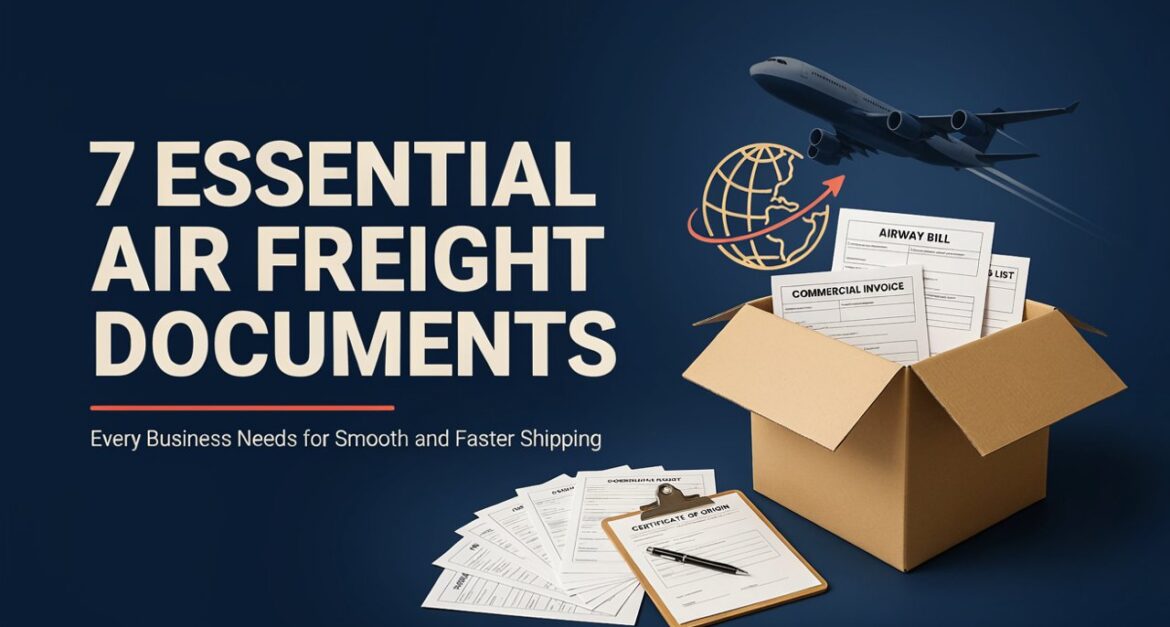
7 Essential Air Freight Documents Every Business Needs for Smooth and Faster Shipping
1. Commercial Invoice
This document details the transaction between buyer and seller — including item description, quantity, price, and terms of sale. Customs authorities use it to assess duties and taxes, making accuracy here critical.
2. Packing List
A detailed breakdown of what’s inside each package — dimensions, weight, and contents. It helps customs and handlers verify the shipment matches what’s declared, and it’s essential for cargo handling and space planning.
3. Air Waybill
The air waybill (AWB) is the contract between the shipper and the airline. It serves as a receipt for goods, proof of the shipping agreement, and a tracking document throughout the journey — one of the most important documents in the entire air freight process.
4. Certificate of Origin
This document certifies the country where the goods were manufactured or produced. It’s often required to determine applicable tariffs, trade agreement eligibility, and compliance with import regulations.
5. Customs Documents
These include import/export declarations and any additional forms required by the destination country’s customs authority. Requirements vary significantly by country and product type.
6. Insurance Certificate
This document confirms that the shipment is covered against loss or damage during transit, protecting the business financially in case of unforeseen incidents.
7. Dangerous Goods Declaration
Required for shipments containing hazardous materials, this document confirms that goods have been properly classified, packaged, and labeled according to international aviation safety regulations — a critical compliance requirement for air cargo.
What Information Should Air Freight Documents Include?
Regardless of document type, accurate air freight documentation should consistently include:
- Shipper and consignee names, addresses, and contact details
- Detailed and accurate description of goods
- Quantity, weight, and dimensions of the shipment
- Declared value of the goods
- Country of origin and destination
- Applicable harmonized system (HS) codes for customs classification
- Special handling instructions, if applicable (fragile, perishable, hazardous)
Consistency across all documents is just as important as accuracy within each individual one — mismatched details between the invoice, packing list, and air waybill are a common cause of customs holds.
How Does the Air Freight Documentation Process Work?
1. Collect Shipment Information
Gather accurate details on cargo weight, dimensions, value, and destination requirements before preparing any documents.
2. Prepare Commercial Documents
Create the commercial invoice and packing list, ensuring product descriptions and values are accurate and consistent.
3. Prepare Transportation Documents
Complete the air waybill with the airline or freight forwarder, confirming shipment details and terms of carriage.
4. Submit Customs Information
File the required import/export declarations and any additional customs forms specific to the destination country.
5. Verify All Freight Documentation
Cross-check every document for consistency — matching weights, values, and descriptions across the invoice, packing list, and air waybill.
6. Complete Cargo Acceptance
Submit the shipment and documentation to the airline or handling agent for acceptance and loading.
7. Complete Customs Clearance and Delivery
Once the shipment arrives, customs authorities review the documentation to clear the cargo for final delivery to the consignee.
What Are the Benefits of Accurate Freight Documentation?
Faster Customs Processing
Complete, accurate documentation allows customs authorities to process shipments quickly without needing to flag them for manual review.
Fewer Documentation Errors
Standardized, verified processes reduce the mismatches and mistakes that commonly cause delays or rejected paperwork.
Better Shipment Visibility
Accurate documentation tied to tracking systems gives businesses and customers clearer insight into where a shipment is in transit.
Easier Customs Clearance
Well-prepared documents reduce the likelihood of shipments being held for additional inspection or clarification.
Better Communication Between Shipping Partners
Consistent documentation ensures freight forwarders, airlines, and customs brokers are all working from the same accurate information.
Reduced Additional Costs
Fewer delays and errors mean fewer storage fees, demurrage charges, and re-documentation costs.
Here’s a look at where accurate freight documentation tends to make the biggest difference:Note: figures are illustrative, based on commonly reported trade documentation benchmarks — actual results vary by destination country, product category, and shipment complexity.
Customs processing speed and clearance success rates show the biggest gains — which makes sense, since documentation accuracy is the single factor customs authorities rely on most to clear cargo without delay.
Common Air Freight Documentation Mistakes
Incorrect Product Description
Vague or inaccurate descriptions can trigger customs holds or misclassification under the wrong HS code.
Incorrect Weight or Quantity
Discrepancies between declared and actual weight or quantity are one of the most common triggers for shipment inspection.
Missing Air Freight Documents
A single missing document — even a minor one — can halt the entire customs clearance process.
Incorrect Shipment Value
Under- or over-declaring value can lead to customs penalties, delays, or disputes over duty assessments.
Inconsistent Information
Mismatched details across the invoice, packing list, and air waybill are a leading cause of documentation rejection.
Late Freight Documentation
Submitting documents after cargo acceptance deadlines can result in missed flights and rebooking delays.
How Technology Improves Air Freight Documentation
Digital tools have significantly reduced the manual errors that used to plague freight documentation:
- Digital documentation platforms — auto-populate consistent data across multiple documents, reducing mismatches
- Electronic air waybills (e-AWB) — replace paper waybills with faster, more secure digital records
- Automated customs filing systems — reduce manual entry errors in customs declarations
- Document verification software — flags inconsistencies before submission
- Cloud-based document storage — ensures all shipping partners access the same up-to-date documentation
Fun fact: The shift to electronic air waybills (e-AWB) has been one of the air cargo industry’s biggest documentation upgrades — IATA has reported e-AWB adoption rates climbing steadily worldwide, cutting processing time significantly compared to traditional paper waybills.
Air Freight Documents vs. Freight Documentation
These terms are related but not identical in scope:
- Air freight documents refers specifically to the individual paperwork required for air cargo shipments — invoices, packing lists, air waybills, and related forms.
- Freight documentation is the broader term covering the entire documentation process across all transportation modes — air, sea, road, and rail — including how documents are prepared, verified, and submitted.
In short, air freight documents are a specific category within the larger freight documentation process.
When Should Businesses Prepare Air Freight Shipping Documents?
Air freight shipping documents should be prepared well before cargo acceptance deadlines — ideally as soon as shipment details are confirmed. Waiting until the last minute increases the risk of errors, missing information, or missed cutoff times for flight bookings. Best practice is to have all documentation finalized and verified at least 24–48 hours before scheduled cargo acceptance.
How Can Businesses Keep Freight Documentation Accurate?
- Standardize documentation templates across all shipments
- Cross-check figures (weight, value, quantity) across every document before submission
- Use digital documentation tools to reduce manual entry errors
- Train staff on destination-specific customs requirements
- Work with experienced freight forwarders or customs brokers for complex shipments
- Conduct periodic audits of past shipments to catch recurring errors
How Palm Horizon KSA Can Help With Freight Documentation
Palm Horizon KSA supports businesses across Saudi Arabia in preparing accurate, complete air freight documentation — from commercial invoices and packing lists to customs declarations and dangerous goods paperwork. By verifying consistency across every document before submission, Palm Horizon KSA helps reduce the customs delays and additional costs that stem from documentation errors.
For businesses shipping internationally, having a logistics partner that understands destination-specific documentation requirements can be the difference between cargo clearing customs smoothly and getting stuck in review — Palm Horizon KSA’s approach is built around exactly that reliability.
Fun Facts About Air Freight Documents
- The air waybill was first introduced in the early days of commercial air cargo and remains one of the only transport documents that is non-negotiable — meaning it cannot be transferred to another party, unlike a bill of lading in sea freight.
- Some countries require certificates of origin to be authenticated by a chamber of commerce before they’re accepted by customs — a step many first-time exporters overlook.
- Dangerous goods declarations follow international standards set by IATA, and even something as ordinary as lithium batteries or perfume can trigger this requirement depending on quantity and packaging.
FAQs About Freight Documentation
What Is Freight Documentation?
Freight documentation is the complete set of commercial, transportation, and regulatory paperwork required to legally and efficiently move goods from origin to destination.
What Are Air Freight Shipping Documents?
Air freight shipping documents are the specific paperwork required for air cargo shipments, including the commercial invoice, packing list, air waybill, and any applicable customs or regulatory documents.
What Are the Main Air Freight Documents?
The main air freight documents include the commercial invoice, packing list, air waybill, certificate of origin, customs documents, insurance certificate, and dangerous goods declaration (when applicable).
Why Is Air Freight Documentation Important?
Air freight documentation is important because it ensures customs compliance, verifies shipment details, and enables faster clearance — inaccurate or missing documents are among the most common causes of shipping delays.
What Is the Difference Between Air Freight Documentation and Freight Documentation?
Air freight documentation refers specifically to the process for air cargo shipments, while freight documentation is the broader term covering documentation requirements across all transportation modes, including sea, road, and rail.
Can Incorrect Freight Documentation Delay a Shipment?
Yes — incorrect or inconsistent documentation is one of the leading causes of customs holds and shipment delays, often resulting in additional storage fees and missed delivery timelines.
Conclusion
Air freight documentation may not be the most visible part of shipping, but it’s often the deciding factor between a shipment that clears customs smoothly and one that gets stuck for days. From the commercial invoice to the dangerous goods declaration, each of these seven documents plays a specific role in keeping cargo compliant, trackable, and moving on schedule.
Businesses that prioritize accurate, consistent freight documentation avoid unnecessary delays, reduce costs, and build more reliable shipping operations overall. And with experienced partners like Palm Horizon KSA managing documentation accuracy across every shipment, businesses in Saudi Arabia can ship internationally with confidence, knowing their paperwork won’t be the reason a shipment gets held up.