
Introduction
Every business that relies on outside suppliers eventually runs into the same problem: inventory piles up in the wrong places, costs creep upward, and supplier performance becomes unpredictable. When vendor relationships aren’t managed with a clear system, the result is stockouts, overstocking, delayed shipments, and strained partnerships that cost far more than they should.
This is where vendor management becomes a competitive advantage rather than just an administrative task. Done well, it connects procurement, inventory, and supplier performance into one coordinated system. Done poorly, it becomes a constant source of friction — missed deliveries, inconsistent quality, and inventory that never quite matches demand.
In this guide, we’ll break down what vendor management really means, how it works, and seven practical strategies you can apply today to improve inventory accuracy, reduce operating costs, and strengthen supplier performance — with real-world context from Palm Horizon KSA, a logistics and supply chain partner supporting businesses across Saudi Arabia.
What Is Vendor Management?
Vendor management is the process of sourcing, evaluating, and overseeing the suppliers a business depends on for goods, services, or equipment. It covers everything from initial vendor selection to contract negotiation, ongoing performance monitoring, and relationship maintenance.
At its core, vendor management answers one question: is this supplier consistently delivering the value, quality, and reliability my business needs?
A mature vendor management approach isn’t a one-time evaluation — it’s an ongoing cycle of selection, measurement, and improvement that touches procurement, finance, operations, and inventory teams alike.
What Are Asset Management Vendors?
Asset management vendors are suppliers or service providers responsible for managing physical or digital assets on behalf of a business — think equipment, machinery, IT infrastructure, or facility assets. Instead of a company tracking and maintaining every asset internally, an asset management vendor handles lifecycle tasks like tracking, maintenance scheduling, depreciation reporting, and replacement planning.
For companies with large equipment fleets or multi-site operations, working with the right asset management vendors reduces downtime and extends the usable life of critical assets.
What Is a Vendor Management System?
A vendor management system (VMS) is software that centralizes vendor data, contracts, performance metrics, and communication in one platform. Instead of tracking suppliers through scattered spreadsheets and email threads, a VMS gives procurement and operations teams a single source of truth.
A good vendor management system typically includes:
- Vendor onboarding and documentation
- Contract and compliance tracking
- Performance scorecards
- Inventory and order visibility
- Automated alerts and reporting
What Is Vendor Management Inventory?
Vendor management inventory refers to the broader practice of overseeing inventory levels, replenishment cycles, and stock accuracy as part of the vendor relationship. It’s the operational layer where procurement decisions meet warehouse reality — ensuring the right products are in the right place at the right time, without excess capital tied up in unsold stock.
What Is Vendor Managed Inventory?
Vendor managed inventory (VMI) is a specific supply chain model where the supplier, not the buyer, takes responsibility for monitoring stock levels and replenishing inventory. Using shared data — often through a vendor management system — the vendor decides when and how much to ship based on real demand signals, rather than waiting for a purchase order.
VMI shifts the burden of inventory monitoring away from the buyer’s team and onto the vendor, who typically has more visibility into production timelines and supply availability.
How Does Vendor Management Work?
Vendor management works as a continuous cycle, not a single step. Here’s how the process typically unfolds:
Vendor Selection
The process begins with identifying and evaluating potential suppliers based on cost, quality, reliability, and capacity. This is where businesses set the foundation for everything that follows.
Vendor Evaluation
Before signing a contract, vendors are assessed against defined criteria — certifications, past performance, financial stability, and references from other clients.
Contract Management
Once a vendor is selected, contract management defines expectations: pricing, delivery timelines, service level agreements (SLAs), and penalties for non-compliance.
Performance Monitoring
After onboarding, ongoing performance monitoring tracks delivery accuracy, quality consistency, and responsiveness against agreed benchmarks.
Inventory Coordination
Vendor management inventory processes ensure stock levels align with actual demand, minimizing both overstock and shortages.
Communication and Collaboration
Clear, consistent communication channels prevent misunderstandings and allow both parties to resolve issues before they escalate.
Continuous Improvement
The most effective vendor relationships evolve — using performance data and feedback loops to refine processes over time.
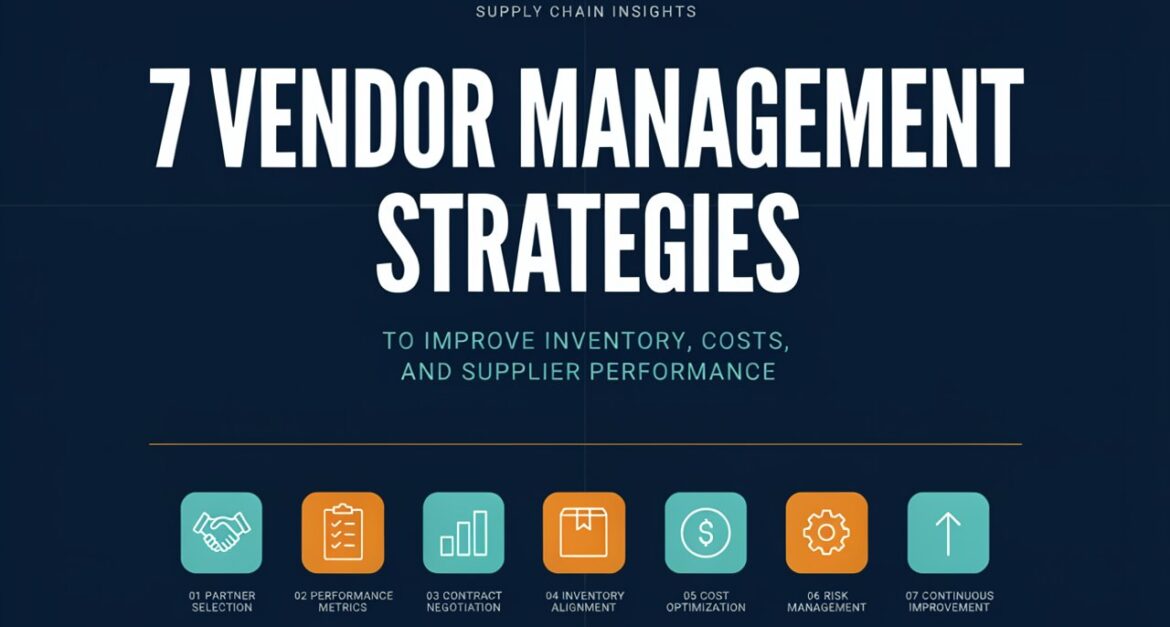
7 Vendor Management Strategies for Better Business Performance
1. Choose the Right Vendors
Vendor selection sets the tone for everything else. Look beyond price and evaluate:
- Track record and industry reputation
- Financial stability
- Production capacity and scalability
- Compliance and certification standards
A slightly higher upfront cost with a reliable vendor almost always outperforms a cheaper option with inconsistent delivery.
2. Set Clear Vendor Performance Standards
Ambiguity is the enemy of accountability. Define measurable standards for:
- On-time delivery rates
- Order accuracy
- Product/service quality
- Response time to issues
Written SLAs give both sides a shared reference point, reducing disputes later.
3. Use a Vendor Management System
A vendor management system eliminates the guesswork of manual tracking. Centralizing vendor data allows teams to spot performance trends, flag compliance issues early, and make faster procurement decisions backed by real data instead of assumptions.
4. Improve Vendor Communication
Poor communication is one of the most common causes of supply chain breakdowns. Establish:
- Regular check-in meetings
- Shared reporting dashboards
- A single point of contact on each side
5. Monitor Vendor Performance
Ongoing monitoring — not annual reviews — catches problems while they’re still small. Use scorecards to track KPIs consistently and flag underperformance before it affects customers.
6. Improve Vendor Management Inventory
Align inventory targets with actual sales velocity. Techniques include:
- Setting reorder points based on real demand data
- Reducing safety stock where forecasting is reliable
- Auditing inventory accuracy regularly
7. Build Long-Term Vendor Relationships
Vendors who understand your business long-term often go further to accommodate urgent needs, offer better pricing, and prioritize your orders during shortages. Treat top-performing vendors as partners, not just line items in a budget.
What Are the Benefits of Effective Vendor Management?
- Better Vendor Performance — consistent standards drive consistent results
- Improved Inventory Control — fewer stockouts and less excess stock
- Lower Operating Costs — reduced waste, better pricing leverage, fewer emergency orders
- Fewer Supply Chain Disruptions — proactive monitoring catches risks early
- Better Product Availability — inventory matches actual demand
- Improved Business Relationships — clear expectations build trust over time
How Does Vendor Managed Inventory Work?
Vendor managed inventory operates through a structured, data-driven cycle:
Sharing Inventory Data
The buyer shares real-time sales and stock data with the vendor, typically through a connected system.
Monitoring Stock Levels
The vendor tracks inventory levels continuously rather than waiting for manual reorder requests.
Forecasting Demand
Using historical and current data, the vendor predicts future demand patterns.
Automatic Replenishment
Based on forecasts, the vendor ships inventory before shortages occur — often without a formal purchase order.
Managing Stock Availability
The vendor takes ownership of maintaining agreed stock thresholds, reducing the buyer’s day-to-day inventory workload.
Here’s a simplified comparison of how inventory responsiveness typically shifts between traditional and vendor-managed models:(Illustrative comparison based on typical supply chain outcomes — actual results vary by industry and implementation.)
As the chart shows, businesses that shift to a VMI model generally see stronger performance across stock availability, cost efficiency, and replenishment speed, largely because the vendor — who has direct visibility into supply timelines — takes proactive ownership instead of reacting to purchase orders.
What Are the Benefits of Vendor Managed Inventory?
- Reduced Inventory Costs — less capital tied up in excess stock
- Better Stock Availability — fewer stockouts and lost sales
- Improved Inventory Visibility — real-time data replaces guesswork
- Faster Replenishment — vendors act before shortages occur
- Better Supply Chain Coordination — buyer and vendor operate from the same data
How Does a Vendor Management System Improve Operations?
A vendor management system strengthens operations in several concrete ways:
Centralized Vendor Information
All contracts, certifications, and contact details live in one accessible location.
Performance Tracking
Automated scorecards make it easy to compare vendors side by side.
Contract Management
Renewal dates, compliance requirements, and terms are tracked automatically, reducing missed deadlines.
Inventory Monitoring
Real-time stock visibility connects procurement decisions directly to warehouse conditions.
Automated Reporting
Custom reports replace manual data pulls, saving hours of administrative work each month.
Better Communication
Shared dashboards reduce back-and-forth emails and keep both parties aligned.
Vendor Management Inventory vs. Vendor Managed Inventory
These two terms are often confused, but they aren’t the same thing:
| Aspect | Vendor Management Inventory | Vendor Managed Inventory (VMI) |
| Who controls it | The buyer’s internal team | The supplier/vendor |
| Scope | Broad — inventory tracking within vendor relationships | Specific supply chain model |
| Decision-making | Buyer decides reorder timing | Vendor decides reorder timing |
| Data flow | Internal inventory tracking | Shared, often automated data feed |
In short: vendor management inventory is a broader concept about overseeing stock within vendor relationships, while vendor managed inventory is a specific operational model where the vendor takes the reins.
Common Vendor Management Challenges
Even well-run procurement teams run into recurring obstacles:
- Poor Vendor Communication — delays and misunderstandings from unclear channels
- Inaccurate Inventory Data — decisions based on outdated or incomplete numbers
- Supplier Performance Issues — inconsistent quality or missed deadlines
- Supply Chain Delays — disruptions from raw material shortages or logistics bottlenecks
- Lack of Visibility — no real-time insight into vendor operations or stock status
- Inconsistent Vendor Standards — different vendors held to different expectations
How Technology Is Changing Vendor Management
Technology has transformed vendor management from a manual, reactive process into a proactive, data-driven discipline:
Vendor Management Systems
Centralized platforms now handle onboarding, compliance, and performance tracking automatically.
Inventory Management Technology
Barcode scanning, RFID, and warehouse management systems provide real-time stock accuracy.
Real-Time Data Sharing
Cloud-based dashboards let buyers and vendors see the same information simultaneously.
Automated Vendor Performance Tracking
Algorithms flag underperformance patterns faster than manual review ever could.
Digital Supply Chain Platforms
End-to-end platforms connect procurement, logistics, and inventory into one visible chain — reducing blind spots across the supply network.
How to Choose the Right Asset Management Vendors
When evaluating asset management vendors, consider:
Industry Experience
Vendors familiar with your sector understand your compliance requirements and operational rhythms.
Technology Capabilities
Look for vendors offering real-time tracking, reporting dashboards, and integration with your existing systems.
Service Quality
Check references and reviews for consistency in maintenance, response time, and issue resolution.
Scalability
Choose vendors who can grow with your business rather than requiring a switch later.
Pricing and Contract Terms
Compare not just cost, but flexibility, penalty clauses, and renewal terms.
Customer Support
Responsive support during disruptions often matters more than day-to-day pricing differences.
How Palm Horizon KSA Can Support Vendor Management and Logistics
Palm Horizon KSA works with businesses across Saudi Arabia to bring structure and visibility to vendor and supply chain operations. From coordinating supplier relationships to supporting inventory flow and logistics execution, Palm Horizon KSA helps businesses reduce the friction that typically comes with managing multiple vendors, inconsistent inventory data, and fragmented communication.
For companies looking to strengthen vendor performance, streamline inventory coordination, or modernize how they track supplier relationships, Palm Horizon KSA offers the operational support needed to turn vendor management from a source of stress into a source of reliability.
Fun Facts About Vendor Management
- The concept of vendor managed inventory gained widespread attention in the late 1980s when Walmart and Procter & Gamble pioneered one of the earliest large-scale VMI partnerships — allowing P&G to manage restocking directly in Walmart’s warehouses.
- Some global retailers use VMI so extensively that vendors can see store-level sales data in near real time, adjusting shipments before a human ever places an order.
- The word “vendor” comes from the Latin vendere, meaning “to sell” — a reminder that vendor management, at its root, is really about managing a relationship built on exchange.
- Companies with mature vendor management programs often report stronger resilience during supply shocks, simply because they already have visibility into alternative suppliers and contingency options.
FAQs About Vendor Management
What Is Vendor Management?
Vendor management is the process of selecting, evaluating, and overseeing suppliers to ensure consistent quality, cost efficiency, and reliable delivery throughout the business relationship.
What Is a Vendor Management System?
A vendor management system is software that centralizes vendor information, contracts, performance data, and communication, helping businesses track and improve supplier relationships from one platform.
What Is Vendor Managed Inventory?
Vendor managed inventory is a supply chain model where the supplier monitors stock levels and manages replenishment on behalf of the buyer, using shared demand and inventory data.
What Is Vendor Management Inventory?
Vendor management inventory refers to the broader practice of overseeing and coordinating inventory levels as part of the vendor relationship, whether managed by the buyer or the vendor.
What Do Asset Management Vendors Do?
Asset management vendors handle the tracking, maintenance, and lifecycle management of physical or digital assets — such as equipment or infrastructure — on behalf of a business.
How Does Vendor Managed Inventory Improve Supply Chain Management?
VMI improves supply chain management by giving vendors direct visibility into demand, allowing them to replenish stock proactively, which reduces stockouts, excess inventory, and reaction time to demand shifts.
Why Is Vendor Management Important for Businesses?
Vendor management is important because it directly affects cost control, inventory accuracy, and operational reliability. Without it, businesses face inconsistent supply, higher costs, and greater exposure to supply chain disruptions.
Conclusion
Vendor management isn’t just about keeping supplier contracts organized — it’s about building a system where inventory, cost control, and supplier performance work together instead of pulling in different directions. From choosing the right vendors to implementing a vendor management system and adopting vendor managed inventory practices, each strategy in this guide plays a role in creating a more resilient, cost-efficient supply chain.
Businesses that invest in structured vendor management — backed by clear standards, consistent monitoring, and the right technology — consistently outperform those relying on ad hoc supplier relationships. And with the right logistics partner, like Palm Horizon KSA, that structure becomes far easier to build and sustain.
If your business is ready to strengthen vendor performance, improve inventory accuracy, and reduce supply chain risk, the strategies above are the place to start.