
Introduction
Global trade runs on containers, and containers run on trust. When a shipment leaves a factory in Shanghai, Jeddah, or Rotterdam, everyone downstream — the buyer, the freight forwarder, the warehouse manager, the end customer — is relying on one simple promise: that the cargo will arrive where it’s supposed to, when it’s supposed to. Yet supply chains are still plagued by blind spots. Containers get misrouted, vessels get delayed by weather or congestion, and paperwork lags behind the physical movement of goods.
This is exactly the problem container tracking was built to solve. Instead of waiting for a phone call from a carrier or refreshing a static shipment status page, modern tracking systems give businesses a live, continuously updated view of where their cargo actually is. For companies moving freight in and out of Saudi Arabia’s ports — Jeddah Islamic Port, King Abdullah Port, Dammam — visibility isn’t a luxury anymore; it’s a competitive necessity.
In this guide, we’ll break down what container tracking really means, how it works behind the scenes, and seven practical strategies your logistics team can use today to gain tighter control over shipment visibility. We’ll also cover the technology powering modern tracking, common challenges businesses face, and how a logistics partner like Palm Horizon KSA can help you turn tracking data into a genuine operational advantage.
What Is Container Tracking?
Container tracking is the process of monitoring the physical location, status, and movement of a shipping container throughout its journey — from the origin port, across ocean or land routes, through transshipment hubs, and finally to the destination terminal or warehouse.
At its core, container tracking answers three questions in real time:
- Where is my container right now?
- What condition or status is it in?
- When will it arrive?
Modern container tracking goes far beyond a simple “in transit” label. It combines GPS coordinates, vessel schedules, port terminal data, and carrier updates into a single, continuously refreshed timeline — giving shippers, freight forwarders, and logistics teams the visibility they need to plan ahead rather than react after the fact.
How Does Container Tracking Work?
Container tracking works by pulling data from multiple sources across the shipping journey and consolidating it into one trackable record tied to a unique container number. Here’s how the pieces fit together.
Container Identification
Every shipping container carries a unique BIC (Bureau International des Containers) code — a combination of letters and numbers that acts like a license plate. This identifier is what tracking systems use to pull up status information from carrier databases, port systems, and terminal operators.
GPS and Location Data
Many containers, especially high-value or refrigerated (“reefer”) units, are fitted with GPS-enabled tracking devices. These transmit location data at set intervals, allowing tracking platforms to plot the container’s exact position on a map — whether it’s on a truck, a rail car, or a vessel mid-ocean.
Port and Terminal Updates
When a container arrives at or departs from a port terminal, terminal operating systems log the event — gate-in, gate-out, loaded, discharged. These milestones feed directly into tracking dashboards, giving visibility at every checkpoint.
Vessel Tracking
Ocean carriers report vessel positions using AIS (Automatic Identification System) signals. Container tracking platforms overlay this vessel data with cargo manifests, so users can see not just “your container is on Vessel X” but exactly where Vessel X currently is.
Container Movement Updates
Every leg of the journey — first-mile trucking, port handling, ocean transit, last-mile delivery — generates a status update. These updates are timestamped and compiled into a single movement log.
Estimated Arrival Times
Using historical transit data, current vessel speed, and route conditions, tracking systems calculate an Estimated Time of Arrival (ETA). Good platforms update this dynamically as conditions change, rather than showing a fixed date set at booking.
Delivery Confirmation
The final step in container tracking is confirming successful delivery — either at the destination port, an inland container depot, or the customer’s own facility — closing the loop on the shipment record.
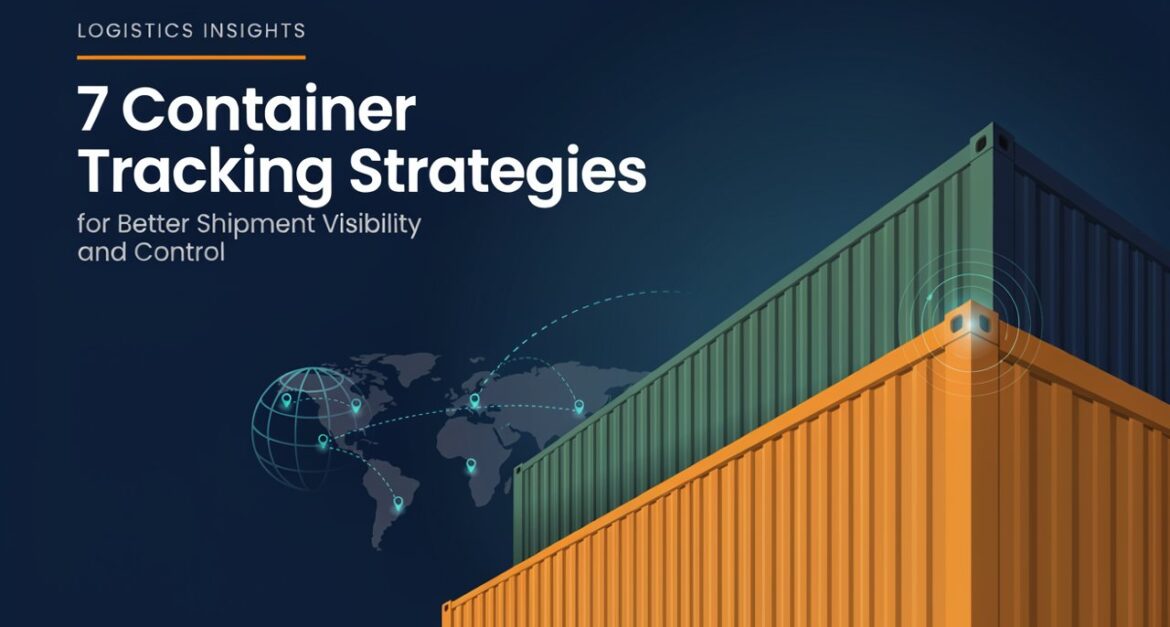
7 Container Tracking Strategies for Better Shipping Performance
Knowing how tracking works is one thing. Using it strategically is another. Below are seven practical container tracking strategies that logistics teams can apply to improve visibility, reduce delays, and keep customers informed.
1. Track Containers in Real Time
Static, once-a-day status checks are no longer sufficient in fast-moving supply chains. Real-time container tracking — updated continuously via GPS and carrier feeds — allows teams to spot issues (a missed vessel connection, an unexpected reroute) as they happen, not days later. This is the foundation every other strategy builds on.
2. Monitor Container Movement Between Ports
A single shipment often passes through multiple ports — an origin port, a transshipment hub, and a final destination port. Tracking movement between each of these checkpoints helps identify where delays are most likely to occur and gives your team a clearer picture of total transit time versus planned schedules.
3. Use Automated Shipment Alerts
Rather than manually checking dashboards, set up automated alerts for key milestones: vessel departure, port arrival, customs clearance, and final delivery. Automated notifications reduce manual monitoring workload and ensure nothing slips through the cracks, especially across high shipment volumes.
4. Connect Carriers and Tracking Systems
Many businesses work with multiple ocean carriers, each with its own tracking portal and data format. Integrating these carrier systems into a single, unified tracking platform eliminates the need to log into five different websites to piece together one shipment’s status.
5. Monitor Container Delays
Proactive delay monitoring — flagging containers that are behind schedule compared to their original ETA — allows teams to intervene early: rebooking connections, adjusting warehouse labor schedules, or notifying customers before a delay becomes a crisis.
6. Keep Customers Updated
Container tracking isn’t just an internal tool. Sharing real-time shipment status with customers — through automated emails, SMS updates, or a client-facing tracking portal — builds trust and dramatically reduces the volume of “where is my order?” support inquiries.
7. Analyze Container Tracking Data
Every tracked shipment generates data: transit times, delay patterns, carrier reliability, port congestion trends. Analyzing this data over time helps businesses choose better carriers, optimize routing, and negotiate more realistic delivery timelines with customers.
What Are the Benefits of Container Tracking?
Better Shipment Visibility
Knowing exactly where cargo is at every stage removes uncertainty from supply chain planning.
Faster Response to Delays
Early detection of schedule slippage means problems can be addressed before they cascade into missed deadlines.
Improved Delivery Planning
Accurate ETAs allow warehouses and distribution teams to schedule labor, dock space, and inventory receiving more efficiently.
Reduced Cargo Risks
Continuous monitoring lowers the risk of theft, misrouting, or unnoticed damage during transit.
Better Customer Communication
Real-time updates let businesses proactively inform customers, rather than reacting to complaints.
Greater Logistics Control
Consolidated visibility across carriers and routes gives logistics managers the data needed to make faster, more confident decisions.
What Information Can Container Tracking Provide?
- Current Container Location — live GPS or last-reported position
- Container Status — loaded, in transit, discharged, gate-out, delivered
- Vessel Information — vessel name, voyage number, current position
- Port Arrival and Departure — timestamped gate and berth events
- Estimated Time of Arrival — dynamically updated ETA
- Shipment Milestones — a full chronological event history from origin to delivery
What Technology Is Used for Container Tracking?
GPS Tracking
Provides precise, real-time location data for containers fitted with GPS devices, especially valuable for high-value or temperature-sensitive cargo.
IoT Sensors
Internet of Things sensors monitor not just location but conditions inside the container — temperature, humidity, shock, and door-open events — critical for perishables and sensitive goods.
RFID Technology
Radio Frequency Identification tags allow automated scanning at gates and terminals, speeding up check-in and check-out processes without manual data entry.
Satellite Tracking
For containers crossing oceans where cellular networks don’t reach, satellite communication keeps location data flowing even in the middle of open water.
Electronic Data Interchange (EDI)
EDI allows carriers, ports, and logistics platforms to exchange standardized shipment data automatically, powering much of the backend synchronization behind tracking systems.
Cloud-Based Tracking Platforms
Cloud platforms aggregate data from GPS, IoT, RFID, and EDI sources into a single dashboard accessible from anywhere — the backbone of modern container tracking software.
How Does Container Tracking Help Ocean Freight?
Tracking Containers at Sea
Satellite and AIS data allow shippers to follow a vessel’s progress across open ocean, even when the container itself is out of cellular range.
Monitoring Port Movements
Terminal data shows exactly when a container is loaded, discharged, or held at a port, helping identify congestion bottlenecks early.
Identifying Delays
Comparing real-time position data against the planned schedule flags delays as soon as they emerge, rather than after the vessel misses its ETA.
Improving Import Planning
Businesses importing goods can align customs preparation, trucking, and warehouse receiving schedules with accurate arrival forecasts.
Managing International Shipments
For companies coordinating shipments across multiple countries and carriers, unified ocean freight tracking simplifies compliance, documentation, and multi-leg coordination.
Container Tracking vs. Traditional Shipment Tracking
| Aspect | Container Tracking | Traditional Shipment Tracking |
| Update Frequency | Continuous / real-time | Periodic, often manual |
| Data Sources | GPS, IoT, AIS, EDI, terminal systems | Carrier status pages, phone/email updates |
| Visibility Scope | End-to-end, multimodal | Often limited to one carrier leg |
| Delay Detection | Proactive, automated alerts | Reactive, discovered after the fact |
| Customer Communication | Automated, self-serve | Manual follow-up required |
| Best Suited For | Ocean, multimodal, international freight | Simple domestic parcel or courier shipments |
Traditional tracking methods often rely on a single carrier’s update cadence, which can leave gaps of days between status changes — especially for ocean freight involving multiple legs and handoffs. Container tracking closes those gaps by pulling from multiple live data sources simultaneously.
Common Container Tracking Challenges
Delayed Tracking Updates
Not all carriers and terminals update their systems at the same speed, creating lag between what’s actually happening and what shows on a dashboard.
Multiple Carrier Systems
Businesses working with several ocean carriers often have to check separate portals, each with different formats and update schedules.
Inaccurate Shipment Information
Data entry errors, mismatched container numbers, or outdated manifests can produce tracking information that doesn’t reflect reality.
Limited Port Visibility
Smaller or less digitized ports may not provide the same level of granular terminal data as major global hubs, creating visibility gaps mid-journey.
Missing Container Data
Occasionally, a container’s tracking record goes quiet — a device malfunction, a missed scan, or a system outage — leaving a temporary gap in the timeline.
How to Choose a Container Tracking Solution
Real-Time Visibility
Look for platforms that update continuously rather than relying on batch updates once or twice a day.
Carrier Integration
The solution should connect with the ocean carriers, freight forwarders, and terminal systems you actually use.
Port and Vessel Coverage
Broad global port and vessel coverage ensures visibility doesn’t disappear the moment cargo leaves a major hub.
Automated Alerts
Prioritize systems that proactively notify your team of delays, milestones, and exceptions — not ones that require constant manual checking.
Data Accuracy
Reliable container tracking depends on clean, verified data. Choose providers with a strong reputation for accuracy over flashy dashboards.
Ease of Use
A tracking system your team will actually use daily needs an intuitive interface, not a steep learning curve.
Scalability
Whether you’re tracking ten containers a month or ten thousand, the platform should scale with your shipment volume without losing performance.
How Palm Horizon KSA Can Support Container Tracking and Logistics
Palm Horizon KSA works with importers, exporters, and freight forwarders across Saudi Arabia to bring clarity to the shipping process. Rather than leaving clients to piece together updates from multiple carrier portals, Palm Horizon KSA consolidates container tracking, customs coordination, and last-mile delivery visibility into one streamlined logistics experience.
For businesses moving cargo through Jeddah Islamic Port, King Abdullah Port, or Dammam, Palm Horizon KSA’s logistics expertise helps translate raw tracking data into actionable decisions — flagging delays early, coordinating with carriers on your behalf, and keeping your team and customers informed at every milestone. Whether you’re managing a single high-value shipment or coordinating recurring container volumes, Palm Horizon KSA positions container tracking as a tool for control, not just observation.
Here’s a simple illustrative look at how different tracking strategies tend to impact shipment visibility outcomes, based on common industry patterns:As the chart suggests, real-time tracking and port monitoring tend to deliver the biggest visibility gains — which is exactly why they top our list of seven strategies above. Note this chart is illustrative of general priority ordering, not a cited statistic.
Fun Facts About Container Tracking
- The modern shipping container was standardized in the 1960s, but GPS-based container tracking didn’t become mainstream until decades later — meaning container shapes were solved long before container visibility was.
- A single large container ship can carry over 20,000 twenty-foot equivalent units (TEUs) — tracking that many containers manually would be nearly impossible without automated systems.
- Some reefer containers used for perishable goods are monitored so closely that alerts can trigger if the internal temperature shifts by even a single degree.
- The unique BIC code on a container follows an international standard, meaning the same numbering system that identifies a container in Jeddah works identically in Rotterdam or Shanghai.
- Satellite tracking means a container can technically be “found” even in the middle of the Indian Ocean, thousands of miles from the nearest cell tower.
FAQs About Container Tracking
What Is Container Tracking?
Container tracking is the process of monitoring a shipping container’s location, status, and movement from origin to destination using GPS, IoT sensors, carrier data, and port systems.
How Does Container Tracking Work?
It works by combining a container’s unique identification number with data feeds from GPS devices, vessel AIS signals, port terminal systems, and carrier updates to create a continuous, real-time shipment record.
How Can I Track a Shipping Container?
Most container tracking is done by entering the container or bill of lading number into a carrier’s tracking portal or a third-party logistics tracking platform, which then displays current status and location.
Can Containers Be Tracked at Sea?
Yes. Vessels transmit AIS signals that reveal their position at sea, and GPS-enabled containers can report location data via satellite connections even far from shore.
What Information Is Needed to Track a Container?
Typically, you need either the container number or the bill of lading (B/L) number, both of which are unique identifiers tied to your specific shipment.
Why Is Container Tracking Important?
It reduces uncertainty in the supply chain, allows businesses to plan around accurate arrival times, and enables faster responses to delays — ultimately improving customer satisfaction and operational efficiency.
How Does Container Tracking Reduce Shipping Delays?
By flagging schedule deviations as soon as they occur — a missed vessel connection or port congestion, for example — tracking allows logistics teams to intervene early, rebook connections, or adjust downstream plans before delays compound.
Conclusion
Container tracking has moved from a “nice-to-have” convenience to a core requirement for any business moving freight internationally. The seven strategies outlined here — real-time tracking, port monitoring, automated alerts, carrier integration, delay monitoring, customer communication, and data analysis — work together to turn raw shipment data into genuine operational control.
For businesses shipping in and out of Saudi Arabia, working with a logistics partner that understands both the technology and the ports themselves makes all the difference. Palm Horizon KSA brings that combination together, helping importers and exporters move from reactive shipment guesswork to proactive, data-driven logistics management. In a global trade environment where delays can ripple across entire supply chains, better container tracking isn’t just about knowing where your cargo is — it’s about staying in control of what happens next.