
Introduction
Ask any importer what keeps them up at night and the answers sound alike: a container stuck at port, a missing document, a surprise charge, a vessel that left a week late. Global trade moves on ships, and small mistakes at any stage become expensive quickly.
Ocean freight forwarding exists to remove that friction. A forwarder plans the route, books the space, prepares the paperwork, clears customs, and gets cargo to the final address, so a business can focus on selling rather than chasing containers.
This guide covers what ocean freight forwarding is, the seven services worth knowing, how the process works step by step, how to choose a provider, and how Palm Horizon KSA supports shipments moving in and out of Saudi Arabia.
Fun fact: According to UNCTAD, roughly 80% of global trade by volume travels by sea. Most of what you own has spent time on a ship.
What Is Ocean Freight Forwarding?
Ocean freight forwarding is the coordination of cargo shipments over sea routes. The forwarder does not usually own the ships. It acts as the expert between the shipper (you) and the carriers, ports, customs authorities, and delivery partners.
Think of it as a travel agent for cargo. You say what you are moving and where. The forwarder handles the route, the booking, the paperwork, and the arrival.
How Does Ocean Freight Forwarding Work?
At a high level:
- The shipper shares cargo details (type, weight, volume, origin, destination).
- The forwarder recommends a shipping method and gets rate options from carriers.
- Space is booked on a vessel, and cargo and documents are prepared.
- Export customs are cleared, and the cargo is loaded and shipped.
- At the destination, import customs are cleared and the goods are delivered.
Why Is Ocean Freight Forwarding Important for Global Trade?
Sea transport offers very large capacity at a lower cost per unit than most alternatives. For businesses shipping machinery, furniture, food products, raw materials, or retail stock, it is often the only practical option. A skilled forwarder makes that option predictable.
What Do Ocean Freight Forwarders Do?
- Shipment planning: choosing routes, timing, and the right container setup
- Carrier and vessel coordination: matching cargo to reliable sailings
- Container booking: securing space, especially in busy seasons
- Cargo handling: coordinating loading, consolidation, and port operations
- Documentation: preparing and checking shipping papers
- Customs clearance: handling declarations at origin and destination
- Final delivery: arranging inland transport to your door or warehouse
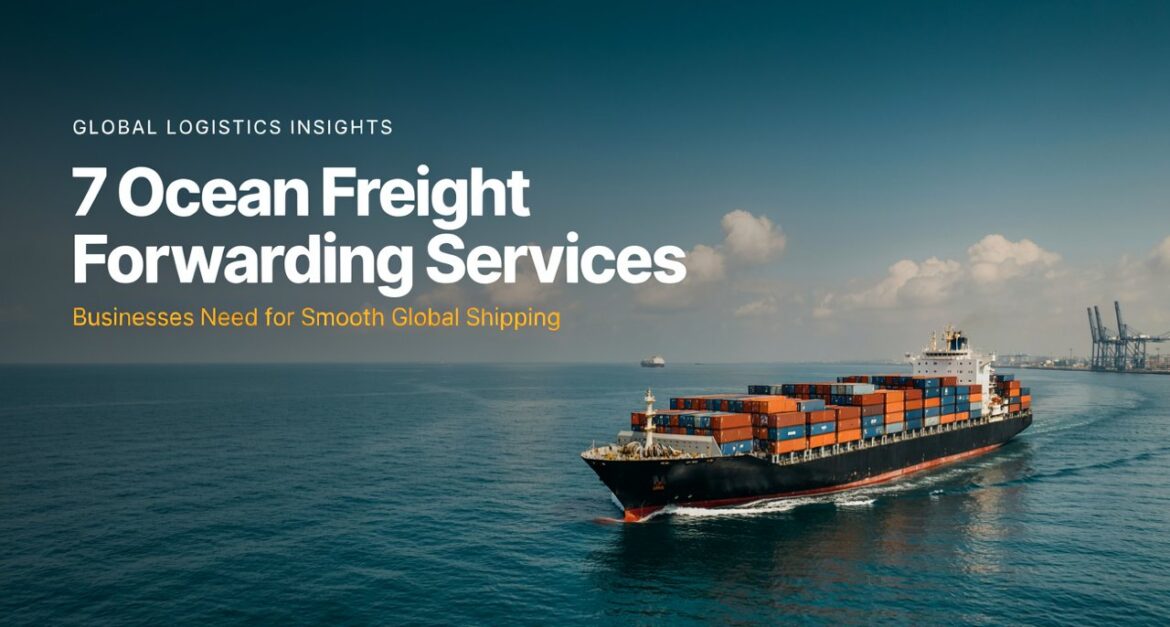
7 Ocean Freight Forwarding Services Businesses Should Know
1. Full Container Load (FCL) Shipping
You rent an entire container for your cargo alone. It suits larger volumes and offers more security, since your goods are not shared with anyone else.
2. Less Than Container Load (LCL) Shipping
Your cargo shares a container with other shippers’ goods. You pay only for the space you use, which suits smaller or occasional shipments.
3. Port-to-Port Ocean Freight
The carrier moves your container from the origin port to the destination port. You arrange or handle everything before and after. It is often the lowest-cost structure if you have your own local partners.
4. Door-to-Door Ocean Freight
The forwarder manages the whole journey: pickup, export clearance, sea transport, import clearance, and final delivery. It is the least stressful option for businesses without an in-house logistics team.
5. Import Ocean Freight Services
Support for bringing goods into a country, including customs documentation, duty-related coordination, port handling, and inland delivery.
6. Export Ocean Freight Services
Support for sending goods abroad: booking, export documents, cargo preparation, and coordination with the destination side.
7. Specialized Ocean Cargo Services
Oversized machinery, sensitive goods, and cargo with special handling needs require extra planning around equipment, packing, and permits.
What Are Ocean Freight Forwarding Services?
Ocean freight forwarding services are the practical building blocks a forwarder combines into your shipment plan:
- Ocean freight booking: reserving space with the carrier
- Container transportation: moving containers by vessel, truck, or rail
- Cargo consolidation: combining smaller loads to use space efficiently
- Port handling: coordinating terminal operations and container release
- Customs clearance: submitting declarations and resolving queries
- Documentation support: preparing, checking, and correcting paperwork
- Shipment tracking: giving you visibility from booking to delivery
- Final-mile delivery: getting cargo from the port to its destination
How Does the Ocean Freight Forwarding Process Work?
Step 1: Assess shipment requirements. Define what you ship, how much, how fast, and at what budget.
Step 2: Select the right shipping method. Choose FCL or LCL, and port-to-port or door-to-door.
Step 3: Compare ocean freight rates. Look at total cost, not just the base freight number.
Step 4: Book container space. Book early, especially before peak seasons.
Step 5: Prepare cargo and documents. Pack correctly and make sure every paper matches.
Step 6: Complete export customs clearance. Cargo cannot legally leave without it.
Step 7: Load cargo and begin ocean transportation. The container is loaded and the vessel sails.
Step 8: Complete import customs clearance. Duties, inspections, and approvals happen at the destination.
Step 9: Arrange final delivery. The container is collected and moved to its final location.
Ocean Freight Forwarding vs. Other Freight Methods
| Factor | Ocean Freight | Air Freight | Road Freight |
| Transit time | Generally longer | Generally faster | Depends on distance |
| Cargo capacity | Very high | More limited | Moderate |
| Cost for large shipments | Often economical | Generally higher | Varies |
| Best for | Large and bulk shipments | Time-sensitive cargo | Regional and domestic movement |
| Main transport | Vessel | Aircraft | Trucks |
The chart below shows how the three modes compare on a general, indicative scale (1 = low, 10 = high). These are illustrative ratings to show the trade-offs, not measured statistics.The takeaway: ocean freight wins on capacity and cost for large loads, and gives up speed. If your cargo isn’t urgent, the sea route usually makes the most financial sense.
What Are the Benefits of Ocean Freight Forwarding?
- Lower transportation costs for large shipments: the cost per unit drops as volume grows.
- High cargo capacity: one vessel carries thousands of containers.
- Flexible container options: standard, high-cube, refrigerated, and open-top units cover different cargo.
- Global port connectivity: sea routes reach markets that other modes reach only with difficulty.
- Support for international trade: a forwarder helps you meet each country’s rules.
- Better options for bulk cargo: heavy or bulky goods are far cheaper to move by sea.
- End-to-end logistics coordination: one partner instead of five separate vendors.
Fun fact: Before shipping containers became standard in the 1950s, cargo was loaded piece by piece, by hand. Malcolm McLean’s converted tanker Ideal X made its first container voyage in 1956 and changed shipping for good.
What Are Ocean Freight Forwarding Companies?
Ocean freight forwarding companies are logistics businesses that arrange sea shipments on behalf of importers and exporters. A good one brings four things:
- Carrier and port network: relationships that help secure space and better schedules
- Customs and documentation support: fewer errors and faster clearance
- Shipment visibility: clear updates so you are never guessing
- Warehousing and delivery coordination: smooth handover after the port
How to Choose Among Ocean Freight Forwarding Companies
Look beyond the price quote. Ask about:
- Global and regional coverage: does it serve your trade lanes?
- Carrier network: can it offer alternatives if a sailing is cancelled?
- Service range: FCL, LCL, door-to-door, specialized cargo?
- Freight pricing: is every charge itemized?
- Transit time: are schedules realistic?
- Tracking technology: can you see your container’s status?
- Customs expertise: does it know your destination’s rules?
- Customer support: will a real person answer when something goes wrong?
- Industry experience: has it handled cargo like yours?
Who Are the Top Ocean Freight Forwarders?
There is no single “top” forwarder for every business. The best one for a furniture importer in Jeddah differs from the best one for a food exporter in Dammam. Instead of choosing on the label alone, judge providers on:
- Global network
- Port coverage
- Carrier relationships
- Digital tracking
- Customs support
- Container availability
- Pricing transparency
- Service reliability
A provider that scores well on these will serve you better than one with the loudest marketing.
Ocean Freight Forwarders vs. Ocean Carriers
Many first-time shippers confuse the two.
A freight forwarder coordinates your shipment and can compare multiple carriers. An ocean carrier operates the vessels and moves the container.
| Factor | Freight Forwarder | Ocean Carrier |
| Main role | Coordinates shipments | Operates vessels and ocean services |
| Customer relationship | Works with shippers | Provides transportation capacity |
| Documentation | Coordinates shipping documents | Issues carrier documentation |
| Route options | May compare multiple carriers | Uses its own network |
| Additional services | May arrange customs, warehousing, and delivery | Primarily transportation |
In short: the carrier sells the ride, the forwarder manages the journey.
What Documents Are Required for Ocean Freight Forwarding?
Documentation errors are one of the most common causes of delay. Keep these ready and consistent:
- Bill of Lading: the contract and receipt for the cargo
- Commercial Invoice: the value and description of the goods
- Packing List: what is in each package, with weights and dimensions
- Certificate of Origin: where the goods were made
- Customs Declaration: the formal declaration to customs authorities
- Import and export documents: permits or licenses specific to your goods
- Insurance documents: proof of cargo coverage
Tip: Even a small mismatch, such as a different quantity on the invoice and the packing list, can hold up clearance.
What Is FCL in Ocean Freight Forwarding?
How FCL works: You book a whole container. It is loaded at your site or a warehouse, sealed, and moves to the port without being opened until it reaches the destination.
Benefits: lower damage risk, faster handling, and a better cost per unit at higher volumes.
When to consider FCL: when your cargo fills most of a container, or when it is high value or fragile.
What Is LCL in Ocean Freight Forwarding?
How LCL works: Your cargo goes to a consolidation warehouse, where it is combined with other shippers’ goods. At the destination, the container is opened and the cargo is separated.
Cargo consolidation: this is what makes LCL affordable, because everyone shares the container’s cost.
Benefits: pay only for the space you use, and ship smaller quantities more often.
When to consider LCL: for smaller loads, product samples, or when you do not want to hold inventory just to fill a container.
What Technology Is Used in Ocean Freight Forwarding?
Modern forwarding relies on:
- Freight management software to organize bookings and documents
- Container tracking to monitor location and status
- Real-time visibility for faster decisions
- Digital documentation to reduce paper delays
- Automated alerts for schedule changes or arrivals
- Data analytics to spot cost and delay patterns
How Does Ocean Freight Tracking Work?
A typical container journey creates these status points:
- Booking confirmation
- Container pickup
- Port arrival
- Vessel loading
- Vessel departure
- Transshipment updates (if the route involves transfers)
- Destination port arrival
- Customs clearance
- Final delivery
Each status update lets you plan warehouse space, staff, and customer promises more accurately.
Common Ocean Freight Forwarding Challenges
- Port congestion: waiting for berths or yard space
- Container shortages: equipment not available where you need it
- Vessel schedule changes: delays or cancelled sailings
- Customs delays: inspections or missing approvals
- Documentation errors: mismatched or incomplete paperwork
- Demurrage and detention costs: fees for keeping containers too long at the port or outside it
- Limited shipment visibility: not knowing where cargo is
- Unexpected freight charges: costs that were not quoted upfront
How to Reduce Ocean Freight Costs
- Consolidate shipments to fill containers.
- Select the right container type and avoid paying for unused space.
- Compare freight rates across carriers and routes.
- Plan bookings in advance to avoid peak-season premiums.
- Reduce documentation errors to avoid fines and delays.
- Optimize container utilization with smarter packing.
- Monitor demurrage and detention and clear cargo before free time ends.
- Improve shipment visibility so you can act before small delays grow.
Fun fact: Container capacity is measured in TEU (twenty-foot equivalent units). The largest container ships today can carry more than 20,000 TEU, enough to line up a very long row of trucks.
How Palm Horizon KSA Supports Ocean Freight Forwarding
Palm Horizon KSA supports businesses that need dependable sea freight coordination without the stress of managing every step themselves. Its support covers:
- International ocean freight coordination: planning and managing sea routes
- Import and export support: for shipments entering and leaving the Kingdom
- Container shipment management: from booking to release
- Documentation coordination: helping keep paperwork accurate and consistent
- Customs clearance support: guiding shipments through the process
- Shipment tracking: keeping you informed along the way
- Final delivery coordination: connecting the port to your destination
The aim is simple: fewer surprises, clearer communication, and cargo that arrives when you expect it.
Ocean Freight Forwarding for Saudi Arabia
Saudi Arabia sits between three continents and has grown into a major logistics hub. Businesses here can use ocean freight in two directions:
- Importing goods through Saudi ports: consumer goods, machinery, building materials, and food products
- Exporting goods from Saudi Arabia: industrial and commercial products bound for global markets
Jeddah Islamic Port on the Red Sea is one of the Kingdom’s key gateways for containerized cargo. King Abdulaziz Port in Dammam serves the Eastern Province and Gulf trade. Both handle large volumes of containerized cargo, so choosing the right port affects transit time and inland costs.
Local knowledge matters here, in customs and import documentation and in inland transportation. A forwarder familiar with Saudi procedures can prevent delays that a generic global process would miss.
Fun fact: Jeddah has been a trading gateway for centuries, historically serving pilgrims and merchants arriving by sea.
Ocean Freight Forwarding KPIs Businesses Should Monitor
| KPI | Why It Matters |
| Transit time | Helps you plan inventory |
| Freight cost per shipment | Shows real cost trends |
| On-time delivery rate | Measures reliability |
| Container utilization | Reveals wasted space |
| Customs clearance time | Flags process problems |
| Demurrage and detention cost | Exposes avoidable fees |
| Documentation accuracy | Predicts delays |
| Shipment visibility | Measures how informed you are |
Ocean Freight Forwarding: Quick Checklist
- [ ] Define cargo requirements
- [ ] Select FCL or LCL
- [ ] Compare freight rates
- [ ] Choose a suitable forwarder
- [ ] Confirm vessel schedule
- [ ] Prepare shipping documents
- [ ] Complete customs requirements
- [ ] Track the container
- [ ] Monitor destination clearance
- [ ] Coordinate final delivery
More Fun Facts About Ocean Freight Forwarding
- A single container ship can carry goods worth billions of dollars in one voyage.
- The humble container did more to shrink shipping costs than almost any other invention in modern logistics.
- LCL shipping works like carpooling for cargo: many shippers, one container, shared cost.
- Reading a Bill of Lading correctly can save days of delay at the port.
FAQs About Ocean Freight Forwarding
What is ocean freight forwarding?
It is the service of planning, booking, documenting, and coordinating cargo shipments by sea, from origin to final delivery.
What do ocean freight forwarders do?
They plan routes, book container space, prepare documents, handle customs coordination, track shipments, and arrange delivery.
What are ocean freight forwarding services?
They include booking, container transportation, consolidation, port handling, customs clearance, documentation support, tracking, and final-mile delivery.
How does ocean freight forwarding work?
You share cargo details, the forwarder recommends a method and books space, documents and customs are handled at both ends, and the cargo is delivered at the destination.
What are ocean freight forwarding companies?
They are logistics providers that manage sea shipments for businesses and connect them with carriers, ports, and customs processes.
Who are the top ocean freight forwarders?
The best choice depends on your routes, cargo, and budget. Compare network, port coverage, tracking, customs support, and pricing transparency rather than relying on rankings.
What is the difference between a freight forwarder and an ocean carrier?
A carrier operates the vessels. A forwarder arranges the shipment, often comparing several carriers, and adds services like customs and delivery.
What is the difference between FCL and LCL?
FCL means you use a whole container. LCL means you share one with other shippers and pay for the space you use.
How long does ocean freight forwarding take?
It varies by route, port, season, and customs. It is generally slower than air freight, so plan ahead and build in buffer time.
How can businesses reduce ocean freight costs?
Consolidate shipments, book early, compare rates, choose the right container, avoid documentation errors, and monitor demurrage and detention.
What documents are needed for ocean freight?
Typically a Bill of Lading, commercial invoice, packing list, certificate of origin, customs declaration, any required permits, and insurance documents.
Conclusion
Ocean freight is the backbone of global trade for good reason: it moves large volumes at a cost that other methods rarely match. But cheap freight only pays off when the process around it is smooth. Late bookings, weak paperwork, and poor visibility can erase the savings in a single delayed container.
That is where a dependable forwarding partner earns its place. With clear planning, accurate documents, active tracking, and local customs knowledge, ocean shipping becomes predictable rather than stressful.
If you are importing into or exporting from Saudi Arabia, Palm Horizon KSA can help you manage the whole journey, from booking to final delivery. Share your cargo details, ask for a plan that fits your route and budget, and move your next shipment with confidence.