

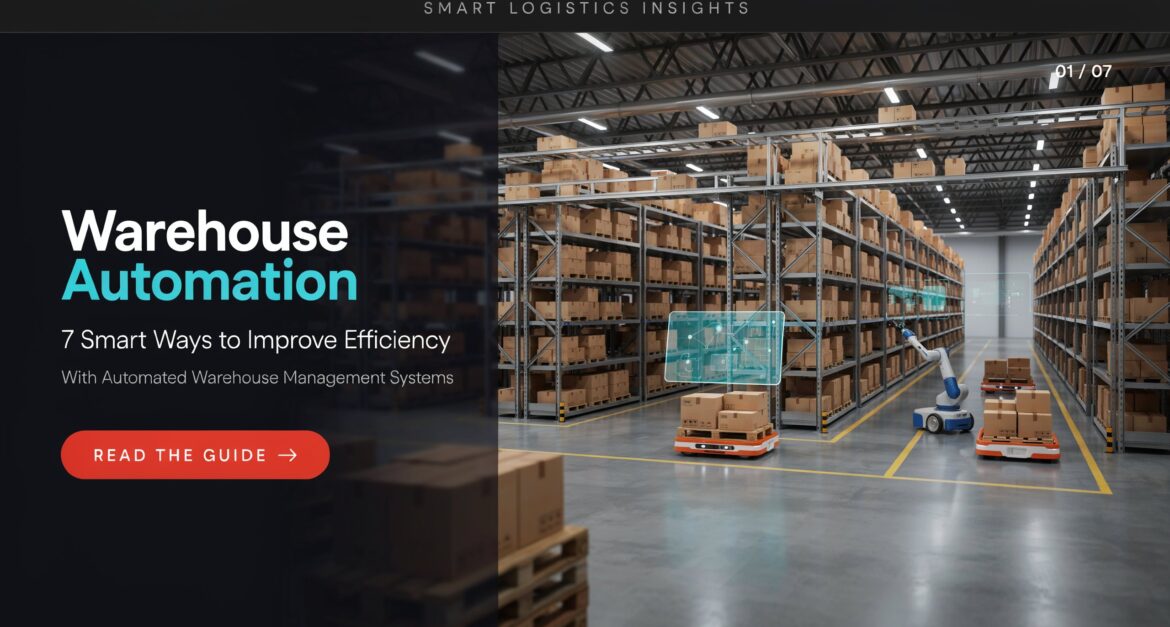
Picture a Thursday evening before a big sale in Riyadh. Orders are pouring in, the floor is crowded, and a picker walks the same aisle for the fourth time because the system says an item is in one place and the shelf says otherwise. Multiply that by hundreds of workers and thousands of orders, and you can see why the warehouse has become the pressure point of modern commerce.
Customers now expect same-day or next-day delivery. Labor is harder to find and more expensive to keep. Floor space costs more every year. Many warehouses still run on spreadsheets, paper pick lists and memory.
Warehouse automation is the practical answer. It doesn’t have to mean a robot-only building. It means using software, machines and data so that people spend less time walking, searching and re-checking, and more time on work that needs judgment.
This guide covers what automation is, which technologies matter, how an automated warehouse management system works, how to choose a provider, what it costs, and how it plays out in Saudi Arabia. Palm Horizon KSA appears throughout as a local partner for businesses planning this move.
Fun fact: The first barcode scanned at a checkout was on a pack of chewing gum in 1974, in Troy, Ohio. A tiny stripe pattern started a revolution in inventory tracking.
What Is Warehouse Automation and Why Does It Matter?
Quick answer: Warehouse automation is the use of technology, such as software, robots, conveyors and scanners, to perform or assist warehouse tasks like storing, picking, packing, sorting and counting with less manual effort and fewer mistakes.
Understanding Warehouse Automation in Modern Logistics
A warehouse is no longer a place where goods sit. It is a node in a fast-moving supply chain, and every delay there reaches the customer. Automation covers a wide range, from a handheld scanner that confirms a pick to a fully robotic storage system that moves pallets without a person nearby.
Most businesses start small and build up. A barcode system comes first, then a warehouse management system (WMS), then conveyors or mobile robots as volumes justify them.
How Automation Improves Warehouse Operations
Automation attacks three costs that quietly drain warehouses:
- Travel time. Workers can spend a large share of their shift walking. Robots, conveyors and goods-to-person systems bring items to the worker instead.
- Search time. Real-time location data tells staff exactly where stock is.
- Rework. Scan-based verification catches errors before a wrong item leaves the dock.
Manual Warehousing vs. Automated Warehouse Operations
| Factor | Manual Warehouse | Automated Warehouse |
| Inventory records | Periodic counts, frequent mismatches | Continuous, scan-based updates |
| Picking | Paper lists or memory, long walking routes | System-directed, optimized routes or goods-to-person |
| Space use | Wide aisles, floor-level storage | High-density, vertical storage |
| Error rate | Depends heavily on fatigue and training | Lower, because every step is verified |
| Scaling for peak season | Hire and train temporary staff | Add capacity through software and equipment |
| Data visibility | Delayed reports | Live dashboards |
Key Benefits of Warehouse Automation for Businesses
- Faster order cycles and more reliable delivery promises
- Higher inventory accuracy, which means fewer stockouts and fewer overstock write-offs
- Lower cost per order over time
- Safer working conditions
- Better use of every square meter you pay for
- Data you can use to plan, not just report
Space is where the numbers get dramatic. Arab News reported that a 1,000-square-meter warehouse could go from holding 500 pallets under a traditional system to 5,700 pallets with automated systems. Here is that comparison:
That comparison, a 500-pallet traditional layout versus 5,700 pallets once automated storage is used, came from an industry executive quoted by Arab News. Treat it as a best-case example for high-bay systems, not a promise for every site. Even so, it shows why space is one of the first things automation changes.
Types of Warehouse Automation Technologies
Quick answer: The main types are automated storage and retrieval systems (ASRS), automated guided vehicles (AGVs) and autonomous mobile robots (AMRs), conveyors and sorters, barcode and RFID tracking, robotic picking and packing, and automated inventory counting.
Automated Storage and Retrieval Systems
An ASRS uses cranes, shuttles or robots to place and retrieve goods in tall racking with almost no human travel. It suits high-volume, repeatable storage and is the technology behind the density gains shown above.
Fun fact: Automated storage and retrieval concepts date back to the 1960s, long before most businesses owned a computer.
Automated Guided Vehicles and Autonomous Mobile Robots
AGVs follow fixed paths, such as magnetic tape or wires. AMRs navigate with sensors and maps, so they can steer around obstacles. AMRs are usually the easier fit for existing buildings because the layout doesn’t need rebuilding.
Fun fact: Amazon bought the robotics company Kiva Systems in 2012 for about $775 million, a deal that pushed warehouse robotics into the mainstream.
Conveyor Systems and Automated Sorting
Conveyors move cartons between zones. Sorters then divert each one to the right lane by destination, carrier or order. This is the backbone of parcel and e-commerce operations.
Barcode Scanning and RFID Tracking
Barcodes need line of sight and one scan at a time. RFID tags can be read in bulk without direct sight, which speeds up receiving and cycle counts.
Fun fact: RFID’s roots go back to World War II, when radio-based identification helped tell friendly aircraft from enemy ones.
Robotic Picking and Packing Systems
Robotic arms with vision systems pick and place items and pack them into cartons. They are improving fast, especially for uniform products, though irregular or fragile items still often need human hands.
Automated Inventory Counting Solutions
Drones, fixed scanners and RFID readers can count stock without shutting down operations. Teams get a continuous picture rather than a once-a-year shock.
Automated Warehouse Management System: Features and Benefits
Quick answer: An automated warehouse management system (WMS) is software that tracks inventory in real time, directs tasks to people and machines, and connects the warehouse to ordering, accounting and transport systems.
Think of the WMS as the brain. The robots and conveyors are the muscles, but without good software they just move things quickly in the wrong direction.
Real-Time Inventory Tracking and Visibility
Every receipt, move and pick is recorded the moment it happens. Managers see what is on hand, what is in transit and what is about to run out, without waiting for an end-of-day report.
Automated Order Processing and Fulfillment
Orders flow in from your online store, marketplace or ERP. The system groups them into efficient waves, assigns pick tasks, generates packing instructions and prints labels. Fewer clicks, fewer hand-offs, fewer chances to err.
Inventory Replenishment and Stock Control
Set minimum and maximum levels, and the system flags or triggers replenishment automatically. Fast sellers stay stocked in prime locations, and slow movers don’t clog them.
Warehouse Space and Location Optimization
Smart slotting places high-demand items close to packing stations and heavy items at safe heights. Some systems keep re-evaluating as demand shifts through the year.
Integration With ERP and Transportation Management Systems
A WMS shares data with your ERP (finance and purchasing) and your TMS (carriers and delivery). That removes double entry and keeps customers informed about shipments.
Data Analytics and Warehouse Performance Reporting
Dashboards show productivity by shift, error hotspots, dock congestion and order aging. You can only improve what you can see.
Warehouse Automation Companies: How to Choose the Right Provider
Quick answer: Choose a provider by checking industry experience, technology range, integration ability, support after go-live, total cost of ownership, and room to grow.
The market includes global equipment manufacturers, software publishers and regional integrators. Each brings different strengths, so the best choice depends on your products, volumes and existing systems.
Evaluate Industry Experience and Technical Expertise
Ask for projects similar to yours in size and product type. A partner who has handled chilled food will see problems that a general-merchandise specialist may miss.
Compare Automation Technologies and Solutions
Be wary of a provider who recommends the same system for everyone. A good partner compares several options against your numbers and is honest when a simple fix beats a big machine.
Check Integration With Existing Warehouse Systems
Find out exactly how the new system talks to your ERP, e-commerce platform and carriers. Integration is where many projects slip.
Review Installation, Training, and Maintenance Support
Equipment is only as good as its uptime. Look for local engineers, spare-parts availability, response-time commitments and hands-on training for your staff.
Compare Implementation Costs and Expected Returns
Compare total cost of ownership, not just the purchase price: installation, software licences, support contracts, energy and upgrades.
Assess Scalability for Future Business Growth
Ask what happens when volume doubles. Modular systems let you add capacity in stages instead of rebuilding.
Palm Horizon KSA approaches projects the same way a buyer should evaluate them: start from your operation, not from a catalog. The aim is a design that fits your products, your building and your budget, with room to expand.
7 Ways Warehouse Automation Improves Operational Efficiency
1. Reduce Manual Handling and Repetitive Tasks
Lifting, walking and re-scanning wear people down. Automation takes over the repetitive parts so staff can handle exceptions, quality checks and customer-specific needs.
2. Improve Inventory Accuracy
Scan-driven updates mean the system matches the shelf. Accurate records cut emergency orders, lost sales and “phantom stock” that shows as available but isn’t.
3. Increase Order Picking and Packing Speed
Optimized routes, batch picking and goods-to-person stations reduce travel time. Orders reach the dock sooner, which matters most during sale peaks.
4. Reduce Warehouse Errors and Product Damage
Verification at each step catches wrong items and quantities. Mechanized handling also means fewer dropped cartons.
5. Optimize Storage Space
Vertical, high-density storage uses the building’s height instead of its footprint. For businesses paying for every square meter, this can delay or avoid a costly move.
6. Improve Workplace Safety
Fewer forklifts in crowded aisles, less manual lifting and clearer traffic rules lower the risk of injuries, especially in hot conditions.
7. Support Faster and More Reliable Order Fulfillment
Speed gets attention, but reliability earns loyalty. Customers forgive a two-day delivery they were told about. They don’t forgive a one-day promise that arrives in four.
Warehouse Automation Solutions for Different Industries
Warehouse Automation for E-Commerce Businesses
High order counts, small baskets and strict delivery promises make e-commerce the classic case for conveyors, sortation and goods-to-person picking. Returns handling also benefits from scan-based processing.
Automated Warehousing for Retail and Distribution
Retail distribution centers balance store replenishment with online orders. Automation helps them serve both from shared stock without double counting.
Automation for Manufacturing and Industrial Goods
Heavy, bulky and varied parts suit pallet shuttles, AGVs and line-side delivery that keeps production lines fed on time.
Warehouse Systems for Food and Beverage Operations
Expiry dates, batch tracking and temperature control matter here. A WMS can enforce first-expired-first-out rules automatically.
Pharmaceutical and Healthcare Warehouse Automation
Traceability and storage conditions are non-negotiable. Automated lot tracking, access control and audit trails help meet regulatory expectations.
Common Warehouse Automation Challenges
Automation isn’t a magic wand. Knowing the obstacles up front is how you avoid them.
High Initial Investment and Implementation Costs
Equipment and software need capital. Phased rollouts, leasing models and starting with software-only improvements can spread the cost.
Integration With Existing Warehouse Software
Legacy systems and custom spreadsheets can be awkward partners. Map your data flows early and test interfaces before go-live.
Employee Training and Change Management
People worry about being replaced. Be open about how roles will change, train early, and involve supervisors in design. Adoption makes or breaks the project.
Equipment Maintenance and System Downtime
Plan for preventive maintenance, spare parts and a manual fallback process. Skilled-workforce availability is a recognized concern in the Saudi supply chain sector too, as industry commentary notes growing demand for skilled people to run advanced technologies like automation.
Managing Data Accuracy and System Reliability
Automation amplifies bad data. Clean up product dimensions, barcodes and location codes before switching on anything new.
How to Implement an Automated Warehouse Management System
Quick answer: Assess your current operation, set priorities, select technologies, integrate your software, train your team and test, then monitor and keep improving.
Step 1: Assess Current Warehouse Operations
Measure first: orders per day, peak volumes, SKU count, pick accuracy, walking distances, space use. A week of honest data beats a month of opinions.
Step 2: Identify Automation Priorities
Find the biggest bottleneck. For some it’s receiving; for others it’s picking or packing. Fix the constraint that limits the whole flow.
Step 3: Select Suitable Warehouse Technologies
Match technology to the problem, not the other way around. Shortlist two or three options and compare them on cost, speed, flexibility and risk.
Step 4: Integrate Warehouse Management Software
Connect the WMS to your ERP, marketplaces and carriers. Test with real orders in a sandbox before touching live stock.
Step 5: Train Employees and Test Workflows
Run pilots in one zone, collect feedback, and fix friction. Keep a manual backup plan for the first weeks.
Step 6: Monitor Performance and Optimize Processes
After go-live, review your KPIs weekly. Tune slotting rules, wave settings and staffing as patterns appear.
Warehouse Automation Costs and Return on Investment
Quick answer: Costs depend on warehouse size, technology, software and integration complexity. Return comes mainly from labor savings, higher throughput, fewer errors and better use of space, and payback periods vary widely by project.
Factors That Affect Warehouse Automation Costs
- Building size and layout
- Order volume and SKU variety
- Level of automation (software only, semi-automated, or fully robotic)
- Integration complexity
- Local installation and support requirements
Software, Robotics, and Equipment Expenses
Expect line items for WMS licences, scanners, racking, conveyors or robots, network infrastructure, installation and training. Ask every vendor for a full list so nothing surprises you later.
Calculating Labor and Operational Cost Savings
A simple way to estimate:
Annual savings = (labor hours saved × hourly cost) + (error costs avoided) + (space or rent avoided)
Hypothetical example, for illustration only: if automation saves 6,000 labor hours a year, and each hour costs SAR 30 fully loaded, that is SAR 180,000. Add avoided re-shipping, returns and write-offs, and the figure grows.
Measuring Productivity Improvements
Compare lines picked per labor hour and orders per shift before and after. Record the baseline now, because you can’t prove improvement without it.
Estimating the Return on Warehouse Automation Investment
Payback period = total investment ÷ annual net savings. Include maintenance and energy in the denominator’s costs. Many projects pay back over a few years, but the right answer is the one calculated from your own numbers.
Warehouse Automation Trends Shaping the Future of Logistics
Artificial Intelligence for Warehouse Planning
AI helps forecast demand, plan labor and decide where to store each item. It works best with clean historical data.
Autonomous Mobile Robots for Material Movement
Flexible AMRs are increasingly affordable and can be added one at a time, which lowers the entry barrier for mid-sized operators.
Predictive Analytics for Inventory Management
Instead of reacting to stockouts, predictive tools suggest what to reorder and when, based on seasonality and sales patterns.
Smart Sensors and Internet of Things Technology
Sensors track temperature, vibration, door openings and equipment health. A motor that reports trouble early is cheaper than one that stops on your busiest day.
Connected Warehouses and Real-Time Data Systems
The direction is clear: warehouse, transport, supplier and customer systems sharing live data, so every party sees the same picture.
Warehouse Automation in Saudi Arabia
Quick answer: Saudi Arabia is investing heavily in logistics under Vision 2030, e-commerce is growing, and labor and rent costs are rising. Together these make warehouse automation Saudi Arabia’s fastest-moving logistics upgrade.
Growing Demand for Automated Warehousing
One market research publication projects the KSA logistics automation market will grow from USD 636 million in 2025 to USD 923 million by 2031, a forecast annual growth rate of 6.41%. The chart below spreads that growth across the years using the same rate, so intermediate values are estimates, not reported figures.
Endpoints from a forecast putting the KSA logistics automation market at USD 636 million in 2025 and USD 923 million by 2031, a 6.41% CAGR. Forecasts differ between research firms, so use them as direction, not destiny.
Warehouse Automation for Saudi E-Commerce and Retail
Online shopping keeps growing, and shoppers expect speed. Global operators are already building automated fulfillment in the Kingdom. For example, Savoye partnered with CJ Logistics to deliver automation for an e-commerce distribution center in Riyadh serving iHerb. That is a sign the standard is rising for everyone.
Improving Distribution Efficiency Across Saudi Arabia
The Kingdom is large, and goods often travel long distances between ports, inland hubs and customers. Industry coverage points to a network of 59 planned logistics zones, which will need fast, accurate warehouses to make the network worthwhile. Riyadh, Makkah and the Eastern Province are the main corridors for automation activity.
Choosing Warehouse Automation Solutions for Local Operations
Local conditions matter. Heat, dust, Arabic-language interfaces, local carrier integrations, and fast spare-parts support all affect how well a system performs. A partner with regional presence, like Palm Horizon KSA, can design with these realities in mind instead of treating them as afterthoughts.
Preparing Saudi Warehouses for Future Logistics Demands
Plan for growth now: modular systems, scalable software, and training programs that build local skills. The businesses that automate in stages today will be the ones able to scale quickly when demand jumps.
How to Measure Warehouse Automation Performance
Quick answer: Track six KPIs: order picking accuracy, inventory accuracy, orders processed per hour, space utilization, order fulfillment time and operating cost per order.
| KPI | What It Tells You | How to Calculate |
| Order picking accuracy | How often the right item and quantity ship | Correct order lines ÷ total order lines |
| Inventory accuracy and stock availability | Whether system stock matches physical stock | Matching locations ÷ locations counted |
| Orders processed per hour | Throughput of your operation | Orders completed ÷ labor hours or machine hours |
| Warehouse space utilization | How well you use the space you pay for | Used storage positions ÷ available positions |
| Order fulfillment time | Speed from order received to shipped | Average time between order release and dispatch |
| Operating cost per order | Overall efficiency | Total warehouse cost ÷ orders shipped |
Set a baseline before launch, review monthly, and share results with the team. Wins are motivating, and problems are easier to fix when everyone sees them.
Frequently Asked Questions About Warehouse Automation
What Is Warehouse Automation?
Warehouse automation uses technology, including software, scanners, conveyors and robots, to carry out warehouse tasks with less manual work. Its goals are higher speed, better accuracy and lower cost per order.
What Is an Automated Warehouse Management System?
It is software that tracks inventory and directs warehouse tasks in real time. It assigns picks, updates stock levels, suggests storage locations and connects with your ERP and shipping systems, so decisions rely on live data.
What Services Do Warehouse Automation Companies Provide?
Typical services include warehouse assessment, system design, equipment supply and installation, WMS implementation, integration with other systems, staff training, and ongoing maintenance. Some firms specialize in software, others in hardware, and some provide both.
How Much Does Warehouse Automation Cost?
There’s no single price. A scanner-based WMS is a modest investment, while robotic storage can be a major one. Costs depend on size, technology and integration needs. The best step is to request quotes based on a measured assessment of your operation, then calculate payback with your own savings estimates.
What Are the Main Benefits of Warehouse Automation?
The main benefits are better inventory accuracy, faster order processing, fewer errors, higher space utilization, safer working conditions and lower long-term operating costs. Better data for planning is a bonus.
Is Warehouse Automation Suitable for Small Businesses?
Yes, in stages. Small operations often begin with barcode scanning and a cloud-based WMS, then add mobile robots or conveyors as volume grows. You don’t need a fully robotic building to see gains.
How Does an Automated Warehouse Management System Improve Inventory Accuracy?
It records each movement as it happens through scans, so system counts follow physical stock. It also enables cycle counting, flags discrepancies quickly and reduces the manual entry errors that cause mismatches.
How Do Businesses Choose the Right Warehouse Automation Company?
Look for relevant experience, a range of technologies, proven integration skills, local support and transparent total costs. Ask for references, visit a live site if possible, and confirm how the provider will handle training and maintenance after launch.
Conclusion: Improve Warehouse Productivity With Smarter Automation Solutions
Warehouses used to be judged by how much they could hold. Today they are judged by how quickly and accurately they can ship. Automation, from a simple scanner to a connected robotic system, is how businesses keep up with higher expectations without a matching rise in cost and stress.
The best approach is a practical one: measure your operation, fix the biggest bottleneck first, choose technology that fits your products, and bring your people along. Saudi Arabia’s logistics growth rewards companies that prepare early.
If you’re considering your first step, or your next one, Palm Horizon KSA can help you assess your current setup, compare options and plan a phased path that makes sense for your budget and growth. Reach out to start with a clear, no-pressure look at where your warehouse stands today.