
The choice of freight forwarding firms in Saudi Arabia is no longer a normal logistics exercise. It is a strategic move, which has a direct impact on controlling costs, stability of operations, the regulation and long-term development.
The logistics environment in Saudi Arabia has changed at a fast rate. Increased capacity and speed of smart ports, digital customary systems, multimodal corridors and the investment made by Vision 2030 has increased expectations–but has also increased capacity and speed. Late deliveries, budgeting, and patchy supply chain operations have never been as expensive or as reputation-threatening as it is today.
Freight forwarders are still selected by many companies depending on price comparisons or the relationship existed between them. Such strategies tend to ignore organizational design, ability to coordinate and responsibility. This leads to indirect expenses and delays at the customs, interruptions in deliveries, and lack of visibility in the supply chain of any business.
The appropriate freight forwarding partner is one that does not just convey cargo. They organize, plan, risk avert and guard margins.
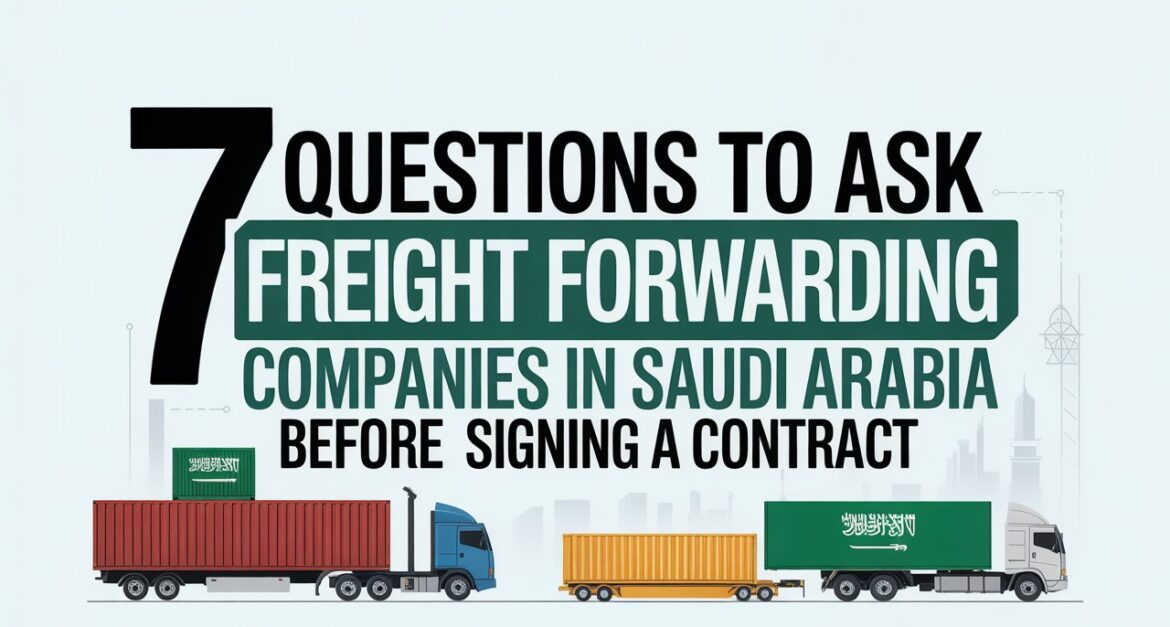
Businesses must pose the following seven questions before they sign any contract. All questions provide the answer to whether a freight forwarding firm can be considered as reactive or provide a logistics implementation that is integrated and disciplined throughout Saudi Arabia.
Question 1: How Do You Control Total Logistics Cost—Not Just Freight Rates?
Freight rates attract attention because they are visible and easy to compare. Total logistics cost, however, tells the real story.
Many companies reduce freight rates only to lose savings through:
- Demurrage and detention
- Emergency air freight
- Storage delays
- Inefficient inland transportation
- Poor shipment planning
Professional freight forwarding companies in Saudi Arabia focus on total cost control, not isolated rate negotiation.
Strong logistics partners actively manage cost drivers before shipments move.
What capable freight forwarders do differently:
- Plan shipments to reduce urgency
- Consolidate cargo where possible
- Coordinate customs clearance before arrival
- Align inland transport with delivery readiness
When a freight forwarder discusses cost only in terms of rates, businesses should expect cost leakage later.
Question 2: How Do You Manage Customs Clearance in Saudi Arabia?
Customs clearance remains one of the most critical points in Saudi logistics operations. Even with digital platforms and automation, clearance delays still occur due to documentation errors, HS code misclassification, and regulatory non-compliance.
Freight forwarding companies in Saudi Arabia must demonstrate deep customs expertise, not just brokerage access.
Key indicators of strong customs capability:
- Pre-arrival document validation
- Accurate HS classification processes
- Regulatory compliance checks before shipment dispatch
- Direct coordination between customs and delivery teams
When customs clearance integrates into the logistics workflow, businesses avoid penalties, delays, and unpredictable costs.
Question 3: Do You Offer Integrated End-to-End Logistics or Only Freight Forwarding?
Freight forwarding alone does not guarantee operational efficiency.
When freight forwarding, customs clearance, warehousing, and inland transportation operate separately, delays and accountability gaps increase. Each handover creates risk.
Integrated logistics reduces fragmentation.
The strongest freight forwarding companies in Saudi Arabia operate within an end-to-end execution model.
Signs of true integration:
- Single operational coordination
- Unified shipment visibility
- One accountable partner from origin to final delivery
- Seamless data and communication flow
This integration model reflects how Palm Horizon KSA supports clients—by coordinating freight forwarding, customs clearance, inland transport, and logistics planning within a unified operational framework rather than isolated services.
Question 4: How Do You Prevent Delays Instead of Reacting to Them?
Many logistics providers respond well after delays occur. Fewer prevent delays from happening in the first place.
Delay prevention requires planning, data, and coordination—not apologies.
Strong freight forwarding companies in Saudi Arabia operate proactively.
Proactive delay prevention includes:
- Shipment readiness checks before departure
- Transit risk assessment
- Port congestion monitoring
- Pre-clearance customs preparation
- Real-time tracking and alerts
By identifying risk early, logistics partners protect delivery timelines and reduce costly last-minute interventions
Question 5: How Do You Optimize Inland Transportation Across Saudi Arabia?
Inland transportation often represents the largest controllable cost in Saudi logistics operations. The Kingdom’s size, regional distribution hubs, and industrial zones demand structured inland transport planning.
Without optimization, businesses face:
- High fuel consumption
- Empty vehicle returns
- Missed delivery windows
- Delivery congestion at sites and warehouses
Efficient freight forwarding companies in Saudi Arabia manage inland transportation as a core capability.
Effective inland transport management includes:
- Route optimization based on delivery sequencing
- Load optimization to maximize vehicle utilization
- Delivery scheduling aligned with site or warehouse readiness
- Real-time tracking to prevent delays
When inland transport integrates into logistics planning, companies reduce costs and improve delivery reliability across regions.
Question 6: How Do You Provide Shipment Visibility and Performance Reporting?
Visibility creates control. Without it, businesses react instead of plan.
Modern freight forwarding companies in Saudi Arabia must deliver real-time insight into shipment status and logistics performance.
Strong visibility frameworks include:
- Real-time shipment tracking
- Milestone-based reporting
- Exception alerts
- Performance dashboards
Clear visibility allows logistics teams to forecast arrivals, manage inventory, and make informed decisions.
Question 7: Who Takes Accountability When Issues Occur?
Logistics challenges reveal the true structure of a freight forwarder.
When responsibility spreads across multiple vendors, issue resolution slows and costs escalate. Accountability gaps often create more damage than the original delay.
Reliable freight forwarding companies in Saudi Arabia operate with clear ownership.
Ask directly:
- Who owns issue resolution end to end?
- How escalation works
- How corrective actions are implemented
Single-point accountability protects operations, budgets, and customer commitments.
Why These Questions Matter in Saudi Arabia’s Logistics Environment
Saudi Arabia continues to position itself as a global logistics hub. Infrastructure investments, port modernization, and regulatory reform have transformed the logistics landscape.
This progress raises expectations.
Businesses now require:
- Faster delivery cycles
- Cost predictability
- Regulatory certainty
- Integrated logistics execution
Freight forwarding companies that fail to adapt struggle to support modern supply chains. Those that operate with integration, planning, and accountability enable long-term competitiveness.
How Integrated Freight Forwarding Protects Margins
Cutting logistics cost does not require harder negotiation. It requires smarter execution.
Companies across Saudi Arabia reduce logistics costs by:
- Eliminating urgency-driven shipments
- Improving inland transport utilization
- Preventing customs delays
- Coordinating logistics end to end
This execution-first approach reflects how Palm Horizon KSA supports businesses seeking stability, visibility, and scalable logistics performance in the Kingdom.
How to Use These Questions During Vendor Evaluation
When evaluating freight forwarding companies in Saudi Arabia:
- Ask these questions in writing
- Compare operational depth—not marketing language
- Look for structure, planning, and accountability
- Prioritize integration over isolated services
The quality of answers often predicts long-term performance.
Frequently Asked Questions
What do freight forwarding companies in Saudi Arabia actually do?
Freight forwarding companies manage the movement of goods across international and domestic routes, including freight booking, documentation, customs coordination, and delivery planning. Advanced providers also integrate customs clearance and inland transport.
Why is customs clearance so important when choosing a freight forwarder?
Customs clearance delays create demurrage, penalties, and delivery disruptions. Freight forwarders with strong customs processes prevent hidden costs and ensure regulatory compliance.
Can small businesses benefit from integrated freight forwarding services?
Yes. Integrated logistics helps small and mid-sized businesses reduce urgency-driven costs, improve visibility, and scale operations efficiently.
Is the cheapest freight forwarder always the best option?
No. Lower freight rates often hide higher downstream costs caused by delays, poor coordination, and lack of accountability.
How long should a freight forwarding contract last?
Contract duration should align with shipment volume and operational complexity. Performance-based contracts with review clauses offer flexibility and control.
Final Conclusion
It is not shortcuts that make freight forwarding a success in Saudi Arabia but structure. Those companies that dictate logistics price, delivery security, and conformity do it and pose the right questions prior to signing a deal. They do not just look at freight rates but also consider how freight forwarding companies arrange shipments, clearance on the customs, how they use inland transportation and how they assume responsibility when things go wrong.
In Saudi Arabia, which is still rising to become an important international logistics destination, incomplete logistics models amount to unnecessary risk. Delays, cost-excesses and visibility gap is usually caused by the unrelated service providers as opposed to external disruption. The companies changing to integrated logistics execution insure the margins, consistency of services, and long-term stability of operations.
This disciplined, end-to-end approach reflects how Palm Horizon KSA supports businesses operating across the Kingdom. By aligning freight forwarding, customs clearance, and inland transportation under a single operational framework, Palm Horizon enables businesses to move cargo with control, transparency, and confidence. More importantly, it allows logistics to support growth rather than constrain it.
In today’s high-expectation logistics environment, choosing the right freight forwarding partner is not a transactional decision—it is a strategic one that shapes performance, resilience, and competitiveness.