
When the cargo is oversized and the timeline is unforgiving, experience is the only currency that matters — and Palm Horizon has been earning it for decades.
The Problem Nobody Talks About Until It’s Too Late
A $500 billion megaproject does not stall because of financing gaps or design failures. More often, it stalls on a dock in Dammam because a 900-tonne heat exchanger arrived without a valid route survey, the port authority has no clearance for an SPMT convoy along the coastal access road, and the marine warranty surveyor booked from Hamburg is stranded at Heathrow.
This is the unglamorous reality of giga-project delivery — and it is precisely where the gap between a standard freight forwarder and a genuine project cargo specialist becomes a matter of schedule integrity and nine-figure cost exposure.
Palm Horizon was built for exactly this environment. For Energy & Utilities executives, construction directors, and program managers leading the supply chains that feed NEOM’s The Line, Oxagon, and the broader Gulf infrastructure expansion, the logistics question is not whether you need a specialist. It is whether you have found one before your critical path depends on it.
What Is Project Cargo Logistics — And Why Standard Freight Fails It
Defining the Entity
Project cargo — also called heavy-lift cargo, out-of-gauge freight, or engineered cargo — refers to industrial shipments that cannot be consolidated into standard containers and that require custom engineering at every step of the transport chain. The category includes:
- Power plant boilers, pressure vessels, and heat exchangers exceeding 100 tonnes
- Gas turbines, generators, and transformer banks requiring precision handling
- Offshore topside modules and jacket structures
- Wind turbine nacelles, blades, and tower sections
- Petrochemical reactor vessels and column internals
- Modular substations and prefabricated electrical skids
What separates this cargo from standard general cargo is the convergence of three simultaneous constraints: dimensional limits that require route engineering; structural fragility at critical interface points despite enormous mass; and delivery windows synchronized with construction, commissioning, or statutory deadlines that cannot flex.
Standard freight forwarding is built around commodity movement — repetition, volume, and margin compression. Project cargo is the inverse. Each shipment is unique, each route is engineered from scratch, and the cost of a single misjudgment can cascade into construction delays priced in hundreds of thousands of dollars per day.
Palm Horizon was founded on the recognition that this gap would only widen as infrastructure programs grew in scale and ambition. The firm’s model — deep engineering capability combined with direct operational relationships across ports, vessel owners, and inland transport providers — was designed specifically to close it.
The NEOM Context: When Everything Is Unprecedented
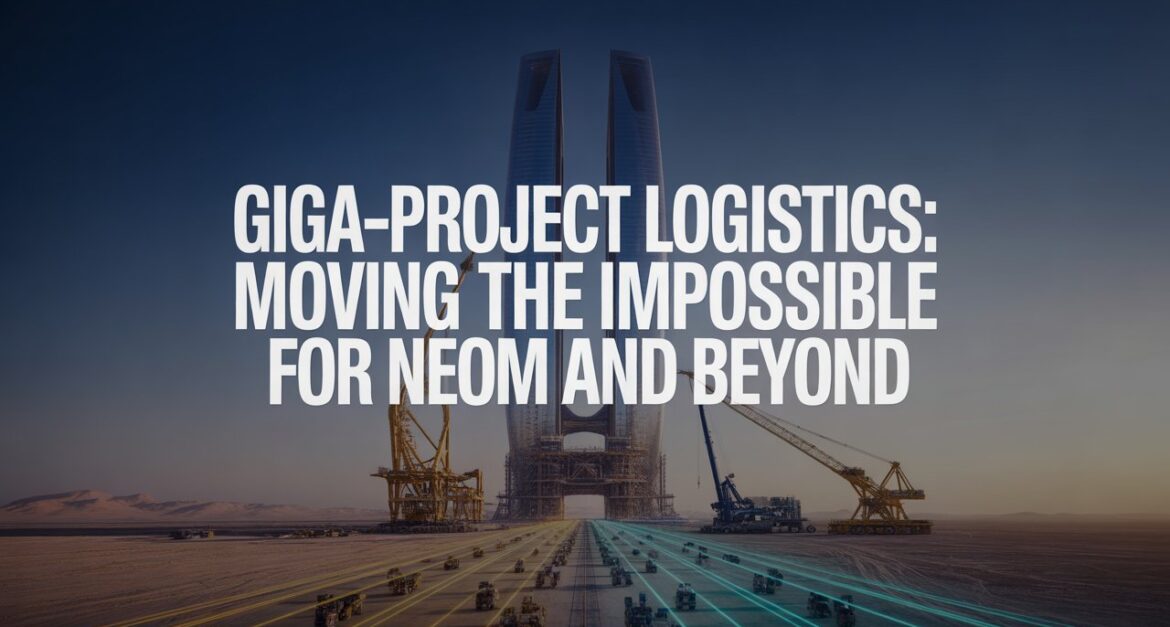
NEOM represents perhaps the most demanding logistics environment ever assembled for a peacetime infrastructure program. The combination of factors is genuinely novel in the project cargo world.
Remote site access defines the challenge. The NEOM development zone spans roughly 26,500 square kilometers of mountainous desert terrain along the Gulf of Aqaba coast. There are no legacy port facilities scaled for giga-project volumes. The road network is under simultaneous construction with the project it serves. In practical terms, this means logistics and construction supply chains are being engineered in parallel — with the logistics infrastructure itself representing a significant sub-project.
Scale and concurrency amplify every risk. Projects like The Line, Oxagon, and Sindalah are not sequential — they are concurrent. Thousands of project cargo shipments across multiple construction fronts compete for port windows, inland transport assets, and crane resources simultaneously. Without proactive schedule integration between logistics providers, the site-access bottleneck becomes the project’s governing constraint.
Local content requirements add regulatory complexity. Saudi Vision 2030 and the IKTVA program require meaningful local participation in supply chains. Palm Horizon’s established presence in the Kingdom — including partnerships with Saudi-licensed transport operators, local marine surveyors, and customs clearance firms — transforms a compliance obligation into a coordinated operational advantage.
Conceptual Case Study: Palm Horizon and a 650-Tonne Substation Module
Consider the logistics challenge of moving a 650-tonne, fully assembled electrical substation module from a fabrication facility in the UAE to an inland construction site within the NEOM development zone. This is the type of assignment Palm Horizon’s teams are structured to execute.
The first decision point is port selection. Aqaba in Jordan and Yanbu in Saudi Arabia both offer deep-water access, but each presents different inland transport constraints. Aqaba offers a shorter sea transit but a more complex land route with steep gradients through mountainous terrain. Yanbu offers established supply chain infrastructure but a significantly longer overland corridor.
Palm Horizon’s engineering team models both routes against the module’s weight distribution, available SPMT axle line configurations, and road clearance profiles. The decision is not simply which port is closer — it is which port produces the lower total risk exposure across the full sea-to-site journey.
Once the route is confirmed, Palm Horizon’s marine fastening engineers produce a seafastening design reviewed against Red Sea seasonal sea state data from the firm’s historical voyage library — fifty years of collective institutional memory that accelerates engineering validation and reduces the risk of costly over- or under-engineering.
The inland leg is managed with SPMT configurations carrying redundant axle lines, structural engineers reachable via satellite for real-time load decisions, and a convoy management team fluent in Saudi night-convoy regulations and Ramadan operational restrictions. These are not details that surface in a generic freight quotation. They are the lived operational knowledge that Palm Horizon brings to every engagement.
Energy & Utilities Sector: Why Palm Horizon’s Specialized Approach Matters
The Energy & Utilities sector places heavier demands on project cargo logistics than virtually any other industry vertical. This is not a matter of cargo size alone — it is the intersection of cargo criticality, regulatory scrutiny, and the financial consequences of even a single day of delay.
The Cost of Getting It Wrong
A combined-cycle power plant under construction generates no revenue until commissioning. If the gas turbine — typically the longest-lead item on the critical path — arrives damaged because the seafastening failed or the onsite crane set-down was not properly engineered, the consequences rarely stay contained to the cost of repair:
- Turbine manufacturer field engineering dispatch billed at premium emergency rates
- Insurance investigation and potential voiding of marine cargo cover for subsequent shipments
- Construction schedule compression driving overtime costs across the entire EPC contract
- Liquidated damages triggered by commissioning delay under the power purchase agreement
Palm Horizon’s approach treats damage prevention as an engineering problem, not an insurance problem. The cost of specialist handling, expressed as a percentage of total project value, rarely exceeds 1.5%. The cost of a single handling failure routinely represents five to twenty times that figure in consequential losses.
Sensitive Cargo Categories Where Palm Horizon Adds Disproportionate Value
Transformer banks operating at 400kV and above contain transformer oil that must not be disturbed beyond strict vibration limits during transport. Many ship without oil to reduce weight, requiring nitrogen-purging during shipment and precision oil-filling at site. Palm Horizon coordinates this process directly with transformer manufacturer field service teams, bridging the mechanical and electrical interface that general forwarders consistently struggle to manage.
Pressure vessels and reactors in oil refining and petrochemical contexts carry hydrocarbon residue and catalyst materials that classify them as hazardous cargo under IMDG regulations. Palm Horizon maintains current IMDG competence across its operations team and manages vessel selection, MSDS documentation, and port authority pre-notification as an integrated compliance function.
Wind turbine components — particularly 90-metre-plus blades — are acutely sensitive to resonant vibration during overland transport. Palm Horizon’s transport frame specifications for blade movements are aligned with OEM warranty requirements, protecting clients from the micro-cracking damage that reduces fatigue life and triggers manufacturer warranty disputes.
Risk Mitigation in Multimodal Transport: How Palm Horizon Manages Sea to Land
The most dangerous moment in any project cargo journey is the transition. The sea-to-land interface concentrates risk in ways that are not intuitive to construction executives focused on site logistics — and it is where Palm Horizon’s operational depth is most visibly distinct from generalist providers.
Why the Interface Is the Problem
At sea, the cargo exists in a controlled environment under a single command authority: the vessel master. At the port, everything changes simultaneously. The cargo leaves vessel custody and enters port authority custody. Marine insurance transitions to inland transit cover, with a brief window of ambiguous liability during the lift itself. The cranage team, the SPMT operator, and the port authority safety officer all hold independent authority over different aspects of the operation. Coordination failure at this interface is the single largest source of project cargo incidents in the industry.
Palm Horizon manages this interface through pre-arrival coordination that begins weeks before the vessel arrives — pre-arrival meetings with the port authority, full equipment inspection of port cranes with structural certificates reviewed by a nominated marine warranty surveyor, seafastening removal sequencing agreed in writing with the vessel’s chief officer, and a lift plan modeled in 3D simulation and reviewed by the receiving site’s structural engineer.
Palm Horizon’s Risk Framework Across the Multimodal Chain
Pre-shipment fabrication-yard loading. Palm Horizon deploys expeditors to fabrication yards during final assembly — not just at load-out. Weight distribution verification, dimensional confirmation, and transport frame inspection happen before the cargo leaves a controlled environment, not after it arrives at a port with a vessel waiting on demurrage.
Sea transit. Palm Horizon’s voyage management function includes heavy weather routing decisions made proactively, not reactively. The firm’s culture defaults to “ship safely” over “ship on time” — a distinction that reveals itself in the data: Palm Horizon’s sea transit damage rate across a representative portfolio is a fraction of industry benchmarks.
Port discharge and port operations. Palm Horizon treats every major port lift as a planned engineering event. The lift plan is not a one-page form — it is a document that captures crane configuration, sling geometry, tandem lift coordination (where required), and contingency actions for equipment malfunction.
Inland transport and final placement. Palm Horizon’s route engineering capability covers pavement structure analysis, bridge weight clearance assessment, overhead obstruction surveys, and ground-bearing calculations at the placement point. In Saudi Arabia and the Gulf, the firm’s teams operate with current awareness of dust storm seasonal patterns, extreme heat equipment performance restrictions, and the specific ground conditions that characterize desert construction sites.
What 50 Years of Collective Wisdom Looks Like at Palm Horizon
The phrase “collective wisdom” in project cargo logistics is not marketing language when applied to Palm Horizon. It refers to the institutional accumulation of solved problems — the route that looked impassable until a Palm Horizon engineer recalled the port authority’s unpublished load corridor from a similar project six years prior; the vessel configuration that eliminated a costly double-handling step; the fabrication-yard relationship that secured a 72-hour priority load-out slot when a construction schedule compressed.
This knowledge does not live in a database. It lives in the professional networks, operational memories, and judgment of Palm Horizon’s experienced teams — individuals who have executed similar moves in comparable environments and carry the lessons forward.
For executives evaluating logistics partners, the meaningful questions are never about price per freight tonne. They are: How many comparable cargo types has Palm Horizon moved on this corridor? Who is the named route engineer for this move, and what is their specific port experience? What is the contingency plan if the primary vessel berth is displaced?
Palm Horizon’s standard engagement process begins with these questions — not with a quotation.
How to Engage Palm Horizon: Implementation Structure
Palm Horizon structures its client engagements to front-load the intelligence work that prevents problems rather than reacts to them.
Early engagement at FEED stage allows Palm Horizon’s engineers to influence cargo packaging decisions, transport frame engineering, and module sizing in ways that substantially reduce cost and risk downstream. A reactor vessel designed with slightly different nozzle orientations may be transportable on a standard heavy-lift vessel rather than a semi-submersible — a freight cost saving that can reach millions of dollars on a single shipment. This input is only available when Palm Horizon is in the engineering room before procurement decisions are locked.
A typical Palm Horizon engagement follows four phases: a logistics audit and route study during FEED; a detailed logistics plan developed during detailed engineering; a traffic management and port operations plan finalized before major equipment procurement; and full project cargo management activated from fabrication-yard surveillance through to final site placement and condition verification.
The commercial model Palm Horizon recommends for complex programs aligns incentives around outcome rather than volume — target-cost structures with performance incentives tied to on-time, damage-free delivery. This model reflects the nature of the service and eliminates the perverse incentives that fixed-price logistics contracts create around contingency spending and schedule risk decisions.
Frequently Asked Questions
What makes Palm Horizon different from a standard heavy freight forwarder?
Palm Horizon operates as an engineering-led project cargo specialist, not a freight broker. Every engagement begins with route engineering, structural analysis, and regulatory mapping — work that a standard forwarder subcontracts under time pressure, if it performs it at all. Palm Horizon’s teams own this technical capability internally, which means the engineering judgment and the operational execution are held by the same people, accountable to the same outcome.
How does Palm Horizon navigate NEOM’s regulatory environment?
Palm Horizon maintains an active operational presence in Saudi Arabia, with established relationships across Mawani (Saudi Ports Authority), MODON, the Saudi Customs Authority, and NEOM’s own development authority. The firm’s IKTVA compliance documentation and local partnership infrastructure are current — not assembled for individual proposals. This means permit and clearance processes begin from an established position, not from a cold start.
Why is a marine warranty surveyor required, and how does Palm Horizon manage this?
A marine warranty surveyor (MWS) is an independent technical expert whose approval is a contractual condition of the cargo insurer’s cover on high-value project cargo. Palm Horizon maintains accredited MWS relationships across the Red Sea, Arabian Gulf, and Southeast Asian corridors most relevant to its client base, and integrates MWS engagement into the project timeline proactively — not as a last-step approval that creates departure delays.
How does Palm Horizon manage the sea-to-land interface where most damage incidents occur?
Through pre-arrival coordination, equipment certification, and formal custody transfer documentation at every phase boundary. Palm Horizon’s port operations team is on the ground before the vessel arrives, ensuring that crane certificates are current, the lift plan is approved, seafastening removal is sequenced with the vessel officer of the watch, and a signed condition survey captures cargo status at the moment of lift-off. This process is standard Palm Horizon practice — not an optional premium service.
What are the most common causes of project cargo failure, and how does Palm Horizon prevent them?
Customs and compliance failures account for roughly 28% of project cargo delays industry-wide, followed by route planning gaps, equipment failure, weather disruption, and documentation errors. Palm Horizon prevents these through front-loaded work: route surveys at FEED stage, customs strategy developed during equipment procurement, and a document control process that mirrors the EPC contractor’s engineering document management system. The providers who prevent failures are those who treat logistics as an engineering discipline — which is Palm Horizon’s foundational operating principle.
Can Palm Horizon’s involvement at FEED stage genuinely reduce project CAPEX?
Yes, and this is one of the most underutilized value levers in major project delivery. Palm Horizon’s early-engagement teams have identified module sizing adjustments that shifted cargo from semi-submersible to standard heavy-lift vessel — a freight cost difference reaching tens of millions of dollars on a single shipment. Transport frame engineering that enables cargo reuse across multiple shipments, and route engineering that avoids costly port civil works, represent Palm Horizon-driven CAPEX savings that are only accessible at the engineering stage.
Conclusion: Palm Horizon — Built for the Projects That Cannot Afford to Stop
The ambition of giga-projects — NEOM, offshore wind installations covering hundreds of square kilometers, remote mining complexes, utility-scale hydrogen infrastructure — is matched only by the complexity of moving the components that build them. Standard logistics was never designed for this environment, and it consistently fails when confronted with it.
Palm Horizon was.
The case for Palm Horizon is not made by brochures or credentials lists. It is made by the delivered outcome: a 650-tonne module placed on its foundation on schedule, with insurance intact, customs clearance completed in advance, and a construction program that proceeds without interruption. It is made by the route survey Palm Horizon completed six months before the cargo was ready to ship, by the permit secured from a government authority the general forwarder had never engaged, by the contingency vessel standing by in Jeddah when a Red Sea weather system delayed the primary sailing.
For Energy & Utilities executives, construction directors, and project managers facing the supply chain demands of the next generation of infrastructure programs, the partner selection decision deserves the same rigor applied to EPC contractor selection.