
Introduction
Are you constantly stressed every time an urgent shipment comes up—wondering if the rate is fair, the routing is reliable, or the cargo will even make it on time?
This constant uncertainty has become one of the most exhausting problems for businesses shipping by air.
Because when one wrong booking leads to delays, penalties, or miscommunication with a carrier, the entire supply chain feels the pressure.
But here’s the good news: there is a solution.
When you ask the right questions before you book an air freight shipment, everything becomes easier—your timelines improve, costs become predictable, risks drop, and your team works with clarity instead of panic. And when supported by a reliable partner like Palm Horizon KSA
Why Asking Questions Matters More in 2025
Air freight changed dramatically over the last 3 years:
- Higher demand for time-critical shipments
- New airline capacity management systems
- Stricter regulatory checks
- Rising fuel and security charges
- More pressure on businesses for fast delivery
Because of these changes, the old way of booking “quickly and blindly” simply doesn’t work anymore.
The companies that succeed today are the ones that confirm visibility, accuracy, compliance, and cost clarity upfront.
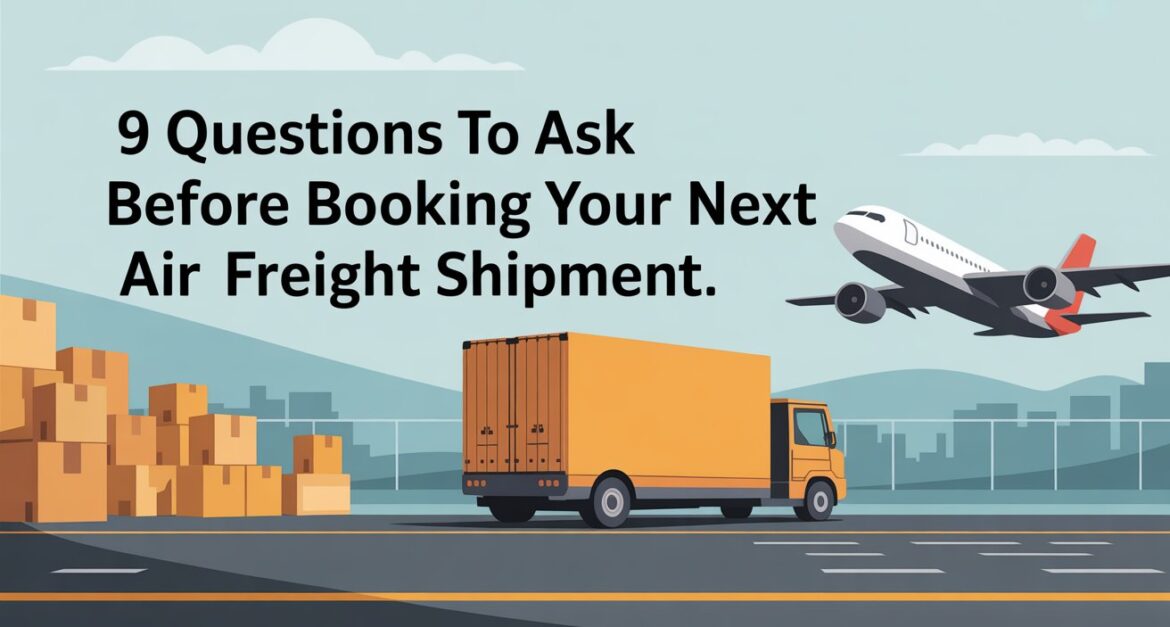
9 Questions to Ask Before Booking Your Next Air Freight Shipment
1. What Exactly Are You Shipping—and How Will It Be Classified?
Before anything else, clarify:
- Cargo type
- Commodity classification
- Temperature needs
- Fragility
- Special handling requirements
- If it’s high-value or sensitive
Airlines treat every commodity differently.
A shipment that seems simple—like electronics or spare parts—may fall under strict handling rules.
Clarifying this early avoids:
- Refusals at the terminal
- Last-minute re-packaging
- Dangerous goods complications
- Re-routing delays
- Unexpected fees
In 2025, even basic cargo is screened under advanced security systems.
Giving full details ensures your shipment enters the fastest lane—not the “problem cargo” queue.
2. What Transit Time Do You Actually Need?
Many businesses still pay for “express” air freight even when they don’t need it.
Before booking, ask:
- Is the delivery urgent?
- Can it move under standard air?
- Will deferred service meet the timeline?
- Are there alternative routes that save cost?
Transit time categories vary across airlines, and choosing the wrong tier wastes money.
In 2025, rate fluctuations are more dynamic, meaning knowing your timeline saves thousands.
3. Which Routing Options Offer the Best Reliability, Not Just Speed?
Not every “fast route” is actually reliable.
When evaluating routing:
- Check congestion at transit hubs
- Compare direct vs. indirect flights
- Ask for lane performance data
- Review historical delay patterns
- Evaluate risk of offloads due to capacity
- Understand airport handling quality
A slightly longer route with stable carrier performance is often better than a faster but inconsistent one.
Carriers are now judged by predictability, not just speed.
4. What Are the Total Costs—Beyond the Base Freight Charge?
Air freight pricing in 2025 includes multiple layers:
- Fuel surcharge
- Security fee
- Terminal handling
- Export/Import charges
- Airline screening
- Carrier documentation
- Customs brokerage
- First/last mile trucking
If your quote only lists the base rate, expect surprises later.
Always ask for a full, itemized breakdown to calculate:
- True landed cost
- Margins
- Budget alignment
- Customer pricing accuracy
A transparent logistics partner will never hide these charges.
5. Does Your Cargo Require Special Packaging or Temperature Control?
The wrong packaging causes:
- Damage
- Rejections
- Re-shipment
- Customer dissatisfaction
- Costly repacking at the terminal
Cargo that needs specific packaging:
- Pharmaceuticals
- Temperature-controlled goods
- Cosmetics and chemicals
- Electronics
- Fragile machinery
- Perishables
- Hazardous goods
Ask your logistics partner:
- What packaging does the airline require?
- Do you need an insulated container?
- Are certified DG labels necessary?
- Is fumigation or palletization needed?
Correct packaging is the simplest way to avoid operational delays.
6. What Documents Are Required for This Shipment?
Documentation delays are still the #1 reason shipments get stuck at customs.
Typical air freight documents include:
- Air Waybill
- Packing List
- Commercial Invoice
- COO (Certificate of Origin)
- MSDS
- Export/Import permits
- IATA DG certificates (if applicable)
In 2025, customs rules are updated faster and enforced more strictly.
Getting documentation right at the start saves days—not hours.
7. Is Insurance Included or Optional for This Shipment?
Many companies assume air freight automatically includes insurance—it does not.
Ask:
- Is your cargo insured?
- What risks does the policy cover?
- How are claims handled?
- What is the declared value?
Insurance protects you from:
- Damage
- Handling mistakes
- Temperature issues
- Theft
- Loss
In a global market with rising cargo value, proper coverage is not optional.
8. What Visibility Tools or Tracking Options Will You Receive?
Tracking is no longer a “nice-to-have”—it is a core requirement.
Ask your logistics partner if they provide:
- Real-time tracking
- Live status milestone updates
- API/ERP integrations
- Automated delay alerts
- Proof-of-delivery updates
Visibility prevents:
- Last-minute confusion
- Missed delivery commitments
- Inventory mismanagement
- Customer complaints
Businesses that track properly operate more efficiently—every single time.
9. Who Will Handle Customs Clearance at Origin and Destination?
Customs clearance can make or break an air shipment.
Before booking, confirm:
- Who handles export clearance?
- Who manages import clearance?
- What HS codes are being used?
- Are duties and taxes calculated correctly?
- Are there restricted items?
Mistakes in clearance cause:
- Penalties
- Rejections
- Storage charges
- Multi-day delays
A forwarder with strong clearance capabilities—like Palm Horizon KSA—reduces risk dramatically.
Industries That Depend on Air Freight in 2025
Air freight is no longer limited to “urgent cargo.”
More industries rely on it today due to rapid production cycles and global competition.
Key sectors include:
- E-commerce replenishment
- Oil & gas spare parts
- Pharmaceuticals & medical supplies
- Automotive parts
- Electronics & semiconductors
- Food & perishables
- Aerospace components
- Fashion & luxury goods
Each sector has strict timelines and minimal tolerance for errors.
Air Freight vs. Sea Freight vs. Road Freight (2025 Updated Comparison)
| Factor | Air Freight | Sea Freight | Road Freight |
| Speed | Fastest | Slowest | Moderate |
| Cost | High | Low | Medium |
| Reliability | High | Medium | Depends on route |
| Ideal For | Urgent & high-value goods | Bulk & non-urgent | Regional movement |
Air remains the preferred choice for fast, high-impact shipments.
How to Implement a Smarter Air Freight Booking Strategy (Step-by-Step)
1. Assess Your Cargo Properly
Understand physical, regulatory, and handling requirements first.
2. Compare Routing Instead of Accepting the First Option
Look at reliability, not just ETA.
3. Request Detailed Pricing
Avoid incomplete rate quotes.
4. Prepare Documentation Early
Delays usually come from missing or incorrect details.
5. Confirm Visibility Tools
You should never lose track of your cargo.
6. Work With a Forwarder Who Knows Your Market
Teams like Palm Horizon offer stronger local insights, especially in KSA.
Simple, real example (end-to-end)
Scenario: A medical device maker needs a replacement part shipped to a KSA hospital within 48 hours.
- They define cargo, value, and delivery window.
- Forwarder proposes two routes: direct express (expensive but fastest) or one-stop time-defined (slightly slower, cheaper).
- Pharma-grade packaging and temperature logger are confirmed.
- Documentation (commercial invoice, COO, device certification) uploaded 24 hours prior.
- Insurance declared for full value.
- Forwarder provides live tracking and pre-clearance at KSA customs.
- Shipment clears and reaches hospital within SLA.
This outcome is repeatable when the nine questions are asked and answered early.
Frequently Asked Questions
Q1 — What is volumetric weight and how does it affect my cost?
Volumetric weight measures the space your shipment occupies. Carriers charge on the higher of actual or volumetric weight. For large, light items, volumetric weight often increases cost.
Q2 — Can I ship lithium batteries by air?
Yes, but you must follow IATA Dangerous Goods Regulations. Rules differ by battery type, SoC, packaging test reports, and carrier acceptance.
Q3 — How can I reduce delays at customs?
Provide accurate HS codes, full documentation, pre-arrival data, and use experienced local brokers who can pre-clear shipments.
Q4 — Do airlines provide temperature guarantees?
Some airlines and forwarders offer validated temperature-controlled lanes and guarantees. Always request SLA and monitoring evidence.
Q5 — What causes the majority of air freight surprises?
Incomplete documentation, incorrect cargo declaration, non-compliant packaging, and last-minute routing changes are the top causes.
Conclusion
Air freight is one of the most powerful logistics solutions in today’s fast-moving supply chains—but only when planned correctly.
When you ask the right questions, you protect your budget, your timeline, and your cargo. You also gain the clarity businesses need to run smoother operations with fewer surprises.
If you want shipments that move with speed, accuracy, and reliability, Palm Horizon KSA offers the expertise, airline network, and support required to make every booking seamless.