

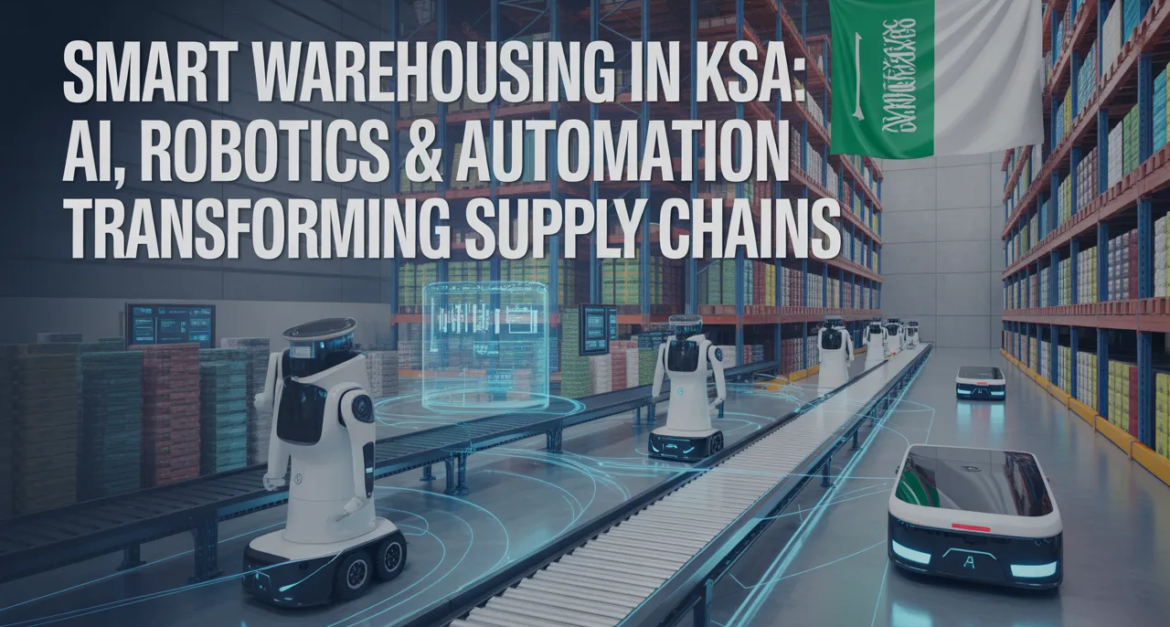
Are you losing control of your inventory, facing costly delays, and watching margins shrink because your warehouse cannot keep up with modern demand?
In Saudi Arabia’s fast-moving economy, outdated warehousing is silently damaging supply chains. Manual inventory tracking, delayed order processing, limited visibility, and disconnected systems create operational bottlenecks that impact customer satisfaction and profitability. As competition intensifies across Riyadh, Jeddah, and Dammam, businesses that rely on traditional storage models struggle to maintain accuracy, speed, and scalability. The pressure is real — and the cost of inefficiency is rising.
Here is the solution: smart warehousing. Powered by Saudi Vision 2030 and driven by AI, robotics, automation, and real-time analytics, intelligent warehouse systems transform storage into a performance engine. Instead of reacting to errors, businesses gain predictive control. Instead of chasing inventory discrepancies, they operate with precision and visibility. Smart warehousing reduces risk, accelerates fulfillment, strengthens compliance, and builds scalable infrastructure designed for long-term growth in Saudi Arabia’s evolving logistics landscape.
The Evolution of Warehousing in Saudi Arabia
Historically, warehousing in KSA focused on capacity and location:
- Proximity to ports or industrial zones
- Basic racking systems
- Manual picking and packing
- Spreadsheet-based inventory tracking
While functional, this model struggles under modern pressure:
- Rapid e-commerce growth
- Complex customs procedures
- Multi-channel distribution
- Time-sensitive project cargo
- Increased compliance expectations
Today’s Saudi market demands:
- Faster turnaround times
- Zero-inventory discrepancies
- Real-time shipment visibility
- Scalable infrastructure
- Data-backed forecasting
Smart warehousing bridges this gap.
What Is Smart Warehousing?
Smart warehousing is the integration of advanced technologies into warehouse operations to create a highly efficient, automated, data-driven environment.
It typically includes:
- AI-powered Warehouse Management Systems (WMS)
- Robotics-assisted picking and sorting
- Automated Storage and Retrieval Systems (AS/RS)
- IoT-enabled tracking devices
- Barcode and RFID scanning
- Predictive inventory analytics
- Integrated Transportation Management Systems (TMS)
Instead of reacting to problems, smart warehouses anticipate them.
Rather than of correcting errors, they prevent them.
Instead of operating independently, they integrate seamlessly across the entire supply chain.
For any serious logistics company in Saudi Arabia, this level of operational maturity is now a competitive requirement.
Why Smart Warehousing Matters in the Saudi Market
Saudi Arabia presents unique logistics dynamics:
1. Geographic Scale
The Kingdom’s vast land area requires optimized inventory positioning to reduce transport costs and delivery time.
2. Regulatory Complexity
Customs clearance, documentation, and cross-border trade within GCC markets demand accurate, synchronized data systems.
3. Mega Projects & Industrial Expansion
Construction, oil & gas, renewable energy, and infrastructure developments require project-based logistics precision.
4. E-Commerce Acceleration
Growing online retail activity demands high-speed order fulfillment and last-mile coordination.
Manual warehouses cannot sustainably handle this pressure.
Smart warehouses can.
Artificial Intelligence: The Brain of Modern Warehousing
AI is the strategic core of intelligent warehouse environments.
Demand Forecasting
AI analyzes:
- Historical sales data
- Seasonal trends
- Industry cycles
- Regional demand shifts
This enables predictive inventory planning, reducing:
- Stockouts
- Overstocking
- Dead inventory
- Emergency freight costs
Space Optimization
AI algorithms determine optimal slotting strategies:
- Fast-moving items placed near dispatch zones
- Seasonal goods repositioned dynamically
- Weight and handling requirements automated
This improves pick efficiency and reduces labor strain.
Risk Mitigation
Predictive analytics identify:
- Slow-moving inventory
- Potential supply disruptions
- Storage compliance risks
For businesses seeking the best logistic company in KSA, intelligent forecasting capabilities directly protect margins.
Robotics and Automation in Saudi Warehouses
Automation is rapidly expanding across industrial zones in Riyadh, Jeddah, and Dammam.
Robotic Picking Systems
Robots assist or replace manual picking in high-volume environments. Benefits include:
- Increased order accuracy
- Faster processing times
- Reduced human error
- Continuous operation
Automated Sorting Systems
Conveyor-based and robotic sorting solutions streamline multi-destination shipments.
This is particularly valuable for:
- E-commerce fulfillment
- FMCG distribution
- Pharmaceutical logistics
Automated Storage and Retrieval Systems (AS/RS)
High-density vertical storage reduces floor space usage and increases inventory accessibility.
For high-value or temperature-sensitive goods, automated systems ensure controlled handling environments.
Automation is not about eliminating workforce value. It is about reallocating human expertise toward supervision, quality control, and process optimization.
Real-Time Visibility: The Foundation of Supply Chain Control
In Saudi Arabia’s logistics landscape, visibility equals control.
Smart warehouses integrate with:
- Freight forwarding systems
- Customs documentation platforms
- Transport tracking networks
- Client ERP systems
This creates real-time transparency from inbound shipment arrival to outbound delivery confirmation.
Benefits include:
- Accurate ETA forecasting
- Faster invoicing cycles
- Reduced detention and demurrage
- Improved financial forecasting
For a modern KSA logistics company, visibility is no longer a value-add feature. It is baseline infrastructure.
Smart Warehousing and E-Commerce Growth in KSA
Saudi Arabia’s digital economy continues expanding rapidly.
Online retailers require:
- Same-day or next-day delivery models
- Accurate order fulfillment
- Reverse logistics management
- Multi-channel inventory synchronization
Smart warehouses support:
- Automated picking lines
- Barcode-driven quality checks
- Digital order confirmation systems
- Efficient returns processing
Without automation, e-commerce scaling leads to chaos.
With smart warehousing, scaling becomes structured.
Cold Chain and Specialized Smart Storage
Saudi Arabia’s pharmaceutical, food security, and medical sectors require advanced temperature-controlled logistics.
Smart cold storage facilities include:
- IoT temperature monitoring
- Real-time compliance alerts
- Automated climate regulation
- Digital audit trails
This ensures compliance with health and regulatory standards while reducing spoilage risk.
For industries handling sensitive goods, smart warehousing protects both compliance and brand reputation.
Cost Efficiency Through Intelligent Operations
Many businesses assume automation increases cost.
In reality, it reduces long-term operational expenses by:
- Minimizing labor inefficiencies
- Reducing inventory losses
- Preventing shipment delays
- Lowering error-related returns
- Improving warehouse space utilization
The ROI model typically includes:
- Faster turnover rates
- Lower carrying costs
- Increased order capacity
- Reduced emergency freight usage
Strategic warehousing decisions directly influence profitability.
Smart Warehousing and National Logistics Transformation
Saudi Arabia’s ambition to become a global logistics hub depends on more than ports and airports.
It depends on internal operational excellence.
Smart warehouses:
- Reduce congestion
- Accelerate customs processing
- Improve trade competitiveness
- Attract international investment
This aligns directly with the Kingdom’s broader economic diversification objectives under Vision 2030.
End-to-End Integration: The True Competitive Advantage
The strongest logistics providers integrate:
- Warehousing
- Freight forwarding
- Customs clearance
- Transportation
- Last-mile delivery
When systems communicate seamlessly, supply chains become synchronized.
Fragmented operations create risk.
Integrated systems create reliability.
Businesses that treat warehousing as isolated storage miss the opportunity to build strategic logistics infrastructure.
The Role of Structured Logistics Leadership
Technology alone does not create smart warehouses.
Execution discipline does.
A forward-thinking <a href=”https://palmhorizonksa.com/”>logistics company in Saudi Arabia</a> must combine:
- Process engineering
- Skilled operational management
- Compliance expertise
- Continuous improvement frameworks
- Technology integration
At Palm Horizon, structured execution, operational accountability, and scalable logistics planning remain central to warehouse and supply chain strategy. Intelligent systems are supported by disciplined leadership — because automation without structure still fails.
Risk Reduction in an Uncertain Global Environment
Global trade volatility, shipping disruptions, and geopolitical instability impact supply chains worldwide.
Smart warehousing reduces exposure by:
- Improving demand predictability
- Maintaining buffer inventory intelligently
- Supporting alternative routing strategies
- Strengthening documentation accuracy
Resilience is built through preparedness, not reaction.
Sustainability and Energy Efficiency
Modern Saudi warehouses are also evolving environmentally.
Smart facilities include:
- Energy-efficient lighting systems
- Automated climate controls
- Solar integration
- Route optimization to reduce fuel usage
Sustainability is becoming a competitive advantage in government and multinational contracts.
The Future of Smart Warehousing in Saudi Arabia
Over the next decade, expect:
- Greater AI-driven predictive automation
- Expansion of robotics adoption
- Increased warehouse digital twins for simulation
- Blockchain-supported inventory validation
- Hyper-integrated supply chain ecosystems
Businesses that invest early secure operational dominance.
Those who delay risk structural inefficiency.
Conclusion: Smart Warehousing Is a Strategic Imperative
Warehousing in Saudi Arabia has evolved from simple physical storage into intelligent supply chain infrastructure. Driven by technological advancement and national transformation under Saudi Vision 2030, modern warehouses now function as high-performance control centers. AI-powered systems, robotics, automation, and integrated visibility platforms are redefining how businesses manage inventory, mitigate operational risk, and scale efficiently. Real-time data enables faster decision-making, predictive forecasting reduces costly stock imbalances, and automated workflows minimize human error. In today’s environment, warehousing is no longer a passive support function — it is an active engine of operational excellence.
Smart warehousing protects margins by reducing waste and inefficiencies, enhances speed through optimized picking and dispatch systems, and strengthens resilience by improving demand forecasting and inventory control. It enables expansion by creating scalable infrastructure capable of supporting multi-channel distribution and growing market demands. In the Kingdom’s increasingly competitive logistics landscape, operational intelligence defines leadership. Companies that treat warehousing as strategic infrastructure rather than background storage position themselves for sustained growth and stronger customer trust — a philosophy that guides Palm Horizon in delivering forward-thinking logistics solutions across Saudi Arabia.
FAQs
What is smart warehousing?
Smart warehousing integrates AI, robotics, automation, IoT sensors, and digital tracking systems to create a highly efficient, data-driven storage environment. It enhances inventory accuracy, accelerates order fulfillment, improves warehouse safety, and provides real-time supply chain visibility from inbound shipments to final dispatch.
How does AI improve warehouse performance?
AI analyzes historical data, demand trends, and operational patterns to predict inventory needs and optimize stock placement. It reduces picking errors, minimizes stockouts, improves space utilization, and supports faster decision-making through advanced analytics and automated reporting systems.
Is smart warehousing suitable for all industries?
Yes. Manufacturing, oil & gas, pharmaceuticals, FMCG, government projects, construction, automotive, and e-commerce sectors all benefit from improved inventory control, compliance monitoring, and faster distribution capabilities.
Does automation reduce workforce dependency?
Automation reduces repetitive and physically demanding tasks such as picking, sorting, and pallet movement. This allows warehouse teams to focus on quality control, supervision, system monitoring, and strategic operations management — improving both productivity and workplace safety.
Why is smart warehousing critical in Saudi Arabia?
Saudi Arabia’s geographic scale, strict regulatory framework, and rapid economic diversification under Saudi Vision 2030 require precision, speed, and integration across logistics networks. Smart warehousing strengthens execution discipline and supports the Kingdom’s ambition to become a global logistics hub.
How does smart warehousing improve cost efficiency?
By reducing manual errors, preventing inventory losses, optimizing storage capacity, and accelerating turnover rates, smart warehouses lower operational expenses and improve cash flow. Predictive planning also reduces emergency freight costs and excess stock holding.
Can smart warehouses integrate with freight and transportation systems?
Yes. Advanced warehouse management systems integrate with transportation management systems (TMS), customs clearance platforms, and ERP software. This creates seamless end-to-end visibility across the entire supply chain.




1 Comment
7 Ways Warehouse Optimization Saves Space, Time, and Money September,01 2026
[…] is exactly the problem warehouse optimization solves — and it’s why companies like Palm Horizon KSA have built their practice around […]