
Why Your Logistics Strategy Deserves a Hard Look Right Now
There’s a quiet crisis happening inside thousands of businesses across Saudi Arabia and the wider Gulf region. Warehouses are full. Orders are late. Costs are climbing. And somewhere in the middle of all this noise, leadership teams are still running the same logistics playbook they used five years ago — hoping it still works.
It doesn’t.
The global supply chain landscape has shifted dramatically. Customers today expect same-day or next-day delivery as a baseline, not a luxury. Regulators are tightening compliance requirements. Fuel costs, port congestion, and geopolitical headwinds are creating unpredictability that older, rigid logistics frameworks simply cannot absorb.
The companies winning right now aren’t just spending more on logistics — they’re thinking differently about logistics strategy and planning. They’re using data. They’re automating intelligently. And they’re building flexibility into their supply chains the way engineers build flexibility into bridges — not because they expect disaster, but because they know the wind will change.
This article is your diagnostic tool. If your business is showing any of the warning signs outlined below, your logistics management approach is due for a serious upgrade — and Palm Horizon KSA is here to help you build what comes next.
What Is a Logistics Strategy — and Why Does It Matter More Than Ever?
Before diagnosing problems, it helps to understand what a modern logistics strategy actually is.
A logistics strategy is the master framework that governs how your business moves goods from origin to customer. It covers procurement decisions, warehousing locations, carrier relationships, last-mile delivery methods, return management, and the technology that ties all of it together.
A logistics strategy isn’t just a transport plan. It’s a competitive asset.
In industries where product differentiation is shrinking — where two competitors sell nearly identical goods at nearly identical prices — the company with the superior logistics strategy wins. They fulfill faster. They make fewer errors. And they handle disruptions more gracefully. And critically, they do all of this at a lower cost per shipment than their rivals.
In the KSA context specifically, with Vision 2030 reshaping trade infrastructure and Saudi Arabia positioning itself as a regional logistics hub, companies that invest in intelligent logistics strategy and planning now are building durable advantages that will compound for years.
Fun Fact: Saudi Arabia currently ranks among the top 20 nations globally in the World Bank’s Logistics Performance Index — and the Kingdom is actively investing billions to push that ranking even higher. Businesses operating in KSA right now are sitting on one of the most promising logistics foundations in the Arab world.
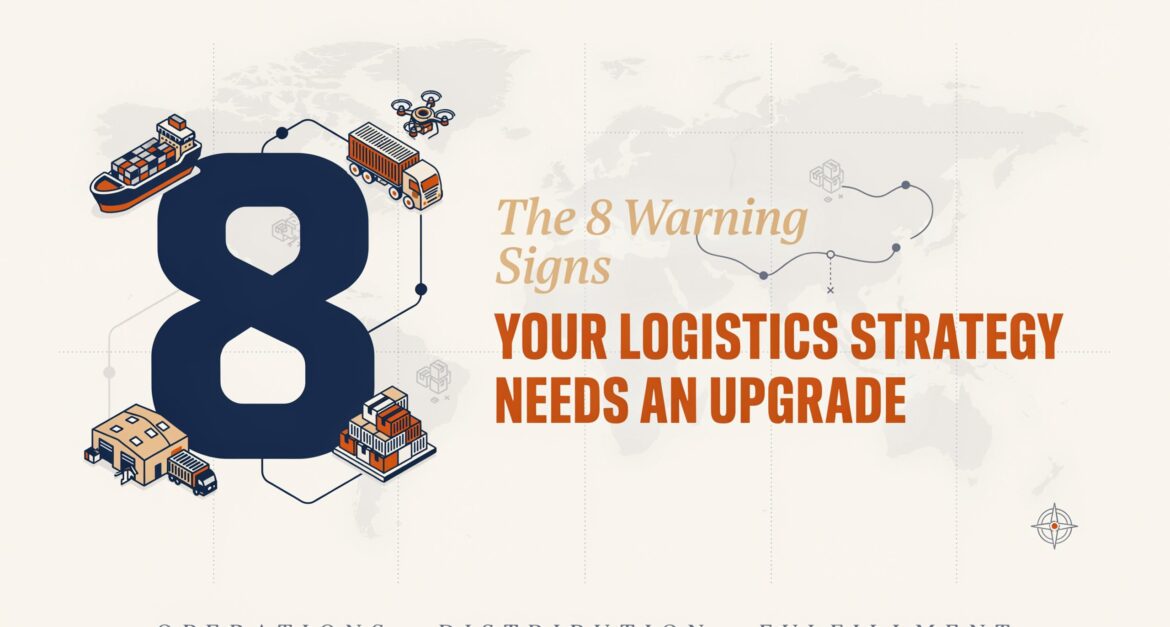
The 8 Warning Signs Your Logistics Strategy Is Broken
Warning Sign #1: Your Delivery Timelines Are Constantly Slipping
This is the most visible symptom, and often the last one companies take seriously because it feels like an operational problem rather than a strategic one. It isn’t.
If your deliveries are consistently arriving late — whether to retail partners, B2B clients, or end consumers — the root cause is almost never the driver or the warehouse team. It’s a failure of logistics strategy and planning at a higher level. Routes aren’t optimized. Carrier contracts don’t include performance accountability clauses. Inventory positioning doesn’t reflect actual demand patterns. Slack isn’t built into the system to absorb the unexpected.
Late deliveries compound quickly. One missed delivery window can trigger a cascade: a retailer marks you as unreliable, reduces your shelf space, and begins evaluating alternatives. In B2B contexts, SLA breaches generate financial penalties. In e-commerce, negative reviews compound with algorithmic consequences on platforms like Noon and Amazon KSA.
The fix isn’t to push your team harder. The fix is to redesign the system.
Warning Sign #2: Your Logistics Costs Are Growing Faster Than Your Revenue
Cost creep is one of the sneakiest warning signs in logistics management . It happens gradually — an extra carrier here, a storage fee there, fuel surcharges that were “temporary” two years ago — until suddenly your logistics spend as a percentage of revenue has ballooned from 8% to 14%.
If your costs are rising without a proportional rise in volume, speed, or quality, something is wrong with the architecture of your logistics strategy.
Common culprits include: reliance on spot freight instead of contracted rates, poor load consolidation leading to half-empty trucks, excessive warehousing from inventory positioned in the wrong locations, and reactive last-minute shipping decisions that carry premium costs.
Smart logistics strategy and planning is, at its core, a cost engineering discipline. Every route decision, every carrier negotiation, every warehouse placement is a financial decision. When strategy is weak, costs drift upward by default.
Fun Fact: Studies in supply chain economics consistently show that every 1% reduction in logistics cost as a percentage of revenue can translate to a 10–15% increase in net operating profit for mid-market manufacturing and distribution businesses. Logistics isn’t a cost center — it’s a profit lever.
Warning Sign #3: You Have No Real-Time Visibility Into Your Supply Chain
Ask yourself honestly: right now, at this exact moment, do you know where every shipment in your network is? Do you know which carrier is running two hours behind? Do you know which warehouse is about to breach its capacity threshold?
If the answer is “not really” or “we’d have to ask someone,” you have a visibility problem — and visibility is the oxygen of modern logistics management.
Without real-time visibility, you’re managing by exception after the fact. A customer calls to ask where their order is. You investigate. You discover it’s been sitting in a transit hub for three days due to a documentation issue. The customer is already frustrated. All of this could have been caught and resolved 72 hours earlier with proper supply chain visibility tools.
This is one of the areas where advanced logistics technology creates the most immediate, measurable value. Transportation Management Systems (TMS), IoT-enabled tracking, and integrated carrier APIs give logistics teams the situational awareness they need to intervene before problems escalate.
Warning Sign #4: You’re Still Running on Spreadsheets and Email Chains
There’s no diplomatic way to say this: if your logistics operations are primarily coordinated through Excel files and email threads, your logistics strategy is not a strategy — it’s organized chaos.
Manual processes are slow, error-prone, and completely opaque to analysis. You can’t identify patterns in data that isn’t being captured. You can’t optimize routes that are being planned by gut feel. And you can’t reduce errors in a process where humans are manually re-entering data across systems that don’t talk to each other.
Businesses that still rely heavily on manual logistics workflows are typically spending 30–40% more time on coordination tasks than they need to. That time translates directly to cost — in salaries, in delayed responses, and in the errors that inevitably slip through.
Advanced logistics technology — from Warehouse Management Systems (WMS) to automated freight auditing to AI-powered demand forecasting — exists precisely to replace these manual bottlenecks with intelligent, automated workflows.
Fun Fact: The global logistics technology market is projected to exceed $75 billion by 2030. The companies investing in these platforms today aren’t just becoming more efficient — they’re building a capability gap that competitors running on manual processes will find nearly impossible to close.
Warning Sign #5: Customer Complaints Are Becoming a Pattern
Every logistics operation will occasionally disappoint a customer. A delayed shipment, a damaged item, a miscommunication — these things happen. What matters is whether they’re isolated incidents or recurring patterns.
If your customer service team is regularly fielding complaints about delivery accuracy, fulfillment speed, or order tracking visibility, you have a structural logistics problem — not a customer service problem. Hiring more customer service staff to handle complaints is putting a bandage on a wound that needs surgery.
The data in these complaints is extraordinarily valuable for logistics strategy and planning. Which routes generate the most complaints? Which carriers underperform? Ans which product categories have the highest damage rates in transit? A well-constructed logistics management system surfaces these patterns automatically, allowing you to address root causes rather than symptoms.
Warning Sign #6: Your Logistics Strategy Can’t Scale With Demand Spikes
Ramadan. National Day. Back-to-school season. Major promotional events. Every market has predictable demand surges — and yet, many businesses treat each one as a surprise emergency.
A mature logistics strategy is built for elasticity. It should be able to flex upward during peak periods without proportional increases in cost or chaos. This requires pre-negotiated surge capacity with carriers, distributed inventory positioning to reduce last-mile distances during peaks, and forecasting tools that project demand increases far enough in advance to act on them.
If your team is in crisis mode every time a seasonal surge hits, your logistics strategy lacks a fundamental resilience layer. This is an architectural problem, and it gets progressively worse as your business grows.
Warning Sign #7: You’re Operating in Data Silos
Your ERP knows what was ordered. Your WMS knows what was picked. And your TMS knows what was shipped. But none of these systems talk to each other in real time — and your leadership team is making decisions based on reports that are 48 hours old.
Data fragmentation is one of the most underappreciated warning signs in logistics management. When information is siloed across systems that don’t integrate, you lose the ability to make fast, confident decisions. Worse, you start making decisions based on incomplete pictures — and those decisions compound in the wrong direction.
Modern logistics strategy and planning requires a unified data layer. Whether that’s a purpose-built logistics data platform, a well-integrated ERP with strong logistics modules, or a custom middleware solution, the goal is the same: one source of truth that everyone in the organization can trust and act on.
Fun Fact: Research from McKinsey & Company found that companies with fully integrated supply chain data platforms make operational decisions up to 5x faster than those operating in siloed environments — and make significantly fewer costly errors in the process.
Warning Sign #8: You’re Reacting to the Market Instead of Anticipating It
The final warning sign is the most strategic of all — and the hardest to see from inside the organization.
Is your logistics strategy reactive or proactive? Are you adjusting routes because customers already complained? Are you renegotiating carrier contracts because costs have already ballooned? And are you adding warehouse space because you’ve already run out?
Reactive logistics management is exhausting and expensive. It keeps your team permanently in firefighting mode, with no bandwidth to think about improvement. And it means you’re always one disruption away from a crisis.
Proactive logistics strategy uses predictive analytics, market intelligence, and scenario planning to stay ahead of change. When a major carrier raises rates, you’re not surprised — your model already projected this and pre-negotiated alternatives. When consumer demand in a new geography spikes, you’re not scrambling — your inventory was already positioned to serve it.
This shift from reactive to proactive is the single biggest mindset change required for a genuine logistics strategy upgrade.
The Role of Advanced Logistics Technology in Modern Strategy
The warning signs above don’t exist in a vacuum — they’re almost always connected to an underlying technology gap. And closing that gap is where advanced logistics technology earns its place.
Here’s how the key technology layers map to the problems outlined above:
Transportation Management Systems (TMS) address delivery consistency, carrier performance, and route optimization. A good TMS doesn’t just plan routes — it learns from historical performance data and continuously improves.
Warehouse Management Systems (WMS) address fulfillment accuracy, labor efficiency, and inventory accuracy. For businesses handling physical goods, the WMS is often the single highest-ROI technology investment available.
Demand Forecasting and Planning Tools address the reactive vs. proactive gap. By analyzing historical sales patterns, seasonal signals, and market data, these tools give logistics teams the runway they need to plan intelligently.
Supply Chain Visibility Platforms address the real-time awareness gap. With IoT integration, carrier API connections, and live exception alerting, these platforms transform logistics management from a reactive discipline to a proactive one.
AI-Powered Analytics cut across all of the above — identifying patterns in data too large for human analysis, surfacing optimization opportunities, and generating recommendations that continually sharpen logistics strategy and planning decisions.
None of these technologies require a complete system overhaul in a single project. Smart logistics strategy upgrades are typically phased — starting with the highest-impact gaps and building progressively toward full integration.
How Palm Horizon KSA Approaches Logistics Strategy Transformation
At Palm Horizon KSA, we’ve spent years helping businesses across the Kingdom diagnose exactly the kinds of problems outlined in this article — and build the strategy frameworks and technology infrastructure needed to solve them permanently.
Our approach to logistics management transformation follows a structured methodology:
Phase 1 — Diagnostic Assessment: We map your current logistics operations in detail — network design, carrier relationships, technology systems, data flows, and cost structure. We benchmark your performance against regional and global peers in your sector.
Phase 2 — Strategy Design: Based on the diagnostic, we design a future-state logistics strategy tailored to your specific business model, growth ambitions, and operating environment. This includes network optimization, technology selection, and a clear implementation roadmap.
Phase 3 — Technology Implementation: We support the implementation of the technology platforms required to execute the strategy — whether that’s a TMS, WMS, visibility platform, or integrated data layer.
Phase 4 — Performance Management: We establish the KPIs, dashboards, and governance frameworks needed to track performance, identify emerging issues early, and continuously improve your logistics strategy over time.
This isn’t a consulting engagement that ends with a deck of PowerPoint slides. It’s a hands-on partnership aimed at building lasting logistics capability inside your organization.
Logistics Strategy vs. Competitors: What Separates Leaders From Laggards
The difference between logistics leaders and laggards in any given industry isn’t usually technology spend — it’s strategic intent. The companies that consistently outperform their peers on logistics metrics made a decision, at some point, to treat logistics as a strategic discipline rather than a necessary cost.
That decision manifests in several observable ways:
Logistics leaders invest in carrier relationship management rather than simply accepting published rates. They build multi-carrier strategies that create healthy competition for their business and provide redundancy during disruptions.
Logistics leaders invest in network design modeling — periodically re-evaluating where their warehouses, distribution centers, and last-mile hubs are located relative to where their customers actually are.
Logistics leaders invest in people and process, not just technology. The best platform in the world underperforms in the hands of a team that hasn’t been trained to use it, or inside a process that wasn’t designed around its capabilities.
And logistics leaders invest in measurement. They know their cost per shipment. They know their on-time delivery rate by carrier, by lane, and by product category. And they know their inventory turns, their order cycle time, and their return rate by reason code. Because they measure these things, they can manage and improve them.
Fun Fact: Companies ranked in the top quartile for supply chain performance generate 3x higher EBITDA margins than those in the bottom quartile, according to Gartner’s Supply Chain Top 25 research. Supply chain and logistics excellence isn’t just operational — it’s one of the most powerful financial performance drivers available to a business.
Implementation Roadmap: From Warning Signs to World-Class Logistics
Recognizing the warning signs is step one. Acting on them is what actually changes outcomes. Here’s a practical framework for moving from diagnosis to transformation:
Weeks 1–4: Baseline Measurement Before changing anything, measure what you have. Establish your current on-time delivery rate, cost per shipment, inventory accuracy rate, and customer complaint volume related to logistics. These become your before-state benchmarks.
Months 1–3: Quick Wins Address the highest-impact, lowest-complexity issues first. This usually means eliminating the most expensive manual processes, renegotiating one or two carrier contracts where you’re paying above-market rates, and establishing basic real-time visibility into your top-volume shipping lanes.
Months 3–9: Core Technology Implementation Implement the foundational technology platforms identified in your diagnostic. For most businesses, this starts with either a TMS or WMS depending on where the biggest operational gaps exist.
Months 9–18: Integration and Intelligence Connect your systems into a unified data environment. Begin using advanced analytics to move from reactive to proactive logistics management. Introduce demand forecasting and scenario planning into your logistics strategy and planning cycle.
Ongoing: Continuous Improvement Logistics strategy is never “done.” The market keeps moving, customer expectations keep rising, and new technologies keep emerging. Build a quarterly logistics strategy review into your business calendar — and keep raising your own bar.
Frequently Asked Questions About Logistics Strategy
Q1: How do I know if my logistics strategy needs a complete overhaul or just minor adjustments?
The scale of the change required depends on how many of the warning signs above apply to your business, and how severe they are. If you’re experiencing two or three warning signs in a mild form, targeted improvements to specific processes may be sufficient. If five or more warning signs are present — particularly cost escalation, poor visibility, and customer complaints simultaneously — a more fundamental redesign of your logistics strategy is likely warranted. A structured diagnostic assessment is the most reliable way to determine the right scope of change.
Q2: What is the difference between logistics strategy and logistics strategy and planning?
Logistics strategy refers to the high-level framework that defines how your supply chain operates — your network design, carrier approach, technology infrastructure, and service level commitments. Logistics strategy and planning refers to the ongoing process of translating that strategy into operational decisions — route planning, inventory positioning, carrier selection for specific shipments, and capacity management. Strategy sets the direction; planning executes it on a day-to-day basis.
Q3: How does advanced logistics technology reduce costs without reducing service quality?
Advanced logistics technology reduces costs primarily by eliminating waste and improving decision-making. Route optimization tools reduce empty miles and fuel consumption. Demand forecasting tools reduce excess inventory holding costs. Automated freight auditing tools identify billing errors and overcharges. Carrier performance analytics tools help you concentrate volume with the carriers who deliver the best cost-to-service ratio.
Q4: How long does a logistics strategy transformation typically take?
A meaningful logistics strategy transformation — one that addresses underlying structural issues rather than just surface-level symptoms — typically takes 12 to 24 months for a mid-market business. The first three months usually focus on assessment and quick wins. The following six to twelve months address core technology implementation. The final phase, which is really an ongoing state, focuses on optimization and continuous improvement. The exact timeline depends on the complexity of your current operations and the scale of the change required.
Q5: What KPIs should I track to know if my logistics strategy is improving?
The most important logistics management KPIs typically include: On-Time In-Full (OTIF) delivery rate, logistics cost as a percentage of revenue, order-to-delivery cycle time, inventory accuracy rate, perfect order rate (orders delivered on time, complete, and damage-free), and customer satisfaction scores related specifically to delivery experience. Tracking these metrics monthly, with year-over-year trend lines, gives you the clearest picture of whether your logistics strategy is genuinely improving over time.
Q6: Can small and mid-sized businesses in KSA realistically implement advanced logistics technology?
Absolutely. The logistics technology landscape has shifted significantly over the past five years. Cloud-based TMS and WMS platforms are now available on subscription models that don’t require large upfront capital investment. Implementation timelines have shortened dramatically. And the ROI for SMEs is often faster than for large enterprises, because the baseline inefficiencies being replaced are typically more significant. Palm Horizon KSA specifically works with businesses across the size spectrum — including mid-market companies that have historically assumed advanced logistics technology was out of their reach.
Q7: How does logistics strategy connect to broader business growth in Saudi Arabia?
In the KSA context, logistics strategy is directly tied to market access and growth velocity. Saudi Arabia’s geographic position — as the largest economy in the Arab world, with Vision 2030 infrastructure investment transforming the country into a regional logistics hub — means that businesses with strong logistics capabilities are positioned to capture significantly larger market opportunities than those without.
Conclusion: The Cost of Waiting Is Always Higher Than the Cost of Acting
Every quarter that passes with an outdated logistics strategy is a quarter of unnecessary costs, missed opportunities, and customer relationships quietly eroding.
The good news is that logistics strategy transformation isn’t the impossibly complex, prohibitively expensive undertaking it might feel like from the inside. With the right diagnostic framework, the right technology partners, and the right phased implementation approach, businesses of all sizes can make meaningful, measurable improvements to their logistics management performance — often within the first 90 days of beginning the process.
At Palm Horizon KSA, we believe that exceptional logistics strategy is the foundation on which exceptional businesses are built. It’s not a back-office function. It’s a front-line competitive advantage — and in the Saudi market right now, it’s one of the most significant advantages available to any business willing to pursue it seriously.
If you recognized your own operations in the warning signs above, the most valuable thing you can do today is start the conversation. The transformation you need is more accessible than you think — and the businesses on the other side of it are already pulling ahead.