
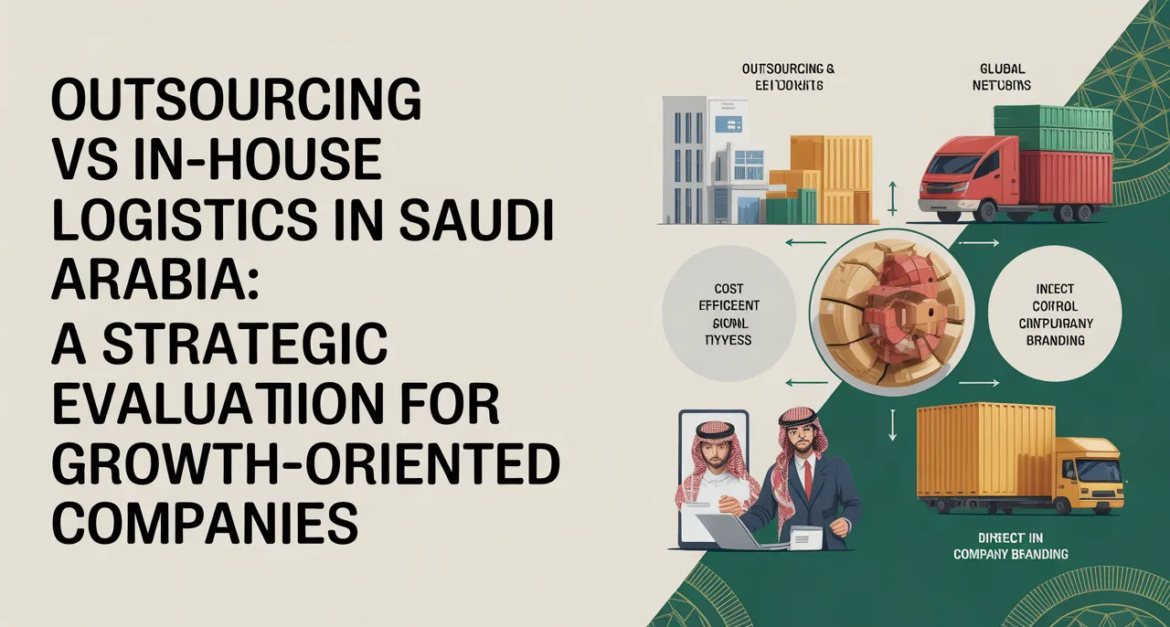
Are rising logistics costs, shipment delays, and operational stress slowing your company’s growth in Saudi Arabia?
In today’s fast-moving Saudi market, many businesses experience strong sales but struggle behind the scenes with transportation bottlenecks, warehouse inefficiencies, customs documentation errors, and limited supply chain visibility. Expansion into Riyadh, Jeddah, or cross-border GCC markets increases pressure even further. What begins as manageable in-house coordination quickly turns into complex operational strain. As the Kingdom accelerates economic transformation under Vision 2030, supply chains are becoming more advanced, regulated, and technology-driven. Without structured logistics infrastructure, growth can feel chaotic instead of controlled.
Here is the solution: strategic evaluation and structured execution. Businesses must carefully assess whether maintaining in-house logistics truly supports long-term scalability — or whether partnering with a professional logistics company in KSA provides the agility, compliance expertise, nationwide distribution capability, and technology integration required for sustainable expansion. The right logistics structure reduces risk, stabilizes margins, improves delivery performance, and transforms operations from reactive problem-solving into proactive growth enablement. In a competitive economy where execution defines leadership, logistics is no longer just movement, it is momentum.
The Strategic Role of Logistics in Saudi Arabia’s Growth Era
Logistics is no longer a back-office function. It directly influences:
- Cash flow velocity
- Customer retention
- Brand reputation
- Operational risk exposure
- Market expansion capability
- Margin stability
In Saudi Arabia’s evolving business landscape, companies that treat logistics as structured infrastructure outperform those that treat it as an afterthought.
The Kingdom’s logistics ambitions under Vision 2030 are accelerating trade facilitation, digital customs processes, and multimodal connectivity. Businesses must decide whether to internally build complex systems or leverage existing professional expertise.
Section 1: Understanding In-House Logistics
In-house logistics means owning and managing:
- Transportation fleet
- Warehousing facilities
- Inventory management systems
- Staffing and compliance teams
- Freight booking and coordination
- Customs documentation
- Distribution network operations
Capital Investment Requirements
Building internal logistics capability requires significant upfront investment:
- Warehouse leasing or construction
- Racking systems and equipment
- Forklifts and material handling systems
- Fleet acquisition
- Insurance and compliance certifications
- Warehouse Management Systems (WMS)
- Tracking technology
These fixed costs increase financial pressure during demand fluctuations.
Operational Control: The Primary Advantage
The main argument for in-house logistics is control.
You control:
- Delivery standards
- Internal KPIs
- Staffing policies
- Inventory procedures
- Routing decisions
For companies with highly sensitive products — such as pharmaceuticals or defense materials — direct oversight may be critical.
The Hidden Operational Complexities
However, growth amplifies complexity:
- Managing seasonal demand spikes
- Navigating regulatory updates
- Handling customs clearance documentation
- Dealing with port congestion
- Managing vehicle breakdowns
- Retaining skilled warehouse labor
Operational management becomes a full-time specialization.
As expansion spreads across Riyadh, Jeddah, and Dammam, infrastructure duplication increases cost exposure.
Section 2: Understanding Outsourced Logistics (3PL Model)
Outsourcing logistics means partnering with a specialized freight and logistics company Saudi Arabia that provides integrated, end-to-end services.
Services typically include:
- Air freight services
- Sea freight services
- Land transportation
- Customs clearance services in KSA
- Warehousing and distribution in Saudi Arabia
- Inventory visibility systems
- Project cargo logistics KSA
- Time-critical logistics services KSA
Rather than building infrastructure, companies leverage existing networks.
Cost Structure Comparison: Fixed vs Variable Models
In-House Model
- High capital expenditure
- Maintenance costs
- Staff salaries
- Technology upgrades
- Compliance management
- Fleet depreciation
Costs remain fixed regardless of shipment volume.
Outsourced Model
- Scalable pricing
- Pay-per-shipment or contract-based models
- Reduced infrastructure burden
- Shared technology systems
- Lower administrative overhead
For growth-stage businesses, flexibility protects margins.
Scalability & Geographic Expansion
Saudi Arabia’s geography is expansive. Serving:
- Riyadh
- Jeddah
- Dammam
- Industrial zones
- Remote project sites
requires infrastructure depth.
An established ksa transportation and logistics company already operates nationwide networks. Expansion becomes faster because infrastructure exists.
Companies operating in-house must build each location individually — increasing delay and risk.
Risk Management & Compliance
Supply chains face multiple risks:
- Documentation errors
- Regulatory penalties
- Freight rate volatility
- Global disruptions
- Port congestion
- Weather conditions
- Insurance claims
Professional logistics providers mitigate these risks daily.
They employ compliance teams specialized in customs regulations, trade documentation, and route optimization.
For businesses unfamiliar with complex import/export frameworks, partnering with the best freight forwarder in Saudi Arabia reduces exposure to financial penalties.
Technology & Digital Integration
Modern logistics depends on digital systems:
- Real-time tracking dashboards
- Warehouse Management Systems
- Automated customs filing
- Electronic proof of delivery
- Demand forecasting analytics
Developing these systems internally requires:
- IT investment
- Software licensing
- Implementation cycles
- Cybersecurity frameworks
Outsourcing provides immediate access to established platforms without long deployment timelines.
Digital visibility enhances:
- Customer transparency
- Inventory control
- Financial forecasting
- Service reliability
Cash Flow & Working Capital Impact
Logistics delays directly impact cash flow:
- Slower order fulfillment
- Delayed invoicing
- Increased storage costs
- Inventory carrying expenses
Structured outsourcing accelerates movement, improving:
- Inventory turnover
- Order cycle time
- Revenue recognition
In competitive Saudi markets, cash flow velocity determines growth capacity.
Industry-Specific Considerations
Oil & Gas Logistics Services KSA
Energy projects require:
- Heavy equipment transport
- Time-critical delivery
- High compliance standards
Professional project cargo logistics KSA teams manage oversized loads, route permits, and safety planning.
Construction & Mega Projects
Saudi Arabia’s infrastructure expansion demands:
- Just-in-time material supply
- Remote site access
- Cross-border equipment sourcing
Integrated logistics providers manage complex multi-vendor coordination.
E-Commerce & Retail
Rapid delivery expectations require:
- Efficient warehousing
- Last-mile distribution
- Reverse logistics systems
Outsourced logistics enables scalable fulfillment infrastructure without heavy capital investment.
Operational Efficiency & Margin Protection
Logistics inefficiency quietly reduces profitability:
- Excess inventory
- Repeated shipments
- Documentation corrections
- Storage penalties
- Idle fleet capacity
Structured logistics management strengthens:
- Documentation accuracy
- Transit time predictability
- Cost transparency
- Service reliability
Precision protects margins.
Control vs Expertise: The Executive Decision
In-house logistics provides control.
Outsourcing provides specialization.
Executives must evaluate:
- Is logistics our core competency?
- Can we justify long-term infrastructure investment?
- Do we have regulatory expertise?
- Can we scale nationally without operational instability?
For many companies, partnering with a reliable logistics partner in Saudi Arabia ensures structured growth.
When In-House Logistics Is Justified
- Extremely high, stable shipment volumes
- Unique compliance requirements
- Long-term predictable demand
- Strong internal logistics expertise
When Outsourcing Is Strategically Advantageous
- Rapid expansion goals
- Multi-city distribution needs
- Cross-border trade operations
- Margin pressure
- Limited logistics specialization
For growth-oriented enterprises, outsourcing converts operational burden into structured capability.
The National Growth Context
Under Vision 2030, Saudi Arabia aims to become a global logistics hub.
Investments include:
- Airport cargo expansion
- Port modernization
- Digital customs platforms
- Integrated logistics zones
Businesses aligning with professional logistics ecosystems position themselves for long-term stability.
Decision Framework for 2026 and Beyond
Ask these questions:
- Can our current logistics model support 2x growth?
- Are fixed infrastructure costs limiting agility?
- Do we have internal regulatory expertise?
- Are delays impacting customer retention?
- Is capital better deployed toward revenue generation?
Clear answers guide the strategic choice.
Long-Term Competitive Advantage
Logistics determines:
- Market speed
- Expansion readiness
- Operational resilience
- Brand credibility
It is not merely transportation. It is structured execution.
For companies seeking the best logistic company in KSA, working with experienced providers such as Palm Horizon KSA transforms logistics from cost center into competitive advantage.
Conclusion
Saudi Arabia’s business environment rewards precision. Companies that engineer logistics as strategic infrastructure scale with confidence, expand across regions without disruption, and protect margins even during market volatility. Companies that delay structural decisions often experience margin compression despite increasing sales because operational strain quietly absorbs profit. Warehousing inefficiencies, documentation errors, inconsistent transit times, and limited supply chain visibility gradually weaken competitive positioning. In a market transforming under Vision 2030, logistics is no longer a background function. It is a core growth driver that determines how efficiently capital moves, how reliably customers are served, and how sustainably businesses expand across Riyadh, Jeddah, Dammam, and beyond.
The outsourcing versus in-house decision is not about preference or tradition — it is about scalability, risk management, financial flexibility, and long-term operational stability. As Saudi Arabia strengthens its position as a global logistics hub, alignment between business strategy and logistics structure becomes essential. Companies that choose structured, professionally managed supply chain frameworks build resilience and execution consistency. Partnering with an experienced provider such as Palm Horizon KSA enables organizations to convert logistics from an operational burden into a competitive advantage. In a rapidly evolving economy, execution defines leadership — and execution begins with logistics.
Frequently Asked Questions (FAQs)
1. Is outsourcing logistics more cost-effective in Saudi Arabia?
For most growing businesses, yes. In-house logistics requires major fixed investment in warehouses, fleets, staffing, insurance, and technology systems. These costs remain even during slow periods. Outsourcing converts them into scalable operational expenses aligned with shipment volume. This improves cash flow, reduces financial risk, and protects margins in a competitive economy influenced by Vision 2030.
2. Does outsourcing reduce visibility and control?
No. Professional logistics providers use advanced tracking systems, warehouse management software, and digital reporting dashboards. Businesses gain real-time shipment tracking, inventory visibility, performance monitoring, and documentation transparency. In many cases, outsourced logistics increases control through structured reporting and defined service-level agreements.
3. Can outsourced logistics support cross-border GCC trade?
Yes. Experienced logistics partners manage import and export documentation, customs clearance, regulatory compliance, and optimized route planning. Their expertise reduces delays, prevents penalties, and ensures smooth cargo movement across GCC borders.
4. Which industries benefit most?
Oil and gas, construction, FMCG, healthcare, retail, and e-commerce sectors benefit significantly. These industries require compliance accuracy, time-sensitive transportation, scalable warehousing, and reliable nationwide distribution.
5. How do I choose the best KSA logistics company?
Assess infrastructure coverage, customs expertise, technology capability, scalability, financial stability, and industry experience. A reliable logistics partner should function as a strategic extension of your operations, supporting long-term growth rather than simply transporting goods.