
Are you growing fast but still feeling like profits are slipping through the cracks?
Many Saudi businesses are expanding aggressively, winning new contracts, increasing shipment volumes, and entering new markets — yet their margins feel tighter, their cash flow feels slower, and operational stress keeps rising. The problem is not always pricing, sales, or market demand. In many cases, the real issue lies deeper — inside fragmented logistics systems that silently drain revenue through delays, inventory inefficiencies, emergency freight costs, and poor coordination.
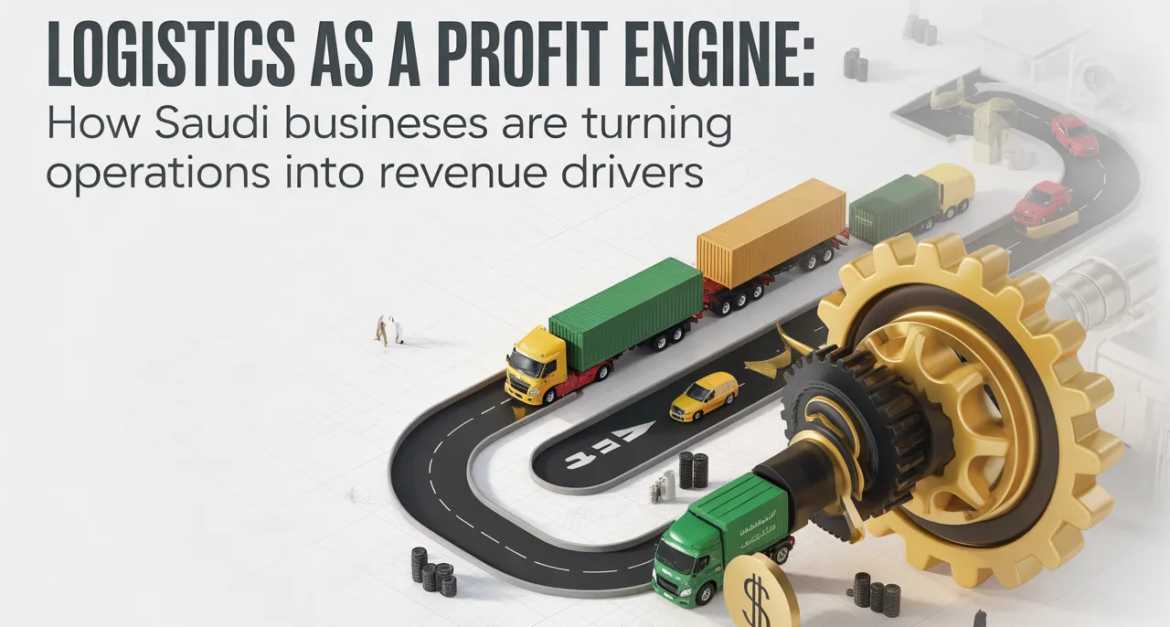
Here is the solution: restructure logistics from a cost center into a profit engine.
When logistics is engineered strategically — with integrated freight forwarding, precise customs clearance, optimized warehousing, and real-time visibility — operations stop leaking money and start generating performance. Delivery timelines become predictable. Cash flow accelerates. Margins stabilize. Growth becomes structured instead of chaotic. In today’s competitive Saudi market, companies that master logistics discipline do not just move goods efficiently — they convert operational control into measurable financial strength.
Moving Beyond the “Cost Center” Mindset
The old paradigm by logistics was predominantly focused on cost savings. Lower freight rates. Minimal storage fees. Cheaper transport contracts.
While billing logistics is still relevant, cost control is missing the big picture as an expense category. Delays in invoicing procedures caused by customs delays. In the case of emergency shipping, poor coordination results in higher cost. Bad warehouse practices lead to a dead capital in the inventory products. It can be challenging to communicate with providers when there isn’t integration, and can potentially extend project timelines and impact client trust.
This isn’t working it out. These are monetary repercussions.
The right logistics management system will minimize lost food money. This streamlines operations, reduces deliveries times. Documentation is more accurate and hence errors and delays are minimized. Frequent transportation of goods is ensured and gives companies better enterprises control. The savings in money don’t only come from the freight cost.
This is because logistics can help you save money instead of spending it.
Cash Flow Acceleration Through Operational Precision
The recognition of revenue for products is related to service delivery to customers, bills are sent out and cash is collected. Time is extended between dispatch and delivery when there is disruption.
Economists are warning that the country’s growing economy contains “small inefficiencies” that can cause “big problems. Delays (port), lack of documentation, misrouted shipments and warehouse miscoordination can cost.
With a modern logistics system, all these uncertainties can be avoided. This guarantees timely deliveries, with integrated freight forwarding and customs clearance services and real-time tracking of shipments. Predictability accelerates invoicing. Quickly invoicing means increased liquidity. Improved liquidity is conducive to growth.
When the business is established, the income can be measured.
One way companies are making logistics a profitable business is through logistics.
Margin Protection: The Silent Advantage
Profitability is often associated with sales growth. However it is equally significant to keep and protect existing margins. Profit is quietly eroded and lost through penalties, emergency freight, loss of inventory and compliance risks.
A good logistics partner does not experience such losses in the first place. The use of precision planning helps to ensure that freight mode selections meet urgency and cost. Preparation of customs documentations is accurate. Stock discrepancy minimisation by warehousing. Inter-agency coordination for avoiding duplication in distribution.
This uniformity eventually will even out the margins.
We have seen that at Palm Horizon, there are less emergency interventions and less volatility in operations in companies with integrated logistics frameworks. The result is a smoother shipping process and tangible financial safeguards.
Inventory as Capital, Not Storage
One of the biggest investments for expanding enterprises is inventory. Too much inventory eats up money. Lack of stock will upset revenue.
A combination of strategic warehousing and distribution management balance this equation. Businesses optimize inbound freight and delivery schedules with demand forecasts and outbound delivery plans, minimizing inventory sitting idle and ensuring delivery reliability.
With the right logistics, inventories are not locked up in storage, but are active capital.
The transition not only enhances working capital efficiency but also boosts financial flexibility, a significant benefit in the competitive market of Saudi Arabia.
Scalability Without Operational Instability
Growth without infrastructure creates risk.
Many companies expand rapidly but fail to align their supply chain systems with their growth ambitions. As shipment volumes increase, coordination becomes complex. Errors multiply. Communication weakens. Costs escalate unexpectedly.
An experienced logistics company in KSA designs scalable systems from the outset. Integrated freight forwarding, customs clearance, warehousing, and transportation are aligned under a unified operational strategy.
Palm Horizon works with businesses to ensure that expansion does not introduce chaos. By structuring logistics as long-term infrastructure rather than short-term transactions, companies can scale confidently while maintaining service quality.
Scalability becomes structured rather than reactive.
Reliability as a Competitive Asset
In competitive markets, reliability builds trust. Trust builds recurring revenue.
Late deliveries damage credibility. Inconsistent performance weakens client confidence. Over time, reliability becomes more valuable than marginal price differences.
Businesses that partner with the best logistic company in KSA understand this dynamic. Consistent execution enhances brand perception. Clients experience professionalism not just in contracts, but in performance.
Reliability strengthens long-term relationships. Long-term relationships stabilize revenue streams.
Logistics, therefore, becomes a brand enhancer — not merely an operational tool.
Technology and Data-Driven Visibility
The modern logistics environment in Saudi Arabia is increasingly digital. Predictive analytics, route optimization software, automated documentation systems, and real-time tracking dashboards are redefining operational control.
However, technology alone does not generate profit. It must be embedded within a structured logistics strategy.
When implemented correctly, digital systems reduce uncertainty. They identify potential delays before they escalate. They improve communication between suppliers, ports, warehouses, and final destinations.
Palm Horizon integrates operational discipline with digital visibility to ensure that technology enhances financial performance rather than complicating processes.
Data-driven logistics reduces risk exposure. Reduced risk strengthens financial predictability.
Cost Center vs Profit Engine: A Strategic Perspective
| Operational Focus | Traditional Model | Profit-Engine Model |
| Core Objective | Reduce immediate expenses | Strengthen overall financial performance |
| Shipment Management | Fragmented execution | Integrated end-to-end coordination |
| Customs Handling | Basic compliance | Proactive regulatory management |
| Inventory Approach | Storage-based | Capital efficiency driven |
| Growth Adaptability | Limited scalability | Structured expansion capability |
| Financial Outcome | Hidden margin erosion | Margin stability and cash flow acceleration |
| Competitive Position | Price-focused | Reliability and performance focused |
The distinction is not theoretical. It is strategic.
Companies that design logistics as infrastructure outperform those who treat it as outsourcing.
Risk Mitigation as Financial Protection
Global trade volatility remains a reality. Regulatory changes, geopolitical shifts, and supply disruptions can impact operations unexpectedly.
Businesses with fragmented logistics frameworks often react too late. Those with structured systems adapt quickly.
An integrated logistics partner builds contingency planning into daily operations. Alternative routing options, compliance expertise, and proactive communication channels create resilience.
Risk management is not an optional service — it is financial protection.
The Leadership Shift in Saudi Arabia
Executives across the Kingdom are recognizing that logistics influences revenue more than previously understood. Boardroom discussions now include supply chain visibility metrics, resilience indicators, and working capital optimization tied directly to operational performance.
The question is no longer, “How do we reduce shipping costs?”
The question is, “How do we design logistics to strengthen our financial performance?”
That shift in perspective defines market leaders.
Conclusion: Execution Defines Competitive Advantage
In today’s Saudi business environment, product innovation and marketing scale are no longer enough. Execution determines leadership.
Companies that treat logistics as structured infrastructure operate with confidence. They protect margins while maintaining operational efficiency. Revenue cycles accelerate as processes become predictable and streamlined. Growth scales seamlessly without introducing instability. Meanwhile, trust is strengthened through consistent reliability.
Logistics, when professionally engineered, becomes a measurable profit engine.
Palm Horizon understands that logistics is not about moving cargo from point A to point B. It is about building systems that strengthen financial performance and support sustainable growth. By aligning operational precision with strategic vision, Palm Horizon helps businesses across Saudi Arabia transform their supply chains into revenue-driving assets.
FAQs: Logistics as a Profit Engine in Saudi Arabia
1. What does it mean to treat logistics as a profit engine?
Treating logistics as a profit engine means designing supply chains to actively support revenue, protect margins, and optimize cash flow, rather than simply moving goods from point A to point B. It turns operations into measurable financial performance.
2. How can Palm Horizon help Saudi businesses improve profitability through logistics?
Palm Horizon integrates freight forwarding, warehousing, customs clearance, and distribution into one seamless system. This reduces delays, prevents costly errors, improves inventory management, and accelerates cash flow, directly contributing to profit growth.
3. Why is traditional logistics considered a cost center?
Traditional logistics focuses primarily on reducing immediate operational costs, often ignoring hidden losses like emergency shipments, inventory holding, delayed invoicing, and penalties. This limits financial impact and efficiency.
4. How does structured logistics protect business margins?
Structured logistics prevents errors, reduces emergency costs, optimizes inventory, and ensures timely deliveries. By minimizing operational risks, businesses maintain stable profit margins while scaling operations efficiently.
5. Can logistics impact cash flow in Saudi businesses?
Yes. Predictable delivery timelines, accurate customs processing, and coordinated warehousing accelerate invoicing cycles. Faster invoicing improves liquidity and allows businesses to reinvest capital in growth initiatives.
6. How does technology enhance logistics profitability?
AI-based route optimization, predictive analytics, automated documentation, and real-time tracking provide proactive visibility. This reduces delays, prevents errors, and allows decision-makers to act before disruptions occur, increasing operational and financial efficiency.
7. Is logistics only important for large companies?
No. Any business handling shipments, warehousing, or distribution can benefit from structured logistics. Even mid-sized and fast-growing companies in Saudi Arabia can transform operations into a profit engine by optimizing supply chain processes.