
Introduction: A Kingdom at the Crossroads of Biotech and Logistics
Saudi Arabia is no longer simply a market that receives pharmaceutical products. It has become a destination for some of the most complex, temperature-sensitive, and time-critical biologics ever manufactured — from mRNA-based therapies and gene-editing compounds to cell and gene therapy (CGT) products that must arrive alive, viable, and within a controlled temperature corridor that tolerates almost zero deviation.
The Vision 2030 healthcare transformation has accelerated this shift dramatically. With the Saudi Food and Drug Authority (SFDA) fast-tracking approvals for advanced biologics, and with regional distribution hubs being established in Riyadh and Jeddah, the kingdom has positioned itself as the biotech gateway to the wider GCC and MENA region. But this ambition creates a direct and urgent pressure point: the cold chain infrastructure behind these imports has not kept pace with the sophistication of what is being imported.
A single misstep — a temperature excursion at a customs hold point, a miscommunicated GDP compliance document, a last-mile breakdown in desert heat exceeding 45°C — can render a batch of monoclonal antibodies or CAR-T cell therapies completely useless. The financial loss alone can run into millions of dollars. More critically, a patient waiting for that therapy loses time they cannot recover.
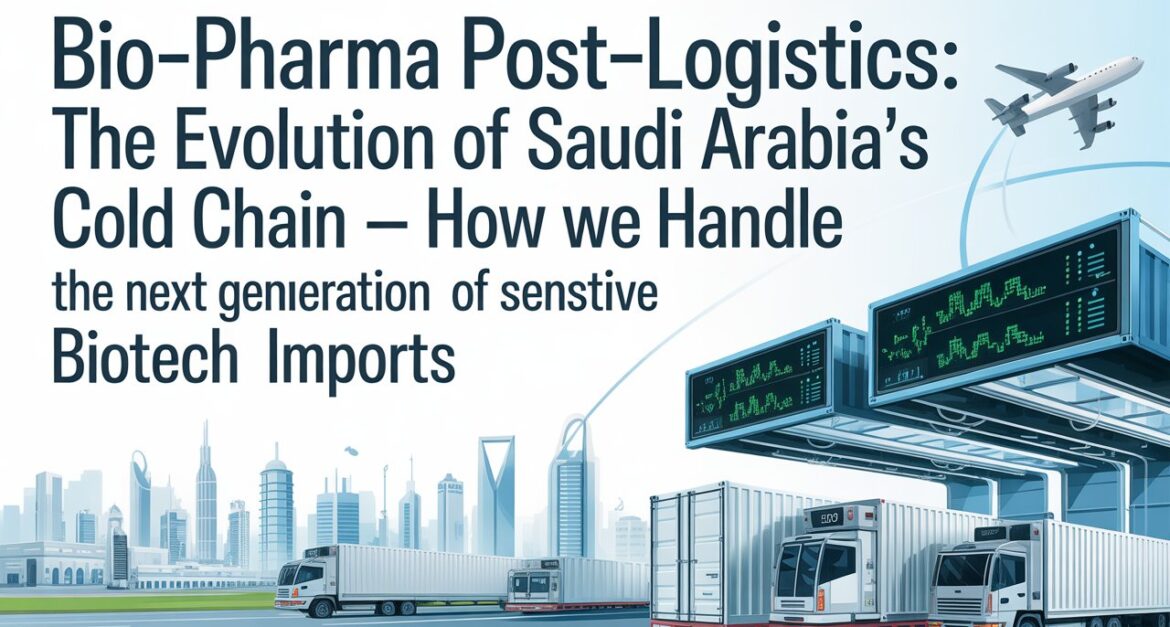
This article examines the state of cold chain pharma logistics in Saudi Arabia, how the next generation of biotech imports is reshaping what pharma logistics companies must do differently, and how pharmaceutical manufacturers and market access teams can streamline pharma market access logistics to protect product integrity from factory to patient.
If your organization is navigating market entry into Saudi Arabia or the broader Gulf region, or if you are evaluating pharma logistics vendors for a biotech portfolio rollout, this is the most complete operational picture available.
What Is Bio-Pharma Post-Logistics — and Why Does It Demand Its Own Framework?
Most discussions about pharmaceutical logistics focus on the journey from manufacturing site to the point of importation. Post-logistics — the phase that begins the moment a product clears customs and enters the destination market — receives far less attention. Yet it is frequently where product integrity is most at risk.
Bio-pharma post-logistics refers to the complete downstream chain of custody activities that occur after a regulated pharmaceutical product enters a destination country. It encompasses:
- Customs clearance and regulatory documentation management
- In-country warehousing and controlled storage
- Last-mile distribution to hospitals, specialty pharmacies, and healthcare facilities
- Cold chain monitoring, deviation management, and requalification protocols
- Returns and destruction management for temperature-compromised stock
For standard small-molecule drugs, this chain is manageable. For advanced biologics — proteins, vaccines, cell therapies, and gene therapies — every node in the post-logistics chain becomes a potential point of failure. The biological nature of these products means they cannot simply be retested and released if a temperature excursion occurs. They must be quarantined, evaluated by a qualified person (QP), and in most cases discarded.
In Saudi Arabia specifically, the post-logistics phase intersects with a regulatory environment that is still maturing around advanced therapy medicinal products (ATMPs), a customs clearance system that can hold temperature-sensitive products for hours without adequate cold storage, and a last-mile infrastructure that is unevenly developed across the kingdom’s geographically vast territory.
Understanding this specific context is the foundation for building logistics strategies that actually work.
The Saudi Arabia Cold Chain Landscape: Where We Are Today
The Infrastructure Gap
Saudi Arabia has invested heavily in general logistics infrastructure under Vision 2030. The Saudi Logistics Hub initiative, the expansion of King Khalid International Airport’s cargo facilities, and the growth of third-party logistics (3PL) providers have all moved the baseline forward meaningfully.
However, the cold chain — specifically the pharma-grade cold chain — remains uneven in its depth and coverage. Here is a clear-eyed assessment of where the gaps persist:
Airport Cold Chain Handling King Khalid International Airport (Riyadh) and King Abdulaziz International Airport (Jeddah) have both expanded their pharmaceutical cargo handling capabilities. IATA CEIV Pharma certification has been pursued by several ground handlers. However, peak periods, especially Hajj season and summer months, create congestion that can extend customs hold times unpredictably. For ultra-cold chain products (−60°C to −80°C), like certain mRNA vaccines and viral vector therapies, this congestion poses an existential product integrity risk.
Warehousing and Distribution Major global 3PLs — DHL Supply Chain, Kuehne+Nagel, Agility, and local players like Saudi Airlines Cargo — operate GDP-compliant pharmaceutical warehouses in the kingdom. However, not all of them have validated ULT (ultra-low temperature) storage capacity. For most biologics requiring standard 2–8°C refrigeration, the infrastructure is reasonably mature. For −20°C products and below, the available GDP-qualified capacity is still limited relative to the demand being generated by the current biologic approval pipeline.
Last-Mile Distribution The last mile is where cold chain pharma logistics faces its most severe test in Saudi Arabia. Delivering temperature-controlled products to secondary and tertiary care hospitals outside Riyadh, Jeddah, and Dammam involves routes crossing extreme ambient heat, with limited access to pre-conditioned vehicles and qualified drivers trained in pharma cold chain protocols. Specialty pharmacies in smaller cities often lack the storage infrastructure to receive and maintain high-value biologics.
The Regulatory Environment
The SFDA has been actively strengthening its Good Distribution Practice (GDP) framework, aligning more closely with EU GDP guidelines (2013/C 68/01). This is positive for product integrity standards but adds complexity to how pharma logistics companies must document, qualify, and report on their operations.
Key regulatory touchpoints that directly affect post-logistics planning include:
- SFDA import permit requirements for controlled biologics
- Batch release documentation translated and authenticated for Saudi customs
- Cold chain deviation reporting requirements for GDP compliance
- SFDA-registered importer requirements — not every logistics provider qualifies
- Halal certification intersection for biologics containing animal-derived components
For pharma market access teams, understanding these regulatory touchpoints is not optional. They are critical path items that determine the actual feasibility of a launch timeline.
Core Attributes of a World-Class Pharma Cold Chain in Saudi Arabia
To evaluate pharma logistics vendors and build a resilient cold chain strategy, procurement and supply chain teams need a clear framework of what excellence looks like. Drawing on global GDP standards, IATA CEIV Pharma criteria, and the specific demands of the Saudi regulatory environment, the following attributes define a best-in-class cold chain operation.
1. End-to-End Temperature Visibility
The gold standard is continuous, sensor-based temperature monitoring from the point of manufacturing release through every node of the post-logistics chain. This means:
- Active data loggers with cellular or satellite connectivity embedded in every shipment
- Real-time dashboards accessible to both the logistics provider and the pharmaceutical client
- Automated alert systems with defined escalation protocols when temperature thresholds are approached or breached
- Full audit-trail data exportable for SFDA GDP documentation requirements
Passive loggers that are read only upon delivery are no longer acceptable for high-value biologics. The industry has moved decisively toward active, connected monitoring, and Saudi Arabia’s leading logistics providers are following suit.
2. Qualified Cold Storage Infrastructure
Storage facilities must be validated across all required temperature ranges: controlled room temperature (15–25°C), refrigerated (2–8°C), frozen (−20°C), and ultra-low temperature (−60 to −80°C). Validation documentation — including installation qualification (IQ), operational qualification (OQ), and performance qualification (PQ) — must be current, available for regulatory inspection, and mapped to SFDA GDP requirements.
3. Customs Clearance Competency
This is frequently the most underestimated element of pharma logistics companies’ capability. A provider’s ability to clear pharmaceutical products through Saudi customs rapidly and without compliance errors directly determines whether temperature-sensitive products survive the importation process intact.
Look for providers with:
- Dedicated pharmaceutical customs clearance desks with SFDA regulatory expertise
- Pre-clearance documentation preparation that minimizes hold times
- Established relationships with customs authorities that enable expedited processing for critical medicines
- Contingency cold storage at the airport for products requiring extended customs processing
4. Last-Mile Specialization
General freight capabilities do not translate to pharmaceutical last-mile competency. Providers serving the Saudi pharma market must demonstrate:
- Temperature-controlled vehicle fleets validated to GDP standards
- Driver training programs that include cold chain protocol, documentation, and deviation reporting
- Route planning that accounts for ambient temperature exposure times, not just delivery distance
- Qualified receiver verification at delivery points for controlled products
5. GDP Compliance Documentation and Quality Systems
Every serious pharma logistics vendor operates within a documented quality management system (QMS) that governs their cold chain operations. For Saudi Arabia, this QMS must address SFDA GDP requirements directly, not just EU or US equivalents. Alignment is high but not identical, and the differences matter during regulatory inspections.
How to Evaluate Pharma Logistics Vendors for the Saudi Market
Choosing the wrong logistics partner for a biologic launch into Saudi Arabia is not a recoverable situation in the short term. The costs — financial, regulatory, and reputational — are severe. The following evaluation framework is built specifically for pharma market access and supply chain teams assessing how to streamline pharma market access logistics in the kingdom.
Evaluation Dimension 1: Regulatory Standing with SFDA
Does the vendor hold the necessary SFDA-registered importer and distributor licenses for your product category? Do they have a documented track record of GDP inspections without critical findings? Can they provide references from pharmaceutical clients who have successfully completed SFDA regulatory audits of their distribution network?
This is the first filter. No other capability matters if the regulatory standing is not solid.
Evaluation Dimension 2: Technical Cold Chain Infrastructure
Request a technical audit of their storage facilities. This is not a paperwork review — it is a physical assessment of validated storage capacity, monitoring systems, backup power systems, and contingency protocols. For ULT products specifically, ask to see evidence of continuous temperature excursion rates from their storage environments over the past 12 months.
Evaluation Dimension 3: Customs Clearance Track Record
Ask for documented clearance time data for pharmaceutical shipments — specifically the average elapsed time from aircraft landing to product release into temperature-controlled custody. For priority biologics, this number should be under four hours. For ULT products, the standard should be even tighter.
Evaluation Dimension 4: Last-Mile Network Coverage
Request a coverage map that is honest about where GDP-compliant last-mile delivery is genuinely available versus where the provider subcontracts to unqualified local carriers. The Riyadh-Jeddah-Dammam triangle is reasonably well served. Secondary cities including Mecca, Medina, Taif, Abha, and Tabuk are where network depth varies significantly between providers.
Evaluation Dimension 5: Digital Integration Capability
Modern pharma supply chain management requires data integration between the logistics provider’s systems and the pharmaceutical manufacturer’s ERP, track-and-trace, and quality systems. Ask about API connectivity, data format standards (GS1, EPCIS), and the provider’s experience with serialization and aggregation requirements. Saudi Arabia’s Vision 2030 digital transformation agenda will accelerate regulatory requirements in this space.
Evaluation Dimension 6: Financial Stability and Strategic Investment Direction
Post-logistics partnerships for biologics are not commodity vendor relationships. They are strategic partnerships that carry regulatory co-accountability. Evaluate whether your prospective vendor is investing in capability expansion — additional cold storage capacity, ULT expansion, digital monitoring infrastructure — or whether they are managing a static operation. The former is a viable long-term partner. The latter is a short-term risk.
Use Cases: How Different Biotech Categories Create Different Cold Chain Demands
Monoclonal Antibodies (mAbs)
The largest and most established category of biologics entering the Saudi market, mAbs typically require 2–8°C storage and transport. The cold chain demands are relatively well understood, but the increasing volume of mAb therapies — particularly in oncology and immunology — is putting pressure on available qualified storage capacity. Providers must demonstrate consistent capacity availability, not just theoretical capability.
Specific logistics challenge: Ensuring continuous 2–8°C maintenance during Hajj season when Jeddah’s logistics networks face extreme capacity compression.
mRNA Therapies and Vaccines
mRNA products represented a turning point for cold chain logistics globally. The requirement for −70°C storage for certain mRNA platforms exposed the inadequacy of existing ultra-low temperature infrastructure in most markets, including Saudi Arabia. While COVID-19 vaccine deployment accelerated ULT infrastructure investment, the capacity available for commercial mRNA-based therapeutics beyond vaccines remains limited.
Specific logistics challenge: Establishing a validated ULT supply chain from European or US manufacturing sites to Saudi hospitals, with qualified cold storage at every node, in a market where ULT capability is still being built out.
Cell and Gene Therapies (CGTs)
CGTs represent the most demanding frontier in pharma logistics. CAR-T cell therapies, for example, are manufactured from an individual patient’s own cells, transported to a manufacturing site, and then returned to the patient within a defined window. The logistics chain is therefore not just temperature-controlled — it is time-critical, identity-critical, and irreplaceable. There is no backup batch. Every shipment is the only option.
Specific logistics challenge: Managing the chain of identity and the chain of custody simultaneously across international borders, with Saudi customs and SFDA regulatory requirements overlaid on an already extraordinarily complex logistics protocol.
Vaccines for National Immunization Programs
Saudi Arabia’s National Immunization Program (NIP) is one of the most comprehensive in the region, and it demands a cold chain capable of moving large volumes of multi-valent vaccines from central government storage through regional health clusters to primary care vaccination points across a geographically vast country. The NIP cold chain is a government-managed operation, but commercial vaccine manufacturers entering the market must align with its infrastructure assumptions and identify where private cold chain capability supplements national capacity.
Competitive Landscape: Pharma Logistics Companies Operating in Saudi Arabia
The competitive landscape for cold chain pharma logistics in Saudi Arabia comprises four tiers of provider, each with different capability profiles and strategic positioning.
Tier 1: Global Integrated Logistics Providers
DHL Supply Chain and Kuehne+Nagel are the dominant global players with dedicated pharmaceutical divisions operating in Saudi Arabia. Both hold IATA CEIV Pharma certification across their key hubs and have invested in GDP-compliant warehousing in Riyadh and Jeddah. Their strengths are network breadth, regulatory compliance infrastructure, and digital monitoring capability. Their limitation is last-mile flexibility in secondary cities and a cost structure that may not suit smaller-volume specialty pharma clients.
World Courier (now part of AmerisourceBergen / Cencora) specializes in clinical trial logistics and high-value biologic transport. For pharmaceutical companies moving investigational therapies or small-batch specialty biologics, World Courier’s combination of white-glove handling and regulatory expertise is a strong fit for the Saudi market.
Tier 2: Regional Specialists with Pharma Capability
Agility operates one of the most significant logistics networks in the GCC, with pharmaceutical-grade warehousing and customs clearance infrastructure in Saudi Arabia. Their local regulatory knowledge and government relationships make them particularly effective in navigating SFDA requirements. Their cold chain technology infrastructure is improving but still trails the global Tier 1 providers in monitoring sophistication.
Almajdouie Logistics is a significant Saudi-owned player with pharmaceutical logistics capability and strong last-mile reach within the kingdom. For pharmaceutical companies that prioritize local market knowledge and last-mile coverage over global platform integration, Almajdouie offers a differentiated value proposition.
Tier 3: National Airlines Cargo Divisions
Saudi Airlines Cargo has made meaningful investments in its pharmaceutical handling capability, including temperature-controlled holds and IATA CEIV certification pursuit. As the dominant air cargo carrier for inbound pharmaceutical shipments, their capability at the airport node directly affects every pharma company shipping into the kingdom. Their last-mile capability beyond the airport is limited.
Tier 4: Specialty Temperature-Controlled Carriers
For specific high-value shipments — particularly CGTs and clinical trial materials — a growing number of specialty temperature-controlled carriers operate in Saudi Arabia on a project basis. These providers do not offer full-network coverage but bring specialist expertise in chain of identity management, ULT transport, and GDP documentation for the most demanding product categories.
Implementation Overview: Building a Resilient Biotech Cold Chain for Saudi Arabia
Launching a biologic into Saudi Arabia is a multi-year project. The cold chain logistics architecture is not something that can be assembled in the final months before approval. It must be designed early, qualified thoroughly, and stress-tested against real conditions before it carries commercial product.
Phase 1: Market Assessment and Logistics Architecture Design (18–24 months before launch)
Begin with a thorough assessment of the Saudi cold chain infrastructure as it applies to your specific product’s requirements. This means defining your temperature profile, your volume projections, your delivery point map, and your regulatory documentation requirements — and then mapping these requirements against the actual capability landscape of available pharma logistics companies in the kingdom.
During this phase, engage with SFDA early. Understanding the import permit timeline, the GDP documentation requirements, and the batch release processes will fundamentally shape your logistics architecture decisions.
Phase 2: Vendor Selection and Qualification (12–18 months before launch)
Using the evaluation framework described above, conduct a formal vendor selection process. Do not limit this to RFP responses and capability presentations. Conduct physical audits of proposed storage facilities. Run tabletop scenarios for temperature excursions, customs delays, and last-mile failures. Ask for GDP qualification documentation that is current and SFDA-aligned.
Engage your quality assurance team in vendor qualification, not just your supply chain team. The QA perspective on GDP compliance, deviation management, and audit trail quality is essential to making the right selection.
Phase 3: System Integration and SOPs (6–12 months before launch)
Establish data integration between your logistics provider’s systems and your own. Define and agree on standard operating procedures for every scenario: routine delivery, temperature excursion response, customs hold escalation, product recall. Ensure your quality agreement with the logistics provider is fully executed and covers all GDP-relevant responsibilities.
For CGT products especially, establish and validate the chain of identity protocols before any shipment of patient material.
Phase 4: Qualification Runs and Dry Runs (3–6 months before launch)
Before commercial product moves through your Saudi cold chain, run qualification shipments using placebo or non-product materials that match your commercial product’s packaging and weight profile. Validate the temperature profile of the actual shipment in actual conditions — not just the transport container qualification data. The Saudi summer ambient temperature environment will test your packaging in ways that a laboratory qualification chamber may not fully replicate.
Phase 5: Launch and Continuous Improvement
At launch, maintain heightened monitoring intensity. Review cold chain performance data weekly in the first three months. Establish a formal cold chain review cadence with your logistics provider that includes temperature excursion trend analysis, deviation root cause reviews, and continuous improvement actions.
The Saudi cold chain environment will evolve — regulatory requirements will tighten, new infrastructure will come online, and your product portfolio may expand into more demanding temperature ranges. Build the organizational capability and vendor relationships to evolve with it.
Frequently Asked Questions (FAQ)
Q1: What makes cold chain pharma logistics in Saudi Arabia different from other GCC markets?
Saudi Arabia presents a unique combination of factors that distinguishes it from other Gulf markets. The extreme ambient temperatures — reaching 50°C in inland areas during summer — create a last-mile cold chain challenge that is more severe than in the UAE or Qatar. The geographic scale of the kingdom means last-mile distribution covers distances and route complexities that smaller GCC markets do not face. The SFDA regulatory framework is also more demanding than some regional equivalents, requiring GDP compliance documentation that is specifically aligned with Saudi requirements rather than simply EU or US-based compliance. Finally, the scale of the Saudi National Immunization Program and the ambition of Vision 2030 healthcare infrastructure create a market that is simultaneously more complex and more strategically important than any other single GCC market.
Q2: How do pharma logistics companies handle temperature excursions during Saudi customs clearance?
Temperature excursion management during customs clearance is one of the most operationally critical elements of Saudi cold chain pharma logistics. Best-practice providers maintain dedicated temperature-controlled holding areas at the airport that can receive pharmaceutical products immediately upon offloading from aircraft, before customs clearance is complete. They also maintain pre-positioned dry ice or phase-change material reserves to extend the thermal life of shipments that face extended holds. Critically, they have documented escalation protocols — agreed with the pharmaceutical client in advance — that define exactly what decisions are made when a shipment has been in customs hold beyond a defined threshold. For ultra-cold chain products, the threshold for escalation should be significantly shorter than for standard refrigerated products.
Q3: How should I evaluate pharma logistics vendors specifically for cell and gene therapy products entering Saudi Arabia?
Cell and gene therapy logistics evaluation requires additional dimensions beyond standard biologic cold chain assessment. First, evaluate the provider’s chain-of-identity capability — specifically their ability to maintain and document the identity integrity of patient-specific products across international borders and through Saudi customs. Second, assess their experience with the specific temperature range required by your product — whether that is cryogenic (liquid nitrogen, −196°C), ultra-low temperature (−80°C), or frozen (−20°C). Third, evaluate their clinical coordination capability — CGT logistics is not just a cold chain operation, it is a clinical coordination operation that must interface with hospital pharmacists, transplant coordinators, and prescribing physicians. Finally, assess their SFDA regulatory experience with ATMPs specifically, as this is a relatively new product category for Saudi regulatory review and the documentation requirements are still evolving.
Q4: What are the most common compliance failures in Saudi pharma cold chain logistics, and how can they be prevented?
The most frequently observed compliance failures in Saudi pharma cold chain operations fall into four categories. The first is documentation gaps — incomplete or incorrectly formatted SFDA import documentation that causes customs holds and extends temperature exposure. Prevention requires dedicated pharmaceutical customs expertise, not general freight expertise. The second is monitoring gaps — temperature data loggers that are not activated, batteries that fail, or data that is not reviewed until after delivery.
Q5: How is Vision 2030 changing the requirements for pharma logistics companies operating in Saudi Arabia?
Vision 2030 is creating both opportunity and demand elevation for pharma logistics companies in Saudi Arabia simultaneously. On the opportunity side, the dramatic expansion of healthcare infrastructure — new hospitals, new specialty care centers, new national programs for oncology and rare disease — is generating significant new demand for high-quality pharmaceutical distribution services, including cold chain. On the demand elevation side, the SFDA is actively strengthening its regulatory framework, which means GDP compliance requirements are becoming more stringent, not less. Vision 2030 also includes a domestic pharmaceutical manufacturing ambition — Saudi Arabia wants to produce some of the biologics it currently imports — which will eventually change the upstream logistics architecture. For pharma logistics companies, this means that investments in GDP compliance capability, digital infrastructure, and last-mile network depth are investments in a growing market, not just table stakes for the current one.
Q6: What role does digital technology play in modern cold chain pharma logistics in Saudi Arabia?
Digital technology has become fundamental to compliant and efficient pharma cold chain logistics in the Saudi market. The most impactful applications are real-time temperature monitoring and alerting, which have moved from optional capability to a GDP compliance expectation; track-and-trace systems that provide chain-of-custody documentation from origin to delivery point; and data integration between logistics providers and pharmaceutical manufacturers that enables real-time visibility without manual reporting. Looking forward, predictive analytics applications — using ambient temperature forecasts, historical route performance data, and equipment performance data to anticipate and prevent excursions rather than just record them — are being piloted by leading providers. For pharmaceutical companies, the practical implication is that vendor selection should now include a serious evaluation of digital capability, not just physical infrastructure.
Q7: How do I calculate the true total cost of cold chain pharma logistics in Saudi Arabia beyond the quoted freight rate?
The quoted freight and handling rate represents only a fraction of the true total cost of pharma cold chain logistics. A complete cost accounting must include product loss costs from temperature excursions — which, for a high-value biologic, can dwarf years of logistics fees from a single incident. Regulatory compliance costs — including the internal and external resources required to maintain GDP documentation, manage SFDA audits, and respond to compliance findings — must be included. Delay costs — the cost of a delayed launch, extended customs clearance, or product hold pending QP release — are real and quantifiable. Finally, the opportunity costs of choosing a lower-capability provider that cannot support your full product portfolio or your growth into secondary markets must be factored in. When these total costs are properly accounted for, the difference in quoted rates between a best-in-class provider and a lower-tier alternative frequently inverts — the higher-priced provider becomes the more economical choice.
Conclusion: The Strategic Imperative for Getting Saudi Cold Chain Right
The next five years will bring a wave of advanced biologic approvals into Saudi Arabia that the kingdom’s cold chain infrastructure is only partially prepared for. The gap between what the biologic pipeline demands and what the current logistics ecosystem can reliably deliver is real, consequential, and closing — but it has not closed yet.
For pharmaceutical companies planning market access into Saudi Arabia, the cold chain is not a logistics detail to be resolved at the end of the launch planning process. It is a strategic constraint that must be planned around from the earliest stages of market entry work. The question is not whether to invest in cold chain capability for the Saudi market — it is how to build and qualify that capability in time to support the launch timeline your commercial team is planning toward.
For pharma logistics companies competing in this market, the investment direction is clear. GDP compliance depth, ULT storage capacity, customs clearance pharmaceutical expertise, and digital monitoring infrastructure are the capabilities that will differentiate the providers who win the next generation of biologic distribution contracts from those who are left competing on price alone for commodity volumes.
Saudi Arabia is building something significant in its healthcare sector. The cold chain that supports its most sophisticated medicines deserves to be built with the same ambition.