
The Quiet Storm No One Warned You About
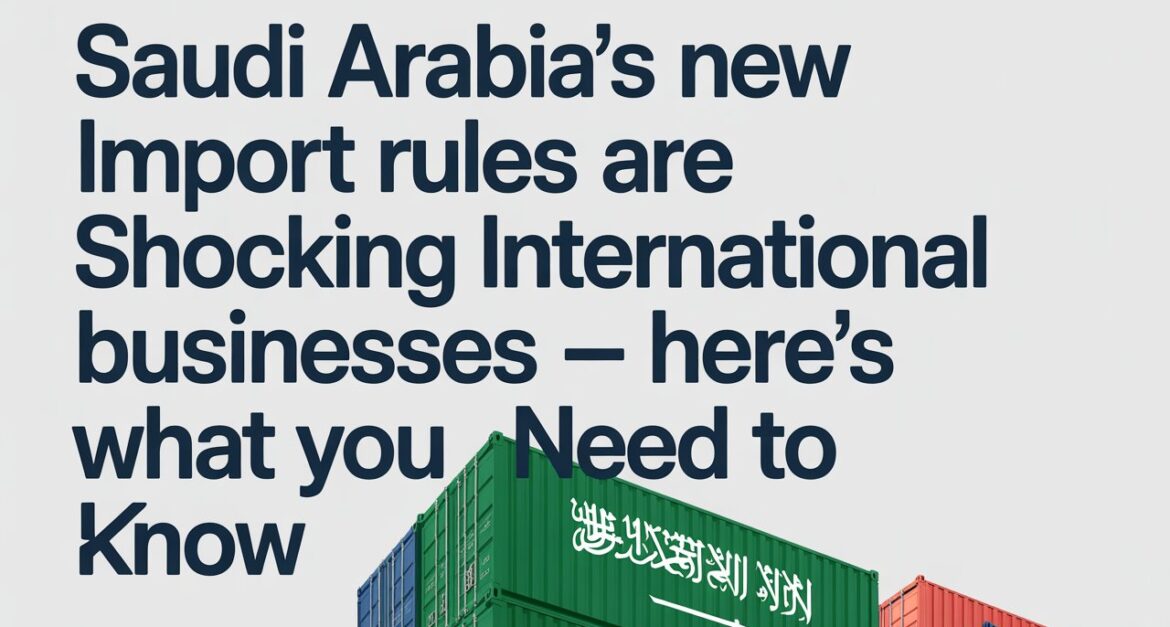
Picture this: A European electronics manufacturer finalizes a major B2B contract with a Saudi distributor. Products are manufactured, packed, loaded onto a container ship. Three weeks later, the shipment arrives at King Abdulaziz Port in Dammam — and sits. Customs officials flag missing SASO conformity certificates. The importer scrambles. Demurrage fees pile up by the hour. The distributor loses patience. The deal nearly collapses.
This is not a hypothetical. It is happening every week across dozens of industries, from consumer electronics and food products to industrial machinery and cosmetics.
Saudi Arabia — the largest economy in the Arab world and the 17th largest globally — is undergoing a sweeping regulatory transformation as part of its Vision 2030 initiative. The Kingdom is simultaneously opening its doors to international trade and tightening the rules through which that trade must pass. The result? A regulatory environment that rewards the prepared and punishes the uninformed.
This article is your comprehensive briefing — written by the trade compliance specialists at Palm Horizon KSA — on every major change, what it means for your business, and exactly how to navigate it without losing a shipment, a fine, or a client.
🌟 Fun Fact: Saudi Arabia is the world’s 17th largest economy, but it imports over $180 billion worth of goods annually — making it one of the most lucrative import markets on Earth. Getting your compliance right here is not optional — it is a strategic business imperative.
What Are Saudi Arabia’s New Import Rules, Exactly?
Saudi Arabia’s import regulatory framework has been evolving since 2016 but entered a period of accelerated reform between 2022 and 2025. The reforms span multiple government bodies: the Saudi Standards, Metrology and Quality Organization (SASO), the Zakat, Tax and Customs Authority (ZATCA), the Saudi Food and Drug Authority (SFDA), and the Ministry of Commerce.
Together, these bodies have introduced or significantly updated:
- Product conformity certification requirements via SASO’s IECEE system and Product Certification Schemes
- VAT and excise tax enforcement at the point of entry through ZATCA’s upgraded customs intelligence platform
- Halal certification mandates expanded to new food and non-food categories
- Mandatory country-of-origin labeling rules tightened under updated GCC customs protocols
- Digital customs declaration requirements via the FASAH platform (Saudi’s single window for trade)
- New restricted and prohibited goods lists aligned with national security, health, and environmental policy
- Updated Authorized Economic Operator (AEO) requirements for businesses seeking expedited clearance
The breadth of these changes is extraordinary. And most international businesses have been caught flat-footed.
Core Regulatory Changes: A Deep Dive by Category
1. SASO Conformity Certificates — The Gateway Rule
The Saudi Standards, Metrology and Quality Organization (SASO) sits at the heart of Saudi Arabia’s import compliance architecture. SASO enforces mandatory product standards for hundreds of product categories, and since 2023, enforcement has intensified significantly.
What has changed:
SASO now requires all regulated products to carry a valid Product Conformity Certificate (PCC) before they can be cleared through Saudi customs. This applies whether you are a first-time exporter or a seasoned supplier with a decade of Saudi market experience.
The conformity certificate must be issued by a SASO-approved testing and certification body. There are two main schemes:
- IECEE CB Scheme — for electrical and electronic products
- SASO Product Certification Scheme (SALEEM) — for a broader range of regulated goods
Who is affected: Consumer electronics, electrical appliances, lighting products, toys, furniture, textiles, chemicals, construction materials, and automotive parts.
Why it matters: Products arriving without a valid PCC are rejected at port. No exceptions. No grace periods. Your goods sit in a bonded warehouse while you scramble — and warehouse fees in Saudi ports are not cheap.
🌟 Fun Fact: SASO was established in 1972 — the same year that Saudi Aramco was being built into the oil giant we know today. For over 50 years, it has quietly governed what enters one of the world’s most import-hungry markets.
2. ZATCA’s Customs Intelligence Upgrade — You Are Being Watched More Closely
The Zakat, Tax and Customs Authority (ZATCA) — formed from the merger of the General Authority of Zakat and Tax and the General Authority of Customs in 2021 — has deployed a dramatically upgraded risk profiling and customs intelligence system.
What has changed:
- Advanced risk scoring of all incoming shipments using AI-based algorithms that cross-reference invoice values, HS codes, historical supplier data, and country-of-origin patterns
- Mandatory pre-arrival customs declarations through the FASAH Single Window for shipments above certain thresholds
- Stricter enforcement of invoice valuation — under-declaration of customs value is now flagged automatically and results in fines, shipment holds, and in repeat cases, supplier blacklisting
- E-invoicing integration at the customs level for registered VAT entities importing goods
Why it matters: The era of inflated “gift” shipments, misclassified HS codes, and undervalued commercial invoices is over. ZATCA’s systems are catching discrepancies that human inspectors used to miss. Businesses that relied on ambiguous documentation practices are facing fines of up to 100% of the customs value of the goods.
3. VAT and Excise Tax — Higher Stakes at the Border
Saudi Arabia introduced a 5% VAT in 2018, then raised it to 15% in 2020. This rate remains in force and applies to most imported goods at the customs stage.
Additionally, the Kingdom’s excise tax — levied on specific goods considered harmful to health or the environment — has been expanded:
| Product Category | Excise Tax Rate |
| Tobacco products | 100% |
| Energy drinks | 100% |
| Sweetened beverages | 50% |
| Electronic smoking devices | 100% |
| Liquids used in e-cigarettes | 100% |
What has changed: Customs authorities are now cross-referencing product ingredient declarations with excise tax categories. A beverage that was previously classified as a “juice” and taxed at 50% may now be recategorized as an “energy drink” and taxed at 100% — based on caffeine content thresholds defined in updated SFDA and ZATCA guidelines.
Why it matters: For food and beverage importers, a single misclassification can erase your entire margin on a shipment.
4. Halal Certification — Expanding Beyond Food
Saudi Arabia has always required halal certification for food products imported into the Kingdom. But the 2023–2025 regulatory cycle has expanded halal certification requirements into new categories.
Newly affected product categories include:
- Cosmetics and personal care products (where animal-derived ingredients are used)
- Pharmaceuticals and nutraceuticals
- Food contact materials and packaging
- Animal feed and pet food
What has changed: The accepted halal certification bodies list has been updated. Certificates from some previously accepted international bodies are no longer recognized unless they hold specific accreditation under the revised GCC Halal Accreditation Framework.
Why it matters: A cosmetics company exporting to Saudi Arabia with a halal certificate from a body that is no longer on the approved list will face shipment rejection — even if the product is genuinely halal-compliant.
🌟 Fun Fact: Saudi Arabia is the world’s second largest importer of food and agricultural products in the Middle East. Given that the Kingdom imports approximately 80% of its food needs, getting halal compliance right is not just a regulatory checkbox — it is the price of admission to a $40+ billion food import market.
5. SFDA Rules — Food, Drugs, and Cosmetics Under the Microscope
The Saudi Food and Drug Authority (SFDA) has tightened pre-market approval and registration requirements for a wide range of product categories.
Key changes include:
- All food supplement products must now be registered with SFDA before they can be imported. This registration process can take 3 to 6 months.
- Cosmetics notification requirements have been updated, and products with certain ingredients (particularly those on the EU/US restricted lists) now face automatic rejection.
- Pharmaceutical imports face updated Good Manufacturing Practice (GMP) verification requirements, with SFDA conducting increased remote audits of international manufacturing facilities.
- Labeling requirements for food products have been updated — Arabic language labeling is mandatory, and nutritional information must follow GCC Standardization Organization (GSO) formats.
6. Country-of-Origin Rules — The Pressure Point Nobody Talks About
Updated GCC customs protocols — implemented in coordination with the Gulf Cooperation Council Unified Customs Law — have tightened the rules around rules of origin declarations.
This matters enormously for businesses that source components or raw materials from multiple countries before finishing and exporting products.
What has changed:
The threshold for “substantial transformation” — the manufacturing process that qualifies a product for a particular country-of-origin designation — has been clarified and in some categories made more stringent. Additionally, Saudi customs has increased scrutiny on origin certificates, particularly for goods from countries with preferential trade relationships with the Kingdom.
Why it matters: Misrepresenting the country of origin — even inadvertently — is treated as customs fraud. Penalties range from financial fines to permanent import bans for the supplier.
Industries Most Affected by Saudi Arabia’s New Import Rules
Not all sectors feel the impact equally. Based on Palm Horizon KSA’s advisory experience and analysis of ZATCA and SASO enforcement data, these are the industries facing the most significant disruption:
Consumer Electronics and Electricals The SASO IECEE/SALEEM certification requirements hit this sector hardest. Lead times for conformity certification can run 8 to 16 weeks, meaning businesses must build compliance into their production planning cycle — not treat it as an afterthought.
Food and Beverage Halal certification, SFDA registration, Arabic labeling, excise tax reclassification — food and beverage importers face a compliance stack that is both complex and heavily enforced.
Pharmaceuticals and Medical Devices SFDA’s registration and GMP verification requirements create some of the longest pre-market timelines in the world. Businesses that underestimate this are routinely delayed by 6 to 18 months.
Cosmetics and Personal Care The intersection of halal certification, SFDA notification, and ingredient-level restrictions creates a minefield for international brands unfamiliar with Saudi-specific standards.
Automotive Parts and Industrial Equipment SASO certification requirements extend to many automotive and industrial components, and the Kingdom’s localization mandates under Vision 2030 are creating additional pressure on international suppliers to establish local partnerships.
Textiles and Apparel Updated labeling requirements and fiber content declaration rules are catching garment exporters off-guard, particularly those used to operating under EU or US standards.
Why Are These Changes Happening? The Vision 2030 Connection
Understanding the why behind Saudi Arabia’s regulatory overhaul is as important as understanding the what. These changes are not bureaucratic noise — they are deliberate strategic policy.
Saudi Vision 2030, Crown Prince Mohammed bin Salman’s ambitious national transformation program, has set out to:
- Diversify the Saudi economy away from oil dependency
- Develop domestic manufacturing and industrial capacity
- Attract foreign direct investment
- Create a transparent, modern, internationally competitive business environment
- Protect Saudi consumers with world-class product safety standards
The new import rules are the enforcement arm of this vision. The Kingdom wants quality imports that meet global safety and quality standards. It wants customs revenue properly collected. It wants its domestic producers protected from dumped or substandard foreign goods. And it wants international businesses that are serious about the Saudi market to demonstrate that seriousness through regulatory compliance.
In short: the Saudi government is professionalizing the import environment. Businesses that meet that professionalism will thrive here. Those that do not will be left outside the gate.
🌟 Fun Fact: Saudi Arabia’s non-oil trade reached a record high of over $300 billion in 2023. The Kingdom’s ports — Jeddah Islamic Port, King Abdulaziz Port in Dammam, and King Fahd Industrial Port in Jubail — collectively handle tens of millions of tons of cargo annually. Getting your goods through these ports smoothly is a logistical feat that starts with compliance, not shipping.
Palm Horizon KSA: Your Strategic Partner in Saudi Import Compliance
This is where Palm Horizon KSA enters the picture.
Palm Horizon KSA is a specialist trade compliance and market entry advisory firm dedicated exclusively to helping international businesses navigate the Saudi Arabian regulatory environment. Our team combines deep expertise in SASO, ZATCA, SFDA, and GCC customs law with on-the-ground operational capability across Saudi Arabia’s major commercial centers — Riyadh, Jeddah, Dammam, and the NEOM development zone.
What Palm Horizon KSA does:
Pre-Shipment Compliance Auditing Before your goods leave the factory, Palm Horizon KSA audits your product documentation, certification status, labeling, and HS code classification against current Saudi requirements. We identify problems before they become port-level crises.
SASO Certification Support We manage the SASO Product Conformity Certificate application process end-to-end — coordinating with approved testing labs, preparing technical documentation, and tracking certification status to ensure your timeline stays on track.
SFDA Registration Management For food, pharmaceutical, cosmetic, and medical device clients, Palm Horizon KSA manages the full SFDA product registration lifecycle — from initial submission through approval and post-market surveillance compliance.
Halal Certification Pathway Advisory We identify the correct halal certification body for your product category and country of origin, ensuring your certificate is recognized by Saudi authorities and avoiding costly rejection scenarios.
Customs Valuation and HS Code Review Our customs specialists review your commercial invoices, packing lists, and tariff classifications to ensure alignment with ZATCA’s current enforcement standards — protecting you from valuation disputes and penalties.
AEO Program Support For businesses with significant Saudi import volumes, achieving Authorized Economic Operator status with ZATCA delivers expedited customs clearance and reduced inspection rates. Palm Horizon KSA guides clients through the AEO application and audit process.
Arabic Labeling and Packaging Compliance We produce SFDA- and GSO-compliant Arabic language labels and review packaging designs against current Saudi and GCC standards.
Ongoing Regulatory Monitoring Saudi Arabia’s regulatory environment is not static. Palm Horizon KSA provides clients with a continuous regulatory monitoring service — alerting you to changes in SASO standards, SFDA requirements, ZATCA policies, and GCC customs protocols before they affect your shipments.
How the Compliance Process Works: A Step-by-Step Overview
For businesses new to Saudi import compliance, here is the general sequence of steps — with approximate timelines:
Step 1: Product Classification and Regulatory Mapping (Week 1–2) Identify the correct HS code for each product. Map the product against SASO, SFDA, and ZATCA regulatory requirements to determine which certifications, registrations, and approvals are needed.
Step 2: Gap Analysis (Week 2–3) Compare your current documentation and certification status against Saudi requirements. Identify gaps — missing certificates, incorrect labeling, unregistered products.
Step 3: Certification and Registration (Week 3–20+ depending on product) Engage with SASO-approved labs for conformity testing. Submit SFDA registration applications. Obtain or update halal certificates. This is the longest phase and must be started well before your planned shipment date.
Step 4: Documentation Preparation (Week 3–4) Prepare Saudi-compliant commercial invoices, packing lists, certificates of origin, and customs declarations. Ensure Arabic labeling is correctly produced and affixed.
Step 5: Pre-Shipment Review (Week before shipping) Final audit of all documentation before goods are loaded. Cross-check against the latest ZATCA and SASO requirements.
Step 6: Customs Clearance (At port) Submit pre-arrival customs declaration via FASAH. Manage customs inspection if required. Facilitate release of goods.
Step 7: Post-Clearance Compliance Maintain records of all certifications and approvals for the required retention periods. Monitor renewal dates for conformity certificates and SFDA registrations. Stay informed of regulatory updates.
Common Mistakes International Businesses Make — and How to Avoid Them
Mistake 1: Treating compliance as a last-minute checklist Many businesses only think about Saudi compliance when a shipment is ready to leave. By that point, getting SASO certification or SFDA registration done in time is nearly impossible. Compliance must begin at the product development and procurement planning stage.
Mistake 2: Using outdated certification lists SASO and SFDA update their lists of approved testing bodies and certification agencies regularly. A certificate from a body that was on the list last year may not be accepted today.
Mistake 3: Ignoring Arabic labeling requirements Arabic language labeling is not optional. It is mandatory. And the format, font size, and content requirements are specific. Generic Arabic translations of your existing label will not necessarily pass SFDA inspection.
Mistake 4: Misclassifying products under HS codes Using a broad or incorrect HS code to minimize duties or simplify documentation is now algorithmically detected by ZATCA. The penalties significantly outweigh any short-term gain.
Mistake 5: Assuming your halal certificate is universally accepted Not all halal certificates are equal in Saudi Arabia’s eyes. The certifying body, the accreditation it holds, and the specific product category all matter.
Mistake 6: Underestimating SFDA registration timelines SFDA registration for pharmaceuticals, supplements, and certain cosmetics can take 6 to 18 months. Planning for a 6-week registration timeline is a guaranteed recipe for disaster.
Saudi Arabia vs. Other GCC Markets — Import Compliance Comparison
| Compliance Dimension | Saudi Arabia | UAE | Kuwait | Qatar |
| Conformity certification body | SASO | ESMA | KUCAS | QS |
| Halal certification required | Yes (expanded) | Yes | Yes | Yes |
| VAT on imports | 15% | 5% | 0% | 0% |
| SFDA-equivalent registration | SFDA (strict) | MOHAP (moderate) | MOH | MOPH |
| Single-window customs platform | FASAH | Dubai Trade | Dharat | MOCI |
| AEO program available | Yes | Yes | Limited | Yes |
| Enforcement intensity (2024) | Very High | High | Moderate | Moderate |
Saudi Arabia stands out for its high enforcement intensity and the expanded scope of its product certification requirements. For businesses operating across the GCC, a Saudi-compliant approach will generally satisfy requirements in other Gulf markets — but not vice versa.
Frequently Asked Questions About Saudi Arabia’s New Import Rules
Q1: Do I need a SASO conformity certificate for every product I export to Saudi Arabia?
Not necessarily for every product, but for all products that fall within SASO’s regulated categories — which cover a very wide range of consumer and industrial goods. The safest approach is to conduct a product-by-product regulatory assessment before attempting to import. If your product involves electrical components, chemicals, textiles, construction materials, toys, or consumer goods of any kind, there is a high probability that SASO certification applies. Palm Horizon KSA’s regulatory mapping service can tell you definitively within days.
Q2: How long does it take to get SASO conformity certification?
For most product categories, the SASO conformity certification process takes between 8 and 16 weeks from the point of engaging an approved testing laboratory to receiving the final certificate. The exact timeline depends on the complexity of the product, the laboratory’s current workload, and the completeness of your technical documentation. Products that require extensive physical testing — such as electrical safety tests — tend to take longer than products that can be certified based on documentary review.
Q3: My shipment was rejected at Saudi customs — what do I do?
First, obtain the official rejection notice from the customs authority, which will specify the reason for rejection. Common reasons include missing SASO certificates, SFDA registration gaps, labeling non-compliance, and customs valuation discrepancies. Depending on the reason and the nature of the goods, you may have options: re-export the goods, re-label or remediate the issue in a bonded warehouse, or formally appeal the customs decision. Do not attempt to navigate a customs rejection without professional support — the window for corrective action is narrow and the procedures are complex.
Q4: How has the 15% VAT affected the economics of importing into Saudi Arabia?
The VAT increase from 5% to 15% in 2020 was significant, but Saudi Arabia remains a highly attractive import market because of its purchasing power, population size, and the relative infrequency of other cost barriers (such as import quotas or aggressive dumping duties). However, the VAT must be factored into landed cost calculations. For B2B importers who are registered VAT entities in Saudi Arabia, input VAT on imports can be reclaimed — but this requires proper registration and compliance with ZATCA’s e-invoicing and tax filing requirements. For consumer goods, the 15% VAT effectively raises the retail price, which means pricing strategy for the Saudi market must be recalibrated.
Q5: What products are completely prohibited from import into Saudi Arabia?
Saudi Arabia maintains a list of absolutely prohibited imports that includes alcohol and alcoholic beverages, pork and pork-derived products, narcotics and controlled substances, items considered offensive to Islamic values, gambling devices and paraphernalia, products from countries subject to Saudi trade embargoes, certain weapons and related equipment without specific government authorization, and items that violate intellectual property laws. Additionally, there are restricted goods — products that require special permits or approvals before import — covering areas such as pharmaceuticals, medical devices, radioactive materials, and certain chemicals.
Q6: What is the FASAH platform and do I need to use it?
FASAH is Saudi Arabia’s National Single Window for trade — a digital platform through which all customs declarations, permits, and trade-related government approvals are processed. For most commercial shipments above de minimis thresholds, use of FASAH is mandatory. The platform integrates with SASO, SFDA, ZATCA, and other government bodies, allowing importers and their agents to submit all required documentation through a single channel. Working with a licensed Saudi customs broker who is registered on FASAH is essential for most international businesses.
Q7: Can my business qualify for Authorized Economic Operator (AEO) status and what does it offer?
Yes, Saudi Arabia operates an AEO program under ZATCA for both importers and exporters with a track record of customs compliance. AEO status offers significant operational advantages: expedited customs clearance, reduced physical inspection rates, priority processing at ports, and simplified customs procedures. To qualify, a business must demonstrate a history of compliance, financial solvency, adequate security measures, and satisfactory internal compliance systems. The AEO application and audit process typically takes 6 to 12 months. Palm Horizon KSA guides clients through this process and helps businesses structure their compliance frameworks to meet AEO eligibility criteria.
The Road Ahead: What to Expect in 2025 and Beyond
Saudi Arabia’s regulatory evolution is not slowing down. Based on announced government initiatives and current legislative pipelines, international businesses should prepare for the following developments:
Expanded SASO Product Scope Additional product categories are expected to come under mandatory SASO conformity certification requirements, including new consumer goods categories and industrial equipment subcategories.
Enhanced E-Invoicing Integration ZATCA’s Phase 2 e-invoicing requirements — which mandate full integration of importer ERP systems with ZATCA’s infrastructure — will progressively cover more businesses. International businesses with Saudi operations or registered entities need to plan for this.
Sustainability and Environmental Import Standards Aligned with Saudi Arabia’s sustainability commitments under Vision 2030 and its carbon neutrality targets, new import standards for energy efficiency, recyclability, and environmental compliance are in development for several product categories.
Deepening Nationalization (Saudization) Requirements While not an import rule per se, the Kingdom’s Saudization (Nitaqat) requirements for businesses operating in Saudi Arabia increasingly incentivize local manufacturing and assembly partnerships over pure importation. International businesses that structure Saudi market entry around local partnerships will find regulatory conditions progressively more favorable.
GCC Harmonization Efforts Saudi Arabia continues to work within the GCC framework to harmonize technical standards and customs procedures across member states. Further harmonization will bring new aligned standards — but the direction of travel is toward Saudi-level stringency, not toward relaxation.
🌟 Fun Fact: Saudi Arabia’s King Abdulaziz Port in Dammam — also known as “Dammam Port” — is one of the largest ports in the Middle East, capable of handling over 1.7 million twenty-foot equivalent units (TEUs) of container cargo per year. Every single one of those containers must clear the regulatory gauntlet we have described in this article.
Conclusion: Compliance Is Not a Burden — It Is Your Competitive Advantage
Here is the counterintuitive truth that the most successful international businesses operating in Saudi Arabia have already internalized: strict regulatory compliance is not a cost center — it is a competitive moat.
Every company that cannot navigate SASO certification, SFDA registration, ZATCA customs requirements, and halal certification is a competitor that is not in the market. Every shipment that gets held at port, every product that gets rejected, every supplier that gets blacklisted — that is one less rival you are competing against.
Saudi Arabia’s market is enormous, growing, and richly rewarding for businesses that approach it correctly. The $40+ billion food market. The $15 billion pharmaceutical market. The rapidly expanding consumer electronics sector. The massive infrastructure and industrial procurement driven by Vision 2030 giga-projects like NEOM, The Line, Qiddiya, and Diriyah Gate.
The regulatory framework that surrounds this market is not an obstacle to your success in Saudi Arabia. It is the filter that separates serious, capable international businesses from opportunistic ones. Pass through the filter — with the right preparation and the right advisors — and what awaits you is one of the most rewarding markets in the world.
Palm Horizon KSA exists to help you pass through that filter.
Whether you are importing for the first time or restructuring a supply chain that has been caught off-guard by regulatory changes, our team of trade compliance specialists, customs experts, regulatory affairs professionals, and market entry advisors is ready to work with you.
Get your Saudi import compliance assessment today. Contact Palm Horizon KSA.