

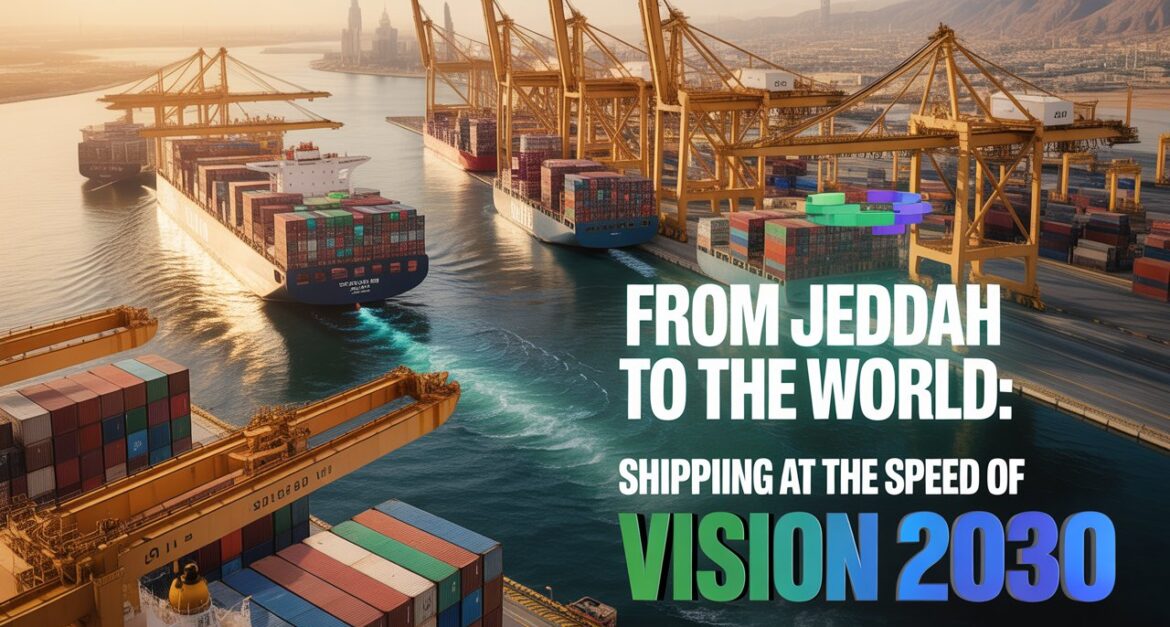
Your Cargo’s Shortcut to Three Continents
Introduction: The Geography Problem Your Competitors Haven’t Solved Yet
Most businesses think about logistics backwards. They build their product first, find their customers second, and then figure out shipping as an afterthought — treating freight forwarding like a necessary pain rather than a strategic weapon.
The businesses winning in global trade right now are doing the opposite. They are looking at the map before the spreadsheet.
And when you look at the map honestly, one city keeps jumping out: Jeddah.
Europe is running out of fast, affordable overland routes. Asian supply chains are getting longer, not shorter. North African markets are booming but remain underserved. Meanwhile, there is a port city on the Red Sea that sits precisely where three of the world’s most commercially active regions converge — and that city is accelerating, not slowing down.
If your business ships goods internationally and you are not thinking about Jeddah as a logistics hub, you are not just leaving time on the table. You are leaving market share on the table.
This article breaks down exactly why Jeddah is rapidly becoming one of the most strategically valuable freight corridors on earth, what Saudi Arabia’s Vision 2030 means for your supply chain, and how businesses of every size can take practical advantage of this geographic and economic reality right now.
What Makes Jeddah Different: Understanding the Entity
Jeddah is the principal port city of Saudi Arabia, located on the eastern coast of the Red Sea. It is home to Jeddah Islamic Port, one of the largest and busiest container ports in the Middle East and among the top 40 container ports globally by throughput volume.
But the port alone does not explain the opportunity. What makes Jeddah a distinct logistics entity is the convergence of four overlapping advantages that no single competing hub fully replicates:
1. Geographic Centrality Jeddah sits at the crossroads of the Red Sea shipping lane — the arterial route connecting the Indian Ocean to the Mediterranean via the Suez Canal. Roughly 12–13% of global trade passes through this lane annually. Jeddah is not near this route. It is on this route.
2. Triregional Market Access From Jeddah, you can reach:
- Major European ports (Rotterdam, Genoa, Piraeus) within 10–14 days by sea
- East African ports (Mombasa, Dar es Salaam) within 4–7 days
- South Asian ports (Mumbai, Colombo, Karachi) within 5–8 days
- Southeast Asian hubs (Singapore, Port Klang) within 12–16 days
No comparable hub in the Arabian Peninsula provides this breadth of proximity.
3. Saudi Arabia’s Infrastructure Investment Pipeline Under Vision 2030, the Kingdom has committed over $100 billion in transport and logistics infrastructure. This includes port expansion, rail corridor development, free zone creation, and aviation network upgrades — all of which directly reduce the cost and time of moving goods through and out of Jeddah.
4. Regulatory and Free Zone Evolution The development of the Jeddah Islamic Port Free Zone and the broader King Abdullah Economic City (KAEC) just north of Jeddah is creating a logistics environment deliberately designed to attract regional distribution mandates from international brands.
Core Attributes and Features of Jeddah as a Logistics Hub
Port Capacity and Infrastructure
Jeddah Islamic Port currently handles over 5 million TEUs (twenty-foot equivalent units) annually and is mid-expansion toward significantly greater capacity. The port features:
- Multiple specialized terminals: Container, bulk, Ro-Ro (roll-on/roll-off), and general cargo
- Deep-water berths capable of accommodating ultra-large container vessels (ULCVs)
- Advanced port management systems connected to global shipping networks
- Integrated customs clearance facilities reducing dwell time compared to regional competitors
Air Freight Gateway
King Abdulaziz International Airport (KAIA) in Jeddah is a certified cargo hub with dedicated freight terminals. Its position between Asia and Europe makes it a natural transhipment point for time-critical air cargo, pharmaceutical shipments, and high-value electronics.
Road and Rail Connectivity
Saudi Arabia’s Landbridge Project — a rail corridor connecting Jeddah on the Red Sea coast to Dammam on the Arabian Gulf coast — creates an entirely new east-west freight corridor through the Peninsula. This route bypasses the congested Strait of Hormuz for Gulf-bound cargo and shortens transit times from Asia to Europe through a multimodal Red Sea routing.
Digital and Customs Infrastructure
Saudi Customs has undergone significant modernization under Vision 2030, including:
- Electronic manifest submission and pre-clearance
- Integration with global trade compliance platforms
- Streamlined documentation for GCC-origin goods
- Bilateral agreements reducing tariff friction with key trading partners
Why Vision 2030 Is a Supply Chain Event, Not Just a Policy Event
Many international businesses treat Vision 2030 as background noise — a political program relevant to Saudi domestic affairs but not to their freight invoices. This is a costly misunderstanding.
Vision 2030 is, at its core, a supply chain transformation program. Its logistics-specific components include:
The National Transport and Logistics Strategy (NTLS)
The NTLS targets making Saudi Arabia one of the top 10 global logistics hubs by 2030. Specific commitments include:
- Tripling freight railway network capacity
- Expanding airport cargo handling by over 300%
- Developing a network of integrated logistics zones
- Reducing logistics costs as a percentage of GDP from approximately 14% to under 8%
Special Economic Zones (SEZs)
Saudi Arabia has launched multiple SEZs with direct bearing on import/export operations:
- King Abdullah Economic City (KAEC): An industrial city with its own deepwater port (King Abdullah Port), positioned as a manufacturing and distribution hub
- Ras Al-Khair Industrial City: Focused on mining and metals
- Jazan Economic City: Targeting heavy industries with Red Sea port access
- Cloud Computing Zone (Riyadh): Relevant for digital trade compliance and supply chain SaaS operations
Each zone offers tax incentives, 100% foreign ownership, and streamlined regulatory pathways that reduce the friction of establishing regional distribution operations.
The Connectivity Effect
The combination of infrastructure investment, regulatory reform, and SEZ development creates what logistics economists call a connectivity dividend — a compounding reduction in trade costs that accumulates as each improvement makes the next improvement more valuable. Businesses establishing Jeddah-anchored supply chains now are locking in access to this dividend before their competitors do.
Real-World Use Cases: Who Benefits Most from Jeddah’s Position
1. European Exporters Targeting GCC and East Africa
A European manufacturer exporting to both Saudi Arabia and Kenya faces a painful logistics equation: two separate shipping lanes, two separate freight relationships, and two separate customs processes. Routing through Jeddah as a regional hub consolidates this into a single inbound shipment with onward distribution — cutting total freight spend and transit complexity significantly.
2. Asian Manufacturers Serving European Markets
Chinese, Indian, and Southeast Asian exporters targeting European retail chains traditionally route through Singapore or Colombo for transhipment. Jeddah offers a competitive alternative, particularly for cargo bound for Southern Europe (Italy, Greece, Spain), where Red Sea routing is faster than Far East routes through Northern European ports.
3. Saudi Manufacturers and Exporters Going Global
For Saudi-origin goods — petrochemicals, construction materials, food products, pharmaceuticals, and increasingly manufactured goods from Vision 2030 industrial initiatives — Jeddah is the natural export gateway. The question is no longer whether to ship from Jeddah but how to optimize the routing to maximize delivery speed and minimize cost across target markets.
4. E-commerce Fulfillment Operators
The explosion of cross-border e-commerce across the MENA region has created demand for regional fulfillment hubs capable of handling B2C volumes with fast last-mile delivery. Jeddah, as Saudi Arabia’s most commercially active city, is emerging as the natural center of gravity for MENA e-commerce logistics infrastructure.
5. Pharmaceutical and Temperature-Controlled Freight
The Red Sea corridor, combined with Jeddah’s air freight capabilities, creates a viable cold chain route for pharmaceutical products traveling between Asian manufacturing hubs and European or African end markets. Saudi Arabia’s own pharmaceutical sector is growing rapidly under Vision 2030 localization targets, creating additional demand for qualified cold chain infrastructure at Jeddah.
Jeddah vs. Competing Regional Hubs: An Honest Comparison
Understanding where Jeddah’s advantages are sharpest — and where competitors remain strong — is essential for making informed logistics decisions.
| Factor | Jeddah | Dubai (Jebel Ali) | Salalah (Oman) | Port Said (Egypt) |
| Red Sea Access | Direct | Via Strait of Hormuz | Direct | Mediterranean end |
| Container Throughput | ~5M+ TEU/yr | ~14M+ TEU/yr | ~4M+ TEU/yr | ~5M+ TEU/yr |
| Free Zone Maturity | Developing rapidly | Highly mature | Established | Moderate |
| Regulatory Reform Pace | Fast (Vision 2030) | Stable/mature | Stable | Variable |
| East Africa Proximity | Strong | Moderate | Strong | Moderate |
| European Routing Speed | Excellent | Good | Good | Excellent |
| Domestic Market Size | Very large (35M+) | Moderate (3.5M) | Small | Large (105M+) |
| Infrastructure Investment | Massive ($100B+) | Ongoing | Stable | Moderate |
The honest takeaway: Dubai remains the more mature hub today. But Jeddah’s combination of infrastructure investment pace, domestic market size, and Red Sea positioning means the gap is closing — and for specific trade lanes (particularly Africa-Europe, Asia-Africa, and intra-MENA), Jeddah is already competitive or superior.
For businesses whose primary markets include East Africa, South Asia, and Southern Europe simultaneously, Jeddah’s geographic position is simply unmatched.
Implementation Overview: How to Build a Jeddah-Anchored Supply Chain
Step 1: Trade Lane Audit
Before making any infrastructure or partnership decisions, map your existing trade lanes against Jeddah’s routing advantages. Ask: which of your current shipments pass within 500 nautical miles of the Red Sea? Which of your target markets are most accessible from a Red Sea hub?
Step 2: Freight Forwarder Selection
Choose a freight forwarder with:
- Established relationships at Jeddah Islamic Port and KAIA
- Saudi customs brokerage licenses and experience
- Connections to onward carriers serving your target markets
- Familiarity with Vision 2030 SEZ incentive structures
Step 3: Evaluate Free Zone and Warehousing Options
Depending on your volume and product category, assess whether establishing a bonded warehouse, consolidation depot, or distribution center within a Jeddah-area free zone makes economic sense. The KAEC industrial zone deserves particular attention for manufacturing-adjacent distribution.
Step 4: Compliance and Documentation
Saudi Arabia’s import/export regulations are modernizing rapidly but still require careful attention to:
- Certificate of Origin requirements (especially for GCC preferential tariff access)
- Halal certification for food, cosmetic, and pharmaceutical products
- SASO (Saudi Standards, Metrology and Quality Organization) product conformity requirements
- Electronic customs filing through the FASAH platform
Step 5: Carrier Diversification
No single carrier or alliance dominates the Red Sea route. Build relationships with at least two ocean carriers and one air freight provider operating through Jeddah to maintain resilience against capacity disruptions.
Step 6: Monitor Vision 2030 Milestones
The logistics landscape around Jeddah is changing fast. Assign someone in your supply chain team to track Vision 2030 logistics milestones quarterly — new free zone openings, rail project completions, bilateral trade agreements — and adjust your routing strategy as new capabilities come online.
Transit Time Comparison: Jeddah vs. Alternative Routing
Here is a practical reference for estimated ocean freight transit times from Jeddah versus Dubai (Jebel Ali) to key destination ports:
Rotterdam (Netherlands)
- From Jeddah: ~12–14 days
- From Jebel Ali: ~16–20 days
- Jeddah advantage: 4–6 days
Mombasa (Kenya)
- From Jeddah: ~4–6 days
- From Jebel Ali: ~7–10 days
- Jeddah advantage: 3–4 days
Mumbai (India)
- From Jeddah: ~6–8 days
- From Jebel Ali: ~4–6 days
- Dubai advantage: 2 days
Piraeus (Greece)
- From Jeddah: ~10–12 days
- From Jebel Ali: ~14–18 days
- Jeddah advantage: 4–6 days
Singapore
- From Jeddah: ~14–18 days
- From Jebel Ali: ~12–15 days
- Dubai advantage: 2–3 days
The pattern is clear: Jeddah wins decisively on westward and southward routes. Dubai retains its edge on eastward routes toward South and Southeast Asia.
Frequently Asked Questions
Q1: Is Jeddah Islamic Port equipped to handle large container vessels, or is it limited to smaller feeder ships?
Jeddah Islamic Port has undergone significant expansion and deepening to accommodate ultra-large container vessels (ULCVs) with capacities exceeding 20,000 TEUs. The port’s main container terminal is served by major ocean carrier alliances including vessels from MSC, CMA CGM, Maersk, and others on mainline Asia-Europe services. Smaller feeder vessels also operate from Jeddah to serve Red Sea and Gulf of Aden ports that cannot accommodate mainline vessels directly.
Q2: What is the typical customs clearance timeline for imports at Jeddah, and how has Vision 2030 improved this?
Pre-Vision 2030, customs dwell times at Jeddah frequently extended to 5–10 days for commercial cargo. Saudi Customs’ modernization program, including the FASAH single window platform, electronic manifest pre-submission, and risk-based inspection protocols, has reduced average clearance times for compliant shipments to 1–3 business days. Time-sensitive cargo with pre-clearance arrangements can often clear faster. That said, documentation accuracy — particularly certificate of origin and conformity certification — remains critical to avoiding holds.
Q3: Can international companies use Jeddah as a transhipment hub without establishing a legal entity in Saudi Arabia?
Yes. Transhipment operations — where cargo arrives at Jeddah and is transferred to another vessel for onward carriage without entering Saudi customs territory — do not require a Saudi legal entity. Your freight forwarder handles the logistics operationally. However, if you want to store goods in a bonded warehouse within a free zone, or conduct any value-added activities (repackaging, labeling, kitting), you will need either a Saudi entity or a free zone license, depending on the specific zone’s regulations.
Q4: How does the Saudi Landbridge rail project affect east-west shipping routes, and when will it be commercially operational?
The Saudi Landbridge is a cross-Peninsula rail corridor connecting Jeddah on the Red Sea to Dammam on the Arabian Gulf, passing through Riyadh. It is designed to allow containers to transfer from Red Sea vessels to Gulf-destined onward shipping — or vice versa — without the delay of routing around the Arabian Peninsula through the Strait of Hormuz. Sections of the rail network are operational for domestic freight, and Saudi Railway Company (SAR) has been expanding capacity. Full commercial optimization of the Landbridge for international transhipment is an evolving timeline, but the route is increasingly viable for Gulf-destined cargo arriving from Europe via Jeddah.
Q5: What product categories face the most regulatory complexity when shipping through Jeddah, and how should exporters prepare?
Several categories require careful preparation. Food and food-adjacent products must carry Halal certification from an approved certification body for products consumed by Muslims. Cosmetics, pharmaceuticals, and medical devices require SASO conformity certification and, in some cases, Saudi FDA registration before import is permitted. Electronics and telecommunications equipment may require CITC (Communications and Information Technology Commission) type approval. Chemical products, including industrial cleaners and adhesives, require Ministry of Environment registration. Exporters should verify product-specific requirements with their Saudi customs broker before the first shipment rather than discovering holds at the port of arrival.
Q6: How does Jeddah’s logistics ecosystem compare for e-commerce fulfillment versus traditional B2B cargo?
Jeddah is increasingly viable for both, but with different maturity levels. B2B cargo, including containerized ocean freight and palletized air freight, is well-served by established carriers and forwarders. E-commerce fulfillment infrastructure — including bonded B2C warehouses, last-mile carrier integrations, and returns processing — is developing rapidly but is less mature than what you would find in Dubai. For businesses targeting Saudi Arabia’s domestic e-commerce market (one of the fastest-growing in the MENA region), Jeddah-based fulfillment centers are already operational through major 3PL providers. For pan-MENA e-commerce distribution, Dubai still holds an operational edge, though this is narrowing.
Q7: What impact does Red Sea shipping disruption (such as the events of 2024) have on Jeddah-based supply chains, and how should businesses build resilience?
The Red Sea disruptions of 2024, caused by Houthi attacks on commercial shipping, temporarily rerouted significant cargo volumes around the Cape of Good Hope, adding 10–14 days and substantial fuel costs to Asia-Europe voyages. Jeddah-based businesses were affected by elevated freight rates and reduced direct service frequency. Resilience measures include: maintaining relationships with both ocean and air freight providers; diversifying carrier relationships to avoid dependence on any single alliance; maintaining buffer stock for high-velocity items; and monitoring geopolitical risk signals through maritime security services. The Red Sea has historically been one of the world’s most transited lanes, and normalcy typically returns as security situations evolve.
Conclusion: The Window Is Open — But Not Forever
Every major logistics hub in history was a strategic opportunity before it became an obvious choice. Rotterdam was not always Europe’s dominant port. Singapore was not always Asia’s gateway. Jeddah is in that inflection moment right now.
The infrastructure is being built. The regulatory environment is modernizing at a pace that would have seemed implausible a decade ago. The geographic advantage has always been there, and the economic policy framework is finally matching the geography.
For businesses exporting from Saudi Arabia, Jeddah is not one option among many — it is the option, and the question is only how aggressively you are going to use it.
For businesses shipping between Europe and Asia who have not yet incorporated Red Sea routing optimization into their logistics strategy, Jeddah represents a concrete way to cut transit times and freight costs on lanes that most of your competitors are still routing the long way around.
And for businesses eyeing the East African market, the South Asian consumer, or the resurgent Southern European buyer — Jeddah sits exactly at the center of that triangle, closer than any other port city in the Arabian Peninsula.
Vision 2030 is not a political slogan. It is a supply chain infrastructure program running at national scale, funded at historic levels, and already producing measurable improvements in port capacity, customs clearance speed, and logistics cost competitiveness.
The businesses that win global markets in the next decade will be the ones that understood this before it became obvious. Jeddah is your cargo’s shortcut to three continents. The window is open. The question is whether you walk through it.