

Introduction: The Growth Trap Most Businesses Fall Into
Growth is supposed to feel good. More orders, more customers, more revenue. But for most Saudi businesses, growth also brings a quieter problem: warehouses that run out of space, delivery timelines that slip, and logistics teams that are stretched too thin to keep up. What worked when you shipped 50 orders a week starts to break down at 5,000.
This is the exact point where many growing companies hit a wall — not because demand is a problem, but because their logistics infrastructure wasn’t built to scale with it. Hiring more staff, leasing more warehouse space, and buying more delivery vehicles is expensive, slow, and risky if demand shifts again next quarter.
This is where contract logistics becomes a strategic advantage rather than just an operational fix. Instead of building logistics capability from scratch, businesses partner with a specialized provider — like Palm Horizon KSA — who already has the warehouses, technology, fleet, and expertise ready to deploy.
In this guide, we’ll break down what contract logistics actually is, its core features, the seven biggest benefits for growing businesses, and how to know if it’s the right move for your company.
What Is Contract Logistics? (Answering “What Is Contract Logistics Services”)
Contract logistics is a long-term, outsourced arrangement where a business hands over some or all of its supply chain operations — warehousing, inventory management, transportation, order fulfillment, and last mile delivery — to a specialized third-party provider under a formal contract.
Unlike a one-off courier booking or a spot-freight arrangement, contract logistics is a dedicated, ongoing partnership. The provider typically manages operations using the client’s branding, service-level agreements (SLAs), and performance benchmarks, functioning almost like an extension of the client’s own operations team.
So when someone searches “what is contract logistics services,” the simplest answer is this: it’s a managed, outcome-based logistics partnership where a specialist runs your warehousing and distribution so you can focus on growing your business, not managing forklifts and delivery routes.
Contract logistics sits under the broader umbrella of third-party logistics (3PL), but it’s more structured and relationship-driven — built around dedicated resources, custom SLAs, and long-term collaboration rather than transactional, pay-per-shipment services.
Core Attributes and Features of Contract Logistics
Before comparing benefits, it helps to understand what a contract logistics service actually includes. The core features typically are:
- Dedicated warehousing and storage — space allocated specifically for one client’s inventory, sized to their needs
- Inventory management systems — real-time stock visibility, demand forecasting, and automated reordering
- Transportation and fleet management — inbound freight, distribution, and last mile delivery under one coordinated network
- Order fulfillment and pick-pack-ship operations — from warehouse shelf to customer doorstep
- Technology integration — Warehouse Management Systems (WMS), Transportation Management Systems (TMS), and API connections to e-commerce platforms
- Custom SLAs and KPIs — agreed delivery timelines, accuracy rates, and cost benchmarks
- Scalable capacity — the ability to flex up or down based on seasonal demand without new capital investment
- Value-added services — labeling, kitting, reverse logistics, customs clearance, and quality checks
These attributes are what separate contract logistics from basic shipping or a single delivery contractor — it’s a complete, technology-backed supply chain function operating under your brand.
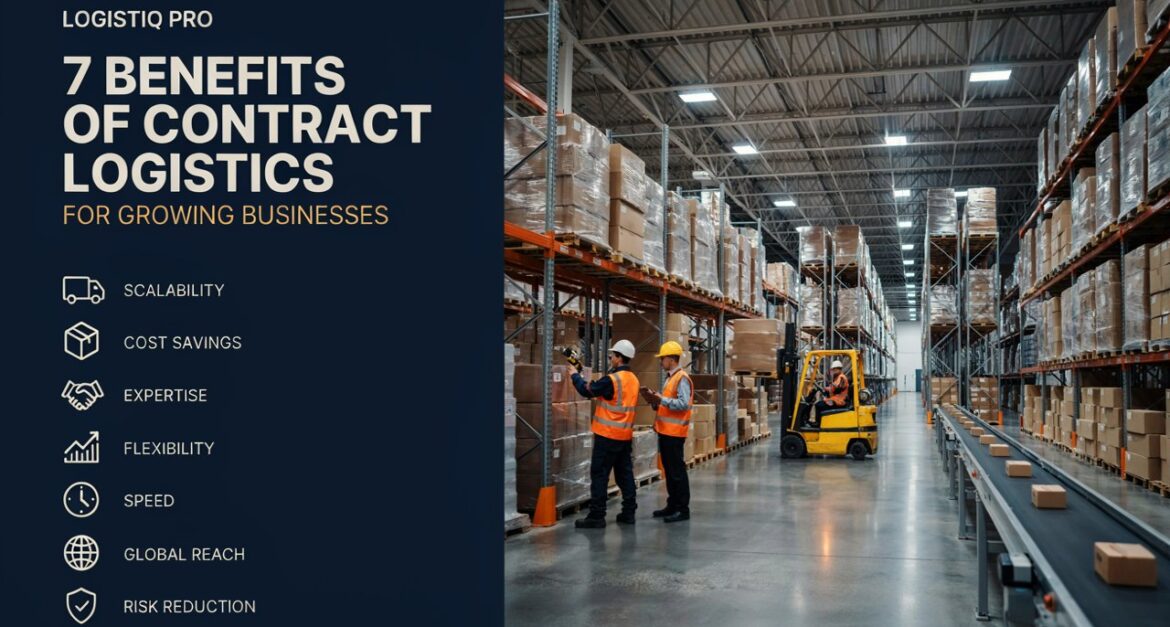
7 Benefits of Contract Logistics for Growing Businesses
Here’s where the real value shows up. Below is how contract logistics directly solves the growth problems most businesses face — ranked by real-world business impact.
1. Significant Cost Efficiency
Building your own warehouses, hiring a full logistics workforce, and buying a delivery fleet requires massive upfront capital. Contract logistics converts these fixed costs into variable, predictable operating expenses. You pay for the space and services you use — not idle capacity sitting empty in the off-season.
2. True Scalability Without Capital Risk
This is arguably the single biggest reason growing businesses choose contract logistics. During Ramadan sales spikes, national holidays, or seasonal promotions, a contract logistics partner can scale warehouse space, labor, and delivery capacity almost instantly — then scale back down when demand normalizes. In-house logistics simply can’t move that fast.
3. Faster, More Reliable Last Mile Delivery
Last mile delivery — the final leg of getting a product from a local hub to the customer’s door — is often the most expensive and failure-prone part of the entire supply chain. Contract logistics providers with established regional networks, route optimization technology, and local delivery partnerships consistently outperform businesses trying to manage last mile delivery internally, especially across dispersed cities and regions in Saudi Arabia.
4. Access to Advanced Logistics Technology
Warehouse Management Systems, real-time tracking, predictive demand forecasting, and automated inventory reconciliation are expensive to build in-house. A contract logistics provider gives growing businesses instant access to enterprise-grade technology and full supply chain visibility — without the software licensing costs or IT overhead.
5. Reduced Operational Risk
Compliance requirements, customs regulations, labor laws, and safety standards are constantly evolving. A specialized logistics partner absorbs much of this regulatory and operational risk, since managing compliance is core to their business — not a side responsibility bolted onto yours.
6. Ability to Focus on Core Business Growth
Every hour a business owner or operations team spends managing warehouse staffing or chasing a delayed shipment is an hour not spent on product development, sales, or customer experience. Outsourcing logistics execution frees internal teams to focus on what actually drives growth.
7. Stronger Market Expansion Support Across KSA
For businesses expanding across Saudi Arabia’s major economic hubs — Riyadh, Jeddah, Dammam, and beyond — an established contract logistics network means faster market entry. Instead of building new warehouse infrastructure city by city, businesses can plug into an existing regional network and start distributing almost immediately, aligning well with the broader logistics and infrastructure growth under Vision 2030.
Industries, Use Cases, and Real-World Applications
Contract logistics isn’t limited to one type of business. It’s widely used across:
- E-commerce and retail — order fulfillment, returns processing, and same-day/next-day last mile delivery
- FMCG (fast-moving consumer goods) — high-volume, high-turnover warehousing and rapid distribution
- Pharmaceuticals and healthcare — temperature-controlled storage and compliance-heavy transportation
- Automotive and industrial parts — spare parts warehousing with just-in-time delivery to dealerships
- F&B and grocery — cold chain logistics and time-sensitive last mile delivery
- Manufacturing — raw material inbound logistics and finished goods distribution
Real-world example: A mid-sized e-commerce brand expanding from Riyadh into Jeddah and Dammam doesn’t need to build three separate warehouses. A contract logistics partner with an existing multi-city network can onboard the brand’s inventory, plug into its e-commerce platform via API, and start fulfilling orders across all three cities within weeks — not months.
Contract Logistics vs. In-House Logistics vs. Basic 3PL
| Factor | In-House Logistics | Basic 3PL (Transactional) | Contract Logistics |
| Setup cost | Very high (warehouses, fleet, staff) | Low | Moderate, no capital investment |
| Scalability | Slow and expensive | Flexible but inconsistent service | Fast and structured, built into SLAs |
| Technology access | Requires in-house investment | Often basic tracking only | Full WMS/TMS integration |
| Relationship model | Internal team | Transactional, per-shipment | Long-term, dedicated partnership |
| Customization | Full control, high cost | Limited | High, tailored to client’s SLAs |
| Best suited for | Very large enterprises with steady, predictable volume | One-off or unpredictable shipping needs | Growing businesses needing scale, reliability, and consistency |
Contract logistics sits in the sweet spot for growing businesses: more structured and reliable than transactional 3PL, without the massive capital burden of building an entire logistics operation in-house.
Implementation Overview: How Businesses Get Started with Palm Horizon KSA
Moving to contract logistics doesn’t have to be disruptive. A typical implementation follows this path:
- Supply chain assessment — Palm Horizon KSA reviews current volumes, warehousing needs, delivery zones, and pain points.
- Custom SLA design — delivery timelines, accuracy targets, and cost structures are defined and agreed upon upfront.
- Technology integration — client systems (e-commerce platforms, ERPs) are connected to Palm Horizon KSA’s WMS and TMS for real-time visibility.
- Inventory onboarding — stock is transferred and organized within dedicated or shared warehouse space.
- Pilot phase — operations run on a limited scale to validate accuracy, delivery speed, and reporting before full rollout.
- Full-scale rollout — warehousing, fulfillment, and last mile delivery operations run at full capacity, with ongoing performance reviews against SLAs.
This phased approach minimizes risk while giving businesses full visibility into performance from day one.
Fun Facts About Logistics You Probably Didn’t Know
- The word “logistics” originally comes from the Greek word logistikos, meaning “skilled in calculating” — military supply officers used it centuries before it became a business term.
- The last mile of delivery can account for more than half of total shipping costs, even though it covers the smallest physical distance in the entire supply chain.
- Modern warehouse robots can pick and sort thousands of items per hour — but human decision-making still outperforms automation for complex exception-handling, which is why the best contract logistics providers blend both.
- Saudi Arabia’s logistics sector is one of the priority pillars of Vision 2030, positioning the Kingdom as a global logistics hub connecting Asia, Africa, and Europe.
FAQ: Contract Logistics Explained
What are contract logistics services in simple terms?
Contract logistics services refer to outsourcing warehousing, inventory management, and delivery operations to a specialized provider under a formal, long-term agreement — rather than managing these functions internally.
How is contract logistics different from a regular courier service?
A courier service handles individual, transactional deliveries. Contract logistics is a complete, ongoing partnership covering warehousing, inventory, fulfillment, and last mile delivery, governed by agreed service levels rather than one-off transactions.
Is contract logistics only suitable for large companies?
No. Growing small and mid-sized businesses often benefit the most, since contract logistics removes the need for heavy upfront capital investment in warehouses and fleets while still enabling enterprise-level scalability.
How does contract logistics improve last mile delivery specifically?
Providers with established regional networks and route optimization technology can consolidate deliveries, choose more efficient routes, and coordinate local hubs — reducing delays and costs that businesses managing delivery internally often struggle with.
How long does it take to implement a contract logistics partnership?
Timelines vary by business size and complexity, but a phased rollout — assessment, SLA design, technology integration, pilot, and full launch — typically allows businesses to be operational within a few weeks to a couple of months.
Does contract logistics require long-term commitment?
Most contract logistics agreements are structured as multi-year partnerships to allow for proper resource planning and infrastructure investment by the provider, though contract length and flexibility can be negotiated based on business needs.
Final Thoughts: Growth Shouldn’t Mean Logistics Chaos
Scaling a business shouldn’t require choosing between growing fast and staying in control of your operations. Contract logistics gives growing businesses a way to do both — accessing warehousing, technology, and last mile delivery capability that would otherwise take years and significant capital to build internally.
Whether you’re expanding into new cities across Saudi Arabia, managing seasonal demand spikes, or simply trying to get products to customers faster and more reliably, a contract logistics partnership can be the difference between logistics being a bottleneck and logistics being a growth engine.
Palm Horizon KSA works with growing businesses across the Kingdom to design and manage contract logistics solutions built around real operational needs — not one-size-fits-all packages. If your current logistics setup is holding back growth instead of enabling it, it may be time for a conversation.