

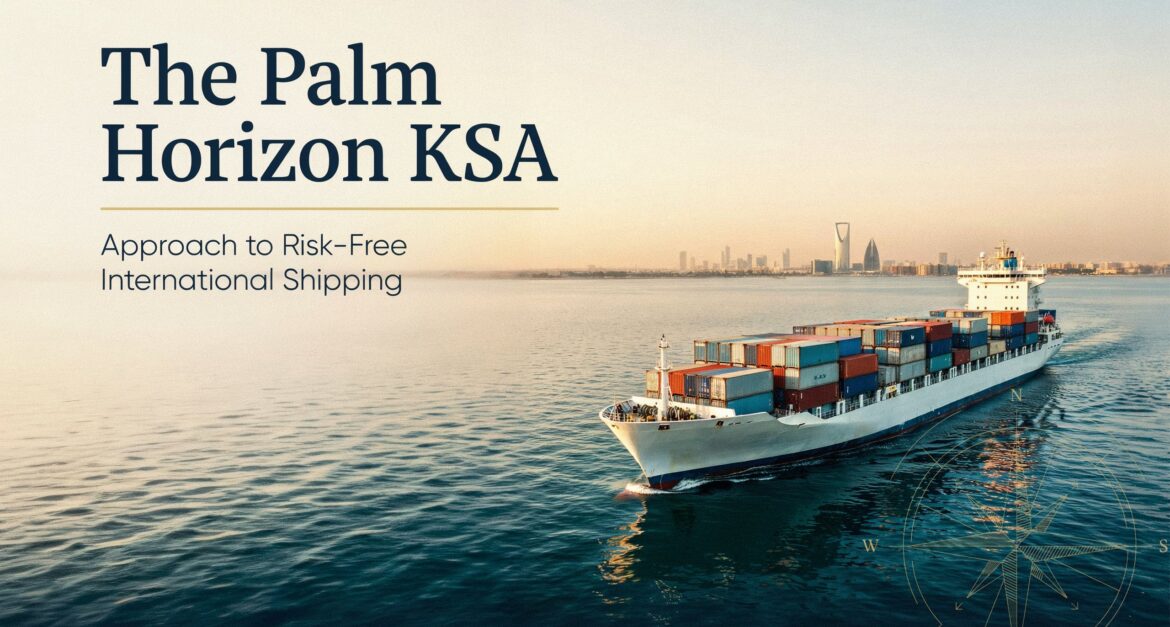
Moving goods into Saudi Arabia sounds simple until the shipment actually leaves the warehouse. Then come the questions nobody warns you about: Is this product cleared for SASO? Does the carton need an Arabic label before it even reaches the port? Will the FASAH declaration get flagged for a missing certificate? For thousands of importers, exporters, and growing e-commerce brands, international shipping isn’t really a logistics problem — it’s a compliance problem wearing a logistics costume.
That distinction matters. A container can sail on time, clear the right paperwork at origin, and still sit in a Jeddah or Dammam bonded yard for three weeks because one regulatory box wasn’t ticked. Demurrage fees pile up. Retail launch dates slip. Sometimes the goods get destroyed or sent back entirely. This is the gap that risk-free international shipping is meant to close, and it’s the gap Palm Horizon KSA was built around.
This guide breaks down what risk-free international shipping actually means in the Saudi context, how Palm Horizon KSA approaches it differently from a standard freight forwarder, which industries depend on it most, and what the process looks like from first inquiry to final delivery.
What is risk-free international shipping?
Risk-free international shipping is an approach to cross-border logistics where every regulatory checkpoint — customs declarations, tax and duty classification, product certification, and labeling requirements — is verified and resolved before a shipment ever leaves origin, rather than being discovered or corrected at the destination border. Instead of treating shipping as a point-to-point delivery task, this model treats it as a chain of compliance steps that have to be cleared in sequence: FASAH customs declarations, ZATCA duty and tax obligations, SFDA and SASO product approvals, Halal certification, and Arabic labeling all get checked against the cargo before it’s booked, not after a customs officer flags a problem.
This is the model Palm Horizon KSA is built around. In plain terms: a typical freight forwarder asks “how do we get this box from A to B?” Risk-free international shipping asks “what does this box need to look like, legally, before Saudi customs will let it through?” — and only then handles the logistics on top of that.
Fun fact: Saudi Arabia’s FASAH platform is the Kingdom’s single-window system for customs declarations — it was introduced specifically to digitize and centralize what used to be a paper-heavy, multi-agency process.
Core attributes of the risk-free international shipping model
Risk-free international shipping isn’t a single feature — it’s a stack of overlapping safeguards. Here’s what sits inside Palm Horizon KSA’s approach.
FASAH-ready customs documentation
Every shipment is pre-checked against FASAH requirements before it’s booked. That means commercial invoices, packing lists, certificates of origin, and HS code classifications are reviewed for accuracy ahead of time, not corrected after a customs officer flags them.
ZATCA tax and duty compliance
Saudi Arabia’s Zakat, Tax and Customs Authority (ZATCA) governs import duties and VAT obligations. Misclassified goods or incorrect valuation are a common — and entirely avoidable — reason shipments stall. Palm Horizon KSA verifies tariff codes and duty calculations before goods ship.
SFDA and SASO product certification
Products regulated by the Saudi Food and Drug Authority (food, pharmaceuticals, cosmetics, medical devices) or requiring a SASO certificate of conformity (electronics, appliances, toys, building materials) need approvals secured in advance, not requested mid-transit.
Halal certification and Arabic labeling
Beyond food products, Halal certification requirements can extend into cosmetics and certain consumables. Arabic labeling rules are stricter than a simple translation — they typically require specific disclosures like manufacturer details, batch numbers, and expiry information presented in a defined format.
Fun fact: Arabic labeling non-compliance is one of the most common — and most preventable — reasons goods get held at Saudi ports, because it’s often treated as an afterthought rather than a pre-shipment requirement.
Cargo insurance and real-time visibility
Even with full compliance, transit risk exists. Cargo insurance and live shipment tracking give importers visibility into exactly where goods are and what condition they’re in, rather than waiting for a phone call.
Pre-shipment compliance audits
Before a single carton is packed, Palm Horizon KSA reviews the product against the full regulatory checklist — certification status, labeling format, tariff classification, and any restricted-goods flags — so problems surface at the warehouse, not at the border.
Here’s a snapshot of where shipments into Saudi Arabia typically run into trouble — and why each of the safeguards above exists for a reason:
The pattern is consistent across industries: certification and labeling gaps cause far more delays than the shipping itself.
Who relies on risk-free international shipping? Industries and real-world use cases
E-commerce and retail
Cross-border e-commerce into Saudi Arabia has grown sharply alongside Vision 2030’s push toward digital retail. A clothing or cosmetics brand shipping direct-to-consumer needs every parcel correctly labeled and duty-classified, because at scale, a single recurring labeling error multiplies into thousands of held parcels.
Pharmaceuticals and medical devices
This is one of the most heavily regulated categories. SFDA registration, batch documentation, and cold-chain handling all need to be locked in before shipment — a missed step here doesn’t just cause delay, it can mean destroyed inventory.
Food and beverage
Halal certification, shelf-life documentation, and Arabic nutritional labeling are non-negotiable. Perishable cargo adds time pressure on top of compliance pressure, which is exactly where pre-shipment auditing pays off.
Electronics and machinery
SASO certificates of conformity, energy efficiency labeling, and safety standards apply broadly here — from household appliances to industrial equipment.
Construction materials and industrial equipment
Large-volume shipments tied to infrastructure and Vision 2030 development projects often involve customs valuation complexity and import licensing that benefit from advance clearance planning.
Palm Horizon KSA vs. traditional freight forwarders
| Dimension | Traditional freight forwarder | Palm Horizon KSA approach |
| Primary focus | Moving cargo from origin to destination | Clearing regulatory checkpoints, then moving cargo |
| Compliance check | Often reactive, handled if customs flags an issue | Proactive, completed before booking |
| Certification sourcing | Typically left to the importer | Coordinated as part of the shipping process |
| Labeling review | Rarely included | Standard pre-shipment step |
| Risk ownership | Limited to transit | Extends to customs clearance outcomes |
| Post-clearance support | Minimal | Includes delivery confirmation and documentation archiving |
Traditional forwarders are excellent at logistics execution. Where the model breaks down is at the regulatory layer — most forwarders aren’t structured to verify SFDA approval status or Arabic label formatting, because that’s not traditionally their job. Risk-free international shipping closes exactly that gap.
How the risk-free shipping process works
- Pre-shipment compliance audit — The product, its certifications, and its labeling are reviewed against current Saudi requirements before anything is booked.
- Documentation and FASAH preparation — Invoices, packing lists, and HS codes are finalized and matched against FASAH declaration requirements.
- Certification coordination — Any missing SFDA, SASO, or Halal certification is identified and sourced before the shipping window opens.
- Customs clearance coordination — The shipment moves through Saudi customs with documentation already aligned, reducing the chance of holds.
- Real-time tracking and delivery — Shipment status is visible end to end, with insurance coverage active throughout transit.
- Post-clearance support — Delivery confirmation, customs records, and compliance documentation are archived for future shipments and audits.
Fun fact: Many importers don’t realize that once a shipment is held at a Saudi port for a certification issue, resolving it from origin can take longer than the original shipping time — which is exactly why front-loading compliance work saves more time than it costs.
Frequently asked questions
What does “risk-free international shipping” actually mean? It means a shipment has been checked against every relevant regulatory requirement — customs, tax, product certification, and labeling — before it leaves origin, so the main risks of delay, fines, or seizure are addressed in advance rather than discovered at the border.
Why do shipments to Saudi Arabia get held at customs? The most common causes are missing or incorrect product certification (SFDA or SASO), incomplete Arabic labeling, documentation errors in the FASAH declaration, incorrect tariff classification, and goods that fall under restricted or prohibited categories.
Is Halal certification required for all imported goods? No. It’s mandatory for food and many beverage products, and in some cases extends to cosmetics and consumables, but it doesn’t apply universally across every product category. Whether it applies depends on the specific product classification.
What is FASAH and why does it matter for importers? FASAH is Saudi Customs’ single-window electronic platform for processing import and export declarations. Because it centralizes documentation review, errors or mismatches in a FASAH submission are a direct and common cause of shipment delays.
How is Palm Horizon KSA different from a regular freight forwarder? A regular freight forwarder focuses on moving cargo. Palm Horizon KSA builds the shipment around regulatory compliance first — certification, labeling, tax classification — and treats logistics execution as the second half of the process, not the first.
How long does compliance clearance typically take? It varies by product category and certification status. Goods with certifications already in place clear faster; products needing new SFDA or SASO approval require lead time before shipping, which is why pre-shipment audits are scheduled well ahead of the planned ship date.
The bottom line
International shipping into Saudi Arabia doesn’t fail because of bad luck — it fails because compliance gets treated as a problem to solve after the goods are already in transit. By the time a shipment is sitting in a bonded yard, the options are limited and expensive. The Palm Horizon KSA approach flips that order: certification, labeling, and customs documentation are resolved before the cargo ever ships, which is what makes risk-free international shipping a realistic standard rather than a marketing phrase.
For businesses entering or scaling in the Saudi market, the cost of getting this right upfront is consistently lower than the cost of fixing it after a shipment is held. That’s the core argument for working with a partner built around compliance-first shipping rather than logistics alone.