

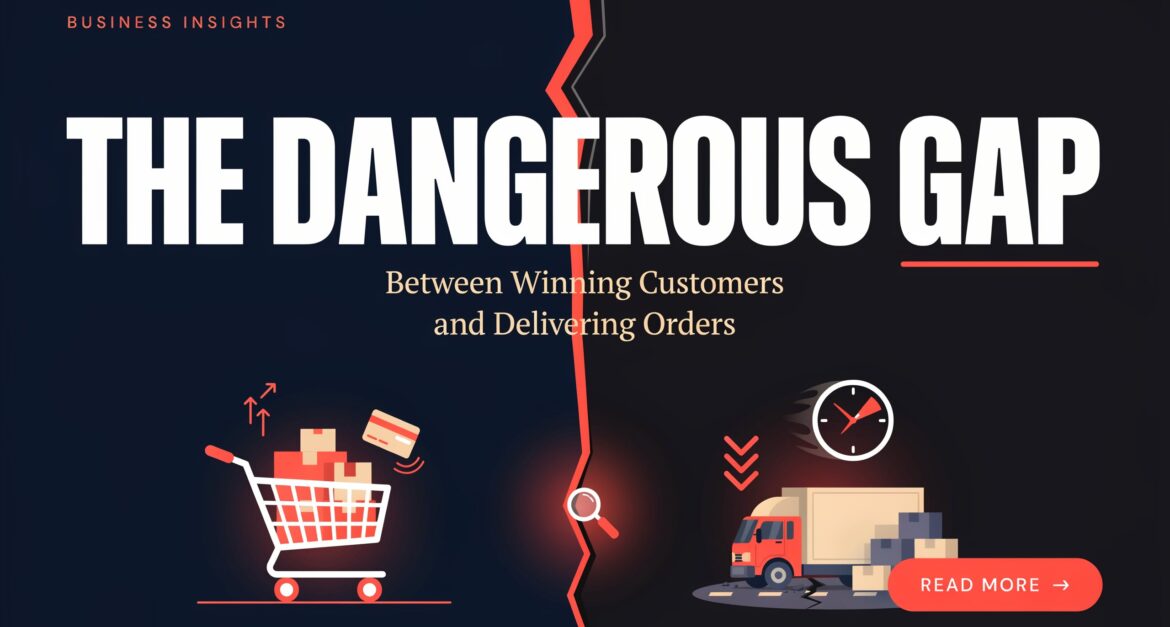
There is a quiet crisis running through many ambitious businesses operating in Saudi Arabia today. On the surface, everything looks like momentum. The pipeline is full. New accounts are signing. Sales teams are hitting targets.
But behind that story, something is quietly breaking.
Orders are delayed. Shipments are sitting at ports. Customers are waiting longer than they were promised. And by the time the business notices the disconnect, it has already lost what took months to build: trust.
This is the gap between winning customers and delivering orders — and in today’s hyper-competitive GCC market, it may be the single most dangerous operational blind spot a business can have.
What Is the Customer-Fulfillment Gap and Why Does It Matter in Saudi Arabia?
The customer-fulfillment gap refers to the growing distance between a company’s ability to attract and close customers and its actual operational capacity to deliver on those commitments. It is not a sales problem. It is not a marketing problem. And it is a supply chain alignment problem.
In Saudi Arabia, this gap is being widened by three forces happening at the same time: rapid commercial expansion under Vision 2030, a surge in e-commerce and cross-border trade, and logistics infrastructure that is scaling quickly but unevenly across regions.
When a business wins a customer, it makes a promise — a delivery date, a quality standard, a product specification. The moment fulfillment falls short of that promise, the sales effort becomes a liability. You have acquired a dissatisfied customer rather than a loyal one.
Across the GCC market, research from the logistics sector consistently shows that poor post-sale execution is one of the leading causes of customer churn. Studies suggest that over 60% of customers who experience a fulfillment failure do not place a second order. Many never complain — they simply leave and go to a competitor who delivered.
Fun Fact: A customer who experiences a poor delivery is 3.5 times more likely to leave a negative review than a customer who had a great experience is to leave a positive one. In Saudi Arabia’s growing review culture on platforms like Google and Jarir, that asymmetry matters enormously.
Understanding Why the Gap Opens: The Core Problem
1. Sales Growth Outpaces Logistics Capacity
The most common version of this problem is straightforward: a company’s sales engine accelerates faster than its warehouse, transport, or customs clearance infrastructure can handle. Orders pile up. Promised lead times become impossible. Operations teams start firefighting.
In Saudi Arabia, this is especially common among businesses entering hyperscale growth phases — particularly importers who are expanding their product portfolios or distributors who are onboarding new regional clients in cities like Riyadh, Jeddah, and Dammam simultaneously.
2. Fragmented Logistics Arrangements
Many Saudi businesses cobble together their supply chains from multiple unconnected providers — one freight forwarder for international shipping, a separate customs broker, and a local courier for last-mile delivery. When something goes wrong at any one of these handoff points, the customer never hears a clear explanation. They just experience the delay.
This fragmentation is the structural cause of the gap. There is no single point of coordination, no unified tracking view, and no consolidated accountability.
3. Weak Visibility Across the Supply Chain
A business cannot fix what it cannot see. Without real-time visibility into shipment status, port clearance timelines, and warehouse inventory levels, sales teams make commitments based on assumptions rather than facts. When those assumptions are wrong — and in complex supply chains, they frequently are — the gap opens.
4. Disconnection Between Commercial and Operations Teams
In many organizations, the team that wins the customer and the team that fulfills the order are operating with entirely different information, incentives, and timelines. Sales teams are measured on revenue. Operations teams are measured on cost. Neither is measured on customer satisfaction across the full journey. This structural misalignment is one of the most underappreciated causes of fulfillment failure.
The Real Cost of the Gap: What Businesses in the GCC Are Actually Losing
The damage from a customer-fulfillment gap is almost always larger than it appears on a single transaction.
| Impact Area | Short-Term Cost | Long-Term Cost |
| Delayed delivery | Operational disruption, emergency freight costs | Customer churn, brand damage |
| Incorrect shipment | Return handling, reprocessing | Loss of repeat orders, negative reviews |
| Customs clearance delays | Port storage fees, demurrage charges | Missed seasonal windows, contract penalties |
| Poor communication | Customer service overload | Loss of account trust |
| Inventory misalignment | Stockouts or overstock | Cash flow problems, warehouse cost spikes |
| Fulfillment inconsistency | Credit notes, partial refunds | Account termination, market reputation risk |
The compounding effect is what makes this dangerous. One delayed order might be forgiven. A pattern of them creates a reputation in the market that is very hard to undo, particularly in Saudi Arabia where business relationships are built on reliability, word of mouth, and long-term trust.
Fun Fact: The Saudi logistics market is projected to reach over USD 27 billion by 2026, driven largely by Vision 2030 infrastructure investments and the growth of domestic e-commerce. Yet the gap between logistics capacity and commercial demand remains one of the sector’s top operational challenges.
Core Attributes of a Business That Has Closed the Gap
Businesses that successfully align their commercial and fulfillment operations tend to share a specific set of operational attributes. Understanding these is the first step toward closing your own gap.
End-to-End Supply Chain Visibility Every stakeholder — from the sales team to the warehouse manager to the customer — has access to accurate, real-time information about where an order is in its journey. This eliminates assumption-based commitments and enables proactive communication when delays occur.
Unified Logistics Coordination Rather than managing a fragmented set of freight, customs, and delivery providers independently, businesses that close the gap work with integrated logistics partners who can coordinate the entire flow — from origin to final delivery — under a single accountability framework.
Realistic Lead Time Communication The temptation to promise fast delivery to win a deal is understandable. But the businesses that retain customers are the ones who set accurate expectations from the beginning. An order delivered on day seven that was promised on day seven is a better customer experience than an order delivered on day five that was promised on day three.
Proactive Exception Management In any supply chain, things go wrong. Port congestion, customs holds, weather disruptions, and supplier delays are realities of trade. What separates high-performing businesses is not the absence of problems — it is how quickly and transparently they manage those problems when they occur.
Sales and Operations Alignment The commercial team and the logistics team are working from the same data, the same realistic capacity estimates, and the same customer commitment standards. Sales is not making promises that operations cannot keep.
Real-World Use Cases: Where This Gap Appears Across Saudi Industries
Retail and E-Commerce Importers
A Riyadh-based importer of consumer electronics runs a successful promotional campaign, generating a spike in orders. Without coordinated customs clearance support and pre-cleared inventory, the surge creates a bottleneck at King Abdulaziz Port in Jeddah. Orders promised in five days take fourteen. Return requests follow.
The gap here opened not at the point of sale but weeks earlier, when the business failed to align its import logistics capacity with its commercial marketing calendar.
FMCG Distributors Expanding Regionally
A distributor of food products expanding from Jeddah into Riyadh and Al Khobar takes on new retail accounts faster than their cold chain logistics can scale. Temperature-sensitive shipments arrive outside specification. Retail partners delist products. The business that was winning customers is now losing accounts.
Industrial and B2B Equipment Suppliers
A supplier of construction materials wins a major contract for a Vision 2030 project. The contract specifies delivery milestones tied to payment terms. Inconsistent freight scheduling and port clearance delays mean milestones are missed. Penalty clauses are triggered. What looked like the company’s biggest win becomes its most painful quarter.
Cross-Border E-Commerce Sellers
Saudi entrepreneurs selling products through regional marketplaces face customs regulations, return logistics, and last-mile challenges that are invisible at the point of sale. Every failed delivery is a one-star review that compounds over time.
How Integrated Logistics Support Closes the Gap
Closing the customer-fulfillment gap is not about working harder across a fragmented set of providers. It is about working smarter through a coordinated logistics structure.
Businesses that successfully close the gap typically move through three operational phases:
Phase One: Diagnose the Breakdown Points Map the full journey from order confirmation to final delivery. Identify every handoff point. Measure the average time and failure rate at each stage. This diagnostic typically reveals that 80% of delays cluster around two or three specific bottlenecks — usually customs clearance, last-mile handoff, or inventory positioning.
Phase Two: Consolidate Coordination Rather than managing each logistics function independently, consolidate under a logistics partner who provides freight forwarding, customs clearance, warehousing, and last-mile delivery as an integrated service. Single-point accountability changes the speed and quality of exception management when problems occur.
Phase Three: Align Commercial Commitments to Real Capacity Introduce lead time standards into the sales process that are based on actual logistics performance data, not aspirational targets. Build buffer time into customer commitments. When you consistently over-deliver against realistic expectations, you build a reputation for reliability — which is ultimately the most valuable commercial asset in the Saudi market.
Fun Fact: Businesses with integrated third-party logistics (3PL) partners report up to 30% faster order cycle times compared to businesses managing logistics through multiple disconnected providers. In the GCC, that speed difference can be the deciding factor in whether a retail buyer renews a contract.
Palm Horizon KSA: Bridging the Gap Between Commercial Ambition and Operational Reality
Palm Horizon KSA exists specifically to close the customer-fulfillment gap for businesses operating in Saudi Arabia and the wider GCC.
For businesses importing goods into the Kingdom, expanding distribution networks, or managing cross-border trade flows, Palm Horizon KSA provides the integrated logistics infrastructure that makes it possible to grow commercially without outpacing your operational capability.
The core services include freight forwarding with Saudi customs expertise, end-to-end shipment tracking and documentation management, warehousing and inventory coordination, and last-mile delivery support across major Saudi cities.
What makes this different from managing a collection of separate providers is the single point of coordination. When a shipment is delayed at port, you do not spend two days trying to reach three different suppliers to find out what happened. You have one logistics partner with full visibility and the authority to resolve the problem.
For businesses focused on growing in Saudi Arabia, this is the operational backbone that transforms customer acquisition from a liability into a competitive advantage.
Frequently Asked Questions
What exactly is the customer-fulfillment gap and how does it affect Saudi businesses specifically?
The customer-fulfillment gap is the operational distance between what a business promises to a customer at the point of sale and what it actually delivers through its logistics and supply chain processes. In Saudi Arabia, this gap is particularly consequential because the market is expanding rapidly — driven by Vision 2030 commercial growth, rising domestic consumption, and cross-border trade activity. Businesses are winning new customers faster than their supply chain infrastructure is being scaled, which means delivery commitments are frequently made on the basis of optimistic assumptions rather than verified operational capacity. The result is a pattern of delays, miscommunications, and unmet expectations that erodes customer trust precisely at the moment when the business is trying to establish itself.
Why do businesses keep winning customers even as their fulfillment quality declines?
Sales cycles are faster than operational feedback loops. A business can close a new deal today and not realize that its fulfillment rates are declining until weeks later, when customer complaints begin to accumulate. By the time the pattern is visible, the reputation damage is already underway. This lag between commercial performance and operational performance is one of the structural reasons the gap is so dangerous — and why it is so often discovered late.
What are the most common logistics bottlenecks causing fulfillment failures in Saudi Arabia?
The three most frequently cited bottlenecks are customs clearance delays at Saudi ports (particularly Jeddah Islamic Port and King Abdulaziz Port), fragmented handoffs between international freight and domestic last-mile delivery, and inventory positioning that does not match actual order demand by region. Businesses that resolve these three bottlenecks close the majority of their fulfillment gap, even without major structural changes elsewhere in their supply chain.
How does fragmented logistics management make the gap worse?
When a business manages its freight forwarder, customs broker, warehouse, and courier as entirely separate relationships, there is no single party responsible for the customer’s end-to-end experience. Problems at any handoff point get passed around between providers, with each one pointing to someone else’s scope of work. The customer waits. The business scrambles. Integrated logistics coordination eliminates these handoff failures by placing accountability for the full journey under one operational umbrella.
How can Palm Horizon KSA specifically help businesses close the customer-fulfillment gap?
Palm Horizon KSA provides businesses with integrated logistics support that covers the full import and distribution journey within Saudi Arabia — from freight coordination and Saudi customs clearance to warehousing, inventory management, and last-mile delivery. This integrated structure means businesses have a single coordination point for their entire supply chain, real-time visibility into shipment status, and proactive exception management when delays or complications arise. For businesses focused on growing their customer base in the Kingdom, Palm Horizon KSA provides the operational reliability that makes that growth sustainable rather than self-defeating.
At what stage of business growth should a company start addressing the customer-fulfillment gap?
The best time to address the gap is before it opens — ideally before a company’s commercial growth accelerates beyond its current logistics capacity. In practice, most businesses address it reactively after a fulfillment crisis has already cost them customers or contracts. The diagnostic process — mapping the full order journey, measuring handoff times, and identifying the top bottlenecks — can be completed quickly and the findings are almost always immediately actionable. Waiting until the gap is painful is waiting too long.
Conclusion: The Businesses That Win Long-Term Are the Ones That Deliver
Winning customers is exciting. It creates momentum, validates your product or service, and signals that your commercial strategy is working. But in any market — and especially in Saudi Arabia, where long-term business relationships are built on reliability and trust — the ability to win customers is only as valuable as your ability to keep them.
The customer-fulfillment gap is the place where commercial momentum goes to collapse. It is invisible on a sales dashboard and catastrophic on a customer satisfaction report. It builds quietly over months and becomes obvious only after the damage is already done.
Closing the gap is not about working harder. It is about building the operational structure that matches your commercial ambition — integrated logistics coordination, real supply chain visibility, and the kind of consistent delivery performance that turns first-time buyers into long-term accounts.
Palm Horizon KSA is built precisely for this purpose. If your business is growing in Saudi Arabia and you want to make sure your logistics capability grows with it, the conversation starts here.
Because in this market, what you deliver matters more than what you promise.