

Why Choosing the Wrong Logistics Company Is Costlier Than You Think
Picture this: your product lands at the port of Dammam. It sits there for four days because your logistics provider didn’t pre-clear customs documentation. Your retail client cancels the order. You absorb the dead stock. The relationship — months in the making — is gone.
This is not a hypothetical. It happens every week across Saudi Arabia’s growing commercial landscape.
The logistics sector in the Kingdom is expanding at an extraordinary pace. With Vision 2030 driving infrastructure investment, port expansion at King Abdulaziz Port, and the rapid rise of e-commerce fulfillment demand, the number of logistics companies has multiplied. That creates opportunity — and dangerous noise.
Not every company that calls itself a logistics provider has the systems, personnel, or geographic reach to actually deliver. And in a market where logistics companies in Dammam, Jeddah, and Riyadh compete fiercely for contracts, the difference between a reliable partner and a costly mistake often comes down to the questions you ask — or fail to ask — upfront.
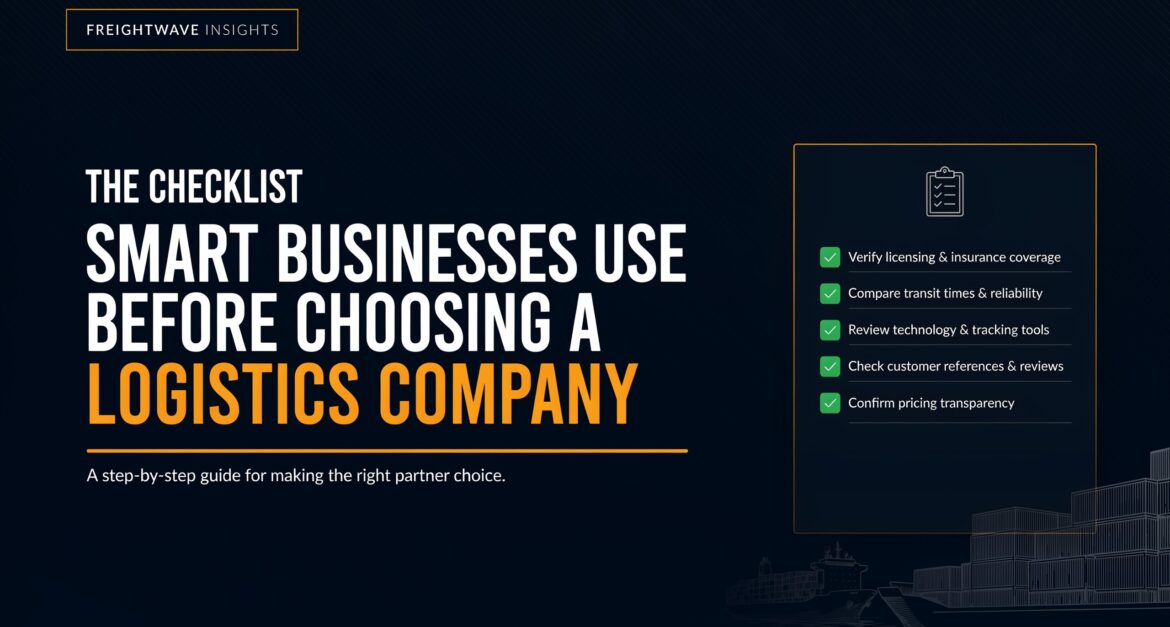
This guide gives you the exact checklist that smart, growth-oriented businesses use before committing to any logistics partner.
🎯 Fun Fact: Saudi Arabia’s logistics sector is projected to cross $22 billion in market value by 2030, making it one of the fastest-growing logistics markets in the Middle East. Choosing your partner now means locking in a long-term relationship at the right moment.
What Is a Logistics Company?
A logistics company is a business entity that plans, implements, and controls the efficient movement and storage of goods, services, and information between the point of origin and the point of consumption. The scope of services varies widely — from simple last-mile delivery to full-scale integrated supply chain management.
In the Saudi Arabian market, logistics providers typically fall into one of four categories:
1. First-Party Logistics (1PL): The business manages its own transport and storage infrastructure.
2. Second-Party Logistics (2PL): Asset-based carriers — trucking companies, freight airlines — that move goods without additional supply chain management.
3. Third-Party Logistics (3PL): Full-service providers that manage warehousing, freight, customs clearance, and distribution on behalf of a client. Most growing businesses operate with a 3PL.
4. Fourth-Party Logistics (4PL): An integrator that manages multiple 3PLs and oversees an entire supply chain ecosystem. Reserved for enterprise-level complexity.
When businesses search for logistics companies near me or evaluate logistics companies in Riyadh, they’re typically looking for a 3PL partner capable of managing end-to-end operations — not just a truck fleet.
Understanding which tier you need is the first filter in your selection checklist.
The Full Checklist: What to Evaluate Before Choosing a Logistics Partner
✅ Checkpoint 1: Geographic Coverage and Network Strength
Before anything else, map your supply chain against the provider’s actual coverage. A company with an impressive Riyadh headquarters may have zero ground presence in Tabuk, Jizan, or across the northern corridor.
Questions to ask:
- Do they operate directly in the cities where your suppliers and customers are located?
- Do they have owned warehouses or rely entirely on third-party storage?
- Can they handle cross-border shipments to UAE, Kuwait, Bahrain, or Jordan?
- What is their average transit time between major hubs — Riyadh, Jeddah, Dammam?
Why it matters: Logistics companies in Jeddah may offer exceptional port handling but lack the inland distribution depth to serve eastern province retailers. Logistics companies in Dammam may dominate industrial cargo but struggle with last-mile residential delivery in Riyadh’s residential zones.
Coverage on paper and coverage in practice are two different things. Ask for client references in your specific corridors.
🌍 Fun Fact: The Riyadh–Jeddah–Dammam triangle handles over 70% of Saudi Arabia’s domestic freight volume. Any serious logistics provider must have established operations in all three cities to serve a national business.
✅ Checkpoint 2: Licensing, Certifications, and Regulatory Compliance
In Saudi Arabia, logistics operations are subject to oversight by the General Authority for Land Transport (GALT), Saudi Customs, and ZATCA for VAT-compliant invoicing. A provider operating without proper licensing exposes your business to legal and financial risk.
What to verify:
- GALT commercial transport license (valid and current)
- Customs brokerage license for import/export operations
- SABER certification awareness for regulated product categories
- Halal logistics certification if handling food, pharmaceuticals, or cosmetics
- ISO 9001 Quality Management certification
- IATA certification if air freight is part of their service
Never take a provider’s word on certifications. Request physical copies. Cross-reference with the issuing authority where possible.
✅ Checkpoint 3: Advanced Logistics Technology and System Integration
This checkpoint separates professional logistics companies from informal operators. In 2025 and beyond, a logistics provider without a robust technology backbone is a liability, not an asset.
What does advanced logistics technology look like in practice?
- Real-time shipment tracking: GPS-enabled vehicle tracking with live dashboards accessible to your operations team
- Warehouse Management System (WMS): Automated inventory visibility, pick-and-pack accuracy, and SKU-level control
- Transportation Management System (TMS): Intelligent route optimization, carrier selection, and cost visibility
- API integration capability: Can their system connect directly to your ERP (SAP, Oracle) or e-commerce platform (Salla, Zid, Shopify)?
- Electronic Proof of Delivery (ePOD): Digital signatures and timestamped delivery confirmation
- Predictive analytics: Can they forecast demand spikes, flag potential delays before they occur, and provide monthly performance reporting?
Why this matters for your bottom line: Businesses that work with tech-enabled logistics providers report an average 23% reduction in order processing errors and a 17% reduction in shipping costs through route optimization alone (McKinsey Supply Chain Report, 2024).
Ask for a live demo of their tracking portal. If they can’t show you a dashboard within minutes, that tells you everything.
💡 Fun Fact: The first GPS tracking system used commercially in logistics was deployed in the early 1990s by a US trucking company. Today, AI-powered route optimization can reduce fuel consumption by up to 15% on high-frequency urban delivery routes.
✅ Checkpoint 4: Warehousing Capabilities and Storage Infrastructure
For businesses that carry inventory, the quality of a logistics provider’s warehousing infrastructure directly affects product integrity, order accuracy, and fulfillment speed.
Storage infrastructure checklist:
- Total square footage and available capacity in your required cities
- Racking systems: Standard palletized, narrow-aisle, high-bay, or automated
- Temperature-controlled storage (for food, pharma, electronics, or chemical products)
- Humidity and climate controls
- Security: CCTV coverage, access control systems, 24/7 on-site security
- Fire suppression systems and compliance with Saudi Civil Defense regulations
- Bonded warehouse status for duty-suspended import storage
Operational excellence markers:
- What is their average order picking accuracy rate? (Best-in-class is 99.5%+)
- Do they use barcode scanning or RFID at the point of pick?
- What is their outbound order cut-off time for same-day dispatch?
- Can they handle returns processing (reverse logistics)?
Businesses scaling through platforms like Salla or Noon.com need a fulfillment partner, not just a storage provider. The distinction matters.
✅ Checkpoint 5: Fleet Condition, Capacity, and Transport Options
If ground freight is part of your logistics requirement, the provider’s fleet quality is a direct reflection of delivery reliability.
Transport evaluation checklist:
- Owned vs. subcontracted fleet ratio (higher owned = more control)
- Vehicle types available: Sedan couriers, light vans, 1-ton, 3-ton, 10-ton, 18-wheeler flatbeds
- Refrigerated (reefer) transport availability
- Vehicle age and maintenance certification records
- Driver vetting, licensing, and training standards
- Accident and incident history (ask directly)
- Hazardous material transport certification (ADR equivalent)
For multimodal requirements:
- Air freight partnerships (SAUDIA Cargo, Nesma Airlines)
- Sea freight agency agreements (King Abdulaziz Port, Jeddah Islamic Port)
- Rail connectivity (Saudi Land Bridge awareness for eastward routes)
A provider that owns its primary delivery fleet and subcontracts overflow — rather than operating entirely through brokers — gives you significantly more consistency.
🚛 Fun Fact: Saudi Arabia has over 500,000 registered commercial freight vehicles — one of the highest concentrations in the Arab world. Yet fleet standardization and maintenance compliance remain the industry’s weakest link, which is why checking vehicle certifications is non-negotiable.
✅ Checkpoint 6: Industry Experience and Sector Specialization
Not all logistics are equal. A company that excels at moving construction materials may be completely unprepared to handle cosmetics that require special handling, pharmaceutical cold chains, or fast-moving FMCG goods with tight shelf-life windows.
Match the provider’s core expertise to your product category:
| Industry | Specialized Requirements |
| Retail / FMCG | High-velocity picking, seasonal surge capacity |
| Pharmaceutical | Cold chain, Halal compliance, SFDA awareness |
| E-Commerce | Last-mile delivery, returns management, COD handling |
| Industrial / B2B | Heavy lift, flatbed, project cargo management |
| Food & Beverage | Temperature control, HACCP compliance |
| Automotive Parts | Bin storage, JIT delivery, parts tracking |
Ask for three client references in your specific industry. Then call those references.
✅ Checkpoint 7: Customs Clearance and Cross-Border Expertise
Saudi Arabia’s import/export regulatory environment is active and evolving. Customs delays cost money — every hour a shipment sits at a border crossing or port facility is a direct financial loss.
What a capable customs partner provides:
- Licensed customs brokers on staff (not outsourced to third parties)
- Pre-arrival documentation filing to reduce port dwell time
- HS code classification expertise to ensure correct duty categorization
- SABER product registration guidance for regulated imports
- Experience with Free Trade Zone (FTZ) operations
- GCC transit documentation and cross-border corridor familiarity
Red flags to watch:
- No in-house customs team (everything outsourced = no accountability)
- Inability to explain duty drawback procedures
- No experience with specific commodity types relevant to your business
- Vague timelines for customs clearance (“it depends” without data)
Logistics companies in Dammam that are positioned near King Abdulaziz Port generally develop stronger customs expertise than inland providers. This is a geographic advantage worth factoring into your selection.
✅ Checkpoint 8: Pricing Structure Transparency and Contract Clarity
Hidden costs in logistics contracts are one of the most common sources of business-provider friction. A low headline rate that balloons with surcharges, fuel levies, re-delivery fees, and accessorial charges ends up more expensive than a clearly priced premium offering.
What to analyze in a logistics contract:
- Base rate structure (per kg, per shipment, per pallet, or flat monthly)
- Fuel surcharge policy: Fixed, floating, or capped?
- Dimensional weight vs. actual weight billing (understand the difference)
- Minimum volume commitments and penalties for falling short
- Storage billing cycle: Daily, weekly, or per-pallet per-month?
- Re-delivery and failed delivery fee structure
- Peak season surcharge policy (Ramadan, National Day, year-end)
- Service Level Agreement (SLA) penalties for missed delivery windows
- Contract exit terms and notice period
Request an itemized quote — not a packaged rate — so you can compare providers on equal footing. Any provider that resists line-item transparency is signaling future friction.
💰 Fun Fact: Studies show that 38% of businesses discover unexpected logistics surcharges only after their first invoice — not during the quoting process. Always request a “worst-case scenario invoice” showing all applicable surcharges before signing.
✅ Checkpoint 9: Service Level Agreements and Performance Accountability
A logistics provider’s SLA is their public commitment to your business. It should be specific, measurable, and enforceable — not a vague promise to “do their best.”
A strong SLA should define:
- On-time delivery rate target (industry standard: 95%+, best-in-class: 98%+)
- Order accuracy rate (99%+ for professional 3PLs)
- Damage and loss rate allowance and liability structure
- Customer service response time for escalations (24-hour maximum)
- Real-time reporting frequency and format
- Monthly performance review process
- Remedies and compensation for SLA breaches
If a provider cannot produce a written SLA document within 48 hours of being asked, that is a serious warning sign.
✅ Checkpoint 10: Financial Stability and Business Continuity
Your logistics provider is a mission-critical business partner. If they collapse — due to financial distress, ownership change, or operational failure — your supply chain collapses with them.
Business continuity questions:
- How long have they been operating? (3+ years minimum is a reasonable baseline)
- Are they locally incorporated with a MISA-registered entity?
- Do they have contingency protocols for vehicle breakdowns, warehouse disruptions, or system failures?
- Who is their backup carrier or overflow warehouse partner?
- What happens to your inventory if they cease operations?
Requesting a company profile, financial references, or a basic background check is not excessive due diligence — it is responsible procurement.
Comparing Logistics Companies: What Sets the Best Apart
When evaluating multiple providers simultaneously, use this comparison matrix.
Logistics Provider Comparison Matrix
| Evaluation Criterion | Weight | What Best Providers Deliver |
| Geographic coverage | High | Owned operations in Riyadh, Jeddah, Dammam + nationwide |
| Technology platform | High | TMS + WMS + live tracking + ERP integration |
| Industry specialization | High | 3+ years in your product category |
| Customs expertise | Medium-High | In-house licensed brokers, sub-48hr clearance |
| Fleet ownership | Medium | 60%+ owned fleet, maintained and certified |
| SLA specificity | High | Written, measurable, penalty-enforced |
| Pricing transparency | High | Itemized, no hidden surcharges |
| Financial stability | Medium | 3+ years operating, local entity registered |
| Client references | High | 3 verifiable references in your sector |
| Customer service | Medium | Named account manager, 24hr response |
Score each provider across these criteria. The highest-scoring provider — not the cheapest — deserves your contract.
Understanding the Saudi Logistics Landscape by City
Logistics Companies in Riyadh
Riyadh functions as the Kingdom’s commercial capital and inland distribution hub. Providers headquartered here typically serve:
- Government and public sector supply chains
- Retail distribution to central and northern regions
- E-commerce fulfillment for the Greater Riyadh Area (population 7.5M+)
- Industrial and manufacturing supply chains in the Riyadh Industrial City corridors
Key infrastructure advantages include direct highway access to Jeddah (via Highway 40), Dammam (via Highway 80), and proximity to King Khalid International Airport for air freight operations.
Logistics Companies in Jeddah
Jeddah is Saudi Arabia’s primary seaport gateway. Providers with strong Jeddah operations are typically best suited for:
- Import-heavy businesses relying on Jeddah Islamic Port
- Retail and FMCG distribution to the Western Province
- Hajj and Umrah seasonal supply chains (high-volume, time-sensitive)
- Regional export consolidation for GCC markets
The city’s cultural and commercial vitality — combined with its role as a gateway to the Red Sea — makes it a natural logistics hub for businesses with global sourcing relationships.
Logistics Companies in Dammam
Dammam and the broader Eastern Province are the Kingdom’s industrial and petrochemical heartland. Logistics providers here specialize in:
- Heavy industrial freight and project cargo
- Oil and gas sector supply chain support
- Port operations through King Abdulaziz Port (one of the region’s busiest)
- Cross-border trade with Bahrain via the King Fahd Causeway
- Manufacturing and SABIC supply chain support
For businesses in the energy, chemicals, or industrial manufacturing space, evaluating logistics companies in Dammam first is strategically sound.
The Role of Advanced Logistics Technology in Modern Supply Chains
Advanced logistics technology is no longer optional — it is the foundational infrastructure on which competitive supply chains are built.
The most forward-thinking providers in Saudi Arabia are deploying:
AI-Powered Demand Forecasting: Machine learning models that analyze historical order patterns, seasonal trends, and market signals to predict inventory requirements 8–12 weeks in advance, reducing stockouts and overstock situations simultaneously.
Automated Warehousing: Goods-to-person robotics systems that reduce pick times by up to 70% compared to manual operations. Several major 3PLs in Riyadh are piloting autonomous mobile robots (AMRs) in their fulfillment centers.
Blockchain for Supply Chain Transparency: Immutable transaction records that verify the provenance and handling conditions of goods across multiple handoff points — particularly valuable for pharmaceutical and food supply chains under Saudi SFDA oversight.
IoT Sensor Integration: Real-time temperature, humidity, and shock sensors embedded in shipments allow logistics providers and their clients to monitor product condition continuously from origin to destination.
Digital Twin Modeling: Virtual replicas of warehouse and transport networks that allow planners to simulate disruptions, test new routes, and optimize operations without physical trials.
When evaluating a logistics provider’s technology stack, ask which of these capabilities live in their current operations — not “on the roadmap.”
🤖 Fun Fact: The global logistics automation market is expected to reach $88 billion by 2027. The businesses that integrate with tech-forward logistics partners today will have a measurable competitive advantage within three years.
How to Implement Your Logistics Partner Selection Process
Follow this structured process to move from evaluation to signed agreement efficiently:
Phase 1 — Requirements Definition (Week 1) Document your current shipment volumes, product types, coverage requirements, peak season patterns, and technology integration needs. Be specific. Vague requirements produce vague proposals.
Phase 2 — Market Research and Longlist (Week 1–2) Identify 8–12 candidates through industry referrals, logistics association directories (Saudi Freight Forwarders Association), and platform searches. Research each company’s credentials, coverage, and client portfolio before contact.
Phase 3 — RFQ and Proposal (Week 2–3) Issue a formal Request for Quotation with your specification document attached. Require line-item pricing, coverage maps, SLA drafts, and client references in every response. Disqualify providers that submit vague or incomplete proposals.
Phase 4 — Shortlist and Site Visits (Week 3–4) Reduce to three to four finalists. Visit their primary warehouse facilities in person. Observe real operations, not presentations. Speak directly with the operations team, not just the sales team.
Phase 5 — Reference Checks and Due Diligence (Week 4) Call the references they provide. Then ask those contacts for two additional referrals they know in the industry. Financial and legal checks at this stage are appropriate.
Phase 6 — Contract Negotiation and Onboarding (Week 5–6) Negotiate SLA metrics, pricing structure, exit terms, and technology integration requirements before signing. Establish a 90-day performance review as a contractual milestone.
FAQ: Common Questions About Choosing a Logistics Company in Saudi Arabia
Q1: How many logistics companies should I evaluate before making a decision?
Evaluate a minimum of five to eight providers to establish a genuine competitive baseline. Evaluating fewer than three means you’re making a selection, not an informed decision. Evaluating more than twelve becomes operationally unmanageable. A shortlist of three to four finalists with site visits is the optimal process for most businesses.
Q2: What is the difference between a freight forwarder and a logistics company?
A freight forwarder specializes in arranging the international movement of goods — booking cargo space, preparing documentation, and managing customs clearance. A full-service logistics company encompasses freight forwarding but also includes warehousing, distribution, last-mile delivery, inventory management, and supply chain consulting. Many businesses need both capabilities — the question is whether they come from one integrated provider or multiple specialized vendors.
Q3: Should I choose a local Saudi provider or an international logistics brand?
Both have distinct advantages. International brands (DHL, Aramex, DB Schenker) offer global network reach, standardized technology platforms, and brand accountability. Local and regional providers — including specialists like Palm Horizon KSA — often offer superior knowledge of Saudi market regulations, stronger relationships with customs authorities, more flexible pricing, and faster decision-making. The right answer depends on the proportion of your business that is domestic versus international.
Q4: How do I evaluate a logistics company’s technology without being a tech expert?
Ask for a live demonstration of their client-facing tracking portal. If they can’t show you real-time shipment visibility within 15 minutes of being asked, they don’t have it. Ask specifically: “Can your system integrate with our ERP via API?” and “Can we receive automated delivery notifications without logging into your portal?” The specificity of their answer will tell you exactly where their technology actually stands.
Q5: What is a reasonable SLA for on-time delivery performance in Saudi Arabia?
For domestic ground freight within the Riyadh–Jeddah–Dammam triangle, 95–97% on-time performance should be the baseline requirement. For extended coverage into Tier 2 and Tier 3 cities, 90–93% is an honest benchmark. Any provider claiming 100% on-time performance is either working with very small volumes or not being truthful. Benchmark SLAs against your product’s sensitivity — pharmaceutical cold chain requires a different standard than industrial spare parts.
Q6: What hidden costs should I watch for in logistics contracts?
The most common hidden costs in Saudi logistics contracts include: dimensional weight surcharges applied when the package volume exceeds its actual weight threshold; fuel adjustment factors that float monthly without a cap; residential delivery surcharges for last-mile addresses outside commercial zones; minimum charge per shipment clauses; re-delivery fees for failed first-attempt deliveries; and storage overflow fees that activate when your inventory exceeds a monthly threshold. Request an itemized scenario invoice before signing.
Q7: How important is it that my logistics provider has experience in my specific industry?
Critically important for regulated or specialized product categories. A provider experienced in FMCG has fundamentally different operational protocols, staff training, and infrastructure than one experienced in pharmaceutical or automotive parts logistics. Industry-specific experience reduces onboarding friction, reduces compliance risk, and generally produces faster operational performance from day one.
Why Palm Horizon KSA Should Be on Your Evaluation Shortlist
Palm Horizon KSA operates as a full-service logistics partner built specifically for the demands of the Saudi Arabian commercial market. Our operations span Riyadh, Jeddah, and Dammam — covering the Kingdom’s primary freight corridors with owned infrastructure, not subcontracted capacity.
We combine ground freight, warehousing, customs clearance, and advanced logistics technology into a single integrated service model, eliminating the coordination friction that businesses experience when working with multiple disconnected providers.
Our client portfolio spans retail, FMCG, e-commerce, pharmaceutical distribution, and industrial supply chains — giving us genuine cross-sector expertise backed by verifiable performance records.
When smart businesses in Saudi Arabia apply the checklist above, Palm Horizon KSA holds up under every criterion. We welcome the scrutiny — because that’s exactly the kind of partner-client relationship that produces long-term results.
Conclusion: The Checklist Is Your Competitive Advantage
Choosing a logistics company is not a procurement exercise. It is a strategic business decision that will shape your operational performance, customer experience, and cost structure for years.
The businesses that thrive in Saudi Arabia’s expanding economy are the ones that treat logistics as a core competency — not a background function. They evaluate providers rigorously. They ask hard questions. And they visit warehouses, read SLA documents line by line, and call references before they sign.
The checklist in this guide is not exhaustive — every business has unique requirements that warrant additional evaluation criteria. But it covers the ten checkpoints that consistently separate reliable logistics partners from expensive disappointments.
Use it. Adapt it. Share it with your procurement team.
And when you’re ready to talk to a logistics partner that already knows it will pass your due diligence — Palm Horizon KSA is ready.