
Introduction: The Hidden Cost of Getting International Trade Wrong
Expanding into international markets sounds simple on paper — find a buyer, ship the product, get paid. In reality, it’s rarely that clean. A single missed customs form can freeze a shipment at port for weeks. A currency swing can quietly erase a profit margin. A poorly chosen carrier can turn a two-week delivery into a two-month ordeal.
These aren’t rare, isolated incidents. They are the everyday challenges of international trade that businesses face the moment they start moving goods across borders. What separates companies that scale smoothly from those that stall out isn’t luck — it’s the logistics partner behind the scenes handling the complexity most customers never see.
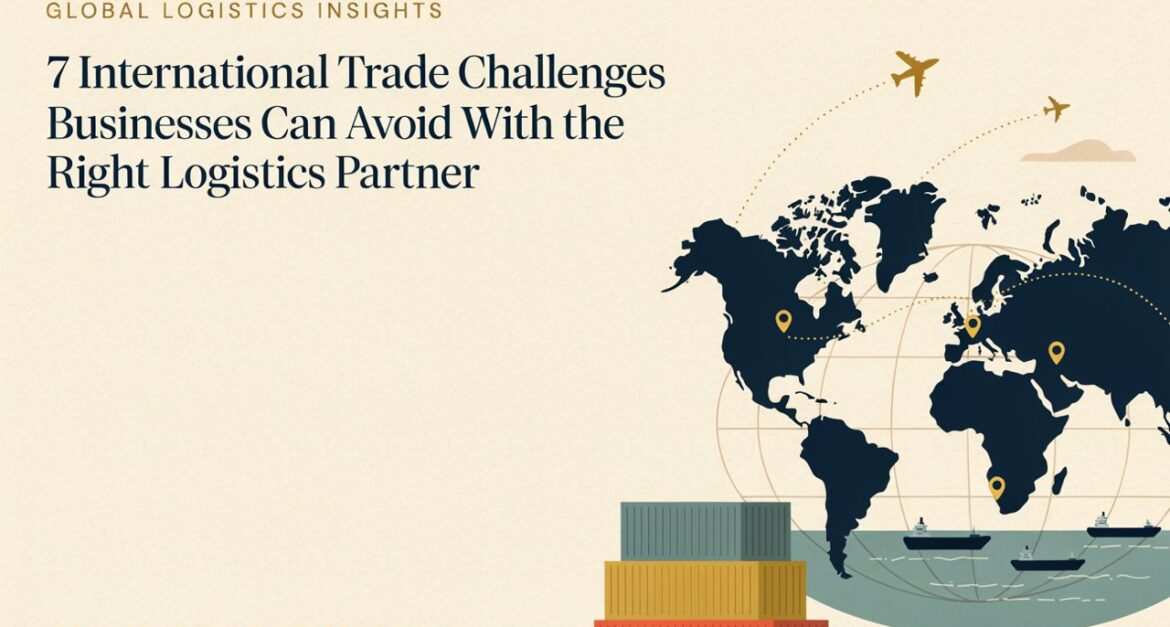
In this article, we’ll break down the seven biggest challenges facing international trade today, explain why they happen, and show exactly how the right logistics partner — equipped with advanced logistics technology — turns these obstacles into non-issues.
What Is a Logistics Partner (And Why It Matters More Than Most Businesses Realize)
A logistics partner is a third-party provider that manages the movement, storage, and documentation of goods on behalf of a business — covering everything from freight forwarding and customs brokerage to warehousing and last-mile delivery.
The key distinction between a basic freight forwarder and a true logistics partner is scope. A freight forwarder moves boxes from point A to point B. A logistics partner manages the entire trade lifecycle — anticipating regulatory hurdles, optimizing routes, managing currency and compliance risk, and providing the visibility businesses need to plan with confidence.
For companies trading in and out of Saudi Arabia and the broader Gulf region, this role has become especially critical as trade volumes grow alongside Vision 2030’s logistics and industrial expansion goals.
Core Attributes of an Effective International Logistics Partner
Before diving into the specific challenges, it helps to understand what “the right logistics partner” actually looks like on paper. The best providers share these core attributes:
- Multi-modal shipping expertise — Ocean, air, rail, and road freight coordinated under one provider
- Customs and compliance knowledge — Deep familiarity with import/export regulations across multiple jurisdictions
- Real-time shipment visibility — Live tracking, predictive ETAs, and automated delay alerts
- Currency and duty management — Tools and expertise to manage landed cost calculations and currency exposure
- Scalable warehousing network — Regional distribution hubs that reduce transit time and buffer against disruption
- Technology integration — API and EDI connectivity with client WMS, TMS, and ERP systems
- Risk and contingency planning — Backup routing, alternative carriers, and insurance options for high-risk trade lanes
With that foundation in place, let’s look at the seven challenges these attributes are specifically designed to solve.
The 7 Biggest Challenges of International Trade — And How the Right Partner Solves Them
1. Customs Delays and Regulatory Complexity
Every country has its own import documentation requirements, tariff classifications, and inspection procedures. A single incorrect HS (Harmonized System) code can trigger inspections, fines, or shipment holds that last weeks.
How the right partner solves it: A logistics partner with in-house customs brokerage expertise pre-validates documentation, classifies goods correctly, and maintains relationships with customs authorities to expedite clearance — turning a common bottleneck into a routine, predictable step.
2. Lack of Shipment Visibility Across Borders
Once goods leave the origin country, many businesses lose sight of them until they arrive — or don’t. This visibility gap makes it nearly impossible to plan inventory, manage customer expectations, or react to delays in time.
How the right partner solves it: Advanced logistics technology — GPS tracking, IoT sensors, and integrated dashboards — gives businesses continuous, real-time insight into shipment location and condition, from origin to final delivery.
3. Currency Fluctuation and Landed Cost Uncertainty
International trade means dealing with multiple currencies, and exchange rate swings can quietly erode profit margins between the time a deal is signed and the time payment is received.
How the right partner solves it: Experienced logistics providers help businesses calculate accurate landed costs upfront — including duties, taxes, and freight — and can advise on currency hedging or invoicing strategies to reduce exposure.
4. Inconsistent Carrier Reliability
Not all carriers perform equally across every trade lane. A carrier that’s excellent on a Europe-to-Asia route may be unreliable on a Middle East-to-Africa corridor, leading to unpredictable transit times.
How the right partner solves it: Established logistics partners maintain vetted carrier networks with performance data across multiple lanes, allowing them to select — or quickly switch — carriers based on real reliability metrics, not guesswork.
5. Port Congestion and Infrastructure Bottlenecks
Global events, seasonal demand spikes, and regional infrastructure limits can cause severe port congestion, backing up shipments for days or weeks with little warning.
How the right partner solves it: A logistics partner with regional expertise and alternative routing options — including inland distribution hubs — can reroute shipments proactively when congestion is detected, minimizing delay impact.
6. Complex, Multi-Jurisdictional Compliance Requirements
Trade compliance isn’t just about customs — it includes product safety standards, labeling requirements, sanctions screening, and industry-specific regulations that vary significantly by country.
How the right partner solves it: A knowledgeable logistics partner keeps compliance checklists updated across jurisdictions and flags potential issues before shipment, preventing costly rejections or legal complications at the border.
7. Poor Communication Between Supply Chain Partners
When freight forwarders, carriers, customs brokers, and warehouses all operate in silos, small miscommunications compound into major delays — and businesses are often the last to know something went wrong.
How the right partner solves it: A single, integrated logistics partner acts as the central point of coordination, using shared technology platforms so every party — including the client — works from the same real-time data.
Fun Fact Break
- The World Trade Organization estimates that reducing global trade documentation and border delays could unlock trillions of dollars in additional global trade value — a large share of which is tied up in avoidable customs friction.
- The humble shipping container, standardized in the 1950s, is often credited with cutting global freight costs so dramatically that it made modern international trade — as we know it — economically possible.
- Saudi Arabia’s logistics performance has been steadily climbing on global competitiveness indexes, driven in part by port modernization and Vision 2030 infrastructure investment.
- Some ocean freight routes can involve more than a dozen different parties — shippers, carriers, ports, customs agents, insurers — all of whom must coordinate for a single container to move smoothly from origin to destination.
Here’s a look at how common trade challenges affect shipment timelines with and without an experienced logistics partner:As the chart shows, nearly every major trade challenge shrinks dramatically in impact once an experienced logistics partner is managing the process — turning multi-day disruptions into minor, manageable delays.
Comparison: Managing Trade In-House vs. Partnering With a Logistics Provider
| Factor | Managing In-House | Working With a Logistics Partner |
| Customs expertise | Limited, learned through trial and error | Dedicated brokerage knowledge across jurisdictions |
| Carrier network | Restricted to known providers | Vetted, performance-ranked carrier options |
| Shipment visibility | Fragmented, carrier-dependent | Centralized, real-time tracking |
| Compliance monitoring | Manual, reactive | Proactive, continuously updated |
| Cost predictability | Variable, prone to surprises | Transparent landed cost calculations |
| Disruption response | Slow, ad hoc | Pre-planned contingency routing |
| Scalability | Difficult without added headcount | Built-in scalability through partner infrastructure |
The pattern is clear: businesses that try to manage international trade complexity entirely in-house often spend more time firefighting than growing. A logistics partner absorbs that complexity so internal teams can focus on the business itself.
Implementation Overview: How Palm Horizon KSA Helps Businesses Navigate Trade Challenges
Bringing on the right logistics partner is most effective when approached as a structured transition rather than a single handoff. A typical implementation path looks like this:
- Trade lane assessment — Review current and planned shipping routes, volumes, and pain points
- Compliance and documentation audit — Identify gaps in customs classification, labeling, or regulatory paperwork
- Carrier and route selection — Match shipment types to the most reliable carriers and modes for each specific lane
- Technology integration — Connect visibility and tracking systems with the client’s existing WMS, TMS, or ERP platforms
- Pilot shipments — Test the new process on a smaller scale before scaling to full volume
- Full onboarding — Transition all relevant trade lanes to the new logistics partnership
- Ongoing performance review — Regularly analyze delay patterns, costs, and carrier performance to keep optimizing
This phased approach ensures businesses see measurable improvement early, without disrupting existing operations during the transition.
Frequently Asked Questions
What are the main challenges facing international trade today?
The most common challenges include customs delays, lack of shipment visibility, currency fluctuation, inconsistent carrier reliability, port congestion, complex multi-jurisdictional compliance requirements, and poor communication between supply chain partners.
How does a logistics partner reduce customs-related delays?
An experienced logistics partner has in-house customs brokerage expertise, correctly classifies goods under the right tariff codes, pre-validates documentation, and maintains working relationships with customs authorities — reducing the likelihood of holds or inspections.
Why is shipment visibility considered one of the biggest challenges of international trade?
Once goods cross borders and change hands between multiple carriers, businesses often lose track of their exact location and condition. Without real-time visibility, companies can’t plan inventory accurately or respond quickly when something goes wrong.
Can small and mid-sized businesses benefit from a logistics partner, or is it only useful for large enterprises?
Small and mid-sized businesses often benefit the most, since they typically lack the internal resources to manage customs compliance, carrier vetting, and multi-country regulations on their own. A logistics partner gives them enterprise-level capability without the overhead.
What role does technology play in overcoming international trade challenges?
Advanced logistics technology — including real-time tracking, predictive ETA modeling, and integrated compliance databases — allows logistics partners to detect and resolve issues proactively, rather than reacting to problems after they’ve already caused delays.
How do I know if my current logistics setup is holding my international trade back?
Common warning signs include frequent customs holds, unpredictable transit times, limited visibility into shipment status, rising landed costs, and repeated miscommunication between carriers and internal teams. If these issues recur, it’s usually a sign the current logistics approach needs reinforcement from a dedicated partner.
Conclusion: Turn Trade Challenges Into a Competitive Advantage
International trade will always involve complexity — different regulations, currencies, carriers, and infrastructure across every border a shipment crosses. But complexity doesn’t have to mean chaos. The businesses that grow confidently across international markets are the ones who’ve partnered with a logistics provider capable of absorbing that complexity and turning it into a smooth, predictable process.
From customs clearance to real-time shipment visibility, the right logistics partner doesn’t just move your goods — it protects your margins, your timelines, and your customer relationships along the way.
At Palm Horizon KSA , we help businesses navigate these exact challenges every day, using advanced logistics technology and deep regional expertise to keep international trade moving — reliably, transparently, and on schedule.
Ready to remove the guesswork from international trade? Palm Horizon KSA is ready to help.