

Introduction: The Blind Spot Costing Supply Chains Millions
Picture this: a customer calls asking where their shipment is. Your team checks three different systems, calls the carrier, and still can’t give a straight answer. Multiply that moment across hundreds of shipments a week, and you understand why “where is my order?” has become one of the most expensive questions in modern logistics.
Supply chains today move faster, span more borders, and involve more partners than ever before. Yet many businesses still operate with fragmented data, manual check-ins, and delayed updates. The result is a costly blind spot: delayed decisions, unhappy customers, and supply chains that react to problems instead of preventing them.
This is exactly the gap that shipment visibility closes. It is no longer a “nice-to-have” feature bolted onto logistics software — it has become the foundation of resilient, efficient, and customer-centric supply chains. In this guide, we’ll break down what shipment visibility really means, the technology behind it, how to implement it correctly, and why companies across Saudi Arabia and the wider GCC region are investing in it now.
What Is Shipment Visibility?
Shipment visibility refers to the ability to track, monitor, and access real-time data about a shipment’s location, condition, and status at every stage of its journey — from the moment it leaves the origin warehouse to the moment it reaches the final customer.
Unlike basic tracking, which usually just tells you a package has shipped or delivered, true shipment visibility provides continuous, granular insight: current GPS location, estimated time of arrival (ETA), temperature and humidity conditions (for sensitive cargo), customs clearance status, carrier handoffs, and potential delay alerts.
In simple terms: tracking tells you what happened. Visibility tells you what is happening and what is likely to happen next.
This distinction matters because it shifts supply chain management from a reactive model to a proactive one. Instead of finding out about a delay after it has already disrupted downstream operations, teams get early warnings that allow them to adjust routes, notify customers, or reallocate inventory before the disruption becomes a crisis.
Core Attributes and Features of a Shipment Visibility Platform
A capable shipment visibility platform is built on several interconnected features. Here are the attributes that separate a genuinely useful system from a basic tracking page:
- Real-time GPS and IoT tracking — Continuous location updates using GPS, RFID, and IoT sensors embedded in containers, trailers, or pallets.
- Multi-carrier and multi-modal integration — Consolidates data from ocean freight, air cargo, rail, and road transport into a single dashboard.
- Predictive ETA modeling — Uses historical data, traffic patterns, weather, and port congestion to forecast arrival times more accurately than static schedules.
- Exception and delay alerts — Automated notifications when a shipment deviates from its planned route, timeline, or condition thresholds.
- API and EDI connectivity — Seamless data exchange with warehouse management systems (WMS), transportation management systems (TMS), and enterprise resource planning (ERP) platforms.
- Condition monitoring — Temperature, humidity, and shock sensors for pharmaceuticals, perishables, and fragile goods.
- Customs and documentation tracking — Visibility into clearance status, so teams aren’t caught off guard by paperwork delays at ports like Jeddah Islamic Port or King Abdulaziz Port in Dammam.
- Unified dashboard and reporting — A single source of truth accessible to logistics managers, customers, and partners alike.
These features work together as part of a broader category of advanced logistics technology, which combines automation, data analytics, and connectivity to make supply chains smarter and more responsive.
How to Achieve End-to-End Shipment Visibility
Achieving true end-to-end visibility requires more than installing a tracking app. It means connecting every node in the supply chain into one continuous data stream. Here’s how businesses typically approach it:
- Map the entire shipment journey — Identify every touchpoint: supplier pickup, warehouse handling, port operations, customs, last-mile delivery.
- Standardize data collection — Ensure every partner (carriers, freight forwarders, 3PLs) shares data in a compatible format, using APIs or EDI standards.
- Deploy IoT and GPS tracking devices — Attach sensors to containers, pallets, or high-value goods to capture live location and condition data.
- Centralize data in a single platform — Consolidate feeds from multiple carriers and modes into one dashboard rather than checking separate systems.
- Automate alerts and exception handling — Set thresholds for delays, temperature breaches, or route deviations that trigger instant notifications.
- Integrate with internal systems — Connect visibility data with your WMS, TMS, and ERP so teams can act on information without switching platforms.
- Continuously audit and refine — Use historical shipment data to identify recurring bottlenecks and adjust routing or carrier selection accordingly.
This process is often referred to as achieving end-to-end shipment visibility, meaning there are no gaps — no “dark zones” — anywhere along the route.
How to Achieve Full Shipment Visibility From Origin to Delivery
Many companies achieve partial visibility (say, tracking only the ocean freight leg) but lose sight of goods once they hit customs or last-mile delivery. Achieving full shipment visibility from origin to delivery means closing those gaps specifically:
- Origin visibility: Real-time confirmation of pickup, loading, and departure from the supplier or manufacturing site.
- Mid-transit visibility: Continuous tracking across every mode — sea, air, rail, road — with carrier handoff confirmations.
- Port and customs visibility: Status updates on container discharge, customs clearance, and bonded warehouse movement.
- Last-mile visibility: Live tracking of the final delivery vehicle, with proof-of-delivery confirmation and geofenced arrival alerts.
The businesses that succeed here typically use a single visibility platform that ingests data from all these stages rather than stitching together separate tools for each leg of the journey. This is where freight shipment visibility platforms prove their value — by unifying fragmented data sources into one coherent, real-time view.
Shipment Tracking Visibility vs. Freight Shipment Visibility: What’s the Difference?
These terms are often used interchangeably, but there’s a subtle distinction worth understanding:
- Shipment tracking visibility generally refers to the customer-facing side — order status updates, delivery notifications, and tracking numbers that let end customers know where their package is.
- Freight shipment visibility refers to the operational, B2B side — the detailed logistics data (carrier performance, transit times, customs status, condition monitoring) that supply chain managers use to run the business.
A mature supply chain platform serves both audiences: simple, digestible updates for customers, and rich, actionable data for logistics teams.
Use Cases, Industries Served, and Real-World Applications
Shipment visibility isn’t limited to one type of business. It has become essential across a wide range of industries:
- Retail and e-commerce — Managing customer expectations with accurate delivery windows and reducing “where is my order” support tickets.
- Pharmaceuticals and healthcare — Monitoring temperature-sensitive shipments (vaccines, biologics) to maintain cold chain integrity.
- Food and beverage — Preventing spoilage by tracking humidity and temperature across perishable goods shipments.
- Manufacturing — Coordinating just-in-time inventory delivery to avoid production line stoppages.
- Oil, gas, and industrial equipment — Tracking heavy machinery and components across long, multi-modal international routes.
- Automotive — Managing complex, multi-tier supplier networks where a single missing part can halt an assembly line.
- Retail distribution in Saudi Arabia — With the Kingdom’s Vision 2030 logistics ambitions, including expansion around NEOM and the Red Sea corridor, real-time visibility is becoming a competitive necessity for companies moving goods through Saudi ports and inland distribution hubs.
Fun Fact Break
- The global logistics industry loses an estimated tens of billions of dollars annually to inefficiencies caused by poor shipment visibility and communication gaps between supply chain partners.
- Saudi Arabia’s Jeddah Islamic Port handles a significant share of the Kingdom’s containerized cargo, making real-time port and customs visibility especially valuable for businesses trading through the Red Sea corridor.
- Studies on cold chain logistics estimate that a meaningful percentage of temperature-sensitive pharmaceutical shipments experience some degree of temperature excursion during transit — a risk that real-time condition monitoring can catch before it becomes a costly write-off.
- The concept of container tracking dates back to the 1950s shipping container revolution, but real-time digital visibility only became widely possible in the last two decades with the spread of GPS and IoT sensors.
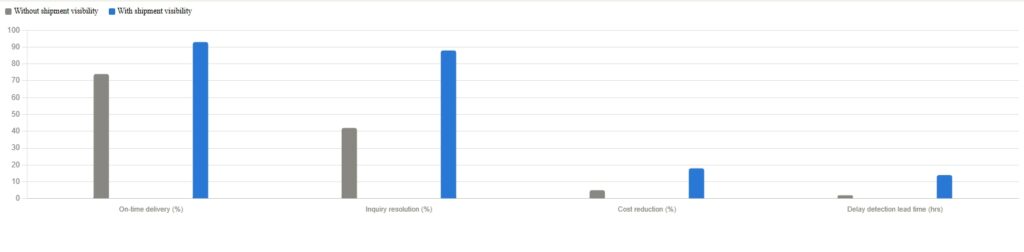
Here’s a look at how visibility adoption typically shifts key performance indicators:
As the chart illustrates, businesses that implement real-time visibility typically see meaningful gains in on-time delivery, faster customer query resolution, lower inventory carrying costs, and — critically — much earlier warning of delays before they escalate.
Comparison: Traditional Tracking vs. Modern Shipment Visibility Platforms
| Feature | Traditional Tracking | Modern Shipment Visibility Platform |
| Update frequency | Manual check-ins, milestone-based | Real-time, continuous |
| Data sources | Single carrier | Multi-carrier, multi-modal |
| Predictive capability | None | AI/ML-based ETA prediction |
| Condition monitoring | Rarely available | Temperature, humidity, shock sensors |
| Integration | Standalone portal | API/EDI integration with WMS, TMS, ERP |
| Exception handling | Reactive (after the fact) | Proactive (before disruption occurs) |
| Customer experience | Static tracking number | Live, personalized delivery updates |
The takeaway: traditional tracking tells you where a package was. A modern visibility platform tells you where it is, where it’s going, and whether something needs your attention right now.
Implementation Overview: How Palm Horizon KSA Approaches Shipment Visibility
Rolling out shipment visibility across a supply chain doesn’t happen overnight, but it also doesn’t need to be overwhelming. A structured implementation typically looks like this:
- Assessment phase — Audit current tracking capabilities, identify visibility gaps, and map all carrier and partner touchpoints.
- Technology selection — Choose a visibility platform that supports the required integrations (API, EDI), sensor types, and reporting needs.
- Pilot rollout — Start with a single trade lane or product category to test data accuracy and system reliability before scaling.
- Integration with existing systems — Connect the visibility platform to WMS, TMS, and ERP systems so data flows automatically without manual entry.
- Team training and process alignment — Ensure logistics coordinators, customer service teams, and warehouse staff know how to use the new data.
- Full-scale deployment — Extend visibility coverage across all trade lanes, carriers, and shipment types.
- Continuous optimization — Use the data collected to refine routing, carrier selection, and customer communication over time.
For companies operating in and around Saudi Arabia, this often includes close coordination with port authorities, customs brokers, and regional carriers to ensure visibility data captures the full journey — not just the international leg.
Frequently Asked Questions
What is shipment visibility in supply chain management?
Shipment visibility is the ability to see and track the real-time location, status, and condition of goods as they move through the supply chain, from origin to final delivery. It goes beyond basic tracking numbers to include predictive ETAs, condition monitoring, and automated delay alerts.
How to achieve end-to-end shipment visibility for a growing business?
Achieving end-to-end visibility involves mapping every stage of the shipment journey, standardizing data formats across partners, deploying GPS and IoT tracking devices, and consolidating all data into a single integrated platform connected to your WMS, TMS, and ERP systems.
What’s the difference between shipment tracking visibility and full supply chain visibility?
Shipment tracking visibility usually refers to customer-facing updates (where’s my package), while full supply chain visibility includes operational data used internally — carrier performance, customs status, inventory positioning, and condition monitoring across the entire network.
Why is freight shipment visibility important for international trade?
International freight often passes through multiple carriers, ports, and customs checkpoints, each a potential point of delay or miscommunication. Freight shipment visibility consolidates this fragmented journey into one clear view, helping businesses avoid costly surprises at customs or during carrier handoffs.
Can a shipment visibility platform reduce logistics costs?
Yes. By catching delays early, optimizing routes based on real-time conditions, and reducing the manual labor spent chasing status updates, visibility platforms typically lower inventory carrying costs, reduce expedited shipping fees, and cut down on customer service overhead.
Is shipment visibility only useful for large enterprises?
No. While large enterprises with complex, multi-modal supply chains benefit significantly, small and mid-sized businesses also gain from reduced customer complaints, fewer manual status checks, and better planning accuracy — often with scalable, subscription-based visibility platforms suited to their volume.
Conclusion: Visibility Is No Longer Optional
Supply chains that operate with blind spots are supply chains that react to problems after they’ve already cost time, money, and customer trust. Shipment visibility flips that model. It gives businesses the ability to see disruptions coming, communicate proactively with customers, and make faster, better-informed decisions at every stage of the journey.
Whether you’re moving pharmaceuticals that demand strict temperature control, retail goods racing to meet delivery promises, or industrial equipment crossing multiple borders, the businesses that will lead their industries are the ones that can answer “where is my shipment?” instantly and accurately — every single time.
At Palm Horizon KSA, we help businesses across the Kingdom build exactly this kind of resilient, transparent, and data-driven supply chain — one where visibility isn’t an afterthought, but the foundation everything else is built on.
Ready to close the visibility gaps in your supply chain? Palm Horizon KSA can help you get there.




1 Comment
7 Ways Demand Forecasting Helps Businesses Plan Smarter August,28 2026
[…] forecasting doesn’t just predict a number — it supports the entire inventory and supply chain planning process, from procurement to warehousing to last-mile delivery. Without it, businesses are […]