
Introduction: The Hidden Cost of Guessing Your Stock Levels
Picture this: a customer orders a product that your system says is “in stock,” but when your warehouse team goes to pick it, the shelf is empty. Or the opposite happens — you’re sitting on thousands of riyals worth of unsold inventory because nobody flagged that demand had dropped. Multiply these scenarios across hundreds of SKUs, multiple warehouses, and a growing customer base, and you get a business that’s constantly firefighting instead of growing.
This is the daily reality for businesses that still rely on spreadsheets, manual counts, or gut instinct to track their stock. As supply chains grow more complex and customer expectations for fast, accurate order fulfillment keep rising, the gap between businesses that scale smoothly and those that stall out often comes down to one thing: how well they manage inventory.
That’s where an inventory management system comes in. Whether you’re running a retail chain, an e-commerce store, a distribution warehouse, or a manufacturing unit, understanding what is inventory management, how to do inventory management properly, and how to manage stock inventory with the right tools can be the difference between chaotic operations and predictable, scalable growth.
In this guide, we’ll break down exactly what inventory management is, the core features that make modern inventory management software effective, and — most importantly — the seven concrete benefits your business can expect when you implement one. At Palm Horizon KSA, we work with growing businesses across Saudi Arabia to help them modernize their operations, and this article distills what we consistently see work.
What Is Inventory Management?
Inventory management is the process of ordering, storing, tracking, and controlling a business’s stock — from raw materials to finished goods — as it moves through the supply chain. It answers three fundamental questions at any given moment:
- What do we have?
- Where is it?
- How much do we need?
Good inventory management sits at the intersection of purchasing, warehousing, sales, and finance. Done well, it ensures you never run out of what customers want, never overstock what they don’t, and always know the real-time value of the goods sitting in your warehouse.
Historically, inventory management meant physical stock counts, ledgers, and a lot of manual reconciliation. Today, it’s largely digital — powered by software that automates tracking, forecasting, and reporting so human error and guesswork are removed from the equation.
Fun fact: According to widely cited retail industry estimates, poor inventory visibility — stockouts and overstocking combined — costs global retailers over a trillion dollars annually in lost sales and excess holding costs. Inventory mismanagement isn’t a small operational hiccup; it’s one of the largest silent profit leaks in commerce.
How to Do Inventory Management the Right Way
Knowing how to do inventory management effectively isn’t about buying software and hoping for the best — it’s about building a process the software supports. Here’s the foundational framework most well-run businesses follow:
- Centralize your data — every unit of stock, across every location, tracked in one system.
- Set reorder points — define minimum stock thresholds that automatically trigger purchase orders.
- Use real-time tracking — barcode or RFID scanning at every stage of movement (receiving, storage, picking, shipping).
- Forecast demand — use historical sales data and seasonality trends to predict future stock needs.
- Audit regularly — cycle counts and periodic full audits to catch discrepancies early.
- Integrate with sales and finance — so stock data automatically updates accounting and order management systems.
This is precisely the workflow that a good inventory management system is designed to automate.
How to Manage Stock Inventory Effectively
If you’re wondering specifically how to manage stock inventory on a day-to-day level, it comes down to a few operational habits:
- FIFO/FEFO methods — First-In-First-Out or First-Expired-First-Out, especially critical for perishable or date-sensitive goods.
- ABC analysis — categorizing inventory by value and turnover rate (A = high value/low volume, C = low value/high volume) to prioritize attention.
- Safety stock buffers — maintaining a cushion of stock to absorb demand spikes or supplier delays.
- Multi-location visibility — knowing exactly how much stock sits in each warehouse or store branch at any time.
- Automated alerts — low-stock and overstock notifications sent directly to the purchasing team.
Manually juggling all of this across spreadsheets becomes nearly impossible once a business crosses a certain size — which is exactly why dedicated systems exist.
Core Features of a Modern Inventory Management System
A capable inventory management system typically includes:
- Real-time stock tracking across multiple warehouses or store locations
- Barcode/QR and RFID scanning for fast, error-free data entry
- Automated reorder alerts based on custom thresholds
- Demand forecasting using historical and seasonal sales data
- Multi-channel sync for businesses selling on e-commerce platforms, marketplaces, and physical stores simultaneously
- Batch and expiry tracking for perishable or regulated goods
- Reporting and analytics dashboards for stock valuation, turnover rate, and shrinkage
- Integration capability with POS, accounting, and ERP software
These features form the backbone of the benefits we’ll explore next.
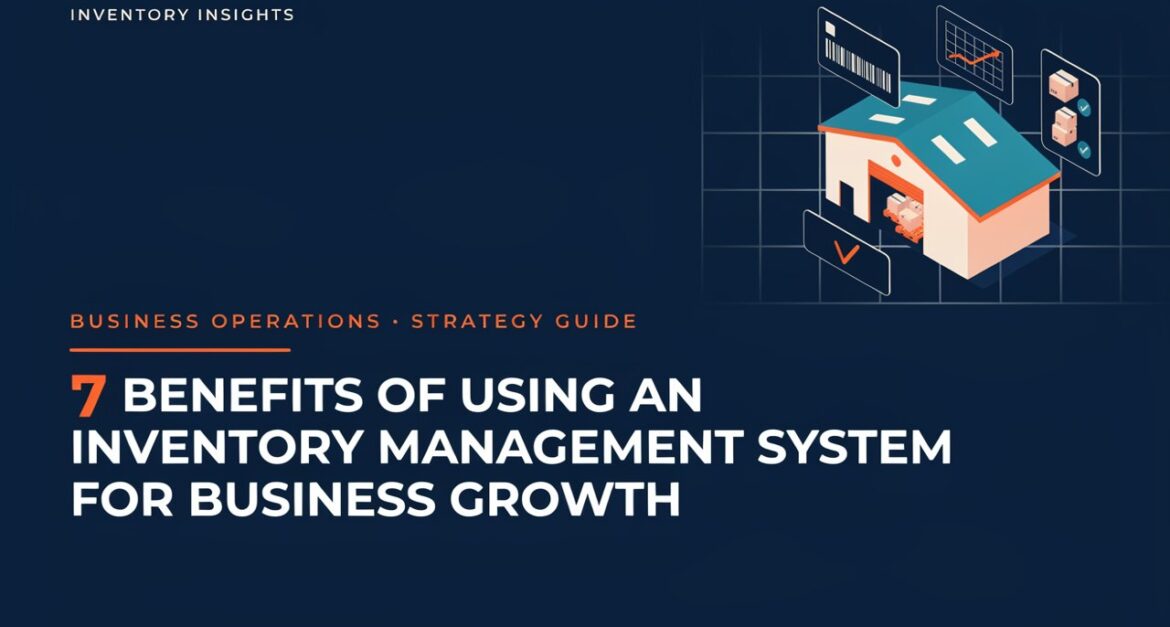
7 Benefits of Using an Inventory Management System for Business Growth
1. Fewer Stockouts and Lost Sales
When stock levels are tracked in real time and reorder points are automated, the odds of a customer hitting a “sold out” wall drop dramatically. This directly protects revenue — every stockout is a sale you didn’t just lose today, but potentially a customer who buys from a competitor tomorrow.
2. Reduced Overstocking and Holding Costs
Excess inventory ties up cash, occupies warehouse space, and — for perishable or seasonal goods — often ends up written off entirely. Demand forecasting built into inventory software helps you order closer to actual need, freeing up working capital for growth instead of storage.
3. Improved Order Accuracy
Barcode scanning and automated stock updates eliminate the manual data-entry errors that come from spreadsheets or paper logs. Fewer picking errors mean fewer returns, fewer refunds, and higher customer trust.
4. Real-Time Visibility Across Locations
For businesses with multiple stores or warehouses, a centralized system means you always know what’s available where — enabling smarter stock transfers between locations instead of unnecessary new purchase orders.
5. Better Cash Flow Management
Inventory is often a business’s single largest tied-up asset. Accurate stock data means finance teams can forecast cash requirements more precisely, avoiding both cash crunches from over-ordering and missed-opportunity costs from under-ordering.
6. Data-Driven Decision Making
Modern systems generate reports on turnover rates, best-and-worst sellers, seasonal patterns, and shrinkage. These insights allow business owners to make purchasing and pricing decisions based on evidence rather than instinct.
7. Scalability for Business Growth
Perhaps the most important long-term benefit: a good inventory system grows with you. Adding new SKUs, warehouses, or sales channels doesn’t require rebuilding your entire process from scratch — the system is built to scale, which is exactly what makes sustained business growth achievable without operational breakdown.
Visualizing the Impact
Here’s a simplified comparison of operational metrics before and after implementing an inventory management system, based on commonly reported industry benchmarks:
| Metric | Manual/Spreadsheet Tracking | With Inventory Management System |
| Stockout frequency | High | Low |
| Order accuracy | 85–90% | 98–99.9% |
| Inventory carrying cost | High (excess buffer stock) | Optimized |
| Time spent on stock counts | Hours/days | Minutes (automated) |
| Visibility across locations | Limited/manual reconciliation | Real-time, centralized |
| Forecasting accuracy | Based on guesswork | Data-driven |
Fun fact: The barcode — now central to almost every inventory system worldwide — was first scanned commercially in 1974, on a pack of chewing gum. What started as a grocery-store checkout shortcut is now the backbone of global supply chain tracking.
Inventory Management Software vs Manual Methods
| Factor | Manual Methods (Spreadsheets/Paper) | Inventory Management Software |
| Accuracy | Prone to human error | Automated, highly accurate |
| Speed | Time-consuming | Real-time updates |
| Scalability | Breaks down as business grows | Built to scale |
| Multi-location tracking | Very difficult | Centralized and instant |
| Forecasting | Based on manual analysis | Algorithm/data-driven |
| Integration | Rarely integrates with sales/finance | Syncs with POS, e-commerce, ERP |
| Cost over time | Hidden costs from errors, overstock | Clear ROI through efficiency |
The comparison isn’t close once a business handles more than a handful of SKUs or more than one sales channel. Spreadsheets work for very small operations, but they simply cannot match the speed, accuracy, and forecasting power of dedicated inventory management software.
Industries and Real-World Use Cases
Inventory management systems aren’t one-size-fits-all — they adapt to the specific rhythms of different industries:
- Retail chains — syncing stock across multiple branches and preventing in-store stockouts during peak shopping periods.
- E-commerce businesses — managing multi-channel inventory across a website, marketplaces, and social commerce simultaneously.
- Wholesale and distribution — tracking bulk stock movement between suppliers, warehouses, and retail clients.
- F&B and grocery — batch and expiry tracking to reduce spoilage and comply with food safety standards.
- Manufacturing — tracking raw materials, work-in-progress, and finished goods across the production cycle.
- Pharmacies and healthcare supply — tracking regulated, batch-numbered, and expiry-sensitive products with strict compliance requirements.
Across all of these, the underlying goal is the same: know what you have, where it is, and when you’ll need more — automatically, not manually.
Implementation Overview: Getting Started the Right Way
Rolling out an inventory management system doesn’t have to be overwhelming. A practical implementation path typically looks like:
- Audit your current inventory process — identify pain points (stockouts, overstock, manual errors).
- Define your requirements — number of SKUs, locations, sales channels, and integration needs (POS, e-commerce, accounting).
- Choose the right system — one that fits your business size and industry, with room to scale.
- Migrate and clean your data — import existing stock records and standardize product data.
- Train your team — ensure warehouse and sales staff understand the new workflow.
- Run a pilot phase — test with a portion of your inventory before a full rollout.
- Go live and monitor — track key metrics (stockout rate, order accuracy, turnover) in the first few months to measure ROI.
At Palm Horizon KSA, we typically recommend starting with a pilot on your highest-value or fastest-moving product category — this lets teams adapt to the new system with minimal risk before scaling company-wide.
Frequently Asked Questions
What is inventory management in simple terms?
Inventory management is the process of tracking and controlling a business’s stock — knowing what you have, where it’s located, and when to reorder — so operations run smoothly without running out of or overstocking products.
How do I start inventory management for a small business?
Start by listing all products, categorizing them by value and turnover (ABC analysis), setting basic reorder points, and choosing simple, scalable inventory management software rather than relying on spreadsheets long-term.
What is the difference between inventory management and inventory control?
Inventory management is the broader process — covering forecasting, purchasing, and strategy — while inventory control refers specifically to the day-to-day handling of stock levels, storage, and movement within that system.
Can inventory management software integrate with my existing POS or e-commerce platform?
Yes, most modern inventory management systems are built to sync with POS systems, e-commerce platforms, and accounting software, allowing stock data to update automatically across all sales channels.
How does an inventory management system reduce costs?
It reduces costs by minimizing overstocking (lower holding costs), preventing stockouts (protecting revenue), reducing manual labor for stock counts, and improving forecasting accuracy to avoid unnecessary purchasing.
Is inventory management software worth it for a small or growing business?
Yes — even small businesses benefit once they manage more than a handful of SKUs or sell across multiple channels, since manual tracking quickly becomes error-prone and time-consuming as order volume grows.
Conclusion: Turning Stock Control Into a Growth Engine
Inventory isn’t just a back-office concern — it’s directly tied to revenue, customer satisfaction, and cash flow. Businesses that continue to manage stock manually eventually hit a ceiling: errors multiply, cash gets tied up in the wrong products, and growth stalls under operational weight.
An inventory management system removes that ceiling. From fewer stockouts and reduced holding costs to real-time visibility and data-driven decision-making, the seven benefits outlined above aren’t theoretical — they’re measurable improvements that compound as your business scales.
If you’re ready to move beyond spreadsheets and guesswork, Palm Horizon KSA helps businesses across Saudi Arabia design and implement inventory systems tailored to their industry and growth stage — so stock control becomes a strength, not a bottleneck.