

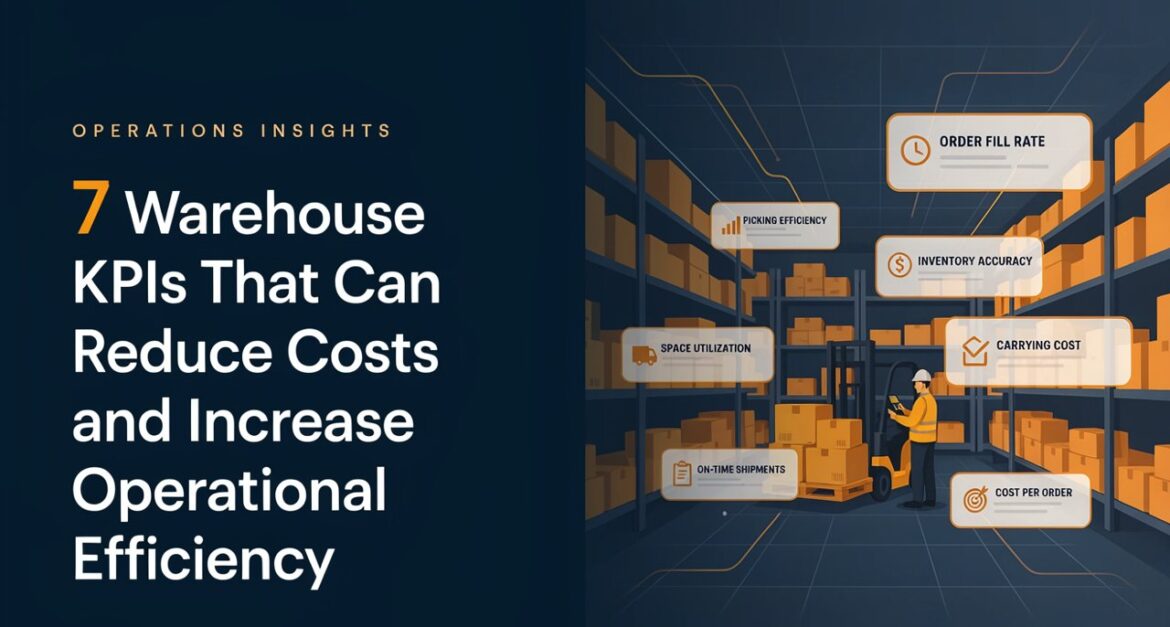
Introduction: Why Warehouse Performance Is Breaking Under Pressure
Warehouses across Saudi Arabia and the wider GCC region are under more pressure than ever. E-commerce order volumes are climbing, customer expectations for same-day delivery are rising, and labor and storage costs keep increasing every quarter. Yet many operations managers are still running their warehouses on gut feeling instead of data.
This is where KPIs for warehouse management come in. Without the right warehouse KPIs, it’s almost impossible to know whether your facility is actually efficient — or just busy. Being busy and being productive are two very different things, and the gap between them is where most of your operational costs are quietly leaking out.
At Palm Horizon KSA, we work with distribution centers, 3PLs, and manufacturing warehouses that want to move from reactive firefighting to proactive, metrics-driven operations. This guide breaks down the standard warehouse KPIs that matter most, how to track them, and how they directly translate into cost savings and efficiency gains.
Fun fact: According to industry benchmarking studies, warehouses that actively track and act on KPIs report up to 20–30% lower operating costs than those that don’t — simply because they can spot inefficiencies before they snowball.
What Are Warehouse KPIs?
Warehouse KPIs (Key Performance Indicators) are measurable values that show how well a warehouse is performing against its operational goals — speed, accuracy, cost, and space utilization. Think of them as the vital signs of your warehouse: just like a doctor checks your pulse and blood pressure, a warehouse manager checks order accuracy, inventory turnover, and dock-to-stock time.
KPIs for warehouse operations generally fall into four categories:
- Speed metrics – how fast tasks are completed (receiving, picking, shipping)
- Accuracy metrics – how error-free your processes are
- Cost metrics – how much it costs to move and store inventory
- Utilization metrics – how efficiently space, labor, and equipment are used
These are sometimes referred to as warehouse short cycle metrics KPIs, because many of them are measured over short, repeatable cycles (daily or per-shift) rather than long quarterly reviews — allowing managers to course-correct in near real time.
Core Attributes of Effective Warehouse KPIs
Before diving into the 7 specific KPIs, it helps to understand what makes a KPI actually useful (as opposed to just a vanity metric). Good KPIs for warehouse management share these attributes:
- Measurable – based on real data, not estimates
- Time-bound – tracked daily, weekly, or per cycle
- Actionable – tells you what to fix, not just what happened
- Benchmarked – compared against industry standards or your own historical performance
- Cost-linked – directly or indirectly tied to labor, space, or inventory cost
If a metric doesn’t meet most of these criteria, it’s probably noise, not a KPI.
The 7 Warehouse KPIs That Reduce Costs and Boost Efficiency
1. Order Accuracy Rate
This measures the percentage of orders picked, packed, and shipped without errors.
- Formula: (Total orders – Orders with errors) ÷ Total orders × 100
- Why it matters: Every incorrect shipment costs money in returns, re-shipping, and customer trust.
- Industry benchmark: 99%+ is considered excellent for most sectors.
Fun fact: A single mis-picked item can cost 3–5x more to fix after shipping than it would have cost to catch during quality control.
2. Inventory Turnover Ratio
One of the most important standard warehouse KPIs, this shows how many times inventory is sold and replaced over a period.
- Formula: Cost of Goods Sold ÷ Average Inventory
- Why it matters: Low turnover means capital is tied up in slow-moving stock, increasing holding costs.
- Use case: Retail and FMCG warehouses use this to identify dead stock draining storage space.
3. Dock-to-Stock Time
This tracks how long it takes for inbound goods to move from the receiving dock to being available for picking.
- Why it matters: Long dock-to-stock times delay order fulfillment and create receiving bottlenecks.
- Best practice: High-performing warehouses aim for under 24 hours.
4. Order Cycle Time
This measures the total time from order placement to shipment — a core warehouse short cycle metrics KPI used to judge fulfillment speed.
- Why it matters: Shorter cycle times mean higher customer satisfaction and better throughput without adding headcount.
- Industries: Critical for e-commerce, pharma distribution, and spare-parts warehousing where speed is a competitive advantage.
5. Warehouse Capacity Utilization
This shows how much of your available storage space is actively being used.
- Formula: Used Storage Space ÷ Total Available Storage Space × 100
- Why it matters: Underutilized space is wasted rent; overutilized space causes congestion and safety risks.
- Sweet spot: Most experts recommend targeting 80–85% utilization — full enough to be efficient, but not so full that operations slow down.
6. Cost Per Order
This is one of the most direct KPIs for warehouse operations because it ties every process back to a dollar (or riyal) figure.
- Formula: Total Warehouse Operating Costs ÷ Total Orders Processed
- Why it matters: Tracking this over time reveals whether efficiency improvements are actually reducing cost, or just shifting work around.
7. On-Time Shipping Rate
This measures the percentage of orders shipped by their promised date.
- Why it matters: Late shipments damage customer relationships and can trigger contractual penalties, especially in B2B and 3PL contracts.
- Benchmark: Top-tier warehouses maintain 95–98% on-time performance.
Visual Overview: Where Each KPI Impacts Cost
| KPI | Primary Impact Area | Cost Risk If Ignored |
| Order Accuracy Rate | Customer returns/labor | High |
| Inventory Turnover Ratio | Capital & storage | High |
| Dock-to-Stock Time | Fulfillment speed | Medium |
| Order Cycle Time | Customer experience | High |
| Warehouse Capacity Utilization | Real estate/rent | Medium |
| Cost Per Order | Overall profitability | Very High |
| On-Time Shipping Rate | Contracts/reputation | High |
(This table doubles as a quick “efficiency vs. cost-risk” chart — the KPIs toward the bottom typically have the largest financial blast radius when neglected.)
Real-World Use Cases and Industries Served
KPIs for warehouse management aren’t one-size-fits-all. Here’s how different industries apply them:
- E-commerce & Retail: Order cycle time and accuracy rate are king — speed and correctness drive repeat purchases.
- Pharmaceutical & Healthcare Distribution: Dock-to-stock time and accuracy are critical due to compliance and expiry tracking.
- 3PL & Logistics Providers: Cost per order and on-time shipping rate directly affect client contracts and profit margins.
- Manufacturing: Inventory turnover and capacity utilization prevent raw material shortages or overstocking.
- Food & Beverage: Dock-to-stock and turnover ratios are essential to manage perishables and reduce spoilage costs.
Comparison: KPI Tracking Approaches
| Approach | Pros | Cons |
| Manual spreadsheets | Low cost, simple | Error-prone, slow, hard to scale |
| Basic WMS reporting | Automated, decent visibility | Limited customization |
| Advanced WMS + Palm Horizon KSA consulting | Real-time dashboards, benchmarked insights, tailored KPI frameworks | Requires initial setup investment |
Unlike generic software-only solutions, Palm Horizon KSA combines technology recommendations with hands-on operational consulting — meaning KPIs aren’t just tracked, they’re translated into concrete action plans for your specific warehouse layout, labor structure, and regional supply chain conditions in Saudi Arabia.
Implementation Overview: How to Start Tracking These KPIs
- Audit your current data sources – WMS, ERP, manual logs
- Select 3–5 priority KPIs to start (don’t try to track everything at once)
- Set realistic benchmarks based on your industry and warehouse size
- Automate data capture wherever possible (barcode scanning, RFID, WMS integration)
- Review KPIs on a short cycle (daily/weekly) — this is why they’re often called warehouse short cycle metrics KPIs
- Adjust processes based on trends, not single data points
- Re-benchmark quarterly as your operation scales
Palm Horizon KSA typically recommends starting with Cost Per Order and Order Accuracy Rate, since these two alone often reveal 70–80% of a warehouse’s biggest inefficiencies.
Frequently Asked Questions
1. What are the most important KPIs for warehouse management?
The most critical ones are order accuracy rate, inventory turnover ratio, cost per order, and on-time shipping rate, since these directly affect both customer satisfaction and operating costs.
2. How often should warehouse KPIs be reviewed?
Short cycle metrics like order cycle time and dock-to-stock time should be reviewed daily or weekly, while broader KPIs like inventory turnover can be reviewed monthly or quarterly.
3. What is considered a good warehouse capacity utilization rate?
Most experts consider 80–85% to be the ideal range — high enough to maximize space efficiency, but low enough to avoid congestion and safety issues.
4. Can small warehouses benefit from tracking standard warehouse KPIs?
Yes. Even small operations benefit significantly, since early KPI tracking prevents inefficient habits from becoming embedded as the business scales.
5. How do warehouse KPIs directly reduce costs?
By identifying specific bottlenecks — such as slow dock-to-stock times or high error rates — KPIs allow managers to fix the exact process causing wasted labor, space, or returns, rather than making broad, costly changes.
6. What tools are used to track KPIs for warehouse operations?
Warehouse Management Systems (WMS), barcode/RFID scanning, and integrated ERP dashboards are the most common tools, often supplemented by consulting support to interpret and act on the data.
Conclusion: Turn Data Into Decisions
Warehouses that treat KPIs as an afterthought are essentially flying blind — reacting to problems only after they’ve already cost money. The warehouses that win, however, treat warehouse KPIs as a daily operating language: a way to catch inefficiencies while they’re still small, cheap, and easy to fix.
Whether you’re managing a single distribution center or a multi-site logistics network across Saudi Arabia, tracking these 7 KPIs — order accuracy, inventory turnover, dock-to-stock time, order cycle time, capacity utilization, cost per order, and on-time shipping rate — gives you a clear, data-backed path to lower costs and higher throughput.
Palm Horizon KSA specializes in helping warehouses turn these numbers into real operational improvements — not just reports that sit in a folder. If you’re ready to stop guessing and start measuring what actually drives your bottom line, it’s time to build a KPI framework that works for your warehouse, not against it.



Comments (2)
Warehouse Slotting Optimization: 7 Picking Strategies October,16 2026
[…] Warehouse slotting is the practice of deciding where each product should live, based on how it moves, how big it is and how it’s picked. Done well, it cuts unnecessary travel, makes products easier to reach and helps the whole warehouse run more smoothly. Done rarely or not at all, locations drift out of step with demand. […]
Bonded Warehouse in Saudi Arabia: 7 Benefits, Customs Rules, and How a Customs Bonded Warehouse Works - Palm Horizon October,23 2026
[…] every warehouse is a bonded one, and not every bonded one suits every product. Ask these […]