

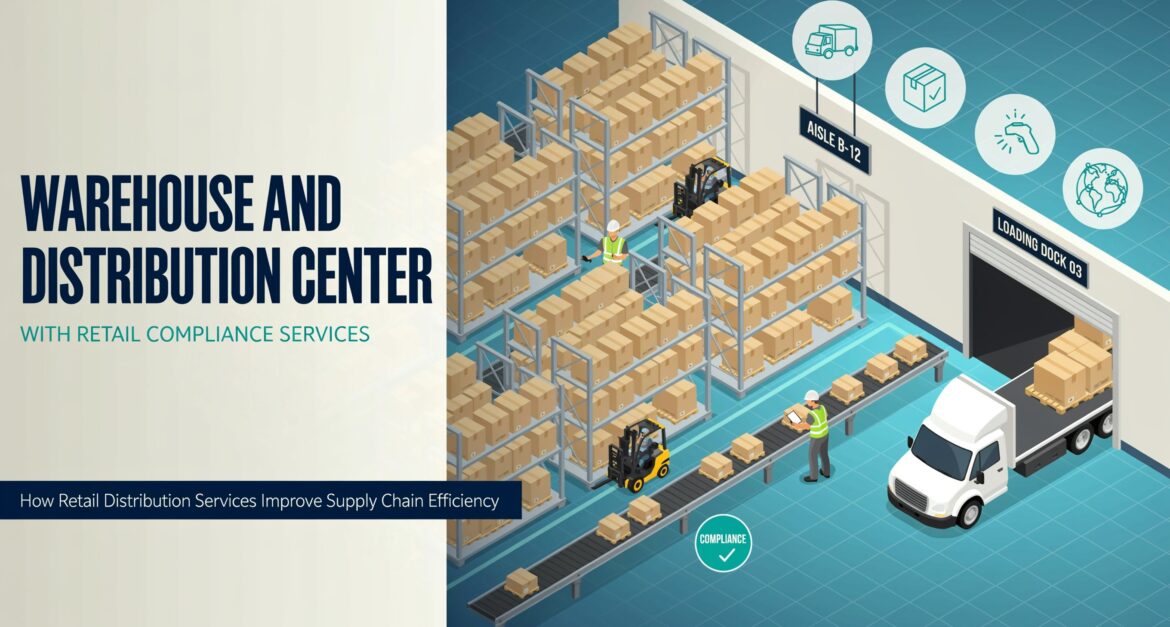
You ship a pallet of products to a major retailer. It arrives on time, but the receiving team rejects it because the barcode label is in the wrong position, the carton markings don’t match the purchase order, and the advance shipping notice has an error. Now the goods sit at a dock, the retailer applies a penalty, and your next replenishment slot moves back by days.
Situations like this are common in retail supply chains. Retailers set strict rules for how products are labeled, packed, documented, and delivered, and the rules differ from one retailer to the next. In Saudi Arabia, a market with fast-growing modern retail, e-commerce, and tighter regulation, getting this wrong costs money and shelf space.
This guide explains how a warehouse and distribution center with retail compliance services works and how retail distribution services improve supply chain efficiency. It also covers how to choose the right partner for your business in the Kingdom.
Fun fact: The first product ever scanned at a checkout was a pack of chewing gum, at a supermarket in Ohio in 1974. Every barcode rule retailers enforce today grew out of that one small beep.
What Are Retail Distribution Services?
Retail distribution services cover everything that moves a product from a brand, manufacturer, or importer to a retailer’s shelf or a customer’s door. They include:
- Receiving and inspecting inbound goods
- Storing products in suitable conditions
- Managing inventory records
- Labeling, packing, and preparing orders to retailer standards
- Picking, loading, and dispatching shipments
- Documenting every step for tracking and audits
In short, retail distribution services connect production to the shelf. A brand can make a great product, but it earns nothing until that product reaches the right store, in the right condition, with the right paperwork, at the right time.
Related terms you will see in this space include third-party logistics (3PL), order fulfillment, warehousing and distribution, B2B distribution, store replenishment, and last-mile delivery. They overlap, but retail distribution services focus on what retailers specifically require.
Who Uses Retail Distribution Services?
- Importers bringing consumer goods into Saudi Arabia
- Local manufacturers supplying supermarkets and hypermarkets
- FMCG, cosmetics, apparel, electronics, and home goods brands
- E-commerce sellers who also supply physical stores
- Foreign companies entering the Saudi market for the first time
How a Warehouse and Distribution Center with Retail Compliance Services Supports Retail Businesses
A standard warehouse stores goods. A warehouse and distribution center with retail compliance services goes further: it prepares goods to pass retailer checks before they leave the building.
Here is how that works in practice:
- Inbound control. Goods are received, counted, inspected, and matched against shipping documents.
- Compliant storage. Products are stored by category, batch, expiry date, or temperature need.
- Retailer-specific preparation. Items are labeled, packed, palletized, and marked to the exact standard each retailer requires.
- Quality and documentation checks. Labels, quantities, and paperwork are verified before dispatch.
- Outbound shipping. Orders go out on schedule, with tracking and proof of delivery.
The result is fewer rejected deliveries, fewer penalties, and faster replenishment. Because one retailer’s rules can differ greatly from another’s, businesses with many retail accounts gain the most from a specialist who already knows the requirements.
Key Benefits of Retail Distribution Services
Faster Order Fulfillment and Product Distribution
Speed in retail depends on predictability as much as raw pace. A distribution center with set processes for receiving, picking, packing, and loading shortens the time between a purchase order and a delivered shipment. When labeling and packing standards are built into the workflow instead of fixed after the fact, orders don’t stop for rework.
Improved Inventory Management and Stock Availability
Empty shelves are expensive. Shoppers who don’t find a product usually buy a substitute, and some change brands for good. Retail distribution services help prevent this with:
- Real-time stock counts
- Batch and expiry tracking (essential for food, cosmetics, and health products)
- Reorder alerts based on sales velocity
- Cycle counting to catch discrepancies early
Accurate inventory also means you stop over-ordering, which ties up cash in stock that sits unsold.
Reduced Distribution Costs and Operational Delays
Running your own warehouse means rent, equipment, staff, systems, and compliance training. A shared distribution model spreads those costs across many clients. Savings also come from avoiding:
- Retailer chargebacks and rejected shipments
- Re-labeling and re-packing at the retailer’s dock
- Missed delivery windows
- Idle stock and duplicate handling
The chart below shows the idea. It is an illustrative model of how time in each order-preparation stage can shrink when compliance is built into the process rather than handled as an afterthought. Use your own operational data for real planning.
The biggest gap is in “rework and corrections.” That is where hidden delays pile up when compliance isn’t planned from the start.
Better Retail Supply Chain Visibility
You can’t manage what you can’t see. Modern retail distribution services give you visibility into:
- What is in stock, and where
- Which orders are picked, packed, or in transit
- Which shipments were delivered, delayed, or rejected
- Lead times by retailer, product, and region
This lets you answer a buyer’s question (“Where is my order?”) in minutes and spot problems before they reach the shelf.
Fun fact: Saudi Arabia’s national transport and logistics strategy aims to turn the Kingdom into a global logistics hub, connecting three continents, with dozens of planned logistics zones. Demand for professional warehousing is growing with it
Essential Features of a Warehouse and Distribution Center with Retail Compliance Services
Not every warehouse is built for retail. Look for these features.
Retail-Compliant Warehousing and Storage
- Clean, organized, secure storage with clear zoning
- Temperature or condition control where the product needs it
- First-expired, first-out (FEFO) or first-in, first-out (FIFO) stock rotation
- Separate areas for quarantine, returns, and damaged goods
- Pest control and hygiene standards for food and personal-care items
- Racking and handling suited to cartons, pallets, and mixed SKUs
Product Labeling, Packaging, and Barcode Management
Labels are one of the most frequent causes of retail rejections. A strong provider handles:
- Barcode application and verification (GS1 standards, GTIN/EAN codes)
- Price tags and shelf-ready labels
- Arabic and English labeling where required
- Carton and pallet labels matching retailer formats
- Kitting, bundling, and re-packing for promotions
- Shelf-ready or retail-ready packaging that goes straight onto the shelf
Fun fact: A standard barcode doesn’t contain a product name or price. It holds a number that points to a record in a database. That is why a single wrong digit can send an entire shipment into rejection.
Order Picking, Packing, and Shipping
- Accurate picking using scanners or a warehouse management system (WMS)
- Pack-out rules per retailer (carton size, weight limits, pallet height)
- Palletizing and load planning for efficient transport
- Carrier coordination and delivery appointment booking
- Dispatch confirmation and proof of delivery
Retail Compliance Checks and Documentation
- Pre-shipment audits of labels, quantities, and packaging
- Advance shipping notices (ASN) matched to purchase orders
- Invoices, delivery notes, and packing lists
- Batch, expiry, and origin records
- Support for regulatory documentation relevant to your category, such as SFDA requirements for food, cosmetics, and medical products, SASO conformity where applicable, and ZATCA e-invoicing rules
How Retail Distribution Services Help Businesses Meet Retailer Requirements
Every large retailer publishes a vendor or supplier manual covering how goods must arrive. Typical requirements include:
| Requirement area | What retailers commonly expect |
| Labeling | Correct barcodes, readable placement, language requirements |
| Packaging | Approved carton sizes, sturdy materials, shelf-ready formats |
| Documentation | Accurate ASN, invoices, and delivery notes |
| Delivery | Fixed time slots, correct quantities, on-time arrival |
| Traceability | Batch and expiry data tied to each shipment |
| Quality | Undamaged goods, correct product condition |
Retail distribution services help by:
- Translating the vendor manual into warehouse instructions so staff follow the same rules every time.
- Checking before dispatch. Errors get caught in the warehouse, not at the retailer’s receiving dock.
- Standardizing documents so each shipment has matching paperwork.
- Keeping records that help resolve disputes and pass audits.
- Adapting quickly when a retailer updates its rules.
This matters more when you sell through several channels at once, such as hypermarkets, pharmacies, online marketplaces, and specialty stores, each with its own standards.
Warehouse Management vs Retail Distribution Services
People often use these terms interchangeably, but they cover different scopes.
| Feature | Warehouse Management | Retail Distribution Services |
| Main focus | Storing and tracking goods | Moving goods to retailers in compliant form |
| Scope | Inside the warehouse | Warehouse plus labeling, packing, documentation, and delivery |
| Compliance role | Basic handling and safety | Retailer-specific requirements and checks |
| Typical output | Accurate stock records | On-time, accepted deliveries |
| Best for | Businesses that only need storage | Businesses selling through retail chains |
| Business goal | Control inventory | Protect shelf presence and margins |
In plain terms: warehouse management is one part of retail distribution services. If you only need a place to keep goods, storage may be enough. If you supply retail chains, you need the full service.
Common Retail Distribution Challenges and How to Overcome Them
1. Shipments rejected for labeling or packaging errors
Fix: Build retailer rules into pre-shipment checks and use barcode verification before loading.
2. Stock discrepancies between systems and shelves
Fix: Use a WMS with cycle counts and scan-based receiving and picking.
3. Seasonal demand spikes (Ramadan, Eid, back-to-school, national day sales)
Fix: Plan capacity ahead, agree on peak-season staffing, and pre-position fast-moving stock.
4. Short shelf-life products
Fix: Apply FEFO rotation and set expiry alerts well before the retailer’s minimum shelf-life threshold.
5. Delivery delays and missed appointment slots
Fix: Coordinate carriers early, share load plans, and keep buffer time in schedules.
6. Poor visibility across the supply chain
Fix: Choose a provider that shares inventory and order status updates in real time.
7. Regulatory complexity
Fix: Work with a partner who understands local requirements and keeps documentation organized.
How to Choose the Right Warehouse and Distribution Partner in Saudi Arabia
A good partner affects your retail relationships directly, so evaluate carefully. Use this checklist:
- Retail experience. Have they served supermarket, pharmacy, or e-commerce clients, and do they know major retailers’ receiving standards?
- Compliance capability. Can they handle labeling, barcodes, ASN, and documentation in-house?
- Location and network. Is the facility near key ports, highways, and consumer centers such as Riyadh, Jeddah, and Dammam?
- Technology. Do they use a WMS with real-time reporting and integrations?
- Storage conditions. Do they offer the right environment for your product type?
- Scalability. Can they handle volume growth and seasonal peaks?
- Transparency. Do they report KPIs such as order accuracy, on-time dispatch, and rejection rate?
- Pricing clarity. Are fees for storage, handling, labeling, and delivery clearly itemized?
- Support and communication. Will you have a responsive account contact?
Ask these questions before signing:
- How do you handle a retailer rejection, and who bears the cost?
- How do you stay current on each retailer’s requirements?
- What are your typical order accuracy and on-time dispatch rates?
- Can I see a sample report or dashboard?
Retail Distribution Services for Businesses Expanding Across Saudi Arabia
Saudi Arabia offers a large consumer base, a young population, rising e-commerce use, and ongoing investment in logistics under Vision 2030. But it is also a big country. Moving goods from a port to stores across regions takes planning.
For businesses expanding in the Kingdom, retail distribution services offer:
- A faster market entry. You can launch without building your own warehouse or hiring a large team.
- Regional reach. Central hubs support delivery to multiple cities.
- Omnichannel support. One inventory pool can serve stores, online orders, and B2B customers.
- Flexibility. Scale space and services up or down as sales grow.
- Local compliance knowledge. Importers avoid delays caused by unfamiliar rules.
If you are an international brand or a growing local company, a distribution partner can turn a complicated expansion into a manageable process.
How Palm Horizon KSA Supports Retail Warehousing and Distribution
Palm Horizon KSA supports businesses that need dependable warehousing and distribution in Saudi Arabia with a retail-ready approach. Instead of treating storage and compliance as separate jobs, the service brings them together so products are prepared correctly before they reach a retailer.
Businesses working with Palm Horizon KSA can expect support in areas such as:
- Retail-focused warehousing and organized inventory handling
- Product labeling, packaging, and barcode preparation
- Accurate order picking, packing, and dispatch
- Retail compliance checks and shipment documentation
- Distribution support for brands expanding across Saudi Arabia
The goal is simple: help your products arrive accepted, on time, and ready to sell, so your team can spend its time on sales and growth rather than chasing rejected deliveries.
Ready to simplify your retail distribution? Contact Palm Horizon KSA to discuss your products, retailers, and volumes, and get a distribution plan built around your business.
Frequently Asked Questions About Retail Distribution Services
What Are Retail Distribution Services?
Retail distribution services are the logistics activities that move products from a supplier to retailers or customers. They include warehousing, inventory control, labeling, packing, order picking, shipping, and documentation, all done to the standards retailers require.
What Is a Warehouse and Distribution Center with Retail Compliance Services?
It is a logistics facility that stores and ships goods and also prepares them to meet retailer rules. That includes correct barcodes, packaging formats, shipping notices, and paperwork, along with quality checks before dispatch. This reduces rejections and penalties.
Why Is Retail Compliance Important in Distribution?
Retailers use compliance rules to keep receiving, stocking, and tracking efficient. Non-compliant shipments can be refused, delayed, or fined, which hurts your margins and your standing as a supplier. Compliance also supports product safety, traceability, and regulatory requirements.
How Do Retail Distribution Services Improve Order Fulfillment?
They standardize each step, from receiving to dispatch. Accurate inventory data, scan-based picking, and pre-shipment checks cut errors and rework. Orders move faster and arrive in the form retailers expect, which improves on-time, in-full delivery.
How Can Businesses Choose the Right Retail Distribution Partner?
Look at their retail compliance experience, facility location, technology, storage conditions, scalability, reporting, and pricing transparency. Ask how they handle rejected shipments, request performance metrics, and confirm they understand the requirements of the retailers you supply.
Is a Retail Distribution Partner Only for Large Companies?
No. Small and mid-sized brands often benefit the most, since they avoid the fixed costs of a warehouse and gain access to compliance expertise they may not have in-house.
Can Retail Distribution Services Support E-commerce Too?
Yes. Many providers use one inventory pool to serve physical retailers and online orders, which reduces duplicate stock and improves availability across channels.
Conclusion: Compliance-Ready Distribution Is a Growth Strategy
In retail, a product is only as good as its availability on the shelf. Late deliveries, label errors, and missing documents quietly drain profit and weaken relationships with retail buyers.
A warehouse and distribution center with retail compliance services solves this at the source. By combining compliant storage, accurate labeling, careful order handling, and thorough documentation, retail distribution services make your supply chain faster, more predictable, and easier to scale. For businesses in Saudi Arabia, where retail and logistics are both expanding quickly, the right partner can mean the difference between constant firefighting and steady growth.
If you want your products to reach retailers accepted, on time, and ready to sell, Palm Horizon KSA is ready to help you build that foundation.
Take the next step: Reach out to Palm Horizon KSA today to discuss your retail distribution needs.