

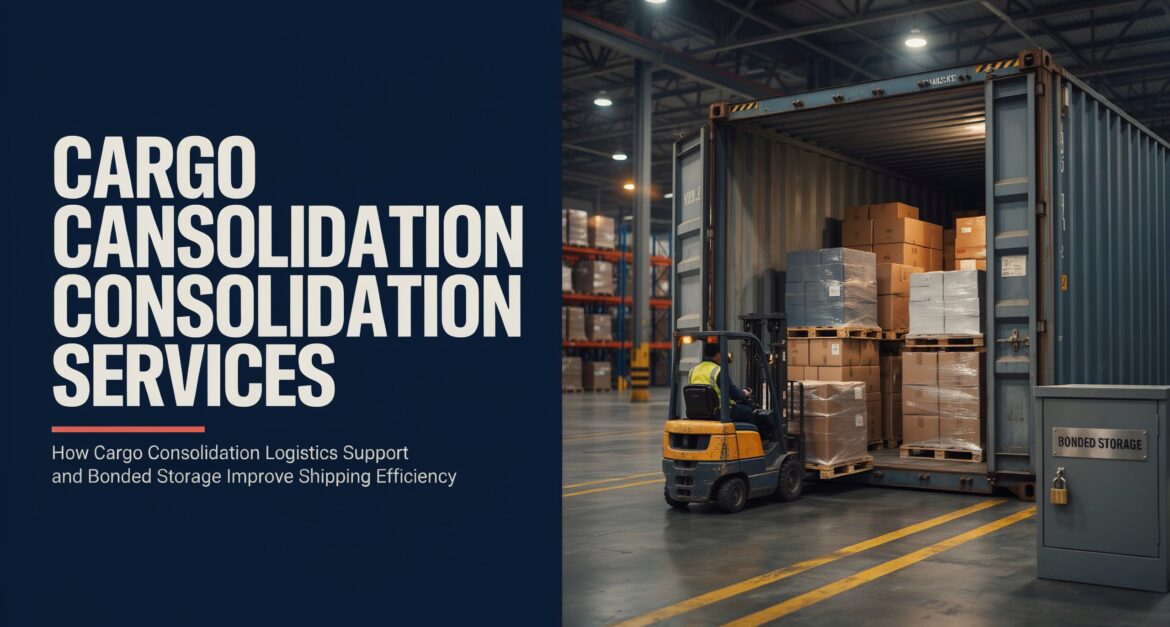
Imagine you run a growing business in Saudi Arabia. Every month you buy from five suppliers in three countries. Each one ships a few cartons, a couple of pallets or one awkward crate. Each shipment has its own booking, its own paperwork, its own arrival date and its own invoice for handling.
Nothing about this is wrong, but all of it is expensive. Small shipments cost more per unit to move. Documents multiply. Goods arrive on different days, so your warehouse team is always receiving something. And when one supplier is late, the rest of the order sits idle.
Cargo consolidation is the logistics answer to this problem. Instead of moving many small shipments separately, it combines them into one larger movement. Add bonded storage, which lets goods wait under customs control before duties are paid, and you get something even more useful: a way to move goods in an orderly way, on your timeline instead of the carrier’s.
This guide explains what cargo consolidation services are, how logistics support and bonded warehousing fit in, what the steps look like, how it compares with full container load shipping, and what to consider for imports into Saudi Arabia. Palm Horizon KSA appears as a practical partner for businesses that want to put this into action.
Fun fact: Modern container shipping is younger than many people think. The first container voyage by Malcom McLean’s company happened in 1956, when the converted tanker Ideal X sailed from Newark to Houston. Before that, ships were loaded piece by piece, which is part of why shipping small lots was so slow and costly.
What Are Cargo Consolidation Services?
Quick answer: Cargo consolidation services combine multiple smaller shipments, often from different suppliers or for different customers, into a single larger shipment so they can travel together to the same destination region, usually reducing cost and complexity.
In practice, a consolidator receives your goods at a warehouse, checks and records them, and loads them together with other cargo into one container, pallet position or air freight load. At the destination, the shipment is broken down and each consignment goes to its owner.
Some terms you’ll see:
- LCL (Less than Container Load): Your goods share a container with other shippers’ cargo.
- Consolidator: The company that groups the cargo and arranges the main transport.
- CFS (Container Freight Station): The facility where cargo is consolidated or deconsolidated.
- House bill vs. master bill: The consolidator issues house documents to each shipper and holds a master document with the carrier.
- Buyer’s consolidation: One importer combining orders from several suppliers into a single shipment.
- Shipper’s consolidation: A single exporter combining orders for several buyers.
Consolidation works for sea freight and air freight, though the economics and timing differ.
How Cargo Consolidation Logistics Support Service Helps Businesses
Quick answer: A cargo consolidation logistics support service handles the work around the consolidation itself, such as collection, receiving, inspection, documentation, booking, tracking and delivery, so you deal with one coordinator instead of many parties.
Consolidation sounds simple, but the value is in the support behind it. Here is what a good logistics support service typically covers:
- Supplier coordination. Chasing cargo-ready dates, collecting goods and confirming quantities.
- Receiving and inspection. Checking cartons against packing lists, noting damage and taking photos.
- Labeling and re-packing. Marking goods properly and protecting fragile items.
- Documentation. Preparing invoices, packing lists, house bills and customs paperwork.
- Booking and scheduling. Choosing the right vessel or flight and managing cut-off times.
- Tracking and reporting. Giving you one view of the whole shipment.
- Delivery. Moving cleared goods from the destination terminal to your door.
The result is time returned to your team. Instead of acting as an amateur logistics coordinator, your buyer can focus on buying, and your operations manager can focus on running the warehouse.
Cargo Consolidation Bonded Storage Service: Benefits for Importers and Exporters
Quick answer: A cargo consolidation bonded storage service stores goods in a customs-controlled facility where import duties and taxes are suspended until the goods are released into the local market or re-exported, giving businesses time and flexibility.
In Saudi Arabia, the Zakat, Tax and Customs Authority (ZATCA) sets the rules. ZATCA’s bonded zones regulation describes bonded areas as zones where goods can be kept under suspension of customs duties and taxes until they enter the local market or are re-exported, under ZATCA supervision and managed by licensed operators.
How Bonded Storage Supports Cargo Consolidation
Consolidation often needs a waiting period. You may receive goods from supplier A on Monday and supplier B on the 12th. Bonded storage gives those goods a legal, secure place to wait while the rest of the order is assembled.
It helps in several ways:
- Staging. Goods from different suppliers are gathered, checked and kept until the full load is ready.
- Flexibility. You can decide when to release goods for local sale, or send them on to another market.
- Value-added work. Depending on licensing and rules, activities such as sorting, labeling and repacking can be done while goods remain in the bonded environment.
- Split releases. You can release part of a consolidated shipment and leave the rest in storage.
Benefits of Bonded Warehousing for International Shipments
- Cash-flow relief. Duties and taxes aren’t payable at arrival, but when goods are released into the domestic market. That keeps working capital free for longer.
- Re-export convenience. Goods meant for other markets can be stored and shipped on without paying local import charges.
- Fewer rushed decisions. You aren’t forced to clear everything immediately just to avoid port storage charges.
- Better planning. You can time release with sales, installation dates or customer orders.
- Added security. Bonded facilities operate under official supervision and recordkeeping rules.
Recent changes are worth noting. A mid-2026 advisory from a professional services firm reports that amendments to Saudi customs procedure controls and bonded zone rules cover goods admission, storage, handling, inventory management, transfer, re-export and release. Another commentary says importers with Authorized Economic Operator status may release goods from a duty-suspension area and submit the customs declaration within 30 days, with payment deferred accordingly. These rules evolve, so confirm current terms with a licensed customs broker before you plan around them.
Managing Customs Procedures and Cargo Storage
Storing goods under bond brings obligations. Typical responsibilities include:
- Accurate records. Every movement in and out must be documented.
- Proper declarations. Goods must be declared correctly when entering the market or being re-exported.
- Inventory controls. What the system says must match what is on the shelf.
- Compliance with product rules. Regulated goods may need approvals or certificates before release.
- Record retention. Authorities expect documents to be kept for a defined period. One bonded-zone guide notes a retention period of no less than five years from completion of customs procedures.
An experienced logistics partner will handle these details so that the benefit of bonded storage doesn’t turn into a compliance headache.
Fun fact: In many bonded systems, goods can be stored for long periods, but the real “clock” that matters is not on the shelf. It is the date the duty rate is applied. In bonded zones, duty is generally calculated when goods are released, not when they first arrived, which can make timing a strategic decision.
Key Benefits of Cargo Consolidation Services
Reduce Shipping Costs Through Consolidated Shipments
Carriers price small loads at a premium because each one demands handling, space and paperwork. By combining loads, you share the fixed costs of the booking, the container or the aircraft position with other shippers. You also reduce:
- The number of customs entries and related fees
- Port or terminal handling events
- Inbound deliveries to your site
Savings vary with volume, route and season, so ask for a quote comparing separate shipments with a consolidated one.
Improve Cargo Handling and Shipment Coordination
When cargo goes through one consolidation point, it is checked once, labeled once and loaded once under a single plan. Damage and mix-ups drop, and everyone works from the same list.
Simplify International Freight Management
Instead of managing five bookings, five sets of documents and five arrival notices, you manage one. This reduces administrative load, lowers the chance of mistakes and makes it easier to track and reconcile costs.
Improve Supply Chain Efficiency
Receiving goods in one planned delivery means your warehouse can schedule labor, dock doors and put-away in advance. Inventory arrives together, so you can start selling or producing sooner, rather than waiting for the last missing carton.
How Cargo Consolidation Works Step by Step
- Plan the shipment. Share your purchase orders, cargo-ready dates and destination. The consolidator proposes a route and cut-off date.
- Collect or receive goods. Suppliers deliver goods to the consolidation warehouse, or the consolidator picks them up.
- Inspect and record. Staff check quantities, condition and labels against documents, and log any issues.
- Store (if needed). Goods wait in the warehouse, or in bonded storage where applicable, until everything is ready.
- Prepare documents. Commercial invoices, packing lists, house bills of lading or air waybills, and any certificates are completed.
- Consolidate and load. Goods are packed into a container, or built onto air freight pallets, and sealed.
- Ship. The main carriage happens by sea or air, with tracking milestones.
- Arrive and deconsolidate. At destination, the cargo is unloaded and separated by consignee.
- Clear customs. Each consignment is declared and cleared according to local rules, or placed into bonded storage.
- Deliver. Goods are delivered to your premises or released from storage as planned.
Cargo Consolidation Services for International Shipping to Saudi Arabia
Quick answer: Consolidation can bring goods from several overseas suppliers into Saudi Arabia on one shipment, with the option to hold them in bonded storage until release, which suits importers managing duties, cash flow and varied product ranges.
Saudi Arabia’s logistics push gives consolidation a growing role. Authorities have been developing bonded and integrated logistics zones as part of the Kingdom’s ambition to become a regional logistics center. For example, coverage of the Riyadh Integrated Logistics Bonded Zone says it was designed to position the Kingdom as a gateway connecting Europe, Asia and Africa, allowing goods to be stored, processed and re-exported with duty suspended or deferred.
Here is what to think about when consolidating for Saudi Arabia:
- Entry points. Choose an airport or port that fits your final delivery area, such as Jeddah, Dammam or Riyadh.
- Separate clearance per consignee. When one container holds goods for several owners, each consignment is usually cleared under its own paperwork. Confirm how your partner handles this.
- Product regulations. Some goods need approvals or conformity certificates. Check requirements before cargo ships, because missing documents are a common cause of holds.
- Documentation quality. Invoices should match packing lists and carry accurate descriptions and tariff classifications.
- Duty and VAT timing. Bonded storage may let you defer duties and taxes until release into the local market, subject to current rules.
- Re-export options. If you serve neighboring markets, bonded storage can make Saudi Arabia a distribution base.
- Last-mile delivery. Plan trucking from the port or airport to your site in advance.
Rules and processes change, so ask your customs broker to confirm the latest requirements before each new lane or product category.
Cargo Consolidation vs Full Container Load Shipping
Quick answer: Consolidation (LCL) is typically better for smaller volumes, mixed suppliers and flexibility, while full container load (FCL) usually makes more sense once your cargo fills most of a container.
| Factor | Cargo Consolidation (LCL) | Full Container Load (FCL) |
| Container use | Shared with other shippers | Exclusive to you |
| Best for | Small and medium volumes, multiple suppliers | Large, single-supplier or high-volume cargo |
| Cost basis | Charged by volume or weight (e.g., per cubic meter) | Charged per container |
| Handling | Extra handling at consolidation and deconsolidation points | Sealed once, opened at destination |
| Transit time | Often slightly longer because of grouping and unpacking | Often faster and more direct |
| Damage and mix-up risk | A bit higher due to extra handling | Lower |
| Flexibility | High; ship smaller lots more often | Lower; you wait to fill a container |
| Control | Shared schedule | Your schedule |
The decision usually comes down to a break-even point. Below a certain volume, you pay for space you don’t use if you book a full container. Above it, per-unit charges on shared cargo add up. Here is a hypothetical, illustrative example, using made-up rates to show the pattern. Real prices vary by route, season and carrier:
In this made-up example the lines cross at roughly 23 cubic meters. Below that, sharing a container is cheaper. Above it, the full container wins. Your own break-even point will differ, so ask for both quotes whenever your volume is near the middle. Other factors, such as speed, product fragility and the need for bonded storage, may also tip the decision.
Common Cargo Consolidation Challenges and How to Overcome Them
| Challenge | Why It Happens | How to Overcome It |
| Suppliers ship late | Cargo-ready dates slip | Set clear deadlines, ask for early notice and agree what happens if a supplier misses the cut-off |
| Mismatched documents | Invoices, packing lists and labels disagree | Review documents before cargo is loaded; use a single checklist |
| Longer transit than FCL | Extra grouping and unpacking steps | Plan lead times realistically and compare service options |
| Damage from extra handling | Cargo is moved more often | Use sturdy packaging, palletize where possible and request photos at receipt |
| Unclear costs | Several small fees add up | Ask for a full quote showing handling, storage, documentation and delivery |
| Customs holds | Classification questions or missing certificates | Check regulated goods early and use a licensed broker |
| Bonded storage compliance | Records and inventory must be exact | Choose a partner with strong inventory control and reporting |
| Poor visibility | Cargo passes through many hands | Require tracking updates and a named contact |
A few habits prevent most problems. Keep one master purchase-order sheet. Insist on photo confirmation at the warehouse. Agree in writing on storage limits and release instructions. And hold a short review after each shipment to decide what to change next time.
How to Choose the Right Cargo Consolidation Logistics Partner
When you compare providers, look beyond the price. Ask these questions:
- Do they have the right licenses and facilities? For bonded storage, confirm they operate under proper authorization.
- How experienced are they with your lane? Saudi import knowledge, including local documentation and product requirements, matters.
- How often do they consolidate your route? Frequent departures mean shorter waits.
- What are the cut-offs and transit times? Get realistic numbers, not best-case promises.
- How do they handle damage and discrepancies? Ask what the process and liability terms are.
- What visibility will you get? Look for tracking, photos, stock reports and a responsive contact.
- Is pricing transparent? Ask for a line-by-line quote and what could change it.
- Can they scale with you? A partner that can handle small lots now and larger volumes later saves you from switching.
- Do they offer integrated services? Consolidation, storage, clearance and delivery under one roof reduce hand-offs.
Request references or case examples, and don’t be shy about asking how they have handled a past problem. The answer reveals more than a brochure.
Why Businesses Need Integrated Cargo Consolidation and Bonded Storage Services
Each service alone is useful. Together, they work as a system.
- One flow, one team. Goods move from collection to consolidation to storage to release without being handed between unrelated companies.
- Fewer gaps in responsibility. If something goes wrong, there’s a single party accountable.
- Better timing. Consolidation tells you when goods arrive. Bonded storage lets you decide when to release them.
- Cash-flow control. You can align duty payments with sales or delivery dates, where rules allow.
- Cleaner data. One system records receipt, storage, release and delivery, which simplifies audits and reporting.
- Faster response. When customers change orders, you can adjust releases rather than re-plan from scratch.
Think of it like a train station with a waiting room. Consolidation is the train that brings everyone together. Bonded storage is the waiting room where passengers can stay until it’s time to leave. Without the waiting room, everyone must exit the station immediately, whether or not they are ready.
Cargo Consolidation Solutions with Palm Horizon KSA
Palm Horizon KSA helps importers and exporters bring order to international shipping. The aim is to give you a single coordinated service instead of a chain of separate vendors, so goods move from suppliers to your door with fewer surprises.
A well-run consolidation partnership with Palm Horizon KSA should include:
- Consolidation planning. Help choosing the right mode, route and schedule for your product mix.
- Logistics support. Supplier coordination, receiving checks, documentation and shipment booking.
- Storage options. Warehousing, and bonded storage where it suits your goods and customs strategy.
- Customs guidance. Preparation of documents and awareness of Saudi requirements before cargo arrives.
- Tracking and communication. Regular updates and a named contact.
- Delivery coordination. Smooth handover to your warehouse, store or project site.
Whether you are bringing in mixed pallets from three countries or building a regional distribution plan, the goal is the same: lower handling effort, clearer costs and better control over timing.
Want to see what consolidation could save you? Contact Palm Horizon KSA with your supplier list, shipment volumes and destination, and ask for a comparison between separate shipments and a consolidated plan.
Frequently Asked Questions About Cargo Consolidation Services
What Are the Main Benefits of Cargo Consolidation Services?
The main benefits are lower per-unit shipping costs, fewer bookings and customs entries, simpler paperwork, better coordination between suppliers and fewer separate deliveries at your warehouse. With bonded storage, you also gain flexibility over when duties and taxes are paid.
How Does Cargo Consolidation Reduce Shipping Costs?
It lets several shippers share the fixed costs of a container or aircraft load. You pay for the space you use rather than an entire container, and you avoid repeating handling, documentation and delivery charges for each small shipment. Actual savings depend on route, volume and season, so compare quotes.
What Is a Cargo Consolidation Bonded Storage Service?
It is a service that combines consolidation with storage in a customs-controlled facility. Goods can be held there with duties and taxes suspended until they are released to the local market or re-exported, subject to the rules of the authority, such as ZATCA in Saudi Arabia.
How Does Cargo Consolidation Logistics Support Service Work?
A provider coordinates the whole process: collecting or receiving goods from suppliers, inspecting them, preparing documents, grouping them into one shipment, arranging transport and clearance, and delivering to you. You work with one contact who manages the details and keeps you updated.
Is Cargo Consolidation Suitable for Small and Medium-Sized Businesses?
Yes. In fact, small and medium-sized businesses often benefit most, because their individual shipments are too small to fill a container economically. Consolidation gives them access to better rates and professional handling without needing a large logistics team.
How Can Businesses Consolidate Shipments to Saudi Arabia?
Start by listing your suppliers, products and ready dates. Ask a logistics partner to receive and check the goods, prepare documents, and ship them together by sea or air to a Saudi port or airport. Confirm customs and product-approval requirements in advance, decide whether to use bonded storage, and plan delivery from the arrival point to your site.
Conclusion: Move Smarter, Store Smarter, Pay Smarter
Shipping rarely goes wrong because of one big failure. It goes wrong because of many small frictions: split deliveries, mismatched documents, rushed clearance and surprise charges. Cargo consolidation removes a lot of that friction by turning many small movements into one organized plan. Bonded storage adds breathing room, letting you decide when goods enter the market instead of reacting to the calendar.
For businesses importing into Saudi Arabia, the combination can mean lower costs, cleaner operations and better cash-flow management. The key is choosing a partner who understands both the logistics and the regulations, and who communicates clearly from the first quote to the final delivery.
With Palm Horizon KSA, you can build a consolidation and storage plan around your suppliers, your products and your timeline. Reach out today and take the first step toward simpler, smarter shipping.