

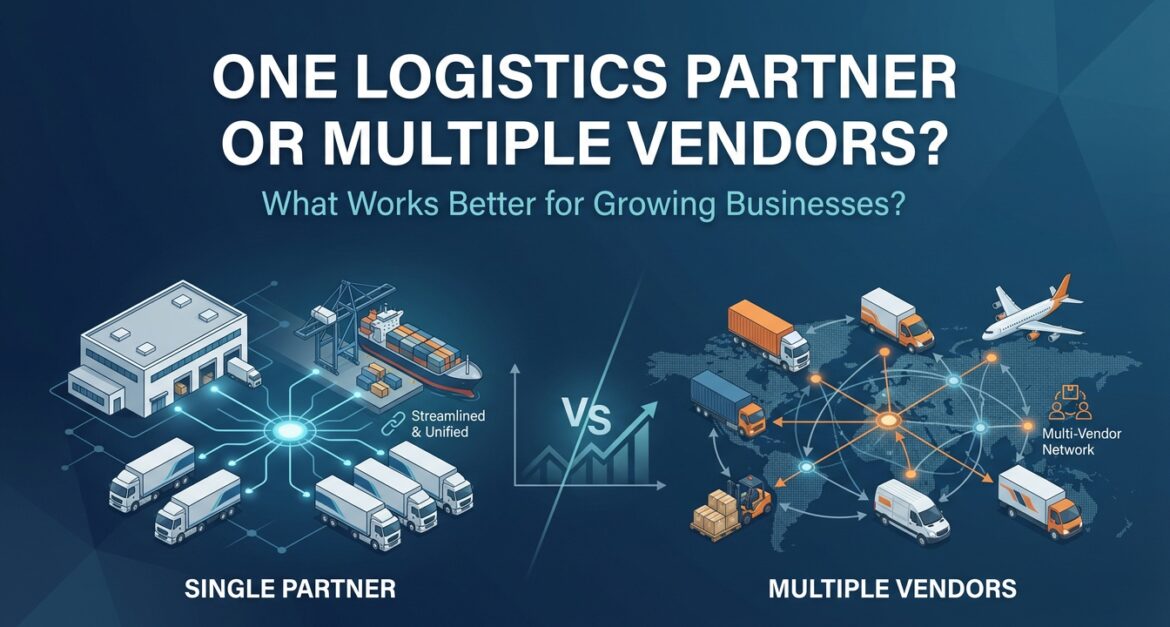
Every growing business reaches the same moment. Orders are climbing, the warehouse is crowded, and delivery complaints are starting to appear. Someone asks whether you should hand everything to one logistics company or spread the work across several specialists.
There is no universal answer, but there is a right answer for your stage of growth. In Saudi Arabia the question matters more than usual. The Kingdom spans a huge territory, runs on two coastlines, and is pushing hard to become a global logistics hub under Vision 2030. A logistics decision here affects your costs, your delivery promise and your ability to scale.
This guide covers how each model works, where each one breaks down, and how to choose. It is written for founders, operations managers and procurement teams who want a practical answer.
Fun fact: Saudi Arabia sits at the crossroads of Asia, Africa and Europe, with ports on both the Red Sea and the Arabian Gulf. Few countries have a map that works this hard for logistics.
Understanding a Single Logistics Partner vs Multiple Logistics Vendors
The difference is about who owns your supply chain.
- Single logistics partner: one provider handles most or all of your logistics, such as transport, warehousing, distribution and reporting. This is often called an integrated or third-party logistics (3PL) model.
- Multiple logistics vendors: you hire different providers for different jobs. One company might handle freight, another warehousing, and a third last-mile delivery. You coordinate them yourself.
Neither model is better in every case. A single partner gives you simplicity and a clear owner. Multiple vendors give you choice and specialization. Most growing businesses end up weighing simplicity against control.
What Is a Single Logistics Partner Model?
In this model one company is accountable for moving your goods from the point of origin to the customer’s door. You share your forecasts, volumes and service targets with one team, and that team builds the operation around them.
How a Single Logistics Partner Manages Transportation, Warehousing, and Distribution
A single partner typically connects the whole chain:
- Inbound transportation: collecting goods from suppliers, ports or factories and moving them to storage.
- Warehousing: receiving, storing, picking and packing, with inventory records kept in one system.
- Distribution: routing orders to retailers, distributors or end customers across cities and regions.
- Reporting: one set of dashboards, one invoice and one point of contact.
Because every stage sits under one roof, the stages are planned together. The warehouse knows when trucks arrive, and the transport team knows what stock is ready.
Key Benefits of Working with One Logistics Provider
- Simpler communication. You call one account manager instead of chasing several companies.
- Predictable budgeting. One contract and one rate structure make costs easier to forecast.
- Better end-to-end visibility. Data from storage and delivery lives in the same place.
- Clear accountability. If a shipment is late, one party owns the problem.
- Volume leverage. Concentrating your business often earns better rates and priority service.
- Less admin. Fewer contracts, fewer invoices and fewer onboarding processes.
Potential Challenges of Relying on a Single Logistics Partner
- Dependency risk. If your partner has a disruption, your whole supply chain feels it.
- Uneven strengths. Few providers are best in class at every service.
- Switching costs. Once systems and processes are integrated, moving away takes effort.
- Less price tension. With no competing quotes, you must benchmark rates deliberately.
What Does Working with Multiple Logistics Vendors Mean?
Here you act as your own logistics integrator. You pick a specialist for each need and manage the connections between them.
How Businesses Manage Different Logistics Service Providers
Businesses using this model usually:
- Assign freight to one carrier, storage to a warehouse operator, and last-mile delivery to a courier.
- Keep an internal logistics or procurement team to coordinate vendors.
- Use spreadsheets or a transport management system (TMS) to track performance across providers.
- Review vendor scorecards regularly, covering on-time delivery, damage rate and cost per shipment.
Benefits of Using Multiple Logistics Vendors
- Specialist expertise. You can choose the best provider for each task, such as cold chain, heavy freight or same-day delivery.
- Risk spreading. If one vendor fails, others can absorb part of the volume.
- Competitive pricing. Vendors know they can be replaced, which keeps quotes sharp.
- Regional flexibility. You can add a local provider for a new city without renegotiating everything.
Common Challenges of Managing Multiple Logistics Partners
- Coordination workload. Every handover between vendors is a place where things can go wrong.
- Fragmented data. Tracking numbers, formats and reports differ from vendor to vendor.
- Blame shifting. When goods arrive damaged, the carrier, the warehouse and the packer can each point at the others.
- Higher admin cost. More contracts, invoices and relationships need management.
- Inconsistent service. Customers may notice that delivery quality varies by region or vendor.
One Logistics Partner vs Multiple Vendors: Key Differences
The comparison below uses an illustrative 1–5 scorecard, where a higher score means the model usually handles that factor more easily. It is a decision-making framework based on common industry patterns, not measured market data, and your results will vary with the providers you choose.
The chart shows a trade-off. A single partner wins on simplicity, and multiple vendors win on flexibility. Here is how each factor plays out.
Cost Management and Budget Control
A single partner usually offers bundled pricing, fewer invoices and easier forecasting. Multiple vendors can sometimes win on price per service, because you can shop each one separately. Those savings often shrink once you count the internal hours spent managing contracts, reconciling invoices and fixing handover errors.
Communication and Coordination
One partner means one escalation path. With several vendors, a single delayed shipment can trigger three phone calls and two email chains before anyone finds the cause.
Shipment Visibility and Tracking
A single partner can show you a shipment’s full journey on one screen. With several vendors, you must stitch data together from separate systems, and gaps appear between handovers.
Service Quality and Accountability
A single partner owns the outcome. Multiple vendors each own only their own link in the chain, so problems that fall between links are harder to assign. On the other hand, a specialist vendor may deliver higher quality in its own niche.
Flexibility and Business Scalability
Multiple vendors let you add capacity or enter a new region quickly. A single partner can scale too, but only if its network, warehouses and fleet are large enough for your plans.
Fun fact: The word “logistics” comes from the military, where it described moving supplies, equipment and people to the front line. Modern businesses borrowed the idea because getting the right thing to the right place at the right time wins wars and customers alike.
Which Logistics Model Works Better for Growing Businesses?
The honest answer is that it depends on your size, your product and your plans. These guidelines will help.
When a Single Logistics Partner Is the Better Choice
A single partner usually fits when:
- Your team is small and cannot spare people for daily vendor coordination.
- You ship steady volumes of similar products.
- You want predictable costs while you focus on sales and product.
- Customer experience and delivery reliability are central to your brand.
- You are building an e-commerce, retail or distribution business and need warehousing and delivery to work together.
When Multiple Logistics Vendors Make More Sense
Multiple vendors usually fit when:
- You handle specialized goods, such as temperature-controlled or oversized cargo, that one provider cannot cover well.
- You operate across many regions or countries with very different requirements.
- You have an experienced in-house logistics team that can manage vendors confidently.
- Your volumes spike seasonally and you need backup capacity.
- Your risk policy requires that no single supplier controls your supply chain.
Choosing the Right Model Based on Business Size and Shipping Needs
| Business stage | Typical shipping profile | Model that usually fits |
| Startup / early growth | Low to moderate volume, limited team | Single logistics partner |
| Scaling SME | Rising volumes, new cities or channels | Single partner, with a backup for peaks |
| Established multi-region business | High volume, varied product types | Hybrid or multiple specialist vendors |
| Enterprise | Complex, multi-country flows | Multiple vendors under strong governance |
Many businesses end up with a hybrid approach. They keep one primary partner for around 70–80% of operations and add a secondary provider for specialist or overflow needs. This keeps the simplicity of one main relationship while reducing dependency risk. The split is a rule of thumb, not a fixed standard.
How the Right Logistics Model Improves Supply Chain Efficiency
Whichever model you pick, the goal is the same: goods flow with fewer delays, fewer errors and lower cost.
Streamlining Transportation and Freight Management
When transport planning is coordinated with order volumes, trucks run fuller and routes get shorter. A single partner can consolidate loads across your shipments. With multiple vendors you need a TMS or a disciplined weekly review to get the same effect.
Improving Warehouse and Inventory Coordination
If your warehouse and your transport team share data, you avoid the classic problems of stockouts, overstocking and goods sitting idle. Accurate, real-time inventory records make demand planning far more reliable.
Reducing Delivery Delays and Operational Costs
Most delays happen at handovers, such as customs, dock, depot and courier. Fewer handovers mean fewer chances for delay. The same logic cuts costs, because each extra touchpoint adds handling time, paperwork and risk of damage.
Strengthening Supply Chain Visibility
Visibility lets you answer the customer’s most common question, “Where is my order?”, without making phone calls. It also helps you spot patterns, such as which route is slowest or which product is damaged most often, so you can fix root causes.
Fun fact: Saudi Arabia’s National Transport and Logistics Strategy aims to turn the Kingdom into a global logistics hub, linking its ports, railways, airports and logistics zones. Businesses that build flexible logistics partnerships now are positioning themselves for that shift.
Factors to Consider Before Choosing a Logistics Partner in Saudi Arabia
Whether you pick one partner or several, evaluate each candidate on these points.
Geographic Coverage and Service Availability
Saudi Arabia is large, and delivery conditions differ between Riyadh, Jeddah, Dammam and smaller cities. Ask where the provider has its own network and where it relies on subcontractors. Check coverage on both coasts if you import or export through the Red Sea and Gulf ports.
Industry Experience and Logistics Expertise
A provider that understands your industry will handle your goods better, whether that is food, FMCG, electronics, healthcare, construction materials or e-commerce parcels. Ask for examples of similar clients and how they solved problems like peak seasons, customs documentation or fragile handling.
Technology, Tracking, and Reporting Capabilities
Look for real-time tracking, order and inventory visibility, and regular performance reports. Ask whether the provider can integrate with your e-commerce platform or ERP. Good technology saves you hours of manual follow-up every week.
Pricing, Contracts, and Service-Level Agreements
Look past the headline rate. Check:
- Fuel, handling and storage surcharges
- Minimum volume commitments
- Contract length and exit terms
- Service-level agreements (SLAs) for on-time delivery, damage and claims
- How disputes and compensation are handled
Ability to Support Future Business Growth
Ask yourself whether this provider can handle three times your current volume. A partner that fits you today but cannot grow with you will force a costly switch later.
Common Mistakes Businesses Make When Selecting Logistics Vendors
- Choosing on price alone. The cheapest quote often hides extra fees or weaker service.
- Skipping the SLA details. Vague promises are hard to enforce.
- Ignoring scalability. A provider that cannot grow with you becomes a bottleneck.
- Underestimating integration effort. Poor system compatibility creates manual work.
- Using too many vendors too early. Small teams drown in coordination.
- Relying on one vendor with no backup plan. Even a strong partner needs a contingency arrangement.
- Never reviewing performance. Without quarterly reviews, small service issues become habits.
How to Build a Reliable Logistics Partnership for Long-Term Growth
- Define your needs clearly. Document volumes, delivery targets, product handling requirements and growth forecasts.
- Shortlist and test. Run a pilot on one route or product line before committing fully.
- Agree on measurable KPIs. Track on-time delivery rate, order accuracy, damage rate and cost per shipment.
- Share forecasts openly. Partners plan better when they know about promotions, launches and seasonal peaks.
- Hold regular reviews. Monthly operations calls and quarterly business reviews keep problems small.
- Plan for contingencies. Know who covers volume if your main partner has an outage.
- Treat the provider as an extension of your team. The best results come from collaboration, not just supervision.
How Palm Horizon KSA Supports Growing Businesses with Logistics Solutions
For businesses that want the simplicity of one accountable partner, Palm Horizon KSA offers logistics solutions built around the needs of growing companies in Saudi Arabia. Its approach connects the parts of the supply chain that businesses often manage separately:
- Transportation and freight coordination to move goods reliably across the Kingdom
- Warehousing and inventory support to keep stock organized and accessible
- Distribution planning to get orders to customers on time
- A single point of contact to reduce coordination effort and speed up problem-solving
- Flexible support that can adapt as order volumes and delivery networks expand
Whether you are consolidating several vendors into one relationship or choosing your first logistics partner, Palm Horizon KSA can help you assess your current setup and design a model that fits your size and goals. Contact the team for a consultation tailored to your shipping profile.
Conclusion: Choosing the Right Logistics Model for Sustainable Business Growth
A single logistics partner gives growing businesses simplicity, visibility and accountability. Multiple vendors give flexibility and specialist depth, but they require strong coordination. For most small and mid-sized businesses in Saudi Arabia, a primary partner with an optional backup provider is the best balance. It frees your team to focus on growth while keeping risk under control.
Your logistics model is not permanent. Review it as your volumes, markets and customer expectations change. The best choice is the one that helps you deliver on time, control costs and scale with confidence.
Ready to simplify your supply chain? Talk to Palm Horizon KSA about a logistics partnership built for growth.
Frequently Asked Questions About Logistics Partners and Vendors
Is It Better to Use One Logistics Partner or Multiple Vendors?
It depends on your size and complexity. Small and growing businesses usually benefit from one partner because it is simpler, cheaper to manage and easier to track. Larger or highly specialized businesses may prefer multiple vendors for flexibility. Many use a hybrid model with one main partner and one or two specialists.
Can a Single Logistics Provider Handle All Supply Chain Requirements?
Often yes for standard needs such as transportation, warehousing and distribution. Very specialized requirements, such as certain hazardous materials or advanced cold chain, may need a dedicated provider. Ask any prospective partner for proof of experience in your specific category.
What Are the Risks of Working with Multiple Logistics Vendors?
The main risks are poor coordination, fragmented tracking data, unclear responsibility when something goes wrong, and higher administrative workload. Inconsistent service quality across vendors can also affect customer experience.
How Can Businesses Reduce Logistics Costs When Choosing a Provider?
- Consolidate shipments to improve truck utilization.
- Negotiate volume-based pricing and clear SLAs.
- Improve forecasting so you avoid rush shipments.
- Optimize packaging to reduce dimensional weight charges.
- Review performance data regularly to remove inefficient routes.
- Compare total cost, including admin time and error costs, instead of rate alone.
When Should a Growing Business Change Its Logistics Strategy?
Consider a change when you see repeated late deliveries, rising complaints, difficulty tracking shipments, costs growing faster than revenue, or a move into new cities or sales channels. A review once or twice a year helps you catch these signs early.