
You launch a product in Riyadh, and it sells well. Orders then start arriving from Jeddah, Dammam, Madinah, and Abha. Your single warehouse in one city now has to serve customers who are hundreds of kilometers away. Deliveries take longer, freight costs climb, and a customer in Jeddah waits three days for something a local competitor delivers tomorrow.
This is the growth problem many businesses in Saudi Arabia run into. The market is large and spread out, and a single-location logistics setup struggles to keep up. Regional distribution solves this by placing stock and delivery capability closer to customers.
This guide explains what regional distribution is, why it matters, how it works across Riyadh, Jeddah, and Dammam, how it compares with centralized distribution, and how to pick the right partner.
Fun fact: Saudi Arabia covers over two million square kilometers, making it one of the largest countries in the world by area. The road distance from Riyadh to Jeddah is roughly 950 kilometers, about the same as driving across several European countries.
What Is Regional Distribution and How Does It Work?
Regional distribution is a logistics model where a business stores inventory in several strategically placed warehouses or distribution centers, each serving a defined geographic area. Instead of shipping every order from one central location, products ship from the facility closest to the customer.
How It Works, Step by Step
- Inbound supply. Goods arrive from ports, factories, or suppliers into a main hub or directly into regional centers.
- Allocation. Inventory is split across locations based on expected demand in each region.
- Regional storage. Each center holds stock for its area and manages local inventory.
- Order processing. An order is picked and packed from the nearest location with stock.
- Local delivery. Products travel a shorter distance to stores, businesses, or homes.
- Replenishment. Stock is moved between hubs and regional centers as sales patterns change.
Regional distribution is sometimes called multi-node distribution or decentralized distribution, and it often works hand in hand with last-mile delivery.
Why Regional Distribution Is Important for Growing Businesses
Growth changes what “good logistics” looks like. What works for one city rarely works for a whole country. Regional distribution matters because:
- Customers expect speed. E-commerce and modern retail have trained shoppers to expect fast delivery.
- Distance adds cost and risk. Long single-origin trips raise fuel costs, delay risk, and damage risk.
- Retailers need reliable replenishment. Stores in different cities want frequent, predictable deliveries.
- Markets differ by region. Demand, climate, and preferences vary, so stock needs vary too.
- Competitors are closer. Local rivals with nearby stock can win on delivery time.
If your growth plan includes more than one city, a regional approach is usually a matter of when, not if.
Key Benefits of Regional Distribution Services
Faster Deliveries Across Multiple Cities
When stock sits near the customer, delivery times drop from days to hours in many cases. Same-day and next-day service becomes realistic in major cities, and even smaller cities see shorter lead times.
Reduced Transportation and Distribution Costs
Shorter final-mile distances mean lower fuel use and fewer driver hours per delivery. Bulk shipments can move between hubs on full trucks, which is cheaper per unit than many small long-distance parcels. Over time, this lowers total cost per order.
Better Inventory Availability and Stock Management
Regional centers help you keep the right products in the right place, reducing:
- Stockouts in high-demand cities
- Overstock in slower regions
- Emergency transfers between locations
- Expired or unsold goods
Improved Customer Satisfaction and Order Fulfillment
Faster, more accurate deliveries raise customer satisfaction and repeat purchases. For B2B customers such as retailers and distributors, reliable regional replenishment protects shelf availability and strengthens long-term relationships.
The chart below shows an illustrative example of how delivery lead times might change after moving from one central warehouse to regional hubs. Actual times depend on routes, volumes, and carrier performance.
The biggest gains show up in cities far from the original warehouse, which is exactly where growing businesses tend to lose customers.
How Regional Distribution Supports Supply Chain Efficiency
Strategic Warehouse Locations
Location is the foundation. Good regional centers sit near:
- Major ports (Jeddah Islamic Port on the Red Sea, King Abdulaziz Port in Dammam on the Gulf)
- Highway and rail links
- Dense customer populations
- Industrial zones and retail clusters
A well-placed facility can shorten both inbound and outbound journeys at once.
Efficient Transportation and Route Planning
- Full-truck transfers between hubs reduce cost per unit
- Multi-stop delivery routes cut empty miles
- Scheduled delivery days keep retailers’ receiving predictable
- Fleet tracking helps dispatchers react to delays quickly
Real-Time Shipment Tracking and Visibility
- Live vehicle and order status
- Estimated arrival times shared with customers
- Alerts for delays or delivery exceptions
- Proof of delivery recorded digitally
Inventory Allocation Across Regional Markets
Smart allocation means splitting stock based on actual demand, not guesswork:
- Use sales history to forecast each region
- Hold more stock where demand is high or lead times are long
- Rebalance inventory regularly between locations
- Keep safety stock for critical products in each area
Fun fact: Saudi Arabia’s rail network includes freight lines linking the Gulf coast with the capital, and dry ports operate inland, so some inbound cargo can clear and move by rail before reaching regional warehouses. Smart distribution planning often mixes road and rail.
Regional Distribution Strategies for Businesses in Saudi Arabia
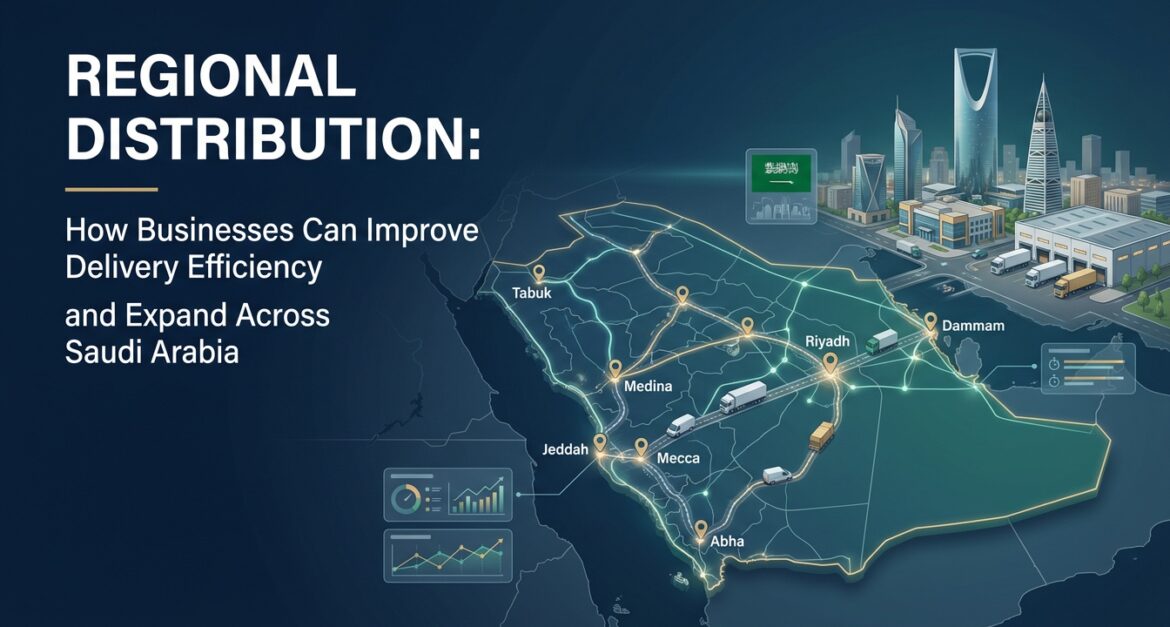
Distribution Networks Across Riyadh, Jeddah, and Dammam
These three cities form the main logistics triangle of the Kingdom:
| Hub | Region served | Why it matters |
| Riyadh | Central region | Capital, large population, major retail and business center, strong road links |
| Jeddah | Western region | Red Sea port gateway, access to Makkah, Madinah, and Taif |
| Dammam | Eastern region | Gulf port, industrial base, access to Khobar, Jubail, and Al Ahsa |
A three-hub setup covers a large share of Saudi consumers and trade flows. From there, businesses can reach secondary markets such as Qassim, Abha, Tabuk, Jazan, and Hail through feeder routes.
Choosing the Right Regional Distribution Centers
When selecting centers, consider:
- Customer location: Where are your orders actually coming from?
- Port and highway access: How quickly can goods enter and leave?
- Facility fit: Does it offer the right storage type, space, and security for your products?
- Compliance readiness: Can it support labeling, packaging, and retailer requirements?
- Costs: Compare rent, labor, and handling fees with delivery savings.
- Flexibility: Can you expand or reduce space as demand changes?
Managing Intercity Transportation and Delivery Schedules
- Set fixed weekly replenishment runs between hubs
- Align departure times with warehouse cutoff times
- Account for summer heat, fuel stops, and driver rest rules on long routes
- Build buffer time for holidays and peak days
- Use tracking to monitor trucks between cities
Supporting Business Expansion into New Markets
Regional distribution lets you grow step by step:
- Start with one hub in the city with your strongest demand.
- Add a second region when orders from there justify it.
- Use a shared or partner facility to test a new area without heavy investment.
- Expand to secondary cities through feeder routes or local partners.
- Review data each quarter to decide where to add capacity
Regional Distribution vs Centralized Distribution
| Factor | Regional Distribution | Centralized Distribution |
| Warehouse setup | Several locations serving defined areas | One main facility serving all customers |
| Delivery speed | Faster for distant customers | Slower the farther the customer is |
| Transport cost | Lower last-mile cost, higher inter-hub cost | Higher long-distance cost per order |
| Inventory | Spread across locations, needs balancing | Concentrated, easier to control |
| Fixed costs | Higher, with multiple facilities | Lower, with one facility |
| Risk | Diversified, so one site issue affects fewer orders | Concentrated, so one disruption affects everything |
| Complexity | Higher, with more coordination needed | Simpler to manage |
| Best for | Multi-city markets, fast delivery expectations, retail replenishment | Small or single-city markets, low volume, slow-moving products |
In plain terms: centralized distribution is simple and cost-efficient at small scale. Regional distribution wins when your customers are spread out and delivery speed matters. Many businesses use a hybrid: a central hub for slow-moving items and regional stock for fast sellers.
Common Regional Distribution Challenges and How to Overcome Them
Managing Transportation Costs Across Long Distances
Challenge: Saudi distances are long, and fuel and driver costs add up.
Fix:
- Consolidate shipments into full truckloads between hubs
- Use route planning to cut empty return trips
- Compare road, rail, and carrier options
- Track cost per kilometer and per delivery
Maintaining Consistent Delivery Times
Challenge: Traffic, weather, and breakdowns cause variation.
Fix:
- Set clear delivery windows by region
- Schedule preventive vehicle maintenance
- Use live tracking to reroute and update customers
- Keep backup carriers for peak periods
Balancing Inventory Across Multiple Locations
Challenge: One hub runs out while another has excess.
Fix:
- Forecast demand by region
- Set minimum and maximum stock levels per location
- Rebalance weekly based on sales data
- Use one shared inventory view across all sites
Handling Seasonal Demand and Order Fluctuations
Challenge: Ramadan, Eid, back-to-school, and sales events create spikes.
Fix:
- Pre-position stock in high-demand regions before peaks
- Arrange flexible labor and storage in advance
- Share promotion calendars with your logistics partner
- Review results after each season to improve the plan
How Technology Improves Regional Distribution Management
Warehouse Management Systems
A warehouse management system (WMS) helps each center:
- Record stock accurately by location and batch
- Direct pickers to the fastest path
- Manage receiving, putaway, and dispatch
- Produce reports on accuracy and productivity
Transportation Management and Route Optimization
Transportation management tools help planners:
- Choose efficient routes and vehicle loads
- Schedule deliveries around customer time windows
- Compare carrier options and costs
- Reduce empty miles and idle time
Real-Time Inventory and Delivery Monitoring
- Dashboards show stock levels across all regions
- Alerts flag low stock or delayed shipments
- Delivery data feeds back into forecasting
- Customers get accurate updates, which reduces support calls
Technology doesn’t replace good planning, but it makes a multi-location network manageable and gives you the data needed to improve it.
How to Choose the Right Regional Distribution Partner in Saudi Arabia
Use this checklist:
- Geographic coverage. Does the provider reach Riyadh, Jeddah, Dammam, and the secondary cities you need?
- Facility quality. Are warehouses secure, organized, and suited to your product type?
- Retail and compliance experience. Can they prepare goods to retailer standards?
- Transport capability. Do they operate or coordinate a reliable fleet for intercity and last-mile delivery?
- Technology. Do they offer a WMS, tracking, and clear reporting?
- Scalability. Can they add space and capacity during peaks or expansion?
- Pricing clarity. Are fees for storage, handling, and transport itemized?
- Service levels. Do they commit to metrics such as on-time delivery and order accuracy?
- Support. Do you have a responsive contact for issues?
Questions to ask before choosing:
- Which regions can you serve directly, and which through partners?
- How do you manage inventory transfers between locations?
- What are your average delivery times from each hub?
- How do you handle peak-season surges?
How Palm Horizon KSA Supports Regional Distribution and Logistics Operations
Palm Horizon KSA helps businesses move goods efficiently across Saudi Arabia by combining warehousing, distribution, and transport support. Instead of managing separate vendors for each step, businesses can work with a partner that connects the pieces.
Companies can look to Palm Horizon KSA for support in areas such as:
- Warehousing and inventory management to keep stock organized and available
- Regional and retail distribution to reach stores, partners, and customers across cities
- Transportation and fleet coordination for intercity and local delivery
- Shipment tracking and visibility so you can see where orders are
- Scalable support for businesses entering new regions or handling seasonal growth
The goal is practical: shorter delivery times, lower distribution costs, and a network that grows as your business does.
Planning to expand into new Saudi cities? Contact Palm Horizon KSA to discuss your products, regions, and delivery goals.
Frequently Asked Questions About Regional Distribution
What Is Regional Distribution in Logistics?
Regional distribution is a logistics approach where inventory is stored in several warehouses or distribution centers, each serving a specific geographic area. Orders ship from the location closest to the customer, which shortens delivery distance and time.
What Are the Main Benefits of Regional Distribution?
The main benefits are faster deliveries, lower transportation costs per order, better stock availability, improved customer satisfaction, and reduced risk because operations aren’t dependent on a single facility.
How Does Regional Distribution Reduce Delivery Times?
By keeping products closer to customers, regional distribution shortens the final trip. A customer in Jeddah, for example, can receive an order from a Jeddah-area warehouse instead of waiting for a shipment from Riyadh.
What Is the Difference Between Regional and Centralized Distribution?
Centralized distribution serves all customers from one main warehouse, which is simple and lower in fixed cost but slower for distant customers. Regional distribution uses multiple locations to serve each area faster, at the cost of more complexity and inventory balancing.
How Can Businesses Improve Regional Distribution Across Saudi Arabia?
Choose warehouse locations near major demand centers and ports, forecast demand by region, plan intercity transport carefully, use warehouse and tracking technology, keep safety stock in each region, and work with a logistics partner that understands local conditions.
Is Regional Distribution Only for Large Companies?
No. Small and mid-sized businesses can start with shared or outsourced regional facilities, so they gain local speed without building their own warehouses in every city.
When Should a Business Switch to Regional Distribution?
Consider it when orders come from several cities, delivery times are hurting sales, freight costs per order keep rising, or retailers ask for more frequent local replenishment.
Conclusion: Bring Your Products Closer to Your Customers
In a country as large as Saudi Arabia, distance is one of the biggest hidden costs in business. The longer products travel, the more they cost, the later they arrive, and the greater the risk that customers choose someone closer.
Regional distribution answers that challenge by placing stock where demand lives. With well-chosen distribution centers, smart route planning, and good technology, businesses can deliver faster, spend less per order, and expand into new cities with confidence. It turns a growing, spread-out market from a logistics headache into a competitive advantage.
If you’re ready to shorten delivery times and expand across the Kingdom, Palm Horizon KSA is ready to help you build a distribution network that grows with you.
Take the next step: Contact Palm Horizon KSA today to discuss your regional distribution needs.