

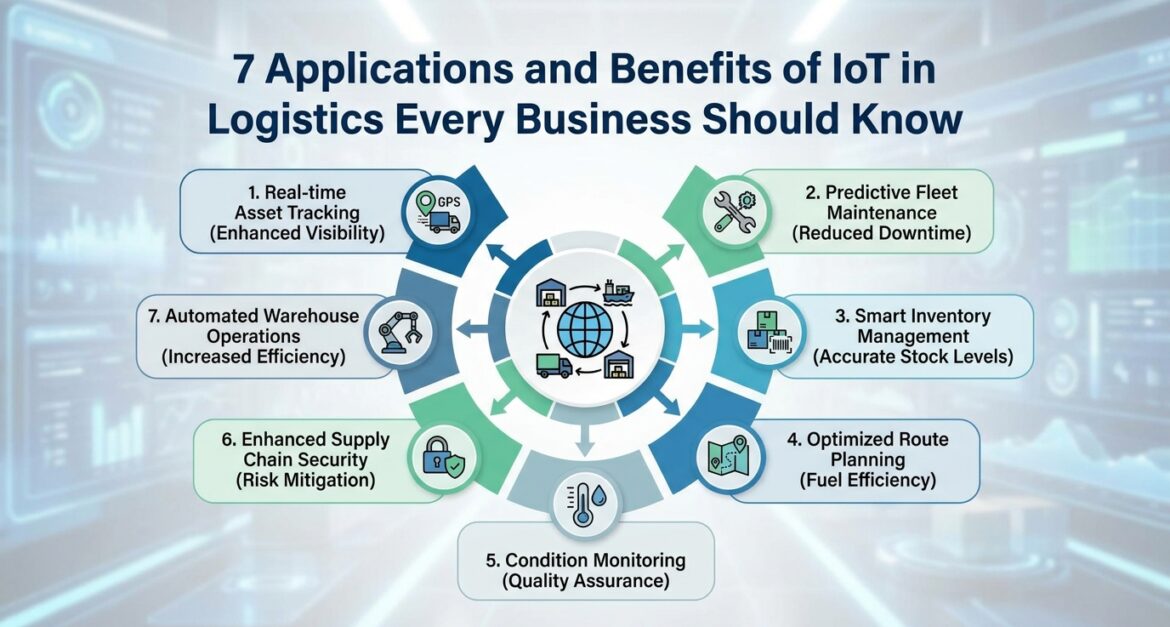
Introduction: The Visibility Problem That’s Costing Logistics Companies Millions
Picture this: a refrigerated truck carrying pharmaceutical shipments crosses three cities, but nobody knows the exact moment the cooling unit failed. By the time the delivery arrives, the cargo is unusable. This isn’t a rare horror story — it’s a daily reality for logistics operators who still rely on manual tracking, guesswork, and delayed reporting.
The logistics industry runs on timing, temperature, location, and trust. Yet most supply chains still operate with blind spots — trucks that “should” arrive on time, warehouses that “should” have accurate stock counts, and shipments that “should” stay within safe temperature ranges. The word “should” is where profits leak and customer trust erodes.
This is exactly the gap that the Internet of Things (IoT) was built to close. And that’s why understanding the benefits of IoT in logistics has become a business priority rather than a technical curiosity — especially for companies competing in fast-growing logistics hubs like Saudi Arabia, where Palm Horizon KSA is helping businesses modernize freight, warehousing, and last-mile delivery through connected technology.
In this guide, we’ll break down what IoT in logistics actually means, its core attributes, and the 7 applications and benefits of IoT in logistics every business — from retail to pharmaceuticals to manufacturing — should understand before investing in it.
What Is IoT in Logistics and Supply Chain?
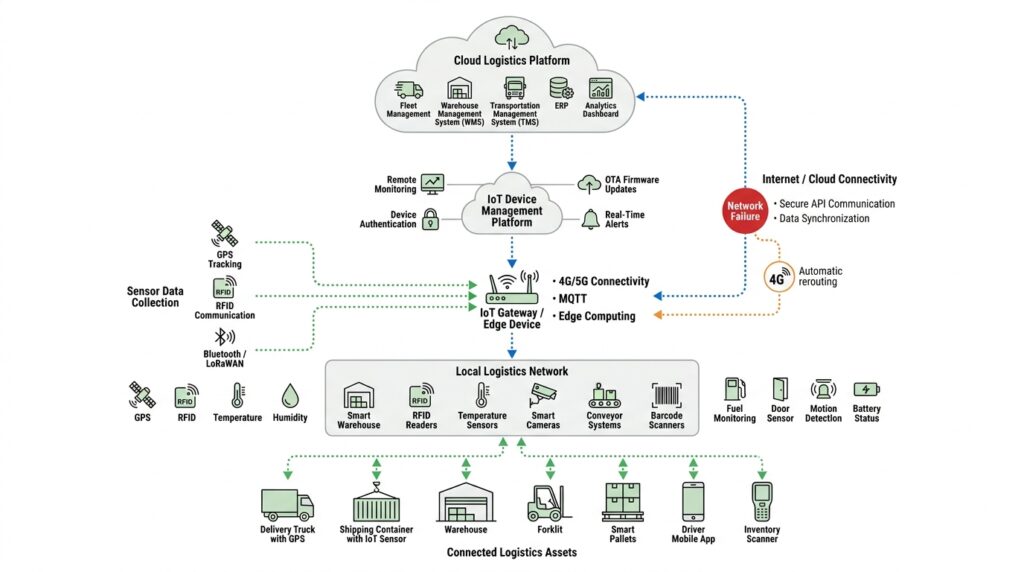
IoT in logistics and supply chain refers to a network of connected sensors, GPS devices, RFID tags, and smart software that collect and transmit real-time data across every stage of the supply chain — from the warehouse shelf to the customer’s doorstep.
Instead of relying on manual check-ins or end-of-day reports, IoT devices continuously report:
- Location of vehicles and shipments
- Temperature and humidity inside containers
- Fuel levels and engine health
- Warehouse stock levels
- Delivery timelines and route conditions
In simple terms, IoT gives logistics companies eyes and ears across their entire operation — something that was physically impossible just a decade ago.
Fun fact: The term “Internet of Things” was coined in 1999 by British technologist Kevin Ashton — nearly two decades before most logistics companies even considered using sensors on delivery trucks.
Core Attributes and Features of IoT in Transport and Logistics
Before diving into applications, it helps to understand what actually makes IoT in transport and logistics different from traditional tracking systems:
- Real-time data streaming – Information updates every few seconds, not once a day
- Sensor-based automation – Devices act on data without waiting for human input
- Cloud connectivity – Data is accessible from anywhere, on any device
- Predictive analytics – Systems forecast problems (like delays or equipment failure) before they happen
- Interoperability – IoT devices integrate with existing fleet management, ERP, and warehouse systems
- Scalability – Small businesses can start with a few sensors; enterprises can scale to thousands of connected assets
These attributes are what separate modern IoT applications in logistics from outdated GPS-only tracking systems.
7 Applications and Benefits of IoT in Logistics
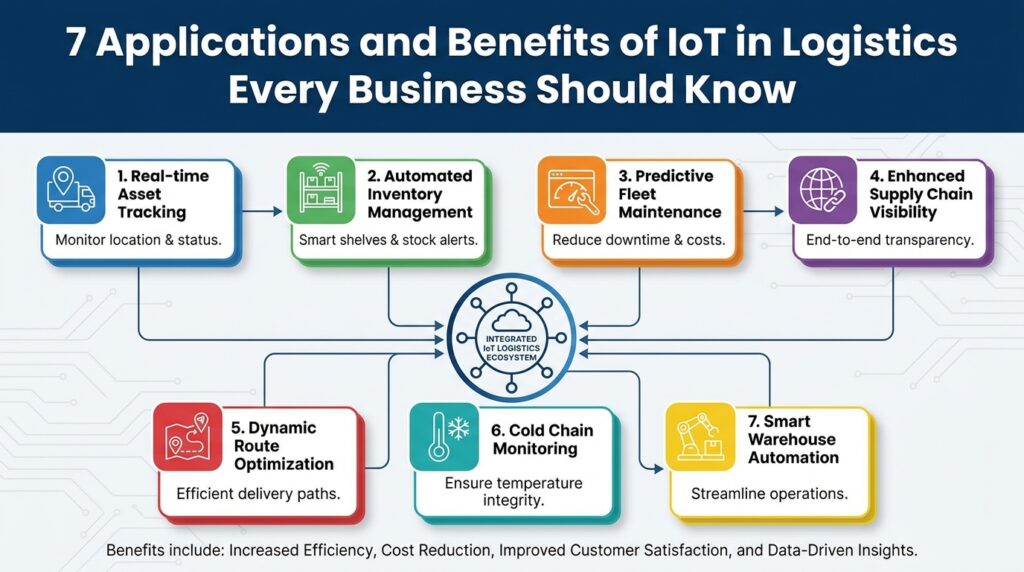
Here are the seven most impactful IoT use cases in logistics that businesses are adopting right now.
1. Real-Time Fleet Tracking and Route Visibility
GPS-enabled IoT sensors allow logistics managers to see the exact location of every vehicle at any moment. This isn’t just about “where is the truck” — modern systems also track driving behavior, idle time, and estimated arrival windows.
Business benefit: Fewer delayed shipments, better customer communication, and reduced fuel waste from inefficient routing.
2. Smart Warehousing and Automated Inventory Management
IoT-enabled shelves, RFID tags, and smart scanners automatically update inventory counts the moment a product moves. This is one of the most requested applications of IoT in logistics because it eliminates manual stock audits.
Business benefit: Reduced human error, faster order fulfillment, and real-time visibility into stock shortages or overstocking.
3. Predictive Maintenance for Vehicles and Equipment
Sensors installed on trucks, forklifts, and conveyor systems monitor engine temperature, tire pressure, and mechanical wear. Instead of waiting for a breakdown, the system alerts maintenance teams in advance.
Business benefit: Fewer unexpected vehicle failures, lower repair costs, and longer equipment lifespan.
Fun fact: Predictive maintenance powered by IoT can reduce unplanned vehicle downtime by up to 50%, according to multiple industry fleet studies.
4. Cold Chain Monitoring for Perishable and Sensitive Goods
For industries like food, pharmaceuticals, and chemicals, temperature-sensitive IoT sensors continuously track humidity and temperature inside containers. This is a core reason businesses search for IoT in shipping and logistics solutions.
Business benefit: Reduced spoilage, regulatory compliance, and protection of high-value perishable shipments.
5. Smart Asset and Container Tracking
Beyond vehicles, IoT tags can be attached to pallets, containers, and individual high-value packages, allowing businesses to track assets across multiple carriers and borders.
Business benefit: Reduced lost shipments, better accountability across third-party logistics partners, and improved customer trust.
6. AI-Powered Route and Fuel Optimization
By combining IoT sensor data with AI algorithms, logistics companies can identify the most fuel-efficient and time-efficient routes based on live traffic, weather, and vehicle load data.
Business benefit: Lower fuel costs, reduced carbon footprint, and faster average delivery times — a growing priority as sustainability regulations tighten across global trade routes.
7. Enhanced Security and Theft Prevention
IoT-enabled locks, motion sensors, and geofencing alerts notify logistics teams immediately if a container is opened unexpectedly or a vehicle deviates from its assigned route.
Business benefit: Reduced cargo theft, faster incident response, and stronger insurance compliance.
Industries That Benefit Most From IoT in Logistics
The application of IoT in logistics isn’t limited to one sector. Businesses across multiple industries are adopting it, including:
- Retail and E-commerce – real-time delivery tracking and inventory sync
- Pharmaceuticals and Healthcare – cold chain compliance
- Food and Beverage – spoilage prevention
- Manufacturing – raw material and equipment tracking
- Oil, Gas, and Energy – asset monitoring across long-haul transport
- Retail Distribution Centers – automated warehousing
The Growing IoT in Logistics Market
The IoT in the logistics market has moved from early adoption to mainstream necessity. Below is a simplified growth snapshot based on widely reported industry trends:
| Year | IoT Adoption in Logistics (Estimated) | Key Driver |
| 2020 | Early adoption phase | Fleet GPS tracking |
| 2022 | Mid-stage growth | Warehouse automation |
| 2024 | Rapid expansion | Predictive maintenance & cold chain tech |
| 2026 | Mainstream integration | AI + IoT convergence, smart ports |
How Palm Horizon KSA Approaches IoT-Driven Logistics
While many logistics providers offer basic GPS tracking, Palm Horizon KSA focuses on building fully connected logistics ecosystems — integrating fleet sensors, warehouse automation, and cold chain monitoring into a single operational dashboard.
Compared to traditional logistics providers that treat tracking as an add-on service, Palm Horizon KSA positions IoT as a core operational layer, not an afterthought — giving businesses in Saudi Arabia’s expanding trade and e-commerce sector a genuine competitive advantage as the Kingdom accelerates digital transformation under Vision 2030.
How Businesses Can Implement IoT in Their Logistics Operations
A simplified implementation roadmap typically looks like this:
- Assess current pain points – delays, spoilage, theft, or inventory errors
- Choose relevant sensors – GPS, temperature, RFID, or motion-based, depending on the goal
- Integrate with existing systems – ERP, WMS, or fleet management software
- Pilot on a small fleet or warehouse zone before full-scale rollout
- Train staff on dashboards and alert systems
- Scale gradually based on measurable ROI
Businesses don’t need to overhaul their entire supply chain overnight — most successful IoT rollouts start small and expand once value is proven.
Frequently Asked Questions
1. What are the main benefits of IoT in logistics?
The core benefits include real-time shipment tracking, reduced spoilage through cold chain monitoring, predictive maintenance that prevents vehicle breakdowns, and improved inventory accuracy across warehouses.
2. How is IoT used in transportation and logistics specifically?
In transportation, IoT is used for GPS fleet tracking, fuel monitoring, route optimization, and driver behavior analysis to reduce delays and operating costs.
3. Is IoT only useful for large logistics companies?
No. Small and mid-sized logistics businesses can start with a limited number of sensors on a few vehicles or warehouse zones and scale up as they see measurable returns.
4. What industries benefit the most from IoT in shipping and logistics?
Pharmaceuticals, food and beverage, e-commerce, and manufacturing benefit the most due to their reliance on time-sensitive and temperature-sensitive shipments.
5. How does IoT reduce cargo theft in logistics?
IoT-enabled locks, geofencing alerts, and motion sensors immediately notify logistics teams of unauthorized container access or unexpected route deviations, allowing faster response times.
6. What’s the difference between traditional GPS tracking and IoT logistics systems?
Traditional GPS only shows location. IoT systems combine location data with temperature, motion, fuel, and predictive analytics — offering a complete operational picture rather than a single data point.
Final Thoughts: Why IoT Is No Longer Optional in Logistics
The logistics industry is shifting from reactive problem-solving to proactive, data-driven decision-making — and IoT is the technology making that shift possible. From real-time fleet visibility to predictive maintenance and cold chain compliance, the benefits of IoT in logistics directly translate into fewer losses, faster deliveries, and stronger customer trust.
Businesses that delay adoption risk operating blind in an industry where visibility is now the competitive advantage. With connected, intelligent logistics solutions, companies like Palm Horizon KSA are helping businesses across Saudi Arabia move from guesswork to precision — one connected shipment at a time.
If your business is still tracking shipments manually, now is the time to explore how IoT can transform your logistics operations from reactive to predictive, and from costly to efficient.