

Introduction: The Hidden Cost of Slow Warehousing
Every fast-moving supply chain has one enemy in common: storage time. The longer inventory sits in a warehouse, the more it costs — in rent, labor, handling, and lost sales opportunity. For businesses moving perishable goods, retail restocks, or e-commerce orders, this delay can be the difference between winning a customer and losing one to a faster competitor.
This is exactly the problem that cross docking was built to solve.
At Palm Horizon KSA, we work with distributors, retailers, and manufacturers across Saudi Arabia who are under constant pressure to move goods faster without inflating warehousing costs. Many of them ask the same starting question: what is a cross dock, and how is it different from traditional storage? This article answers that question in full — and shows exactly why cross-docking has become one of the most effective strategies inside modern freight rate management and supply chain optimization.
What Is Cross Docking? (The Core Definition)
Cross docking is a logistics practice where incoming goods from a supplier or manufacturer are unloaded at a cross dock warehouse and immediately sorted, consolidated, and reloaded onto outbound trucks — with little to no long-term storage in between.
Instead of goods sitting on shelves waiting for the next order cycle, products move directly from the receiving dock to the shipping dock, often within hours.
What Is a Cross Dock, Practically Speaking?
A cross dock is a specialized facility — often shaped like a “T” or “I” — with:
- Receiving doors on one side
- Shipping doors on the opposite or adjacent side
- Minimal (or zero) racking/storage space
- A sorting and staging area in the middle
Unlike a traditional distribution center, a cross dock warehouse is designed for flow, not for storage.
Core Attributes and Features of a Cross Dock Warehouse
Understanding what is cross docking at an operational level means understanding its defining features:
- Minimal dwell time — goods typically stay less than 24 hours, sometimes less than 2 hours
- Dock-to-dock design — facility layout optimized for direct transfer, not shelving
- Real-time sorting systems — barcode/RFID scanning to route goods to the correct outbound truck
- High door density — more loading bays per square foot than a standard warehouse
- Integration with freight rate management systems — to match consolidated loads with the most cost-efficient carriers
- 24/7 cross dock operations — many high-volume facilities run around the clock to match retail and e-commerce demand cycles
- Consolidation and deconsolidation capability — combining smaller shipments into full truckloads (or breaking bulk shipments into smaller regional deliveries)
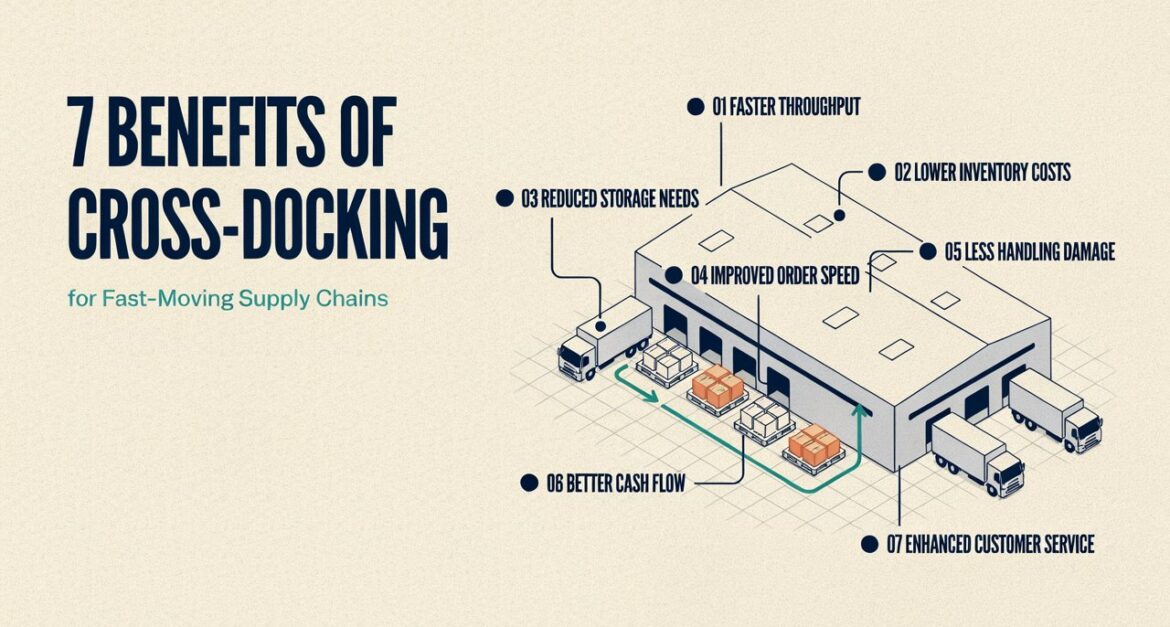
7 Benefits of Cross-Docking for Fast-Moving Supply Chains
1. Drastically Reduced Storage Costs
Since goods aren’t held in long-term storage, businesses eliminate the need for large racking systems, extended warehouse leases, and excess labor for put-away and picking.
2. Faster Order Fulfillment Cycles
Cross docking shortens the time between “goods arrive” and “goods delivered,” which is critical for retailers and FMCG brands competing on speed.
3. Lower Handling and Labor Expenses
Fewer touches on each product means fewer forklift trips, less manual handling, and lower risk of damage — directly reducing operational cost per unit.
4. Improved Freight Rate Management
By consolidating multiple smaller shipments into full truckloads at a cross dock, companies gain stronger negotiating leverage with carriers — a core advantage inside modern freight rate management strategy.
5. Reduced Inventory Holding Risk
Less stationary inventory means less exposure to spoilage (for perishables), obsolescence (for seasonal goods), and shrinkage.
6. Better Support for Just-In-Time (JIT) Models
Cross docking naturally supports JIT manufacturing and retail replenishment, since goods move in sync with real demand rather than static forecasts.
7. Scalability for Peak and 24/7 Operations
A well-run 24/7 cross dock can absorb demand spikes (holiday seasons, promotional events) without requiring additional storage infrastructure.
A Simple Look at the Impact (Cross Dock vs. Traditional Warehouse)
| Metric | Traditional Warehouse | Cross Dock Warehouse |
| Average dwell time | 5–10+ days | Under 24 hours |
| Storage footprint needed | High | Minimal |
| Labor cost per unit | Higher (multiple touches) | Lower (1–2 touches) |
| Freight consolidation potential | Limited | High |
| Best fit for | Long-term stock, bulk storage | Fast-moving, perishable, JIT goods |
Fun fact: Retail giants like Walmart pioneered large-scale cross docking decades ago, and it’s credited as one of the operational strategies that helped the company keep prices consistently lower than competitors — because savings in freight and storage get passed down the chain.
Cross Docking in Supply Chain: Industries and Real-World Use Cases
Cross docking in supply chain operations is especially valuable across:
- Retail and grocery — fast replenishment of perishable and high-turnover SKUs
- E-commerce and last-mile delivery — sorting parcels by region for same-day or next-day delivery
- Automotive parts distribution — just-in-time part delivery to assembly lines
- Pharmaceuticals — reducing dwell time for temperature-sensitive shipments
- FMCG (Fast-Moving Consumer Goods) — matching supply with rapid sell-through cycles
- Import/export and freight forwarding — consolidating international freight for regional distribution, especially relevant in port-heavy regions like the Gulf
Fun fact: Some 24/7 cross dock facilities near major ports can process and re-route thousands of pallets in a single day — turning what used to be a multi-day storage-and-ship process into a same-day operation.
Cross Docking vs. Traditional Distribution: How Do They Compare?
| Factor | Cross Docking | Traditional Distribution Center |
| Speed to market | Very fast | Slower |
| Storage dependency | Low | High |
| Best for | High-velocity, predictable-demand goods | Slow-moving, bulk, or safety-stock items |
| Freight cost efficiency | High (via consolidation) | Moderate |
| Flexibility for demand spikes | High (with 24/7 operations) | Moderate to low |
Cross docking isn’t a replacement for all warehousing — it’s a complementary strategy. Many modern supply chains use a hybrid model: cross docking for fast movers, traditional storage for buffer stock.
Implementation Overview: How Businesses Adopt Cross Docking
For companies exploring what is cross docking as a potential upgrade to their logistics network, implementation typically follows these steps:
- Demand and SKU analysis — Identify which products are fast-moving enough to benefit from cross docking versus which need buffer storage
- Facility or partner selection — Choose or build a cross dock warehouse with the right door capacity and location relative to suppliers and customers
- Technology integration — Implement WMS/TMS systems with real-time tracking, barcode scanning, and freight rate management tools for carrier optimization
- Carrier and route coordination — Align inbound and outbound schedules so trucks arrive and depart in tight, predictable windows
- Staff training and SOPs — Train teams for speed-focused sorting rather than long-term storage handling
- Continuous performance monitoring — Track dwell time, dock utilization, and freight cost savings to refine the model over time
Palm Horizon KSA supports businesses through each of these stages — from facility assessment to freight rate management integration — ensuring cross docking is implemented in a way that fits the specific rhythm of each supply chain.
Frequently Asked Questions (FAQ)
1. What is a cross dock, in simple terms?
A cross dock is a warehouse facility designed for goods to move directly from inbound trucks to outbound trucks with little or no storage time in between.
2. What is cross docking used for?
Cross docking is used to speed up distribution, lower storage costs, and improve freight efficiency — especially for fast-moving, perishable, or high-demand goods.
3. How does cross docking help with freight rate management?
By consolidating multiple smaller shipments into full truckloads at a cross dock, businesses can negotiate better freight rates and reduce cost-per-unit shipping expenses.
4. Is a 24/7 cross dock necessary for every business?
Not necessarily. A 24/7 cross dock is most beneficial for businesses with high shipment volume, tight delivery windows, or seasonal demand spikes — such as e-commerce and grocery retail.
5. What industries benefit most from cross docking in supply chain operations?
Retail, e-commerce, pharmaceuticals, automotive, and FMCG industries benefit the most, due to their reliance on speed and inventory turnover.
6. Does cross docking eliminate the need for warehousing entirely?
No. Most supply chains use a hybrid approach — cross docking for fast-moving goods and traditional warehousing for buffer or seasonal stock.
Final Thoughts: Why Cross Docking Is No Longer Optional for Fast-Moving Supply Chains
As customer expectations shift toward faster delivery and lower prices, businesses can no longer afford the inefficiencies of traditional, storage-heavy warehousing for every product line. Cross docking offers a proven path to reduce costs, speed up fulfillment, and strengthen freight rate management — all while keeping inventory risk low.
Whether you’re managing perishable goods, retail replenishment, or high-volume e-commerce orders, a well-designed cross dock warehouse — potentially running as a 24/7 cross dock — can be the operational upgrade that keeps your supply chain ahead of the competition.
Palm Horizon KSA helps businesses across Saudi Arabia design, implement, and optimize cross docking strategies tailored to their specific freight, storage, and delivery needs. If your supply chain is ready to move faster, the shift starts with rethinking how — and how long — your goods sit still.