
Introduction: The Hidden Cost of Shipping Small
Every importer eventually hits the same wall. You order from three suppliers, none of the shipments fill a container on their own, and suddenly you’re paying full freight rates for half-empty space. Multiply that across a month of purchasing, and small, uncoordinated shipments quietly become one of the biggest line items on a logistics budget.
This is the exact problem freight consolidation was built to solve. Instead of every shipment traveling alone — with its own paperwork, its own handling fees, and its own wasted cargo space — freight consolidation groups compatible shipments together so businesses pay for space they actually use.
For companies in Saudi Arabia sourcing from multiple suppliers across Asia, Europe, or within the GCC, this isn’t a minor efficiency tweak. It’s often the difference between a shipping strategy that scales profitably and one that erodes margins one small shipment at a time.
This guide breaks down what freight consolidation actually is, how it works, when it makes sense, and the seven concrete benefits businesses gain when they consolidate shipments the right way — with real operational detail, not just theory.
Fun fact: The global LCL (Less-than-Container-Load) consolidation market exists largely because ocean carriers charge based on space reserved, not space used. A shipment that fills only 30% of a container often still gets billed close to a much larger portion of the full container rate — which is exactly the inefficiency consolidation eliminates.
What Is Freight Consolidation?
Freight consolidation is the process of combining multiple smaller shipments — often from different shippers, suppliers, or purchase orders — into a single, larger shipment for transportation.
Instead of five separate shipments each traveling under-capacity, those five loads are grouped together, moved as one coordinated shipment to a shared destination or region, and then separated again for final delivery.
Key elements of freight consolidation:
- Combining multiple smaller shipments into one larger, shared shipment
- Using available cargo space more efficiently
- Coordinating pickup, transit, and delivery for grouped shipments
- Splitting the consolidated load back into individual shipments near the final destination (deconsolidation)
Consolidated vs. individual freight shipments:
| Individual Shipment | Consolidated Shipment |
| Travels alone, regardless of size | Grouped with compatible cargo |
| Pays for full or near-full space allocation | Shares space and cost with other shipments |
| Simpler routing, but often costlier per unit | Requires coordination, but lowers per-unit cost |
| Handled separately at every stage | Handled together until final deconsolidation |
When does freight consolidation make sense? Generally, when a shipment doesn’t require a full container or full truckload on its own, when a business is sourcing from multiple suppliers, or when cost efficiency matters more than direct, single-shipment simplicity.
What Is Consolidated Freight?
Consolidated freight refers to cargo that has been physically grouped together from different orders, suppliers, or shippers so it can move as a single transportation unit.
Rather than describing the process (that’s freight consolidation), “consolidated freight” describes the cargo itself once it has been combined.
How consolidated freight typically comes together:
- Shipments from different suppliers are collected at a central point
- Compatible cargo (by size, destination, and handling requirements) is grouped
- The combined cargo is loaded and transported as one unit
- Transportation efficiency improves because space is used more fully
Common types of consolidated freight include grouped ocean containers (LCL), combined air freight pallets, multi-supplier road freight, and rail-based consolidated loads — each suited to different shipment sizes, timelines, and budgets.
What Is a Freight Consolidator?
A freight consolidator is a company or service provider that manages the process of combining shipments from multiple sources into a single, coordinated movement.
The role of a freight consolidator typically includes:
- Collecting shipments from different suppliers or origin points
- Combining cargo into a single, space-efficient load
- Coordinating transportation across the relevant leg — ocean, air, road, or rail
- Managing documentation, including bills of lading, customs paperwork, and shipment manifests
- Arranging deconsolidation once the shipment reaches its destination hub
- Coordinating final delivery to each individual recipient or business
In practice, a freight consolidator acts as the coordination layer between multiple suppliers and a business’s final delivery point — reducing the operational burden on the importer while improving cost efficiency.
How Do Freight Consolidators Work?
Freight consolidators follow a structured, repeatable process to keep multiple shipments organized and compliant from origin to final delivery.
The typical freight consolidation process:
- Cargo is collected from different shippers or suppliers at agreed pickup points.
- Shipments are inspected and documented, confirming quantities, condition, and paperwork accuracy.
- Compatible cargo is grouped together based on destination, size, and handling needs.
- The consolidated shipment is transported via the chosen mode — ocean, air, road, or rail.
- Cargo reaches the destination hub, where it’s received and prepared for separation.
- Shipments are separated and delivered to their final destinations individually.
Fun fact: Deconsolidation hubs — the facilities where combined shipments are split back apart — are sometimes called “cross-dock” facilities, because cargo is moved directly from an inbound consolidated load to outbound individual deliveries with minimal storage time in between.
How to Ship Consolidated Freight
For businesses new to consolidation, the process can feel unfamiliar at first. Here’s a practical, step-by-step approach.
- Identify shipments suitable for consolidation — smaller loads that don’t justify a full container or truckload on their own.
- Compare shipment sizes, destinations, and delivery requirements to see which shipments are genuinely compatible.
- Choose a reliable freight consolidator with experience in your trade lanes and cargo type.
- Prepare accurate shipment documentation — inaccurate paperwork is one of the most common causes of consolidation delays.
- Deliver cargo to the consolidation facility on the agreed schedule.
- Combine compatible shipments under the consolidator’s coordination.
- Track the consolidated shipment until it reaches final delivery, using the tracking tools your consolidator provides.
Getting each of these steps right — especially documentation accuracy and consolidator selection — has a direct impact on how smoothly the shipment moves and how much it ultimately costs.
How to Consolidate Freight From Asian Suppliers
Asia remains one of the most common sourcing regions for businesses in Saudi Arabia and across the GCC, which makes freight consolidation especially relevant for import-heavy operations.
Key considerations when consolidating freight from Asian suppliers:
- Coordinating multiple Asian suppliers so their shipments arrive at a consolidation point within a compatible timeframe
- Choosing a consolidation warehouse located near major export hubs (commonly in China, Vietnam, India, or other manufacturing centers)
- Setting clear supplier shipping instructions, including labeling, packaging standards, and delivery windows
- Combining LCL or smaller shipments into a single ocean or air freight movement
- Checking packaging and documentation carefully before consolidation, since errors are harder to correct once cargo is combined
- Selecting the right ocean or air freight option based on budget and delivery timeline
- Arranging customs clearance and final delivery into Saudi Arabia, factoring in local import regulations
Because multiple suppliers are involved, communication and scheduling discipline matter more here than in single-supplier consolidation — a delay from one supplier can hold up the entire consolidated shipment.
What Are Consolidated Freight Shipping Options?
Not all consolidated freight moves the same way. The right option depends on shipment size, budget, and how quickly the cargo needs to arrive.
- LCL Ocean Freight — Best for smaller, non-urgent shipments where cost efficiency matters more than speed. Widely used for consolidating goods from overseas suppliers.
- Consolidated Air Freight — Suited to time-sensitive or higher-value goods where faster transit justifies a higher cost per unit than ocean freight.
- Road Freight Consolidation — Common for regional and domestic distribution, combining multiple smaller loads onto shared trucking routes.
- Rail Freight Consolidation — Useful for certain long-distance overland routes, particularly where rail infrastructure supports cost-effective bulk movement.
- Multimodal Transportation — Combines two or more of the above (for example, ocean plus road) to balance cost and delivery timelines across a full shipping route.
Choosing between these options usually comes down to a trade-off: ocean and rail consolidation tend to favor cost efficiency, while air consolidation favors speed.
What Are Freight Consolidation Services?
Freight consolidation services refer to the full range of support a logistics provider offers to manage consolidated shipments from origin to final delivery — going beyond just combining cargo.
A complete freight consolidation service typically includes:
- Supplier coordination across multiple origin points
- Cargo collection from various suppliers or shippers
- Warehousing at consolidation points
- Cargo inspection for accuracy and condition
- Shipment consolidation into a single coordinated load
- Documentation management, including customs paperwork
- Customs support for smoother clearance
- Freight transportation across the chosen shipping mode
- Shipment tracking throughout transit
- Final-mile delivery to the end recipient
At Palm Horizon KSA, this is the core of how consolidated freight is managed for businesses importing into Saudi Arabia — handling the coordination work so businesses can focus on their operations rather than shipment logistics.
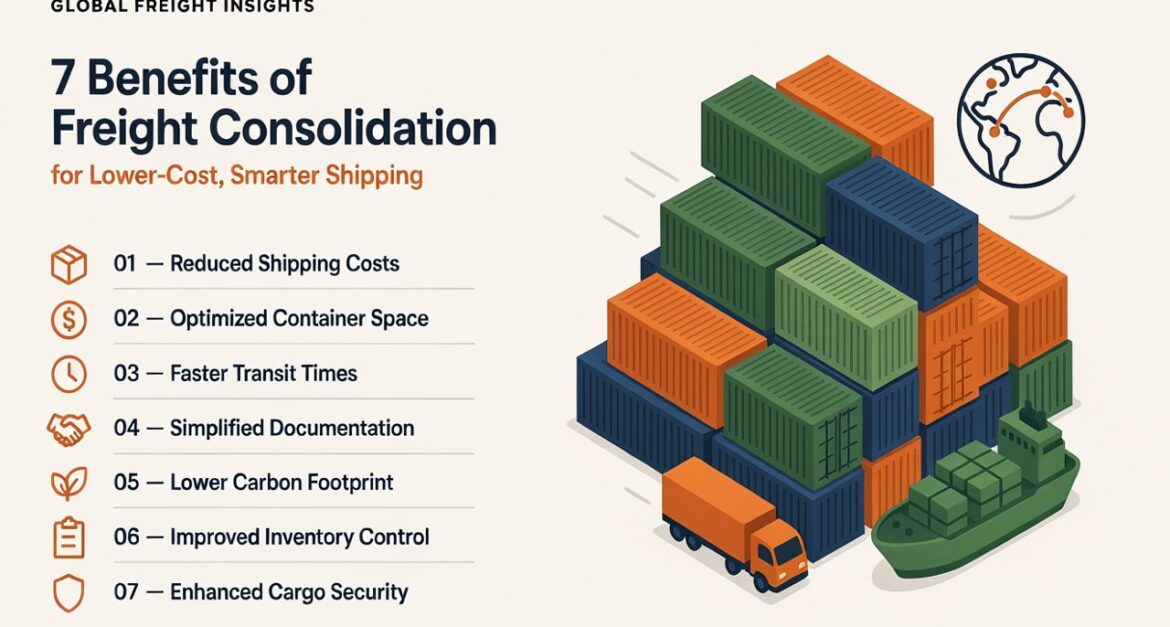
7 Benefits of Freight Consolidation
Here’s where the real value of consolidation shows up in day-to-day business operations.
1. Lower Shipping Costs
By combining smaller shipments, businesses share transportation costs across multiple loads instead of each shipment absorbing a full or near-full freight rate on its own. This can meaningfully reduce the effective cost per unit shipped.
2. Better Container Utilization
Consolidation makes use of available cargo space that would otherwise travel empty. This means more goods move per container or vehicle, improving the overall efficiency of every shipment.
3. Fewer Shipments to Manage
Instead of tracking and coordinating many separate shipments, businesses deal with fewer, larger, better-organized movements — reducing administrative overhead.
4. Improved Supply Chain Efficiency
Coordinating multiple shipments through a single, organized consolidation process creates more predictable transit patterns, which supports smoother planning across the wider supply chain.
5. Better Inventory Planning
When supplier shipments are coordinated around consolidation schedules, businesses gain clearer visibility into when goods will arrive — supporting more accurate inventory and restocking decisions.
6. Simplified Freight Management
Fewer transportation movements mean fewer documentation processes, fewer points of contact, and a simpler overall freight management workload.
7. Greater Shipment Visibility
Centralized tracking of a consolidated shipment is often easier to monitor than tracking several unrelated shipments separately, giving businesses a clearer real-time view of where their cargo is.
Fun fact: Some estimates suggest that fully loaded containers can be up to 40% more cost-efficient per unit shipped compared to multiple partially filled containers covering the same total cargo volume — which is essentially the mathematical foundation behind why consolidation saves money.
When Should Businesses Use Freight Consolidation?
Freight consolidation isn’t the right fit for every shipment, but it tends to make strong sense for businesses that:
- Have multiple small shipments moving regularly
- Buy from several suppliers rather than a single source
- Import on a recurring, ongoing basis
- Source products from Asia or other overseas manufacturing regions
- Want to reduce transportation costs without cutting order volume
- Do not need full-container capacity for each individual order
- Need better control and visibility over inbound freight
If most of these apply to your business, consolidation is likely worth evaluating as a standing part of your shipping strategy — not just a one-time cost-saving measure.
Freight Consolidation vs. Full Truckload or Full Container Shipping
| Freight Consolidation | Full Load Shipping |
| Combines multiple shipments | One shipper generally uses the full load |
| Suitable for smaller shipments | Better for larger shipments |
| Can reduce costs for partial loads | Can provide faster, more direct movement |
| Requires coordination | Simpler shipment structure |
| Cargo may be handled at consolidation points | Fewer handling points |
Neither approach is universally “better” — the right choice depends on shipment volume. Businesses with consistently large, single-source shipments often benefit more from full truckload or full container shipping, while businesses with smaller, multi-supplier shipments generally see more value from consolidation.
How to Choose the Right Freight Consolidation Services
Not all freight consolidators offer the same level of coordination or reliability. When evaluating providers, consider:
- Geographic coverage — Does the provider operate in the regions you source from and ship to?
- Carrier network — How established are their relationships with ocean, air, road, and rail carriers?
- Consolidation facilities — Are their warehousing and consolidation points well-located and well-equipped?
- Transit times — Can they provide realistic, consistent timelines?
- Pricing — Is their pricing structure transparent and predictable?
- Tracking technology — Do they offer real-time visibility into shipment status?
- Customs expertise — Can they handle the customs requirements of your specific trade lanes?
- Cargo handling capabilities — Are they equipped to handle your specific cargo type safely?
- Supplier coordination — Can they manage communication across multiple suppliers effectively?
- Final delivery options — Do they offer flexible last-mile delivery into your specific location?
Palm Horizon KSA is built around exactly these criteria — combining regional expertise in Saudi Arabia’s import landscape with the carrier relationships, warehousing, and customs know-how needed to make consolidation genuinely cost-effective rather than just theoretically cheaper.
Frequently Asked Questions
What is freight consolidation in simple terms?
Freight consolidation is combining multiple smaller shipments into one larger shipment so businesses can share transportation costs and use cargo space more efficiently.
Is freight consolidation cheaper than shipping individually?
For smaller shipments that don’t fill a full container or truckload, consolidation is generally more cost-effective than shipping each load separately, since costs and space are shared across multiple shipments.
How long does consolidated freight take to arrive?
Transit time depends on the shipping mode chosen (ocean, air, road, or rail) and how the consolidation schedule aligns with supplier readiness — ocean consolidation is typically slower but more economical, while air consolidation is faster but costs more.
What is the difference between a freight consolidator and a freight forwarder?
A freight forwarder typically arranges transportation for a shipment, while a freight consolidator specifically focuses on combining multiple shipments together to improve space utilization and cost efficiency — many providers, including Palm Horizon KSA, offer both functions together.
Can freight consolidation work with multiple suppliers in different countries?
Yes — this is one of the most common uses of freight consolidation, particularly for businesses sourcing from several suppliers across Asia or other regions, where shipments are coordinated to a shared consolidation point before being combined.
Is freight consolidation suitable for small businesses?
Yes. Freight consolidation can be especially valuable for small and mid-sized businesses that don’t have the shipment volume to justify full containers or truckloads on their own.
Conclusion: Smarter Shipping Starts With Smarter Coordination
Freight consolidation isn’t a complicated concept, but its impact on shipping costs and supply chain efficiency is significant when it’s managed well. By combining smaller shipments, using cargo space more fully, and coordinating documentation and delivery under one process, businesses gain lower costs, fewer moving parts, and clearer visibility into their inbound freight.
For businesses in Saudi Arabia importing from multiple suppliers — especially across Asia — the question isn’t really whether consolidation can help, but who manages it well enough to make that value real.
That’s the role Palm Horizon KSA plays: coordinating supplier pickups, managing documentation, handling customs, and delivering consolidated shipments smoothly from origin to final destination — so businesses spend less time managing freight and more time growing their operations.
Ready to lower your shipping costs through smarter consolidation? Talk to Palm Horizon KSA about your next shipment.