
Introduction
An online shopper in Riyadh orders a product from a seller overseas. The checkout page promises delivery in two weeks. Behind that promise sit a dozen moving parts: a supplier, an export declaration, a freight booking, a customs review, a warehouse, a local courier and a customer who wants updates at every step.
If one piece slips, such as a missing invoice, a wrong product description or a held container, the whole promise slips with it. The customer doesn’t see the cause. They see a late parcel.
This is the everyday challenge of cross border logistics. Moving goods across borders involves different regulations, documents, carriers, currencies and delivery conditions in every country. Businesses that plan for these differences ship faster and with fewer surprises. Businesses that don’t tend to learn about them through delays and unexpected costs.
This guide explains what cross border logistics is, what cross border logistics services include, seven strategies for improving them, how cross border e-commerce logistics differs, common challenges and fixes, how to choose among cross border logistics companies, and what Saudi businesses should consider. It also shows how coordination support, including from Palm Horizon KSA, fits into the picture.
What Is Cross Border Logistics?
Cross border logistics is the planning, movement, documentation and coordination of goods as they travel from a sender in one country to a receiver in another. It covers transport by air, sea, road or rail, plus the customs, paperwork, storage and delivery steps that make the journey possible.
It differs from domestic logistics in one important way: every border adds requirements. Goods must be declared, classified, valued, checked against local rules and cleared before they can continue.
In short: cross border logistics = international transport + customs + documents + local delivery, coordinated as one flow.
Why Cross Border Logistics Matters
- It protects delivery promises. Shippers and shoppers expect reliable dates, even on international orders.
- It controls cost. Duties, freight rates, handling fees and storage charges all add up, and poor planning makes them grow.
- It supports compliance. Accurate declarations and documents help goods meet import and export rules.
- It enables growth. Businesses that can ship across borders reliably can reach new customers and suppliers.
- It builds trust. Clear tracking and predictable delivery make international buyers more likely to return.
What Do Cross Border Logistics Services Include?
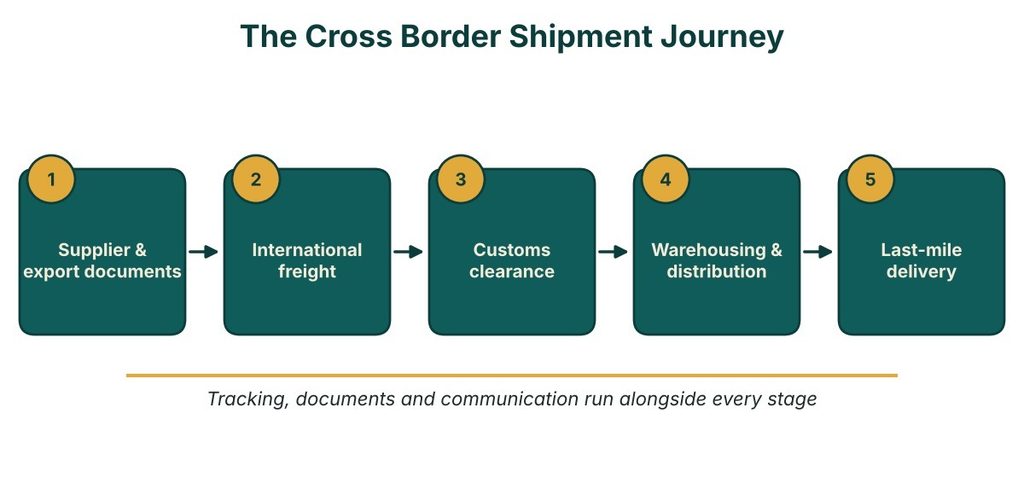
Cross border logistics services are the connected activities that move a shipment from origin to destination. Depending on the provider and the shipment, they typically include six areas. Always confirm the exact scope before booking, because providers differ in what they perform directly and what they coordinate through partners.
International Freight Transportation
Moving cargo by air, sea, road or rail between countries. The mode depends on speed, cost, cargo type and route. Air suits urgent or high-value goods, sea suits larger volumes at lower cost, and road or rail often connects neighboring markets.
Customs Clearance Coordination
Preparing and submitting declarations, classifying goods, calculating duties and taxes and responding to customs queries. Customs submissions and approvals may require authorized personnel and official verification.
Import and Export Documentation
Organizing the paperwork behind every shipment: commercial invoices, packing lists, transport documents, certificates of origin and any permits or product certificates required for regulated goods.
Shipment Tracking and Visibility
Giving shippers and receivers a clear view of where cargo is, which milestones it has passed and whether anything needs attention.
Warehousing and Distribution
Receiving, storing and distributing goods at origin, in transit or at destination, including consolidation and order preparation where needed.
Last-Mile Delivery Coordination
Planning the final leg to the receiver’s door, warehouse or store, including delivery scheduling and communication.
7 Strategies to Improve Cross Border Logistics
1. Prepare Accurate Shipping Documentation
Most avoidable delays trace back to paperwork. Check that product descriptions, quantities, weights, values and party names match across the invoice, packing list and transport document. Small mismatches invite questions and holds.
Quick win: use one standard checklist for every shipment and have a second person check it before submission.
2. Choose the Right Transportation Mode
Match the mode to what the cargo needs:
- Air freight: faster, higher cost per kilogram, suited to urgent, light or high-value goods
- Sea freight: slower, lower cost per unit, suited to bulk or heavy shipments
- Road or rail: practical for regional routes and connecting legs
- Multimodal: combines modes to balance cost and speed
Consider total cost and risk, not only the freight rate. A cheaper, slower mode can cost more if it causes stockouts.
3. Work With Experienced Cross Border Logistics Companies
The right partner brings route knowledge, carrier relationships, customs familiarity and communication discipline. Look for experience with your product type and destination, then confirm what the provider handles directly versus through partners.
4. Improve Shipment Visibility
Visibility turns “where is it?” from a support call into a dashboard check. Agree on tracking milestones with your providers, share updates with receivers and escalate exceptions early.
5. Plan for Customs and Regulatory Requirements
Identify requirements before you book freight, not after cargo arrives. Check product classification, duty and tax expectations, permits, labeling and conformity requirements for your destination. Rules vary by product and country and change over time.
6. Control International Shipping Costs
Look beyond the freight quote. Include duties, taxes, handling, documentation fees, storage, inland transport and possible delay charges. Consolidating shipments, improving packaging and booking earlier can all reduce cost per unit.
7. Strengthen Delivery and Supplier Coordination
Share forecasts and shipment details with suppliers, carriers and receiving teams. Confirm cut-off times, delivery windows and receiving capacity so goods arrive when someone is ready to take them.
Where Does the Time Go? A Quick Illustration
The chart below shows an assumed example of how days might be split across a cross border shipment. Transit takes the longest, but customs and last-mile delivery are the steps businesses can often improve most through preparation.
What Is Cross Border E-Commerce Logistics?
Cross border e-commerce logistics is the set of logistics processes that let online sellers ship individual orders to customers in other countries. It combines international transport, customs handling, local delivery and returns for high volumes of smaller parcels.
It’s more demanding than traditional business-to-business shipping because each order may have a different recipient, product mix, declared value and delivery expectation.
Key Requirements for Cross Border E-Commerce Logistics
Accurate Order and Product Information
Product descriptions, values, quantities and customer details feed customs declarations and delivery labels. Errors on any of them can delay a parcel.
Reliable Delivery Estimates
Shoppers expect honest delivery windows. Build estimates from real transit and clearance times, with buffer for peak periods.
End-to-End Tracking
Customers want to follow their order from the seller’s warehouse to their door. Consistent tracking updates reduce “where is my order?” contacts.
Returns and Reverse Logistics
International returns involve more steps than domestic ones: return authorization, shipping back across the border, customs treatment and refund timing. Set clear policies before the first order ships.
Transparent Shipping Costs
Unexpected duties or fees at the door frustrate buyers and cause refusals. Show the likely total cost, including duties and taxes where possible.
Cross Border Logistics vs. Cross Border E-Commerce Logistics
| Factor | Cross Border Logistics | Cross Border E-Commerce Logistics |
| Typical shipment | Pallets, containers or commercial consignments | Individual parcels or small orders |
| Main customers | Businesses, distributors, manufacturers | Online shoppers and e-commerce sellers |
| Order volume | Fewer, larger shipments | Many smaller shipments |
| Delivery focus | Warehouse, store or facility | Customer’s address |
| Customer communication | Business contacts and shipment updates | Consumer-facing tracking and notifications |
| Returns | Less frequent, often handled by agreement | Frequent and part of the customer experience |
| Key risk | Documentation, compliance and cost control | Delivery speed, visibility, duties and returns |
Both rely on the same foundations: accurate documents, reliable transport, clear communication and customs readiness. E-commerce simply multiplies them across many more orders.
Common Cross Border Logistics Challenges and How to Solve Them
Customs Delays
Why it happens: incorrect documents, wrong product classification, missing permits or inspections.
How to solve it: prepare documents early, verify classification, confirm requirements before shipping and work with experienced customs professionals.
Changing Transportation Costs
Why it happens: fuel prices, seasonal demand, capacity limits and port conditions.
How to solve it: compare total landed cost, book earlier for known peaks, consolidate shipments and review rates regularly.
Different Regulations Across Countries
Why it happens: each country sets its own import, labeling, safety and tax rules.
How to solve it: research destination requirements before ordering or shipping, and verify them with official sources or qualified advisers.
Limited Shipment Visibility
Why it happens: shipments pass through multiple carriers and systems that don’t share data.
How to solve it: agree on tracking milestones with providers, centralize updates and keep documents and reference numbers consistent.
Unexpected Delivery Delays
Why it happens: weather, congestion, missed connections or last-mile issues.
How to solve it: add buffer time, plan alternatives, communicate early with receivers and monitor milestones.
Complex Returns
Why it happens: returns cross the border again, with their own customs and cost implications.
How to solve it: set clear return policies, confirm customs treatment for returned goods and plan return routes in advance.
How to Choose Cross Border Logistics Services for Your Business
Ask these questions when comparing providers.
Evaluate Destination Coverage
Does the provider serve your origin and destination markets? Can it handle the modes and routes you need?
Review Relevant Experience
Has it moved goods like yours: e-commerce parcels, machinery, regulated products or temperature-sensitive cargo? Ask for examples, not just claims.
Compare Service Scope
List what you need (transport, documentation, customs coordination, warehousing, last-mile) and check which parts the provider performs directly and which are coordinated through partners.
Assess Communication and Tracking
How will you receive updates? Who is your contact if something goes wrong? Is tracking available to your customers too?
Understand Pricing and Additional Charges
Request a breakdown that includes freight, handling, documentation, storage and possible surcharges. A low headline rate can hide extra fees.
Confirm Compliance Responsibilities
Clarify who prepares which documents, who is responsible for classification and declared values and where regulatory approvals are required. Don’t assume a provider takes on legal responsibilities unless the agreement says so.
Cross Border Logistics for Saudi Arabian Businesses
Saudi Arabia’s position between Asia, Africa and Europe, along with its growing e-commerce market and large infrastructure and industrial projects, makes cross border shipping a daily reality for many businesses in the Kingdom. Importers, exporters and online sellers all depend on smooth coordination between suppliers, carriers, customs and receivers.
Important Considerations for Shipments to Saudi Arabia
- Customs documentation: the commercial invoice, packing list, transport document and customs declaration should be accurate and consistent. Customs in the Kingdom is administered by the Zakat, Tax and Customs Authority (ZATCA).
- Product classification and declared value: these influence duties and taxes, so check them before shipping.
- Product conformity requirements: many regulated products must show conformity with Saudi technical regulations, often through the SABER platform. Whether your goods are covered depends on the product category.
- Special approvals: some goods need permits or approvals from relevant authorities before import.
- Language and labeling: certain products may need specific labeling, sometimes in Arabic, so confirm requirements for your category.
- Delivery planning: long domestic distances and high summer temperatures make timing and packaging choices important for last-mile delivery.
Saudi requirements vary by product category, origin, customs classification and applicable regulations, and they change over time. Verify current requirements with ZATCA and the relevant Saudi regulatory authority before shipping.
How Logistics Coordination Supports Cross Border Shipping
Moving goods across borders involves many separate parties, and the biggest risk is often the gaps between them. Coordination closes those gaps.
Palm Horizon KSA supports businesses with the coordination around international shipments, including:
- Shipment and freight coordination: aligning transport arrangements with delivery plans
- Freight forwarding support: helping plan routes and coordinate with carriers and partners
- Documentation coordination: helping keep shipping paperwork organized and consistent
- Shipment tracking and updates: keeping shippers and receivers informed as cargo moves
- Communication with logistics partners: keeping suppliers, carriers and receivers aligned
- Delivery planning: helping plan arrivals so receiving teams are ready
If you’re planning an international shipment and want clearer coordination from origin to delivery, speak with the Palm Horizon KSA team early. The earlier planning starts, the more options you have.
Future Trends in Cross Border Logistics
Digital Documentation
Electronic invoices, transport documents and declarations are replacing paper in many trade lanes, reducing re-keying and speeding up checks.
Data-Driven Shipment Planning
Historical transit times, carrier performance and demand patterns help businesses plan routes and inventory more accurately.
Greater Shipment Visibility
Connected tracking and shared milestones give shippers and customers a clearer picture of progress and exceptions.
Growth in Cross Border E-Commerce Logistics
More online sellers shipping internationally means more demand for parcel-level tracking, flexible returns and transparent duties.
More Resilient Supply Chains
Businesses are adding alternative carriers, routes and suppliers so that one disruption doesn’t stop the flow.
Fun Facts About Cross Border Logistics
- Boxes changed global trade. Modern container shipping is generally traced to 1956, when the first container voyage left Newark, and standard boxes made international handling far more efficient.
- Customs speaks one code language. The Harmonized System, maintained by the World Customs Organization, classifies goods using codes whose first six digits are shared by most trading countries.
- Paperwork still matters. A single international shipment can involve several documents, and a small mismatch between two of them can be enough to cause a hold.
- Most trade travels by sea. Industry bodies often estimate that around 80% of global trade by volume moves by ship, which is why port and carrier planning matter so much.
- Duties can surprise buyers. Unexpected fees at the door are a common reason international parcels are refused, so clear cost communication helps.
Cite a source such as UNCTAD or the World Customs Organization if you present these as hard claims.
Frequently Asked Questions
What Is Cross Border Logistics?
Cross border logistics is the planning, transport, documentation and coordination of goods moving from one country to another, including customs clearance, storage and final delivery.
What Do Cross Border Logistics Services Include?
They typically include international freight transportation, customs clearance coordination, import and export documentation, shipment tracking, warehousing and distribution and last-mile delivery coordination. The exact scope depends on the provider.
How Do I Choose Cross Border Logistics Companies?
Compare destination coverage, relevant experience, service scope, tracking and communication, pricing transparency and compliance responsibilities. Confirm which services the company performs directly and which it coordinates through partners.
What Is Cross Border E-Commerce Logistics?
It’s the set of logistics processes that let online sellers ship individual orders to customers in other countries, including international transport, customs handling, last-mile delivery, tracking and returns.
How Can Businesses Reduce Cross Border Shipping Delays?
Prepare accurate documents before shipping, verify product classification and requirements, choose suitable transport, track shipments and keep suppliers, carriers and receivers informed.
Is Cross Border Logistics Important for Saudi Arabian Importers?
Yes. Saudi importers depend on international suppliers and carriers, and delays or documentation errors can affect stock, costs and customer commitments. Planning for customs, product requirements and delivery timing helps keep shipments moving.
What Is the Difference Between International Shipping and Cross Border Logistics?
International shipping usually refers to the transport of goods between countries. Cross border logistics is broader: it includes transport plus documentation, customs coordination, storage, tracking and final delivery.
Conclusion
Cross border logistics isn’t just about moving a box from one country to another. It’s about making a series of handovers work together: supplier to carrier, carrier to customs, customs to warehouse and warehouse to customer.
The seven strategies in this guide are practical ones. Prepare accurate documents, choose the right transport mode, work with experienced providers, improve visibility, plan for customs and regulations, control total costs and coordinate suppliers and delivery. None requires complicated technology, but all reward early planning and consistent habits.
For e-commerce sellers, the same principles apply to every parcel: honest delivery estimates, clear tracking, transparent costs and a returns process that works. For Saudi businesses, add careful attention to product requirements, documentation and delivery timing.
Palm Horizon KSA supports businesses with shipment and freight coordination, freight forwarding support, documentation coordination, tracking updates and communication with logistics partners. Contact the team to discuss how clearer coordination can help your next cross border shipment arrive on time and with fewer surprises.