

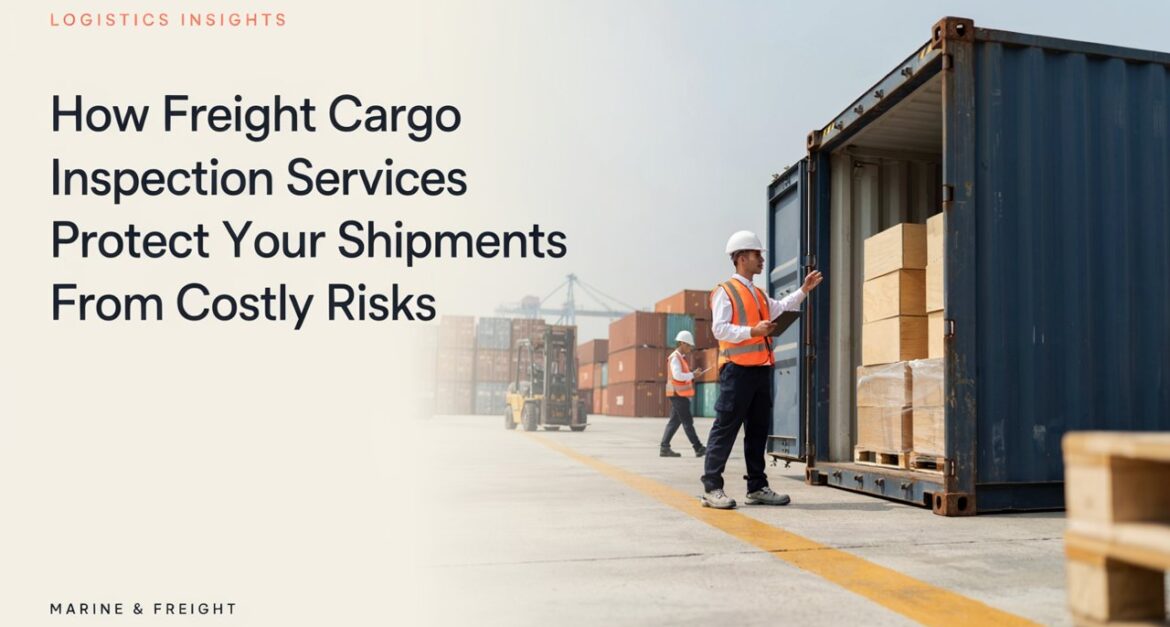
Are you tired of watching your profits vanish into damaged, rejected, or disputed shipments before they even reach your customer? It’s a gut-punch every logistics manager knows too well — the phone call that starts with “there’s a problem with the container,” followed by the sinking realization that thousands of dollars, weeks of planning, and a client relationship are all on the line. Freight damage and cargo discrepancies quietly drain over $50 billion from the global supply chain every single year, and most of it happens silently, before anyone even notices something went wrong.
Here’s the good news: almost all of it is preventable. Freight cargo inspection services exist to catch exactly these problems — a torn seal, a miscounted pallet, an overweight container — while they’re still cheap, quiet fixes instead of expensive, public disasters. With a trusted partner like Palm Horizon KSA verifying your shipments before they leave the dock, you’re not just moving cargo — you’re protecting your revenue, your reputation, and your peace of mind, one inspection at a time.
What Is Cargo Inspection?
Cargo inspection is the systematic examination of goods, packaging, containers, and shipping documentation before, during, or after transit to confirm that a shipment matches its declared quantity, quality, weight, and condition — and that it complies with the regulatory, contractual, and safety standards required to move it.
In plain terms: it’s the process of verifying that what’s supposed to be in the container is actually in the container, that it hasn’t been damaged, tampered with, or misdeclared, and that it’s safe to load onto a vessel, truck, or aircraft.
The inspection of cargo typically covers:
- Physical condition — checking for water damage, crushing, corrosion, pest infestation, or leakage
- Quantity and weight verification — confirming declared vs. actual load (critical under the IMO’s SOLAS VGM rule)
- Packaging integrity — ensuring crates, pallets, and containers meet handling and stacking standards
- Documentation accuracy — matching bills of lading, packing lists, and certificates of origin to the physical goods
- Compliance checks — hazardous materials handling, temperature control for perishables, and customs classification
Fun fact: the standard shipping container — the humble 20-foot steel box you see stacked at every port — was standardized in the 1950s by trucking entrepreneur Malcom McLean, and it’s credited with cutting cargo handling costs by more than 90%. But that same standardization is exactly why inspection matters so much today: a single mislabeled or overloaded container can throw off an entire vessel’s stability calculations.
Why Cargo Inspection Exists: The Industry Problem
Global trade moves an extraordinary amount of freight — but that scale creates equally extraordinary exposure. According to industry loss data, the global financial impact of cargo loss exceeds $50 billion annually when you account for theft, damage, supply interruption, and insurance costs. In ocean freight specifically, 75% of cargo losses come from damage, not theft — meaning most losses are preventable through better handling, packaging checks, and pre-shipment inspection rather than security measures alone.
That’s the graph above in a nutshell: damage, not crime, is the real enemy of your freight. And damage is exactly what a trained inspector catches before it becomes a claim.
Here’s the problem this creates for shippers, importers, and logistics managers:
- A damaged shipment discovered after it arrives is a dispute, not a fix
- Overweight or misdeclared containers can get shipments rejected at port, or worse, cause safety incidents
- Non-compliant packaging can void insurance coverage entirely
- Customs discrepancies between declared and actual cargo trigger delays, fines, and reputational damage with regulators
Freight cargo inspection services exist to intercept these problems at the point where they’re still cheap to fix — before the container is sealed and loaded.
Core Attributes and Features of Freight Cargo Inspection Services
Not all inspection services are built the same. A professional freight cargo inspection provider typically offers:
- Pre-shipment inspection (PSI) — verifying goods before they leave the supplier’s warehouse
- Loading supervision — an inspector physically present during container stuffing or vessel loading
- Container condition surveys — checking for structural damage, seal integrity, and cleanliness before use
- Weight verification (VGM) — mandatory under SOLAS for all containerized ocean exports
- Quality and quantity control (QQC) — sampling and testing goods against contract specifications
- Damage and loss surveys — post-incident assessment for insurance claims
- Third-party certification — independent, unbiased reporting that both buyer and seller can trust
- Digital reporting with photo/video evidence — timestamped documentation that holds up in disputes
Cargo Inspection Checklist: What Inspectors Actually Look For
A thorough cargo inspection checklist generally includes:
- Exterior packaging condition (dents, tears, moisture stains)
- Container/trailer structural integrity and cleanliness
- Seal number verification against shipping documents
- Correct labeling, marking, and hazard classification
- Weight and dimension verification (VGM compliance)
- Quantity count against the packing list
- Temperature and humidity checks for sensitive cargo
- Photographic documentation of loading process
- Certificate of origin and customs paperwork cross-check
- Final sign-off and inspection report issuance
This checklist structure is why standardization matters — it turns inspection from a subjective judgment call into a repeatable, auditable process.
How Often Should Cargo Inspections Be Made?
This is one of the most common questions shippers ask, and the honest answer is: it depends on cargo type, route risk, and regulatory requirements — but there are clear industry baselines.
- Every shipment, at minimum, at the point of loading — a visual and documentary check before sealing is non-negotiable for any commercial freight
- High-value or high-risk cargo — inspected at both origin and destination, plus at any transshipment point
- Perishable and temperature-sensitive goods — checked at every handoff where cold-chain integrity could be broken
- Long-term storage or multi-leg shipments — periodic condition checks every 30–90 days depending on cargo sensitivity
- After any incident — rough weather, a reported seal break, or a delay that exposes cargo to new conditions should trigger an unscheduled inspection
A useful rule of thumb: inspect at every point of custody change. Every time a shipment moves from one party’s responsibility to another’s — supplier to freight forwarder, forwarder to carrier, carrier to consignee — is a point where liability shifts, and it’s the cheapest moment to catch a problem before it becomes someone else’s expensive surprise.
Use Cases, Industries Served, and Real-World Applications
Freight cargo inspection isn’t a one-industry service. It shows up anywhere goods change hands across distance:
- Import/export trading companies — verifying supplier shipments before they leave origin countries, protecting against fraud or substandard goods
- Oil, gas, and industrial equipment — heavy machinery and project cargo inspections for weight distribution and securing
- Food and agriculture exporters — quality, quantity, and cold-chain verification for perishable goods
- Construction and infrastructure — inspecting bulk materials, steel, and equipment shipments for damage claims
- Retail and consumer goods — pre-shipment quality control to catch defects before they reach store shelves
- Petrochemical and hazardous materials — compliance inspection for dangerous goods classification and handling
- Government and customs authorities — verifying declared cargo against actual contents for duty and trade compliance
In the Kingdom of Saudi Arabia specifically, the logistics sector has grown rapidly alongside Vision 2030’s push to position the country as a global logistics hub connecting Asia, Africa, and Europe. That growth brings more freight volume through ports like Jeddah Islamic Port and Dammam — and more need for inspection services that can keep pace with throughput without slowing it down.
Freight Cargo Inspection Services: Comparison to Alternatives
Businesses often ask whether they need a dedicated inspection service or whether existing processes are “good enough.” Here’s how the options stack up:
| Approach | Independence | Documentation Quality | Risk Coverage |
| Relying on carrier’s own checks | Low — carrier has an interest in the outcome | Basic, often informal | Limited to loading errors |
| In-house QC team only | Medium — internal bias possible | Variable, depends on training | Good for known risks, weak on new lanes |
| Insurance-only protection | None — reactive, not preventive | Strong after a claim, none before | Covers financial loss, not the disruption |
| Independent third-party inspection (e.g. Palm Horizon KSA) | High — neutral, contractually independent | Standardized, photo/video-backed reports | Covers damage, quantity, compliance, and documentation before loss occurs |
The key differentiator is independence. A third-party inspector has no financial stake in “passing” a shipment — their value is precisely that both buyer and seller can trust the report. That’s why international trade contracts increasingly specify third-party inspection as a condition of payment release.
Implementation Overview: How Palm Horizon KSA Approaches Cargo Inspection
Bringing a freight cargo inspection service into your supply chain doesn’t need to be complicated. A well-run implementation typically follows this sequence:
- Scoping the shipment — Palm Horizon KSA reviews the cargo type, route, contract terms, and any regulatory requirements specific to the goods
- Pre-inspection planning — scheduling inspection windows around loading times so verification doesn’t create bottlenecks
- On-site inspection — trained inspectors physically examine cargo, cross-check documentation, and verify weight and quantity
- Real-time reporting — digital, photo-and-video-backed inspection reports issued immediately, not days later
- Issue escalation — any discrepancy (damage, shortfall, mislabeling) is flagged to the client before the container is sealed, giving time to resolve it
- Final certification — a signed inspection report that supports customs clearance, insurance claims, or payment release under letter-of-credit terms
The goal of this workflow is simple: catch the problem when it’s still a phone call, not a lawsuit.
Frequently Asked Questions
What is cargo inspection, in simple terms?
Cargo inspection is the process of physically and documentarily verifying that a shipment matches what was declared — checking condition, quantity, weight, and compliance before it moves further down the supply chain.
How often should cargo inspections be made?
At minimum, at every point of custody change — loading, transshipment, and delivery. High-value, perishable, or high-risk cargo should be inspected more frequently, including after any incident like severe weather or a broken seal.
What’s the difference between cargo inspection and cargo surveying?
Inspection generally happens before or during shipment to prevent loss, while surveying often happens after an incident to assess damage for an insurance claim. Many providers, including Palm Horizon KSA, offer both.
Do freight cargo inspection services slow down my shipment?
A well-scheduled inspection is built into the loading window, not added on top of it. The time cost of inspection is almost always smaller than the time cost of a rejected shipment or a customs dispute later.
Is cargo inspection required by law?
Certain elements are legally mandatory — such as SOLAS-required container weight verification (VGM) for ocean freight. Beyond that, many buyers and letters of credit contractually require independent inspection as a condition of payment.
What industries benefit most from regular cargo inspection?
Any industry moving high-value, perishable, hazardous, or regulation-heavy goods benefits most — including food and agriculture, industrial equipment, petrochemicals, and general import/export trade.
Can cargo inspection reduce my insurance costs?
Insurers often view a documented history of independent inspection favorably, since it demonstrates reduced risk exposure and provides evidence that supports faster, cleaner claims processing when something does go wrong.
Final Thoughts: Inspection Is Cheaper Than the Alternative
The math on cargo inspection is not complicated. A thorough inspection costs a fraction of what a single damaged, rejected, or disputed shipment costs — in direct losses, in insurance disputes, in delayed payments, and in the relationship damage that comes from delivering a problem instead of a product.
Palm Horizon KSA exists to sit at exactly that point in your supply chain — the point where a problem is still cheap to fix. Whether you’re exporting agricultural goods, importing industrial equipment, or managing multi-leg freight across the Gulf and beyond, independent, documented, and timely cargo inspection isn’t overhead. It’s the cheapest insurance policy your shipment will ever have.
If your freight is moving, it should be inspected. The only real question is whether you find the problem before it ships — or after it costs you.