

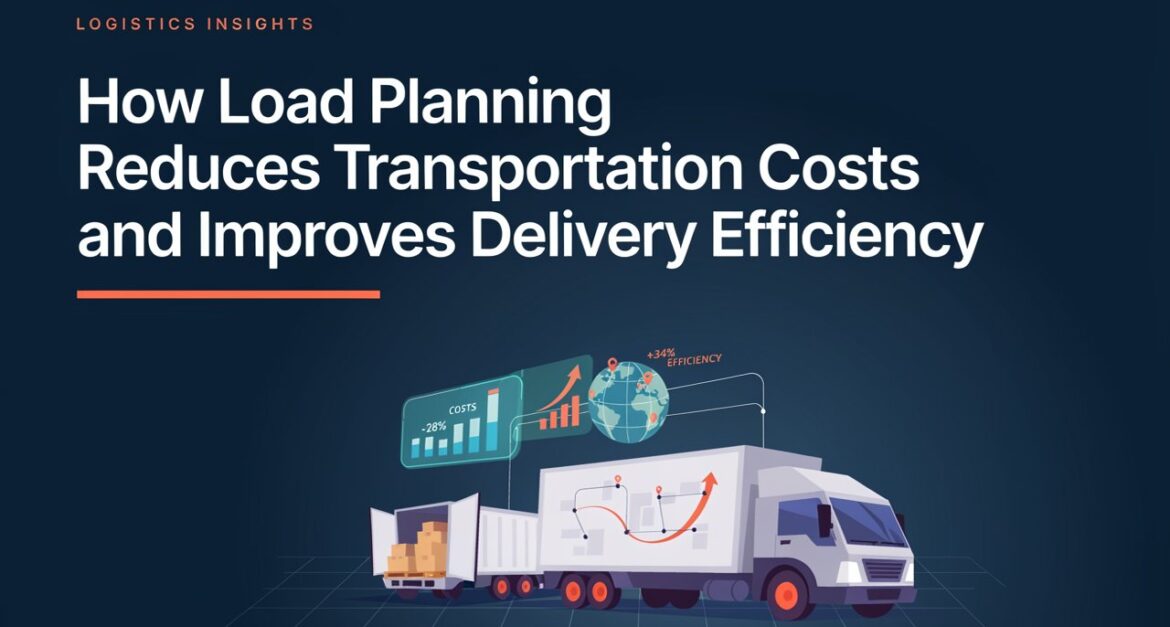
Introduction: The Hidden Cost Bleeding Every Fleet Dry
Ask any fleet manager in Riyadh, Jeddah, or Dammam what keeps them up at night, and “empty truck space” probably isn’t the first answer you’ll hear. Fuel prices, driver shortages, and traffic congestion usually take the spotlight. But underneath all of that sits a quieter problem that costs the logistics industry billions every year: trucks leaving the yard half-empty, badly balanced, or routed in the wrong order.
This is where load planning comes in — the unglamorous, spreadsheet-and-sensor-driven discipline that decides what goes where before a single wheel turns. Done well, it’s invisible. Done poorly, it shows up as blown budgets, damaged goods, and customers who call to ask why their delivery is three hours late again.
Saudi Arabia’s logistics sector is expanding fast, driven by Vision 2030’s push toward a regional trade and distribution hub. More warehouses, more last-mile delivery, more cross-border container movement to and from Jeddah Islamic Port and King Abdulaziz Port. That growth only pays off if the trucks moving all that freight are loaded intelligently.
What Is a Loading Plan? Understanding Load Planning in Logistics
If you’ve searched what a loading plan, the short answer is this: a loading plan is a documented strategy for how cargo is arranged inside a truck, container, or trailer — before the loading process begins.
A good loading plan answers four questions before a single box is lifted:
- What goods are being shipped, and in what quantity?
- Where does each item go inside the vehicle or container?
- In what order should items be loaded and unloaded (based on delivery stops)?
- How is weight distributed so the vehicle stays balanced, legal, and safe?
Load planning, more broadly, is the operational process of designing this plan — often across multiple vehicles, multiple stops, and multiple constraints. It sits at the intersection of warehouse operations, fleet management, and route planning, which is exactly why it has such an outsized effect on transportation cost.
In modern logistics, load planning has evolved beyond manual whiteboards and driver experience. Businesses now rely on load planning software to optimize every shipment. These digital systems automatically calculate the best load configuration based on cubic volume, and regulatory axle-weight requirements.
Load Planning vs. Other “Load” Concepts: A Quick Disambiguation
Because the word “load” is used across several industries, it’s worth a quick clarification — search intent here can get crossed easily.
- Load planning (logistics) — the topic of this article: arranging freight inside trucks and containers for cost efficiency and safety.
- Load testing test plan (software engineering) — a document outlining how a software application will be tested under simulated user traffic to check performance, response time, and stability. Unrelated to transportation, despite the shared terminology.
- Load bearing structure plan (civil/structural engineering) — an architectural or engineering plan showing which walls, beams, or columns carry a building’s structural weight. Again, a different discipline entirely, though the underlying principle — is conceptually similar to transportation load planning.
If you landed here searching for one of those terms, this article won’t cover software QA or building architecture. Instead, it explores load planning in the logistics industry. So, if you’re here for freight, containers, and trucks, you’re in exactly the right place.
Core Attributes and Features of Truck Load Planning Software
Modern truck load planning software isn’t just a digital version of a packing checklist. It’s closer to a mini logistics engine that runs constraint-based calculations in seconds. Here are the attributes that separate a genuinely useful platform from a basic spreadsheet tool.
1. 3D Load Visualization
Additionally, the system generates a to-scale visual model showing how pallets, boxes, or drums should be arranged inside the trailer or container. As a result, warehouse staff know exactly where each item belongs before loading begins.
2. Weight Distribution & Axle Compliance
Good software automatically checks that axle weights stay within legal limits (a major concern on GCC highways where overloaded axle violations lead to fines and vehicle impoundment). This prevents both safety hazards and regulatory penalties.
3. Cubic Space Optimization
Instead of relying on guesswork, the software calculates the most efficient use of available space. As a result, businesses can reduce the number of trucks needed to transport the same amount of freight.
4. Multi-Stop Sequencing
For delivery routes with multiple drop-off points, the system creates a loading plan based on the delivery sequence. As a result, the last stop’s goods are loaded first, so they can be unloaded last. This approach minimizes unnecessary handling and reshuffling during the route.
5. Integration With TMS and Route Planning
The best load planning software connects directly with a Transportation Management System (TMS), so load configuration, routing, and dispatch operate as one continuous workflow instead of three disconnected steps.
6. Real-Time Adjustments
Order volumes change last-minute. Strong platforms recalculate load plans on the fly rather than forcing a manual redo.
7. Safety and Compliance Documentation
Every plan can double as part of a formal loading and unloading transportation safety plan — documenting how hazardous materials, fragile goods, or temperature-sensitive cargo were secured, stacked, and separated, which matters heavily for audits and insurance claims.
Container Loading Plan: Free Tools vs. Enterprise Software
For smaller operators, a container loading plan free tool can be a reasonable starting point — most offer basic 3D box-stacking simulations for a single container size, useful for occasional shippers or small exporters testing the waters.
But free tools tend to hit a ceiling quickly:
| Capability | Free Container Loading Tools | Enterprise Load Planning Software |
| 3D visualization | Basic, single container | Multi-container, multi-vehicle |
| Weight/axle compliance | Rarely included | Built-in, regulation-aware |
| TMS/ERP integration | Not supported | API-based integration |
| Multi-stop sequencing | Not available | Fully supported |
| Real-time recalculation | Manual re-entry | Automated |
| Reporting & audit trail | Minimal | Detailed, exportable |
| Scalability | Single-user, single-shipment | Fleet-wide, multi-warehouse |
A container loading plan built in a free tool works fine for a one-off shipment. But once a business is coordinating recurring container loads for export through Saudi ports, or managing a fleet of delivery trucks across multiple cities, the lack of integration and compliance checking in free tools quickly becomes a bottleneck rather than a convenience.
Loading and Unloading Transportation Safety Plan: Why It’s Non-Negotiable
A loading and unloading transportation safety plan isn’t a bureaucratic afterthought — it’s often the difference between a smooth delivery and a warehouse injury, a spoiled shipment, or a legal liability.
Key components typically include:
- Securement standards — how straps, dunnage, and locking bars are used to prevent shifting cargo
- Sequencing rules — heavier items low and toward the front axle, fragile goods protected from crushing
- Personnel protocols — designated loading zones, PPE requirements, forklift traffic rules
- Hazmat separation — keeping incompatible goods (chemicals, food items, electronics) properly isolated
- Documentation — signed checklists confirming the load was inspected before departure
When load planning software generates the loading sequence automatically, safety compliance becomes a built-in output of the process rather than a separate manual checklist — which is a major reason regulated industries (chemicals, pharmaceuticals, food & beverage) increasingly demand software-driven load plans over manual ones.
Use Cases, Industries Served, and Real-World Applications
Load planning isn’t a niche concern for a handful of mega-carriers. It shows up across nearly every sector that moves physical goods.
- Retail & E-commerce Distribution — Multi-drop delivery routes across cities benefit enormously from sequenced loading, cutting down on double-handling at each stop.
- FMCG & Food Distribution — Weight balance and temperature-zone separation prevent spoilage and product damage during transit.
- Manufacturing & Industrial Supply — Heavy, irregularly shaped components (machinery parts, steel coils, pipes) require precise weight distribution to avoid axle violations.
- Import/Export & Freight Forwarding — Container loading plans maximize cubic utilization for sea freight, directly reducing the number of containers needed per shipment — a meaningful cost lever given current freight rates.
- Construction & Building Materials — Bulk materials like cement, tiles, and steel require careful sequencing to prevent shifting and structural stress on the trailer bed.
- Pharmaceuticals & Healthcare Logistics — Strict handling and separation rules make automated, auditable load plans essential for compliance.
In the Saudi market specifically, the growth of e-commerce fulfillment centers, cross-border GCC trade, and Vision 2030-driven infrastructure projects means demand for smarter, software-based load planning is climbing steadily across almost all of these categories.
How Load Planning Software Compares to Manual Planning and Legacy Methods
| Factor | Manual/Whiteboard Planning | Basic Spreadsheet Tools | Dedicated Load Planning Software |
| Speed of plan creation | Slow, driver/experience-dependent | Moderate | Fast, automated |
| Accuracy of space utilization | Inconsistent | Improved but still manual | Optimized algorithmically |
| Weight/axle compliance checks | Rare | Manual calculation | Automatic |
| Scalability across a fleet | Poor | Limited | High |
| Error rate | Higher | Moderate | Lowest |
| Integration with TMS/WMS | None | None | Native/API |
The pattern is consistent across the industry: as shipment volume and delivery complexity increase, manual methods stop scaling — and the cost of inefficiency (extra trucks, fuel waste, damaged goods, axle fines) grows faster than the cost of adopting proper software.
Implementation Overview: How to Roll Out Load Planning Software
For businesses considering a move from manual or spreadsheet-based planning to dedicated software, implementation generally follows these stages:
- Audit Current Load Patterns — Review historical shipment data to identify where space is wasted, where axle violations have occurred, and where damage claims are highest.
- Define Constraints — Document vehicle types, weight limits, product categories, and any regulatory requirements specific to your routes (e.g., GCC axle load regulations).
- Select and Integrate the Software — Choose a platform that connects with existing TMS/WMS/ERP systems rather than operating as an isolated tool.
- Pilot on a Single Route or Depot — Test the system on a limited scope before fleet-wide rollout, comparing cost-per-shipment and delivery time against historical baselines.
- Train Warehouse and Dispatch Teams — Loading staff need to understand and trust the generated plans, not revert to old habits under time pressure.
- Monitor, Measure, and Refine — Track fuel cost per delivery, number of trucks used per shipment batch, and safety incident rates over the following quarters.
Most operations see measurable improvement within the first two to three months — primarily from reduced truck count per shipment run and fewer reloading incidents at multi-stop deliveries.
Fun Facts About Load Planning You Probably Didn’t Know
- A standard 20-foot shipping container looks small, but poor loading can waste up to 30% of its usable volume — the equivalent of shipping an entire extra pallet of “empty air.”
- The concept of load balancing in trucks borrows physics principles from aviation — pilots use nearly identical weight-and-balance calculations before takeoff.
- Some of the earliest “load planning” was done with literal chalk diagrams on warehouse floors before pallets were even standardized in the 1920s.
- A truck with poorly distributed weight can experience up to 20% more tire wear on overloaded axles compared to a properly balanced load.
- The international pallet standard (1200mm x 1000mm, common across Europe and the Middle East) exists specifically because inconsistent pallet sizing was once one of the biggest causes of wasted container space.
Frequently Asked Questions
1. What is the difference between load planning and route planning?
Load planning determines what goes where inside a vehicle, while route planning determines the path and sequence the vehicle takes between delivery points. The two are closely linked — a well-sequenced load plan should match the delivery order defined by the route plan.
2. How does load planning software actually reduce transportation costs?
It reduces costs mainly by improving cubic space utilization (fewer trucks needed per shipment batch), preventing axle-weight fines, reducing product damage from poor stacking, and cutting down on unloading/reloading time at multi-stop routes.
3. Is container loading plan free software good enough for small businesses?
For occasional, single-container shipments, free tools can work reasonably well. Once a business manages recurring shipments, multiple vehicle types, or compliance requirements, dedicated software becomes far more cost-effective than the inefficiencies free tools create at scale.
4. What industries benefit most from truck load planning software?
Retail and e-commerce distribution, FMCG, manufacturing, pharmaceuticals, and import/export freight forwarding see the largest gains, largely because they deal with high shipment volume, multiple stops, or strict handling requirements.
5. Does load planning software help with safety compliance, not just cost savings?
Yes. A proper loading and unloading transportation safety plan is often generated as a direct output of the load planning process — covering weight distribution, securement, and hazard separation — which supports both regulatory compliance and insurance documentation.
6. How long does it take to implement load planning software in an existing fleet?
Most businesses can complete a pilot rollout within four to six weeks, with fleet-wide adoption typically following over the next one to two quarters, depending on integration complexity with existing TMS or WMS systems.
Final Thoughts: Why Load Planning Deserves a Seat at the Strategy Table
Transportation cost reduction usually gets chased through the obvious levers — fuel efficiency, route optimization, driver scheduling. Load planning rarely gets the same attention, yet it sits underneath nearly every one of those metrics. A truck that’s loaded inefficiently burns more fuel per delivered unit, takes longer at each stop, and runs a higher risk of compliance penalties — no matter how well the route itself was planned.
For logistics operations across Saudi Arabia scaling up to meet Vision 2030’s trade and infrastructure ambitions, treating load planning as a core operational discipline — backed by proper software rather than guesswork — isn’t just a safety or efficiency upgrade. It’s a direct, measurable lever on the bottom line.
Palm Horizon KSA works with fleet operators, distributors, and freight forwarders across the Kingdom to bring exactly this kind of structured, software-driven load planning into everyday operations — turning wasted truck space into real cost savings, delivery after delivery.