
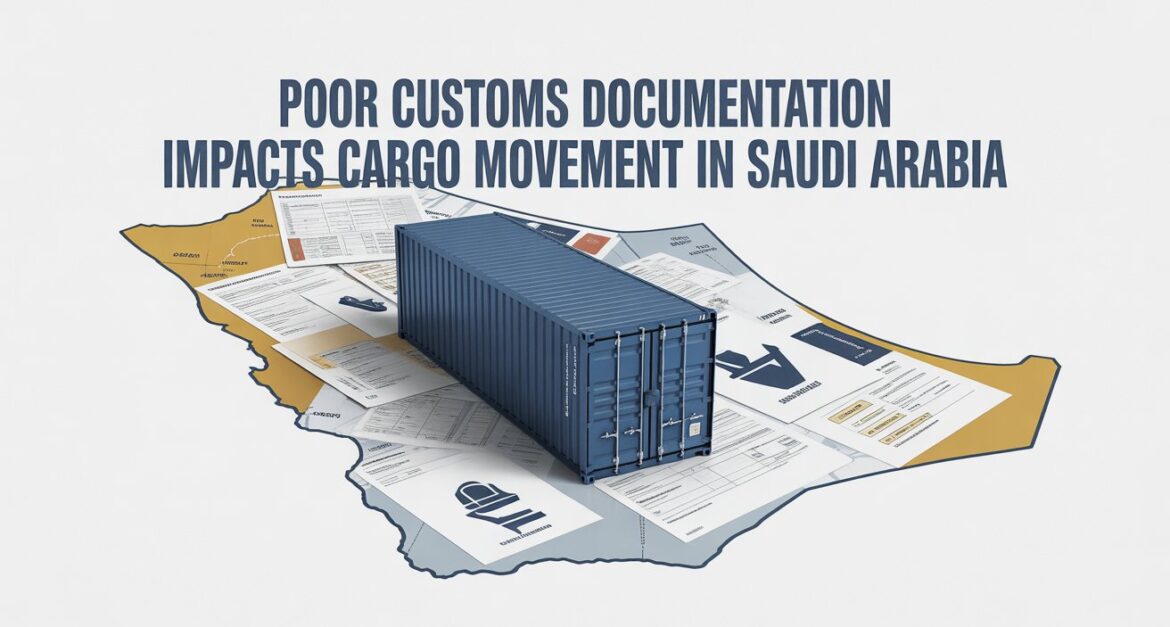
Cargo delays in Saudi Arabia are rarely caused by a lack of transportation capacity. Ports are modern, airports are efficient, and trade corridors are continuously expanding. Yet shipments still get stuck. The root cause is often invisible at first glance—documentation errors that prevent cargo from moving forward.
In Saudi Arabia’s regulated trade environment, customs documentation is not a procedural formality. It is a legal requirement that determines whether cargo flows smoothly or remains immobilized at ports, airports, or border crossings. Even a single inconsistency in declared values, commodity descriptions, or HS codes can trigger inspections, penalties, and costly delays.
For importers, exporters, manufacturers, and project operators, poor customs documentation directly translates into financial loss, operational disruption, and reputational risk. Understanding how documentation impacts cargo movement is no longer optional—it is a core logistics competency in Saudi Arabia.
What Is Customs Documentation in Saudi Arabia?
What is customs documentation in the context of Saudi trade regulations?
Customs documentation refers to the complete set of legally required records submitted to Saudi customs authorities to declare goods entering or leaving the Kingdom. These documents confirm cargo identity, origin, value, classification, ownership, and regulatory compliance.
Saudi customs authorities rely on documentation to:
- Assess customs duties and taxes
- Verify trade compliance
- Enforce import and export controls
- Protect national security and economic interests
Customs documentation is reviewed digitally and physically. Any discrepancy between documents and actual cargo immediately raises compliance concerns.
In Saudi Arabia, documentation errors are treated as compliance risks, not clerical mistakes. This strict approach is designed to protect trade integrity, but it also means businesses must treat documentation preparation with precision and accountability.
The Strategic Role of Customs Documentation in Cargo Movement
Customs documentation directly influences cargo movement speed. Cargo does not move based on arrival time—it moves based on clearance approval.
When documentation is accurate:
- Cargo clears faster
- Inspection probability decreases
- Delivery schedules remain intact
When documentation is poor:
- Cargo is held for verification
- Clearance timelines become unpredictable
- Storage and detention costs escalate
In Saudi Arabia’s logistics ecosystem, documentation accuracy is often the deciding factor between same-day clearance and multi-week delays.
Essential Customs Clearance Documents for Cargo in KSA
Accurate customs clearance documents form the foundation of uninterrupted cargo movement in Saudi Arabia. Each document serves a defined regulatory function and must align perfectly with the others.
Commercial Invoice
The commercial invoice defines cargo value, transaction terms, buyer and seller details, and currency. Errors in valuation or incorrect Incoterms frequently lead to reassessment and clearance delays.
Packing List
The packing list details cargo quantity, packaging type, weight, and dimensions. Mismatches between the packing list and physical cargo often trigger inspections.
Certificate of Origin
The certificate of origin verifies where goods were manufactured. Saudi customs applies origin-based regulations strictly, especially for regulated or preferential goods.
Bill of Lading or Airway Bill
These transport documents confirm shipment details, consignee information, and routing. Any inconsistency can delay cargo release.
HS Code Declaration
HS code accuracy determines duty rates, regulatory requirements, and inspection risk. Incorrect classification is a common compliance violation.
Import Permits and Regulatory Approvals
Certain goods require prior approval from Saudi authorities. Missing permits result in immediate shipment holds.
All customs clearance documents must be internally consistent. Saudi customs systems automatically cross-check data fields, flagging discrepancies instantly.
How Poor Customs Documentation Disrupts Cargo Movement
Poor documentation does not cause minor inconvenience—it disrupts entire supply chains.
Cargo Holds and Physical Inspections
Documentation inconsistencies trigger inspections. These inspections delay cargo release and disrupt delivery timelines.
Demurrage and Detention Costs
When cargo remains uncleared, storage fees accumulate rapidly at Saudi ports and airports.
Missed Project and Contract Deadlines
Delayed shipments impact construction projects, industrial operations, and commercial supply commitments.
Compliance Penalties and Financial Exposure
Incorrect declarations can lead to fines, reassessed duties, or enforcement actions under Saudi customs law.
Supply Chain Instability
For manufacturers and distributors, delayed cargo interrupts production schedules and inventory availability.
In Saudi Arabia, documentation errors create cascading consequences far beyond customs clearance.
Can a Customs Broker Handle Import and Export Documentation?
A critical question for businesses is: can a customs broker handle import and export documentation in Saudi Arabia?
Licensed customs brokers are authorized to:
- Prepare customs declarations
- Submit documentation to customs systems
- Coordinate clearance procedures
- Communicate with Saudi customs authorities
However, brokers depend heavily on accurate information from shippers, suppliers, and freight forwarders. Documentation errors originating at the source cannot always be corrected during clearance.
This is why many businesses choose logistics partners that integrate freight forwarding, customs coordination, and documentation validation under a single operational structure.
Palm Horizon KSA operates as a logistics company in Saudi Arabia that supports customs clearance coordination as part of its end-to-end logistics services, helping businesses reduce documentation-related delays across air, sea, and project cargo shipments.
Customs Documentation Challenges Unique to Saudi Arabia
Saudi Arabia’s regulatory framework introduces specific documentation challenges:
- Strict valuation controls
- Detailed commodity classification requirements
- Mandatory Arabic documentation for certain filings
- Digital system compliance expectations
- Sector-specific import regulations
These factors increase the risk of documentation errors for businesses unfamiliar with Saudi trade procedures.
Compliance Documentation and Customer Trust
Documentation accuracy directly affects customer perception. Delays caused by paperwork errors raise questions about reliability and operational competence.
Modern logistics operations increasingly focus on how to track customer engagement with compliance documentation, including:
- Documentation approval timelines
- Revision cycles
- Clearance status transparency
- Compliance communication records
When customers receive accurate updates and predictable clearance timelines, trust strengthens. Repeated documentation failures erode confidence and long-term partnerships.
Why Customer and Market Personas Matter in Logistics Documentation
Understanding how to write a proper customer/market persona document helps logistics teams align documentation processes with shipment requirements.
Different customer types require different documentation approaches:
- SMEs often need structured guidance
- Industrial clients demand technical accuracy
- Government and project cargo require audit-ready compliance
Persona-based documentation standards reduce errors, streamline clearance, and improve operational outcomes.
Persona-Based Documentation Strategy
Different customers generate different documentation risks. Knowing how to write a proper customer/market persona document allows logistics teams to anticipate documentation needs based on shipment type, industry, and compliance sensitivity. This reduces errors before they reach customs systems.
Persona-based documentation planning improves consistency and clearance speed.
The Cost of Repeated Documentation Errors
Repeated documentation failures create long-term damage:
- Increased inspection risk
- Higher compliance scrutiny
- Reduced customer retention
- Rising operational costs
In Saudi Arabia, repeated errors may place businesses on higher-risk monitoring lists, increasing clearance complexity.
Preventing Documentation Errors in Saudi Cargo Operations
Effective prevention strategies include:
- Standardized documentation checklists
- Pre-clearance verification
- Regulatory update monitoring
- Clear responsibility assignment
- Broker and carrier coordination
Palm Horizon KSA applies structured documentation coordination across its logistics operations to support smoother cargo movement and compliance alignment within Saudi Arabia’s regulatory framework.
Documentation as a Strategic Logistics Function
Documentation should be treated as a core logistics function—not administrative overhead. In Saudi Arabia’s trade environment, documentation quality determines clearance speed, cost control, and customer satisfaction.
Companies that invest in structured documentation processes gain:
- Predictable cargo flow
- Reduced compliance risk
- Stronger customer relationships
Frequently Asked Questions (FAQs)
What is customs documentation in Saudi Arabia?
What is customs documentation refers to the official records required by Saudi customs authorities to declare, assess, and approve cargo entering or leaving the Kingdom. These documents verify cargo value, origin, classification, and regulatory compliance.
Which customs clearance documents are required in Saudi Arabia?
Common customs clearance documents include the commercial invoice, packing list, certificate of origin, bill of lading or airway bill, HS code declaration, and any required import permits or approvals.
How do documentation errors affect cargo clearance in Saudi Arabia?
Documentation errors can lead to cargo holds, inspections, delayed clearance, financial penalties, and increased demurrage or detention charges. In Saudi Arabia, errors are treated as compliance risks rather than administrative mistakes.
Can a customs broker handle import and export documentation?
Yes, can a customs broker handle import and export documentation is a common question. Licensed customs brokers in Saudi Arabia can prepare, submit, and coordinate documentation, but they rely on accurate information from shippers and logistics partners.
Why do Saudi customs authorities inspect shipments with documentation issues?
Saudi customs authorities use documentation accuracy to assess shipment risk. Inconsistent or incorrect documentation increases inspection probability to protect regulatory and trade integrity.
How can businesses reduce documentation-related delays?
Businesses can reduce delays by standardizing documentation processes, validating documents before shipment, monitoring regulatory changes, and coordinating closely with brokers and logistics partners.
How to track customer engagement with compliance documentation?
Tracking how to track customer engagement with compliance documentation involves monitoring document approvals, revision frequency, clearance updates, and customer communication timelines related to compliance status.
Why is a customer or market persona important in logistics documentation?
Understanding how to write a proper customer/market persona document helps logistics teams tailor documentation processes based on shipment complexity, industry requirements, and compliance sensitivity, reducing errors and clearance delays.
Does documentation accuracy affect long-term clearance performance?
Yes. Consistent documentation accuracy lowers inspection rates, improves clearance speed, and reduces compliance scrutiny over time in Saudi Arabia.
Is customs documentation more important than transport speed?
In Saudi Arabia, customs documentation often has a greater impact on cargo movement than transport speed. Cargo cannot move without clearance approval, regardless of how fast it arrives.
Final Thoughts
Effective cargo movement in Saudi Arabia depends as much on documentation as it does on transportation infrastructure. Poor customs documentation creates delays, increases costs, and threatens supply chain reliability, while precise and compliant paperwork ensures smooth clearance, operational efficiency, and stronger customer trust.
Businesses that treat customs documentation as a strategic function gain a competitive advantage, reduce risk, and maintain uninterrupted logistics operations across Saudi ports, airports, and land routes. Leveraging expertise in documentation coordination, licensed brokers, and integrated logistics services can turn potential compliance hurdles into seamless cargo movement.
For companies seeking reliable support in Saudi Arabia, Palm Horizon KSA provides end-to-end logistics solutions, including expert handling of customs clearance documents, regulatory compliance, and cargo coordination—ensuring shipments reach their destination on time, every time.