

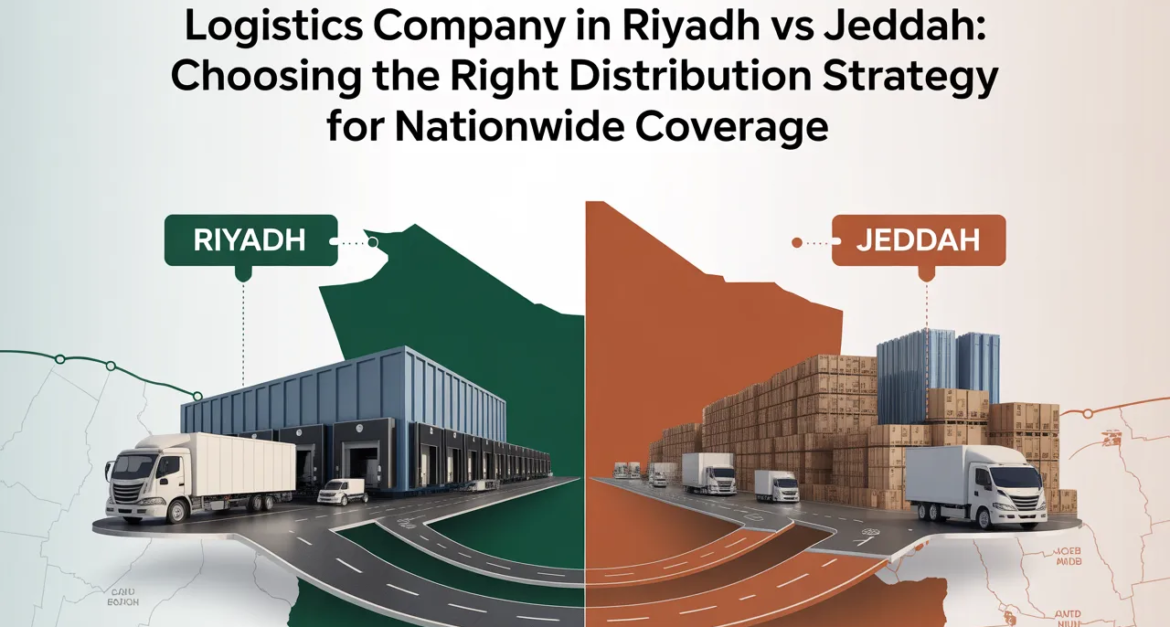
Are you expanding your business across Saudi Arabia but struggling to determine whether Riyadh or Jeddah should anchor your distribution strategy? Many companies focus on sales growth while leaving logistics as an afterthought, only to face rising transport costs, inventory mismanagement, and delivery delays. In today’s fast-evolving Saudi market, logistics is no longer a background function — it is a strategic asset that directly impacts margins, customer satisfaction, and long-term scalability. Choosing the wrong city or distribution model can silently erode profits, slow nationwide expansion, and create operational bottlenecks that become increasingly costly over time.
Saudi Arabia’s logistics landscape is rapidly transforming under Vision 2030, with major investments in ports, industrial zones, inland transport corridors, and digital trade systems. As the Kingdom positions itself as a global logistics hub connecting Asia, Europe, and Africa, businesses must evaluate their logistics strategy with precision. The decision between establishing operations in Riyadh or Jeddah is not about preference; it is about aligning infrastructure with growth, ensuring operational efficiency, and maximizing nationwide coverage. Companies like Palm Horizon KSA specialize in designing distribution frameworks that integrate warehousing, freight, and customs solutions to support scalable, resilient, and profitable operations.
Riyadh: The Central Hub for Nationwide Reach
Riyadh, the Kingdom’s capital and administrative heart, serves as the strategic nucleus for businesses that aim to deliver efficiently across multiple provinces. Its central geographic location allows balanced distribution to northern, southern, and eastern regions, making it ideal for companies with nationwide ambitions. Businesses headquartered or operating primarily in Riyadh benefit from direct access to government institutions, regulatory authorities, and large corporate clients, which is particularly advantageous for B2B-focused operations and companies involved in government contracts.
The city also offers expanding industrial and logistics infrastructure. Modern warehousing clusters, multimodal transport corridors, and growing inland connectivity support scalable operations and consolidated inventory management. Companies can centralize stock in Riyadh, allowing better visibility, reduced duplication, and optimized capital allocation. Additionally, Riyadh’s air cargo facilities enable time-sensitive shipments and support rapid domestic and regional delivery.
However, relying solely on Riyadh introduces certain challenges. For import-heavy businesses, the inland distance from western ports like Jeddah increases transportation costs and delivery lead times. Urban congestion and high demand for warehouse space can further impact last-mile performance. Companies that do not account for these factors may encounter bottlenecks when expanding into western regions or handling high-volume import cycles.
Jeddah: The Gateway to Global Trade
Jeddah, located on the Red Sea, functions as Saudi Arabia’s primary maritime gateway. The city hosts Jeddah Islamic Port, one of the busiest ports in the region, connecting the Kingdom to global shipping lanes. For businesses that rely heavily on imports or international trade, Jeddah offers strategic advantages by reducing inland transport costs, accelerating container processing, and providing proximity to western consumer hubs such as Makkah and Madinah.
Importers benefit from shorter lead times for port-to-warehouse transfer, reducing demurrage risks and improving inventory velocity. Jeddah is also ideal for companies distributing fast-moving consumer goods, retail products, and e-commerce orders in the western corridor, where population density is high and delivery expectations are stringent.
Despite these advantages, a Jeddah-focused model may create challenges for nationwide operations. Deliveries to central, northern, and eastern provinces require longer overland transit, potentially increasing fuel costs, delivery times, and fleet utilization. Without careful planning, businesses risk fragmented inventory, uneven service levels, and higher operational complexity when scaling beyond the western region.
Nationwide Coverage: Single Hub vs Dual-Hub Strategy
For growth-oriented businesses, the real question is not “Riyadh or Jeddah?” It is how to structure a logistics architecture that ensures nationwide efficiency, risk mitigation, and cost optimization. Companies have three strategic options:
Single-City Centralization
This model uses either Riyadh or Jeddah as the primary hub. It suits moderate-volume operations, simplifies inventory management, and lowers upfront infrastructure costs. However, it may compromise delivery speed, increase long-haul transportation costs, and reduce resilience during disruptions such as port congestion or traffic bottlenecks.
Dual-Hub Hybrid Model
Establishing hubs in both Riyadh and Jeddah balances the strengths of each city. Riyadh provides central reach to northern, southern, and eastern regions, while Jeddah ensures efficient import handling and western region coverage. This model improves delivery timelines, reduces transport redundancy, and strengthens operational resilience. High-growth companies and those serving multiple regions nationwide often adopt this approach.
Distributed Multi-Node Networks
For enterprise-level operations, companies may add regional distribution nodes in addition to Riyadh and Jeddah. This further accelerates delivery, allows inventory segmentation, and supports large-scale e-commerce fulfillment. While capital-intensive, it maximizes speed, service reliability, and scalability for nationwide coverage.
Cost Implications
The choice of hub impacts operational costs, including:
- Inland freight and fuel
- Warehouse leasing and management
- Fleet utilization and maintenance
- Delivery lead times
- Inventory carrying costs
- Risk exposure to delays or regulatory changes
A Riyadh-based model may reduce inland transit to central and eastern regions but increase delivery costs to the west. Conversely, Jeddah provides import efficiency and western reach but adds overland transport expense to central and eastern markets. A dual-hub approach balances these costs while improving overall service performance.
Industry-Specific Considerations
Oil & Gas
Requires heavy, specialized freight. Centralized access in Riyadh facilitates coordination with industrial zones and operational sites in eastern and northern provinces.
FMCG & Retail
Dual hubs ensure faster replenishment, maintain consistent stock levels, and optimize distribution in high-demand regions.
E-Commerce
Regional inventory placement enhances delivery speed, supports time-sensitive shipments, and improves customer satisfaction.
Construction & Project Cargo
Large-scale imports benefit from Jeddah port proximity for equipment and materials, while centralized inland distribution ensures timely delivery across project sites.
Healthcare & Pharmaceuticals
Cold chain compliance and strict regulatory adherence necessitate both hub locations for nationwide coverage, inventory control, and emergency response.
Technology & Visibility
Modern logistics companies provide real-time tracking, warehouse management dashboards, and automated reporting. Advanced systems allow companies to:
- Monitor inventory levels across multiple locations
- Track shipment status in real time
- Manage regulatory documentation digitally
- Identify delays before they affect operations
Outsourced logistics providers eliminate traditional visibility challenges, giving businesses the transparency and control required for executive decision-making.
Risk Mitigation
Saudi Arabia’s geographic scale and regional complexity create operational risks, including seasonal congestion, fuel price fluctuations, customs changes, and workforce variability. Strategic hub placement mitigates these risks through:
- Redundant routing
- Inventory segmentation
- Multi-modal planning
- Compliance and regulatory support
Companies that integrate risk management into hub selection maintain service consistency and protect margins.
Scalability for Future Growth
Business growth without logistics scalability creates operational friction. Common challenges for companies expanding nationwide include:
- Warehouse capacity strain
- Delivery inconsistency
- Inventory misalignment
- Increased operational overhead
The right logistics partner designs scalable infrastructure capable of supporting three-to-five-year growth projections without compromising service levels or profitability.
How Palm Horizon KSA Supports Strategic Logistics
Palm Horizon KSA approaches logistics as a strategic business enabler. Rather than offering generic solutions, the company evaluates:
- Revenue distribution geography
- Import vs domestic sourcing ratios
- Delivery speed requirements
- Cost structure optimization
- Industry compliance needs
This data-driven approach allows Palm Horizon to design hybrid Riyadh-Jeddah or multi-node distribution frameworks that maximize efficiency, reduce costs, and improve delivery reliability. Their integrated solution combines warehousing, freight forwarding, customs clearance, and real-time visibility, giving businesses the operational confidence required to scale.
Executive Decision Framework
Before selecting a logistics partner or hub, executives should answer:
- Where is the majority of revenue generated?
- Are operations import-heavy or domestically sourced?
- What are the required service-level agreements for delivery?
- What is the three-to-five-year growth forecast?
- Is speed, cost, or service reliability the top priority?
Data-driven answers form the foundation for an optimized distribution network that aligns with both operational and financial objectives.
Final Insights
Riyadh provides centralized national reach, operational governance access, and inland distribution efficiency. Jeddah offers import optimization, port proximity, and western region coverage. The optimal strategy integrates the strengths of both hubs, balancing cost, speed, and scalability.
In a market shaped by Vision 2030 and increasing global trade, logistics precision is no longer optional. Companies that align distribution infrastructure with revenue flow, risk profile, and long-term strategy scale efficiently, protect margins, and build operational resilience. Those that delay strategic logistics decisions risk invisible inefficiencies that silently erode profitability.
Distribution strategy is not a location choice; it is a growth decision. Execution begins with logistics, and with the right partner like Palm Horizon KSA, businesses can transform their supply chain from a cost center into a competitive advantage.