
The Problem Every International Importer Faces at the Saudi Border
Every year, thousands of consignments from Europe, Asia, North America, and beyond arrive at Saudi ports — King Abdulaziz Port in Dammam, Jeddah Islamic Port, King Khalid International — only to be held, delayed, or returned because of one missing or incorrectly issued document: the SABER certificate.
Saudi Arabia is one of the fastest-growing consumer markets in the Middle East, with a GDP exceeding SAR 4.2 trillion and a government-backed push under Vision 2030 to diversify imports, elevate product safety standards, and digitise customs infrastructure. But that growth comes with strict gatekeeping. The Saudi Standards, Metrology and Quality Organization (SASO) — the regulatory body overseeing product conformity — launched the SABER electronic platform to replace the old manual import inspection system. The result is a faster, more transparent, and far more rigorous conformity verification regime.
The problem? Most international manufacturers and exporters still do not fully understand how SABER works, which products it covers, what the two-certificate structure means, or how to move through the process without costly delays. Missteps at any stage can freeze your shipment for weeks, trigger fines, or result in full confiscation of goods.
This guide — prepared by the product compliance advisors at Palm Horizon KSA — breaks the entire process down in plain language so that whether you are a first-time exporter to Saudi Arabia or a seasoned trade professional looking to streamline recurring shipments, you come away with a clear, actionable roadmap.
What Exactly Is the SABER Certificate?
SABER stands for Saudi Arabia’s Electronic Portal for Product Registration and Conformity Verification. It is the official digital platform through which all regulated products imported into Saudi Arabia must obtain conformity certification before they can clear Saudi customs.
In practical terms, SABER is a two-certificate system:
1. The Product Certificate (PC) This is a product-level certification that confirms your product complies with applicable Saudi technical regulations (primarily issued by SASO) and relevant international standards. It is issued once per product model and remains valid — typically for one year — across multiple shipments.
2. The Shipment Certificate (SC) This is a per-shipment document linked to your valid Product Certificate. Each time you send a consignment of that product to Saudi Arabia, a new Shipment Certificate must be generated through the SABER platform. It ties the specific shipment details — quantity, HS code, shipping date, port of entry — to your previously approved product file.
Fun Fact: Before SABER launched in 2019, Saudi customs verification relied heavily on paper documents and manual inspection at ports, a process that took weeks on average. SABER reduced the average clearance timeline for pre-certified products to as little as 24–72 hours for digital processing.
The SABER system is integrated directly with the FASAH single-window customs platform, which means that once your SABER certificates are in order, they flow automatically into the customs clearance system. This integration is one of the major reasons Saudi Arabia has risen dramatically in global trade facilitation rankings.
Why SABER Exists: The Regulatory Purpose
Saudi Arabia’s product safety landscape used to be fragmented. Different regulators handled different sectors, documentation requirements varied, and physical inspection of goods at ports was inconsistent. SABER was designed to solve all three problems simultaneously.
Its core purposes are:
- Consumer protection: Ensuring that products sold in Saudi Arabia meet minimum safety, health, and environmental standards
- Market quality control: Preventing the dumping of substandard or counterfeit goods
- Customs efficiency: Digitising and automating the import clearance trail
- Regulatory harmonisation: Aligning Saudi standards with Gulf Cooperation Council (GCC) and international frameworks such as ISO, IEC, and EN
SABER is not a standalone initiative. It operates within the broader regulatory framework of SASO’s National Standards of the Kingdom of Saudi Arabia (SASO standards), which in many product categories mirror or directly adopt IEC, ISO, EN, and ASTM standards.
Which Products Require SABER Certification?
Not every product imported into Saudi Arabia requires SABER certification, but the list is comprehensive and growing. SASO maintains a regulated products list that currently covers more than 900 product categories across multiple sectors.
The most commonly regulated categories include:
Electrical and Electronics Consumer electronics, household appliances, power tools, lighting equipment, batteries, extension cords, and any device operating on electrical supply must meet IEC-based SASO standards. This is one of the most strictly regulated categories.
Construction and Building Materials Cement, steel rebar, ceramic tiles, sanitary ware, glass, insulation materials, and waterproofing products all fall under SABER compliance requirements. Saudi Arabia’s Vision 2030 construction boom has made this sector a high-priority area for regulators.
Children’s Products and Toys All products designed for children under 14 are regulated, including toys, childrenswear, car seats, strollers, and nursery furniture. Safety testing requirements here are among the most stringent.
Fun Fact: Saudi Arabia’s regulated products list is updated periodically. SASO added more than 150 new product categories to SABER’s scope between 2021 and 2024 as part of the country’s accelerating regulatory modernisation programme.
If you are unsure whether your product falls under SABER’s scope, the fastest check is to search your product’s Harmonised System (HS) code against the regulated products list available on the official SABER platform at saber.sa.
The Two-Certificate Structure Explained in Detail
Understanding the Product Certificate and Shipment Certificate as two distinct but connected instruments is essential before beginning any application.
The Product Certificate (PC)
The Product Certificate is the foundational document. Obtaining it involves the most work, but once issued, it covers all subsequent shipments of that product for its validity period.
To obtain a Product Certificate, your product must pass through a conformity assessment process conducted by a SASO-accredited Conformity Assessment Body (CAB). The process typically involves:
- Review of technical documentation (user manuals, technical drawings, bill of materials, test reports)
- Laboratory testing of physical samples against applicable SASO standards
- In some cases, a factory audit at the production facility
The CAB uploads the conformity assessment results to the SABER platform, and if everything is in order, the Product Certificate is issued electronically. Its validity is usually 12 months, after which renewal is required.
The cost and timeline of obtaining a Product Certificate vary significantly depending on the product category, the complexity of applicable standards, and whether your product has existing certifications (such as CE marking or UL listing) that can be leveraged for mutual recognition.
The Shipment Certificate (SC)
Once a valid Product Certificate exists in the SABER system, the Shipment Certificate is a relatively quick and straightforward step. The importer or their licensed customs clearance agent logs into SABER and creates a new shipment request, linking it to the approved Product Certificate. The accredited CAB reviews the shipment details and, if satisfied that the shipped goods match the certified product, issues the Shipment Certificate — often within 3 to 7 working days.
The Shipment Certificate carries shipment-specific information: quantity, container number, bill of lading reference, port of loading, expected Saudi port of entry, and the date of shipment.
Step-by-Step: How to Get Your SABER Certificate Quickly
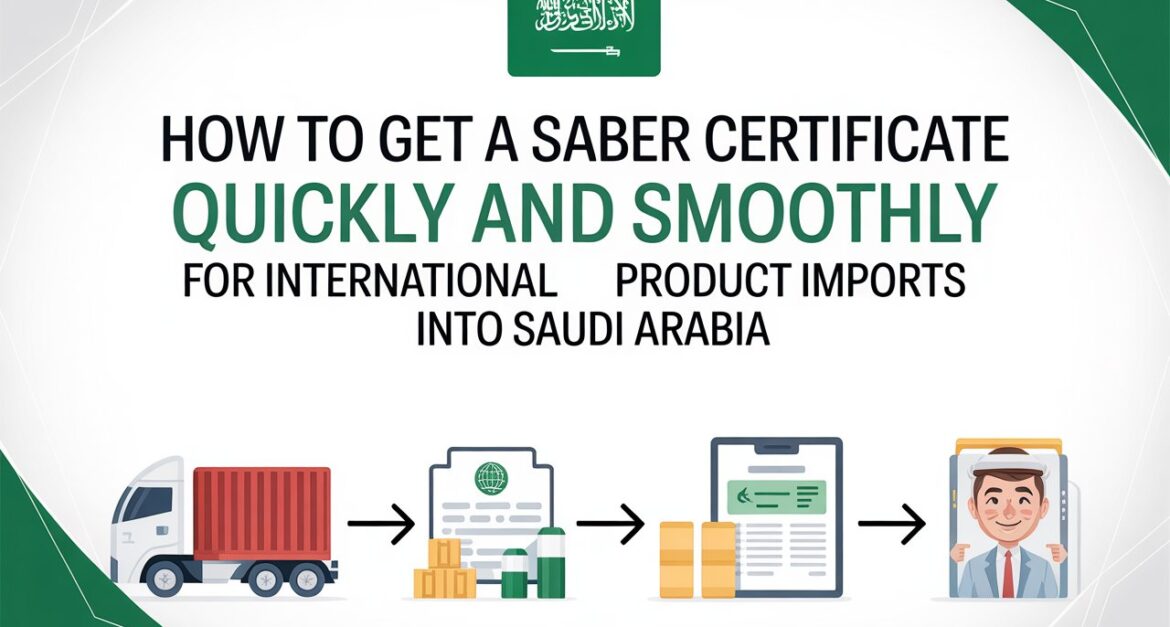
The process above is represented visually in the flowchart at the top of this article. Here is a detailed narrative explanation of each step.
Step 1 — Register on the SABER Platform
Visit saber.sa and create an account as an importer or manufacturer. You will need:
- A valid Commercial Registration (CR) number (for Saudi-based importers) or the overseas manufacturer’s company details
- Contact information and authorised representative details
- A verified email address for notifications
For overseas manufacturers without a Saudi entity, a licensed Saudi importer typically acts as the SABER account holder. Palm Horizon KSA assists international exporters in establishing this relationship correctly.
Step 2 — Classify Your Product and Identify Applicable Standards
Search your product using its HS code or product description in the SABER platform. The system will return the applicable SASO technical regulations and standards. This step is critical — misclassification leads to incorrect standards being applied, wrong testing requirements, and ultimately a rejected or invalid certificate.
This is also where you determine whether your product falls under mandatory SABER regulation or a non-regulated category. For regulated products, the system will show which standards govern your product.
Step 3 — Select an Accredited Conformity Assessment Body (CAB)
SASO maintains a list of internationally accredited CABs — third-party certification bodies and testing laboratories approved to conduct conformity assessments for SABER. The list includes major international names such as SGS, Bureau Veritas, Intertek, TÜV SÜD, and DEKRA, among others.
Your choice of CAB depends on:
- Their accreditation scope (which product categories they cover)
- Their geographic presence relative to your factory location
- Timeline commitments and service pricing
- Whether they accept existing test reports from your current certifications (CE, UL, FCC, etc.)
Engaging a CAB early in your export planning — ideally 2 to 3 months before your first shipment — gives you the best chance of avoiding delays.
Fun Fact: SASO’s accredited CAB network includes bodies operating in more than 45 countries, meaning your product can be tested at a laboratory close to your factory in China, Germany, or the United States without shipping samples to Saudi Arabia.
Step 4 — Submit Technical Documentation and Complete Testing
Your CAB will provide a detailed document checklist. Commonly required documents include:
- Technical file or product specification sheet
- Electrical schematic diagrams (for electrical products)
- Bill of materials and component details
- User and installation manuals (in Arabic and English)
- Existing test reports (CE technical file, UL test reports, ISO certificates)
- Safety Data Sheets where applicable
- Product photos and labelling artwork
If your product already holds a recognised international certification (especially for EU CE marking), many CABs offer an expedited review process that relies on existing test reports without requiring full repeat testing — significantly reducing both cost and time.
Step 5 — Receive Your Product Certificate
Once the CAB completes its conformity assessment and uploads the results to SABER, the Product Certificate is issued to your account. You will receive notification by email. Download and retain the certificate — it is the document against which all future shipments will be linked.
Keep track of the expiry date. Certificate renewal should be initiated at least 4 to 6 weeks before expiry to avoid gaps in coverage that would prevent new Shipment Certificates from being issued.
Step 6 — Apply for a Shipment Certificate Before Each Shipment
At least 5 to 10 working days before your shipment departs (more is always better), log into SABER, link the shipment to your Product Certificate, and submit the Shipment Certificate request. Your CAB will verify the shipment details — quantity, markings, labelling compliance — and issue the certificate digitally.
The Shipment Certificate must be ready before the goods arrive at the Saudi port. Shipments arriving without a valid SABER Shipment Certificate face mandatory hold and additional inspection, which can take weeks and incur demurrage costs.
Step 7 — Customs Clearance and Port Release
With a valid Shipment Certificate in the SABER system, your Saudi customs broker can proceed with the customs declaration through the FASAH platform. The two systems are integrated, so a confirmed SABER Shipment Certificate significantly accelerates the port release process.
For most pre-certified products, physical inspection at the port is either waived or conducted as a brief spot check rather than a full consignment examination.
Common Reasons SABER Applications Get Rejected or Delayed
Palm Horizon KSA has worked with hundreds of exporters navigating the SABER system. The most frequent causes of rejection and delay are consistently the same:
Incorrect product classification is the single biggest problem. Assigning the wrong HS code leads to wrong standards being applied and wrong testing requirements. Always cross-reference your HS code with a Saudi customs specialist before beginning the SABER process.
Incomplete or inconsistent documentation trips up many applicants. If the product name on the technical file does not match the product name on the labelling, the CAB review will flag it immediately. Every document must consistently describe the same product.
Expired or non-applicable existing certifications are often submitted in good faith but rejected because the standards version is outdated. Saudi Arabia aligns with specific editions of IEC and ISO standards — make sure your existing test reports reference the correct editions.
Missing Arabic labelling requirements delay many shipments. Saudi regulations require Arabic text on consumer product labels, including safety warnings, instructions for use, country of origin, importer details, and in some cases Arabic manuals.
Late Shipment Certificate application is an entirely preventable delay. Applying for the SC less than a week before shipment departure — or worse, after goods have already left — creates a real risk of arriving at the Saudi port without a valid certificate in the system.
Fun Fact: Saudi Arabia processes over 8 million SABER certificates annually as of 2024, making it one of the highest-volume product conformity management systems in the world.
Regulated vs. Non-Regulated Products: A Quick Comparison
| Factor | Regulated Products | Non-Regulated Products |
| SABER certification required | Yes — mandatory | No — voluntary |
| Product Certificate needed | Yes | No |
| Shipment Certificate needed | Yes | No |
| CAB involvement | Mandatory | Optional |
| Customs clearance impact | Blocked without certificate | No SABER barrier |
| Typical industries | Electronics, toys, construction materials, auto parts, chemicals | Raw materials, some industrial inputs, select B2B goods |
How Long Does the SABER Process Take?
Timeline is the most common question Palm Horizon KSA receives from clients preparing for their first Saudi shipment.
The honest answer is that the timeline depends almost entirely on the Product Certificate stage. Once a PC exists, the Shipment Certificate is a matter of days.
Product Certificate timelines by scenario:
A product that already holds EU CE marking with a complete technical file and recent IEC-based test reports can often achieve a SABER Product Certificate in 2 to 4 weeks through an expedited CAB review process.
A product without any existing international certification — relying entirely on new testing — typically requires 6 to 12 weeks, accounting for laboratory booking, sample shipment to the test lab, testing time, report review, and SABER platform processing.
Products in higher-risk categories (children’s toys, electrical appliances, certain chemicals) may require additional documentation, factory inspections, or multi-standard compliance assessment, pushing timelines to 12 to 20 weeks in some cases.
Palm Horizon KSA’s practical recommendation: Plan your SABER compliance at least 3 months before your intended first shipment. For products with no international certification background, start 5 to 6 months in advance.
Palm Horizon KSA: How We Help International Exporters
Palm Horizon KSA is a Saudi-based trade compliance and market entry advisory firm specialising in helping international manufacturers and exporters navigate the Kingdom’s regulatory requirements. Our SABER compliance services include:
Full SABER Compliance Assessment We review your product range, classify it correctly, identify applicable SASO standards, and map your existing certifications against Saudi requirements — before you spend a single riyal on testing.
CAB Selection and Management We maintain working relationships with all major SASO-accredited CABs and help you select the right body based on cost, timeline, location, and product category expertise.
Documentation Preparation and Review Our team reviews your technical files, labelling artwork, safety data sheets, and manuals to ensure they meet Saudi requirements before submission — catching costly errors in advance.
Shipment Certificate Management For clients with ongoing export programmes to Saudi Arabia, we manage recurring Shipment Certificate applications, track Product Certificate expiry dates, and handle renewal processes so nothing falls through the cracks.
Arabic Labelling Compliance We work with certified translators and labelling specialists to ensure your product labels meet all SASO Arabic language and content requirements.
Whether you are shipping a single container of electrical appliances or managing a high-volume ongoing import programme, Palm Horizon KSA provides end-to-end SABER compliance support so your goods reach Saudi buyers on time, every time.
SABER vs. Traditional Import Certification: What Changed?
Exporters who dealt with the old Saudi pre-shipment inspection regime will notice several key differences:
The old system was paper-based, inspection-heavy, and often conducted entirely at the Saudi port of entry — meaning delays happened after goods had already arrived and incurred demurrage costs. Under SABER, the conformity verification happens before the goods leave the origin country. By the time your shipment arrives at Jeddah or Dammam, the compliance decision has already been made.
The old system also had limited electronic integration with customs, meaning importers often had to manually present inspection certificates at multiple points in the clearance process. SABER’s direct integration with the FASAH customs platform eliminates most of this duplication.
The level of technical rigour has also increased significantly. Where the old system often relied on document review alone, SABER mandates actual laboratory testing through accredited bodies for most regulated categories. This raises the bar for all exporters equally — making it harder for low-quality products to reach Saudi consumers while rewarding well-prepared exporters with faster clearance.
Frequently Asked Questions About SABER Certification
1. Does every product I import into Saudi Arabia need SABER certification?
No. Only products classified as regulated under SASO’s regulated products list require SABER certification. However, the list covers a wide range of consumer and industrial goods across more than 900 categories. You should check your specific HS code against the SABER platform’s regulated products database to confirm your product’s status. Non-regulated products are imported without SABER certificates, though voluntary certification is always an option.
2. Can I use my existing CE marking or UL certification to fast-track SABER?
In many cases, yes. SASO has alignment agreements with major international standards bodies, and SABER-accredited CABs can often accept existing test reports issued against harmonised standards (such as IEC-based EU standards) as partial or full technical evidence for SABER conformity assessment. This is sometimes called a desk review or document-only assessment. The result is a significantly shorter and less expensive path to a SABER Product Certificate. However, Saudi-specific requirements — particularly Arabic labelling — must still be fulfilled regardless of existing certifications.
3. What happens if my shipment arrives in Saudi Arabia without a SABER Shipment Certificate?
Goods arriving at a Saudi port without a valid SABER Shipment Certificate in the system are subject to mandatory hold. The shipment cannot proceed to customs clearance. The importer will typically be required to obtain the missing certificate retrospectively — a process that requires additional CAB engagement, takes additional time, and incurs additional costs including port storage and demurrage charges. In cases where the product itself does not have a valid Product Certificate, the goods may be confiscated or returned to origin.
4. How often does a SABER Product Certificate need to be renewed?
Product Certificates issued through the SABER system are typically valid for 12 months from the date of issue, though the exact validity period depends on the product category and the conditions set by the issuing CAB. Renewal requires re-engaging your accredited CAB, updating documentation for any changes to the product or applicable standards, and in some cases submitting new test reports if standards versions have been updated. Palm Horizon KSA recommends initiating renewal at least 6 weeks before expiry.
5. Can a foreign manufacturer apply for SABER certification directly, or does it need a Saudi importer?
Both models are possible, but the practical approach depends on your market entry structure. Foreign manufacturers can hold SABER Product Certificates under their own name. However, Shipment Certificates must be linked to a Saudi importer who holds a valid Commercial Registration. Many international exporters partner with a Saudi trading company or distributor who acts as the SABER account holder for shipment certificates. Palm Horizon KSA can help structure this relationship correctly for exporters without an existing Saudi entity.
6. Are there product categories that require additional approvals beyond SABER?
Yes. Some products require sector-specific approvals from other Saudi regulatory bodies in addition to SABER certification. Medical devices require registration with the Saudi Food and Drug Authority (SFDA). Telecommunications equipment requires type approval from the Communications, Space and Technology Commission (CST). Pesticides and agricultural chemicals are regulated by the Ministry of Environment, Water and Agriculture (MEWA). In these cases, SABER certification and the relevant sector approval must both be in place before the product can legally be imported and sold in Saudi Arabia.
7. What are the most common product standards tested under SABER?
The most frequently referenced standards families in the SABER system are IEC 60335 series (household electrical appliances), IEC 62368-1 (audio/video and IT equipment), EN 71 (toys), ISO 9001 (quality management, sometimes referenced for factory assessment), EN 13501 (fire classification of construction products), and SASO GSO standards for GCC-wide regulated products. Saudi Arabia also references its own SASO standards — many of which adopt international standards wholesale but with Saudi-specific labelling and documentation addendums.
The SABER Certificate Is Your Gateway to the Saudi Market
Saudi Arabia represents one of the most attractive and least saturated consumer markets for quality international products in the world today. With a young, affluent, import-hungry population of over 36 million, a government investing hundreds of billions of dollars in infrastructure and economic diversification, and a regulatory environment that increasingly rewards compliant, high-quality products, the rewards for getting your SABER certification right are substantial.
The SABER system is not a barrier to be feared — it is a framework to be understood and navigated efficiently. Exporters who invest in proper compliance planning before their first shipment consistently experience faster market entry, fewer customs delays, lower total cost of compliance, and stronger credibility with Saudi buyers and distributors.
The mistake most first-time exporters make is treating SABER as a last-minute paperwork exercise rather than an integral part of their market entry strategy. By the time they realise the Product Certificate takes 8 weeks, their shipment is already at the port.
Palm Horizon KSA exists to make sure that never happens to you. Our team of Saudi regulatory specialists, international trade compliance experts, and logistics advisors brings end-to-end SABER expertise to every client engagement — from initial product classification through to ongoing shipment certificate management for established export programmes.
Whether you are a European electronics manufacturer looking to break into the Saudi retail market, an Asian building materials supplier targeting Vision 2030 construction projects, or a North American consumer goods brand exploring GCC distribution, the path to the Saudi market runs through SABER — and Palm Horizon KSA knows every step of that path.